A kessan tanshin (決算短信) is the earnings summary a Japanese listed company publishes on the day it releases its results: the first and fastest document of a Japanese reporting season, required by the stock exchange rather than by statute. It opens with a dense page of figures, year-on-year changes, dividends and management's forecast, followed by the statements and notes. Reading one needs four things a generic translator gets wrong: the scale 百万円, the negative sign △, the way fiscal years are named and the line between results and forecasts. Botminds' Financial Statement Translation picks up each tanshin of an issuer a fund holds, translates it into English line by line and proves every figure against the Japanese, and compares the issuer's own English where there is one.
The worked example is a fictional sample: the first-quarter summary of Hoshimura Denki K.K., a Tokyo-listed electronics maker held by Quillfield Capital, a fictional fund manager, as it runs through the solution. The rules and research are Japanese government and academic sources, linked where they are used.
Decoding the title line of a kessan tanshin
2027年3月期 第1四半期決算短信〔IFRS〕(連結)
2027年3月期
Fiscal year ending March 2027Japanese issuers name a year by the month it ends. 2027年3月期 runs from April 2026 to March 2027.
第1四半期
First quarterApril to June for a March year-end. 四半期 is “quarter”; 第2四半期 is the half year.
決算短信
Earnings summary (kessan tanshin)決算, settlement of accounts; 短信, a short report.
〔IFRS〕
Accounting standardIFRS, or 〔日本基準〕 for Japanese GAAP. It decides which glossary the terms come from.
(連結)
Consolidated(非連結) would mean the parent company alone.
What is a kessan tanshin?
A kessan tanshin is a listed Japanese company's summary of financial results, published through the exchange as soon as the period's figures are approved. It is the document Japanese and global investors trade on first, ahead of the statutory reports, and it is now the quarterly report as well. When the Diet amended the Financial Instruments and Exchange Act in November 2023, the Minister for Financial Services announced that "the quarterly report under laws and regulations will be abolished on April 1 next year, and it will be integrated into the financial results report required by exchanges" (FSA, November 24, 2023).
The statutory annual document, the annual securities report or yuho (有価証券報告書), comes much later. The FSA describes it as "a disclosure document required for listed companies under the Financial Instruments and Exchange Act" that "contains more detailed information", and its own count shows that for fiscal years 2022 to 2024 more than 80% of these reports were disclosed on the day of the annual general meeting or the day after (FSA Secretariat, June 2, 2025). For March year-end companies, the tanshin is the results document for weeks before the yuho exists.
What does kessan tanshin mean?
Kessan tanshin means, word for word, a short report (短信, tanshin) on the settlement of accounts (決算, kessan): in English, an earnings summary or summary of financial results. The full title tells a reader nearly everything about the document before the first figure, as the decoded title above shows: the fiscal year by the month it ends, the quarter, the accounting standard and whether the figures are consolidated.
The fiscal-year convention catches people out. 2027年3月期 is the year ending March 2027, which began in April 2026, so Hoshimura's first quarter covers April to June 2026 and its summary appeared in late July 2026. An English draft that calls it "fiscal 2027 first quarter" is accurate; one that calls it "Q1 2027" invites a reader to put it in the wrong calendar year.
What is inside a kessan tanshin, page by page
The summary page is where analysts start, and it is built for speed. It sets out the period's results, typically revenue, operating profit, profit before tax, profit attributable to owners of the parent and earnings per share, each with the percentage change against the same period of the prior year (前年同期比). It shows the financial position, the dividend paid and planned, and management's forecast for the full year (通期予想), with any revision. The pages that follow carry a qualitative discussion of results, the condensed statements and notes.
The forecast is what makes the document distinctive. In Japan, Kato, Skinner and Kunimura found, "forecasts are effectively mandated but managers have considerable latitude over the numbers they release". Studying those forecasts, they found that managers' initial forecasts for a year "are systematically upward-biased but that they revise their forecasts downward during the fiscal year so that most earnings surprises are non-negative" (The Accounting Review, 2009). For a translator the practical point is narrower: actual results and forecasts sit side by side in similar tables, and an English version must never let a forecast read as a result, or a revised forecast read as the original one.
Reading the units, signs and labels of a kessan tanshin
| In the Japanese | Means | In English | Trap |
|---|---|---|---|
| 百万円 | millions of yen | ¥ million | The usual scale of the summary tables; a figure of 8,412 is ¥8,412 million, not ¥8,412. |
| 億円 | hundreds of millions of yen (億 = 10⁸) | ¥100 million, or convert the scale and say so | Japanese government English tables keep the unit as "(100 million yen)". Read as ¥ million, a figure is 100 times too small. |
| △ before a figure | negative | (1,234) or −1,234, in the house style | Not a footnote mark. Japan's Ministry of Finance lists "△ : negative" among its statistical symbols. |
| - in a cell | no figure | a dash, with a note if needed | In the same Ministry of Finance legend, "-" means no figure, not minus. |
| 前年同期比 | change on the same period of the prior year | year-on-year change | Percentages may be blank or marked where a comparison has no meaning. |
| 通期予想 | full-year forecast | forecast for the fiscal year | Must stay labelled as a forecast, with its revision date. |
| 親会社の所有者に帰属する | attributable to owners of the parent | attributable to owners of the parent | Not the same line as profit for the period. |
What do 百万円, 億円 and △ mean in Japanese financial statements?
百万円 means millions of yen, 億円 means hundreds of millions of yen, and △ marks a negative number. The first is the usual scale of a tanshin's tables, and the header that says so sits above the table, not beside each figure, so a figure lifted out of its table loses its scale. The second appears in narrative text and in some tables: Japan's Ministry of Finance renders it in its own English statistics as a unit of "(100 million yen)", so its quarterly corporate statistics show all-industry sales for October to December 2020 as 3,320,903, which is about ¥332 trillion (MOF).
The sign conventions are the quiet trap. The Ministry of Finance's legend lists "△ : negative" and, in the same line, "-" for no figure (MOF). A system that reads △ as a bullet drops the sign; one that reads - as a minus invents a negative where there is nothing. Machine translation research shows why scale words are fragile: to translate "10.01 million" into Chinese, a system "has to convert ‘10.01’ into ‘1001’ and then use the correct unit ‘万’", and errors happen at either step (Wang et al., 2021). The same arithmetic runs in reverse from Japanese.
Is a kessan tanshin available in English?
For companies on the Tokyo Stock Exchange's Prime Market, yes: English is now mandatory for financial statements and timely disclosure information. The FSA's 2024 Action Program noted that "In May2024, the TSE revised its Listing Rules which make mandatory English disclosures of financial statements and timely disclosure information (effective on or after April 1, 2025)" (FSA, June 7, 2024), and the FSA confirmed in June 2025 that the amendment "took into effect on 1 April, 2025" (FSA, June 2, 2025).
Outside the Prime Market, and for the long tail of smaller holdings, English is voluntary and patchy. The tanshin itself is published on TDnet, the exchange's timely disclosure network. For the statutory annual report the FSA keeps a list of companies that post an English yuho, published on its EDINET disclosure system, created on the recommendation that "To encourage companies to translate the Annual Securities Report into English, a list of companies that post the English version of their Annual Securities Report on the website could be published" (FSA). A list that exists to encourage translation is a fair measure of how far from universal it is.
How Japan's results documents reach an English reader
Apr 2024
statutory quarterly report abolished; the exchange-required results report carries the quarter
Apr 2025
English mandatory for Prime Market financial statements and timely disclosure information
80%+
of annual securities reports disclosed on the AGM day or the day after, FY2022–FY2024
Kessan tanshin or yuho: which does an analyst read?
An analyst reads the tanshin first and the yuho for depth. The tanshin is the speed document: results, forecast and dividend on the day. The yuho is the statutory document under the Financial Instruments and Exchange Act, with more detail, and for most companies it follows weeks later. A translation workflow that waits for the yuho waits too long; one that translates only the tanshin's summary page misses the notes the yuho later expands. The results call that usually follows the tanshin sits outside US Regulation FD for most Japanese issuers, which is explained in foreign private issuer calls.
The two documents behind a Japanese company's results
Kessan tanshin (決算短信): The exchange's rules; since April 2024 it also carries the quarterly disclosure the law used to require
Annual securities report, yuho (有価証券報告書): The Financial Instruments and Exchange Act
Kessan tanshin (決算短信): When results are approved, before the statutory report
Annual securities report, yuho (有価証券報告書): For more than 80% of companies, FY2022–FY2024, on the day of the AGM or the day after
Kessan tanshin (決算短信): Summary page, forecasts, dividends, condensed statements and notes
Annual securities report, yuho (有価証券報告書): Fuller statements, notes and company information, including cross-shareholdings
Kessan tanshin (決算短信): Mandatory for Prime Market companies from April 2025
Annual securities report, yuho (有価証券報告書): Voluntary; the FSA lists companies that post an English version
Kessan tanshin (決算短信): TDnet, the exchange's disclosure network
Annual securities report, yuho (有価証券報告書): EDINET, the FSA's disclosure system
What goes wrong when a tanshin meets a generic translator
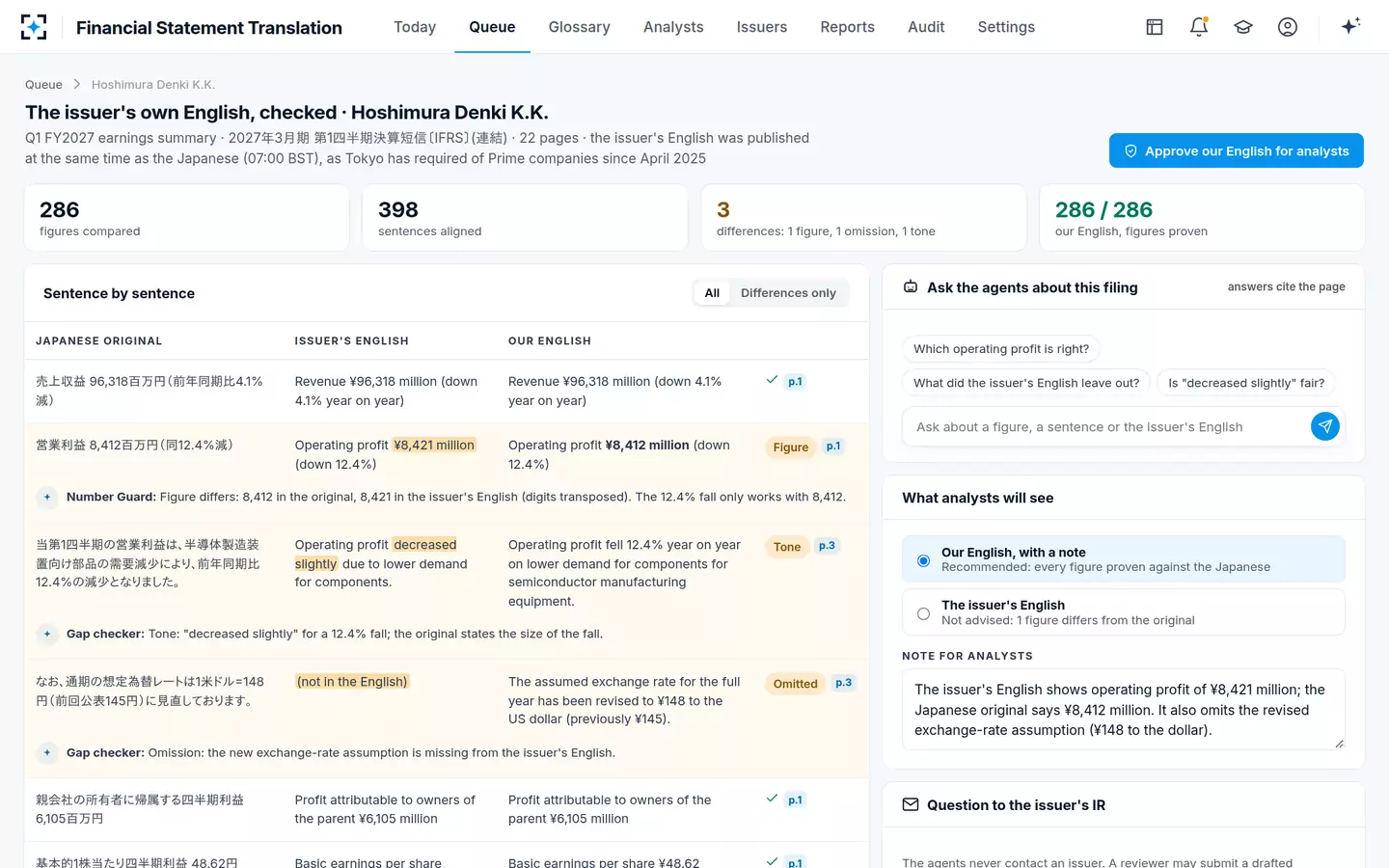
Three things go wrong most often: a scale or sign is lost, a figure is copied wrongly, or a sentence softens what the numbers say. Hoshimura's sample summary shows the last two even in the issuer's own English. The Japanese reported operating profit of 8,412百万円, down 12.4%; the English said ¥8,421 million. The Japanese stated that the exchange-rate assumption for the year had been revised to ¥148 to the dollar from ¥145; the English left it out. And the English said operating profit "decreased slightly" for a 12.4% fall.
None of these would trouble a fluency check. The transposed digits are caught by proving each English figure against the Japanese, and confirmed by the arithmetic: only 8,412 gives a 12.4% fall. The omission and the tone are caught by comparing the two texts sentence by sentence. In the sample, the solution compared 286 figures and 398 sentences, found the three differences, and recommended that analysts read the solution's own English, every figure proven, with a note on what the issuer's English got wrong.
Financial Statement Translation checks a Japanese earnings summary against the issuer's own English
A checklist for reading a kessan tanshin in English
Whoever produced the English, the same checks apply before a figure goes into a model. The list below is the one the agents run on every tanshin, and the one an analyst can run by hand on a single document.
Before you use an English kessan tanshin
- Confirm the period from the title
Fiscal year by the month it ends, and which quarter. 第2四半期 is the half year, cumulative.
- Read the scale above every table
百万円 in most tables; 億円 or 千円 can appear elsewhere in the same document.
- Map every △ to a negative and every - to no figure
And check the English keeps the sign the house style uses.
- Keep results and forecasts apart
Label each forecast with its date and say whether it was revised.
- Re-check year-on-year percentages
A percentage that does not fit the two figures beside it points to a copied digit.
- Compare any issuer English with the Japanese
Figures, omissions such as exchange-rate assumptions, and words such as "slightly".
- Note the accounting standard
IFRS and Japanese GAAP use different terms for similar lines; the glossary must follow the standard.
In practice the volume is the hard part. A Japanese reporting season puts many tanshin out in the same weeks, and a global fund holds names far beyond the Prime Market. The solution's turnaround target for a priority results document is four business hours from publication. Convenience translation and the issuer's English explains what weight the issuer's own English carries, and the four tests of translation quality assurance explains how each tanshin is checked.
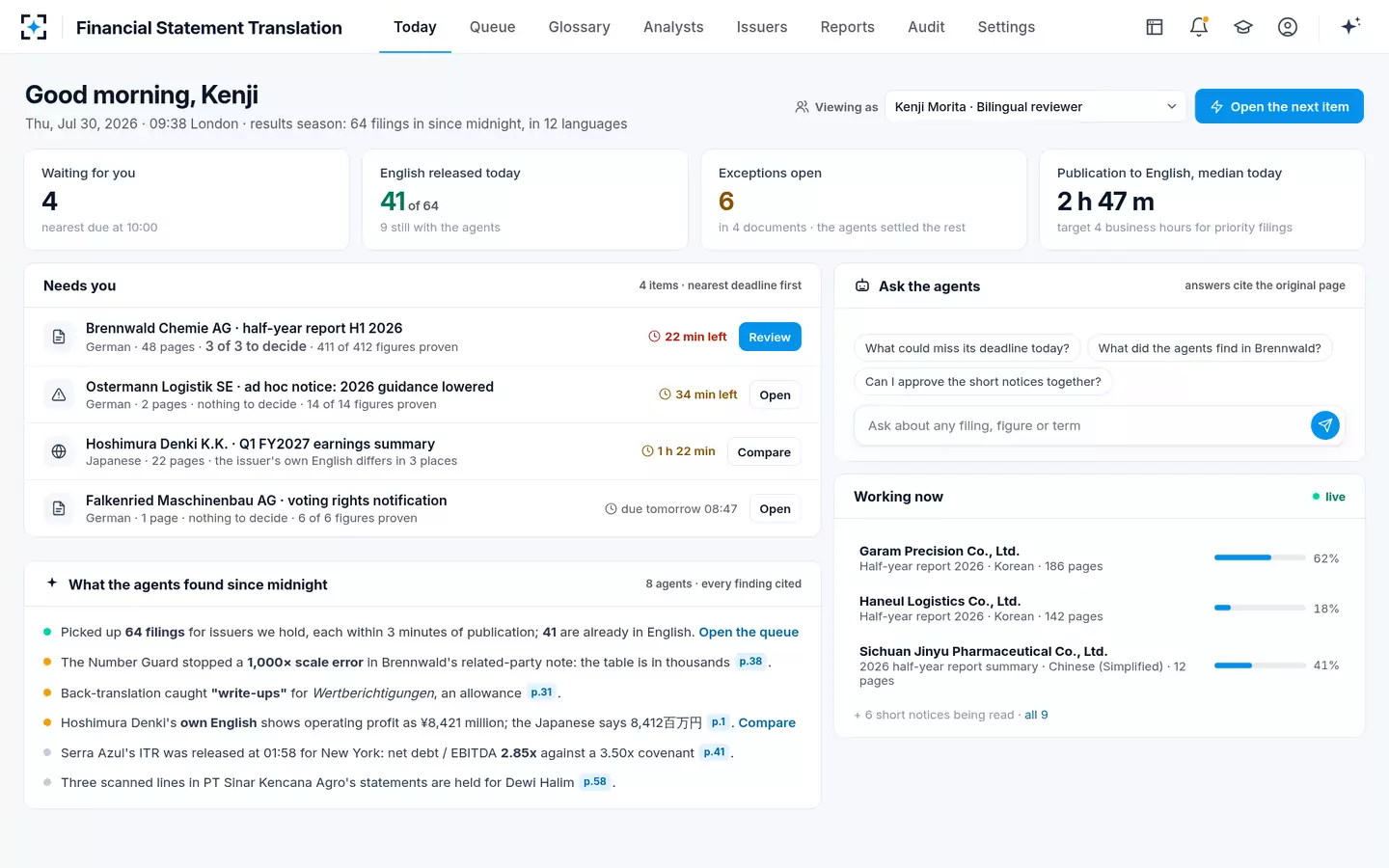
The reviewer's morning in Financial Statement Translation, with a Japanese summary in the queue
Questions people ask
What does tanshin mean in Japanese?
Tanshin (短信) means a short report or short message. Combined with kessan (決算), the settlement of accounts, it names the summary of financial results a listed company publishes when its period's figures are approved.
What is TDnet?
TDnet is the Tokyo Stock Exchange's timely disclosure network, where listed companies publish kessan tanshin and other timely disclosures. Statutory reports such as the annual securities report are filed on EDINET, the Financial Services Agency's disclosure system.
When do Japanese companies report earnings?
Each company publishes its kessan tanshin when its results are approved, quarter by quarter, and the fiscal-year name tells you the calendar: a 2027年3月期 company's year runs April 2026 to March 2027. Since April 2024 the tanshin has also carried the quarterly disclosure that the statutory quarterly report, now abolished, used to provide.
Is the English kessan tanshin legally binding?
The Japanese original is the disclosure the issuer is held to, and English versions are generally offered for convenience. The FSA's own English texts are marked as provisional translations, a reminder that the Japanese governs.
Why do Japanese forecasts matter so much?
Because in Japan forecasts are, in the researchers' words, effectively mandated, so the market measures results against them. Research on Japanese management forecasts found initial forecasts systematically optimistic and revised downward during the year, so the date and revision of each forecast matter as much as the number.
What is the difference between kessan tanshin and yuho?
The tanshin is the fast results summary required by the exchange; the yuho is the statutory annual securities report under the Financial Instruments and Exchange Act, with fuller detail. The FSA counts more than 80% of yuho disclosed on the day of the annual meeting or the day after, weeks after the tanshin.