For a research team, annual report translation costs what its pages cost, and how much translation costs per page depends on the language pair, the subject and how a page is counted, but there is a public benchmark: the Court of Justice of the European Union paid freelance translators an average of €30.78 to €49.03 per standard page in 2020 to translate legal texts into English from every European language it buys except one, with German into English at €38.78; Lithuanian, the outlier, cost €15.43. A standard page there is 1,500 characters without spaces, counted in the source language. For a research team buying financial translation, that price is the visible cost; the larger one is the time a held position spends waiting for English, and the risk that a hurried version carries a wrong figure. Botminds' Financial Statement Translation changes both: agents translate each local-language filing of an issuer a fund holds within hours of publication, prove every figure against the original, and a bilingual reviewer approves.
The prices below are public procurement figures, not market quotes. The worked example uses the solution's fictional sample: Quillfield Capital and the 48-page half-year report of Brennwald Chemie AG, a German issuer it holds.
The public price of a translated page into English
€38.78
average paid per standard page, German into English, 2020
Court of Justice of the EU
1,500characters
a standard page, without spaces, counted in the source language
€49.03
highest average paid per standard page into English, 2020
Court of Justice of the EU
How much does translation cost per page? A public benchmark
A public benchmark for professional translation into English is €31 to €49 per standard page for most European source languages, from the Court of Justice of the EU's own purchasing. When the Court re-tendered its framework contracts for translating legal texts into English in 2021, it published what it had paid on average in 2020 under the previous contract, lot by lot: "price per standard page of 1 500 characters, not including spaces, in the source language and covering all costs" (CJEU, contract notice 265564-2021).
Average price per standard page paid by the EU's Court of Justice to translate legal texts into English, 2020
Read the benchmark for what it is. These are averages a public body paid freelancers under framework contracts, for legal texts, five years ago, and the Court states that it "reserves the right to reject any tenders deemed to be excessively expensive or abnormally low". The same year's prices into French, from a parallel notice, were similar: €42.24 a page from German and €38.62 from English (CJEU, 265565-2021). Asian languages are not covered, and nothing here is a quote for financial translation. What the figures do give a buyer is an order of magnitude, from a source with no reason to flatter it.
What is a standard page in translation?
A standard page is a unit of text used to price translation, defined by character count rather than by printed page. The Court of Justice uses 1,500 characters without spaces, counted in the source language. Counting the source matters because the English of a German or Japanese text is a different length from the original, and a price tied to the source can be known before the work starts.
The printed page of a financial report is a poor proxy. A page of narrative may hold well over one standard page; a page of balance sheet holds mostly figures and short labels, whose characters may or may not count, depending on the contract. Before comparing quotes, count the characters in one past report from each language you buy and ask every provider how they count tables.
How much does it cost to translate an annual report?
Multiply the report's standard pages by the price per page, then add what the price leaves out: the checking of figures, the glossary and the delay. The table below works one example, with the assumption that drives the answer marked as one. Replace it with your own character count.
Worked estimate: translating one 48-page German half-year report at the public benchmark
| Step | Calculation | Result |
|---|---|---|
| 1. Characters per printed page | Assumption for illustration: 2,500 characters without spaces on an average page of narrative, tables and notes | 2,500 |
| 2. Standard pages | 48 pages × 2,500 ÷ 1,500 | 80 standard pages |
| 3. Price at the benchmark | 80 × €38.78 (German into English, CJEU average, 2020) | about €3,100 |
| 4. A full annual report | The same arithmetic scales with length; a report four times as long costs about four times as much | about €12,400 at 192 pages |
| 5. What the price excludes | Proof of every figure, the firm's glossary, back-checking meaning, the issuer's own English, and the wait | not priced |
Across a fund's holdings the per-page cost adds up quickly, which is why most research teams send only the largest positions to an agency and read the rest some other way. That is the decision the price per page actually drives: not how much one report costs, but how many issuers get a checked English version at all.
How much does translation cost per word?
Per-word pricing is the other common basis, and it converts to per-page pricing only through the average word length of the source language. Word counts for the same content differ between languages, German compounds being one reason, so the same text priced per word and per page can produce different bills. Convert using your own documents: count words and characters in a past report, and compare quotes on the same unit.
For financial filings, per-word pricing has a specific weakness. Figures are often excluded from word counts, or counted as words at full rate, and neither choice reflects the work they need: a figure takes no effort to type and real effort to prove. Ask any provider how figures are counted and how they are checked.
Bilingual reviewers are the scarce cost
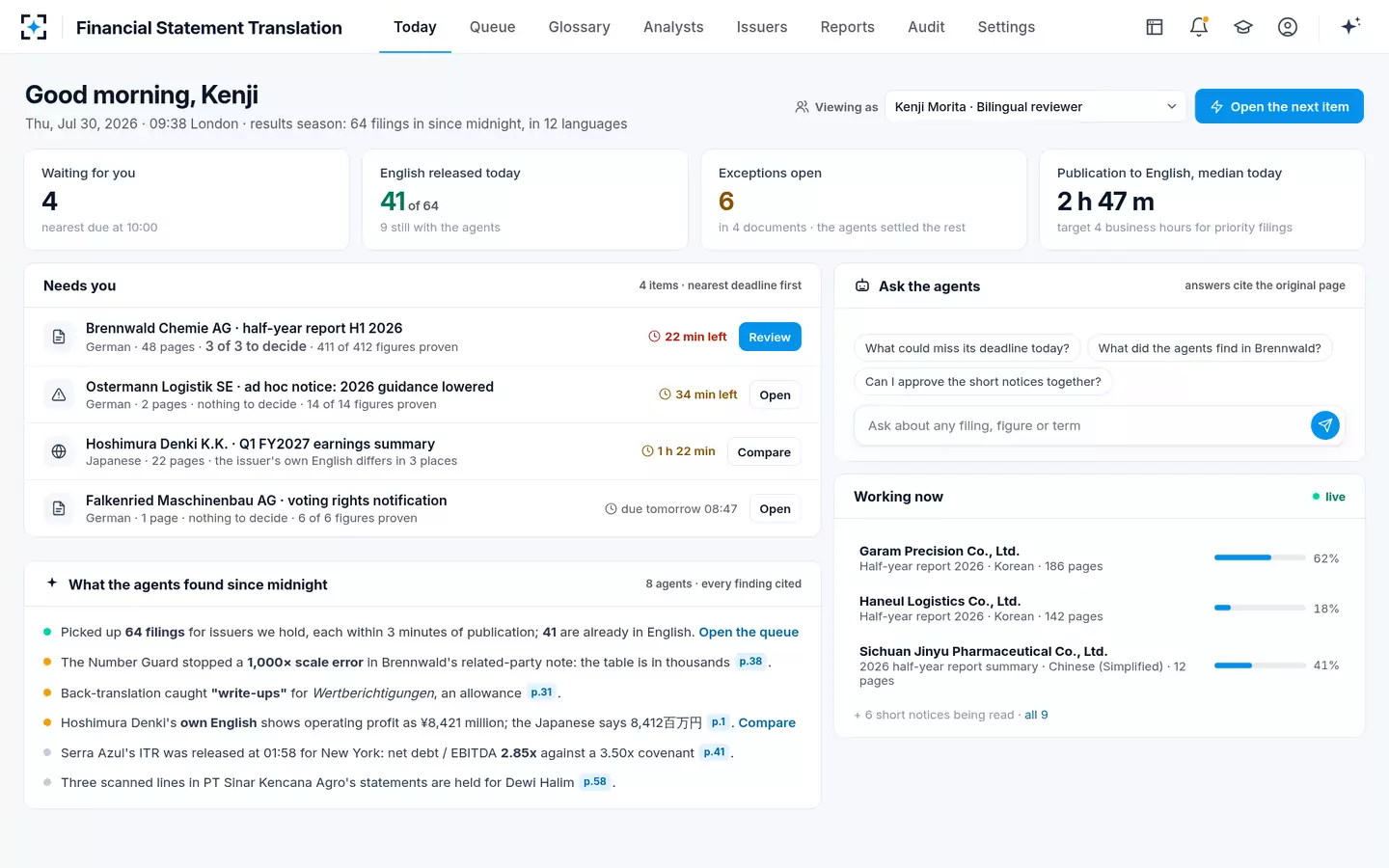
The bilingual reviewers a research team needs, people who read both languages and know IFRS or local GAAP, are scarce, and that scarcity is the economic case for changing how their time is spent. In the solution's sample, a bilingual reviewer who once read 15 to 25 translated documents a day in results season, line by line, now sees only what the agents could not settle, and approved 84 documents in the quarter at a median of 11 minutes each.
How long does it take to translate an annual report?
Agency turnaround depends on length, language and queue, and no regulator or researcher publishes a benchmark for it; the turnaround times agencies quote for themselves are sales figures, so time your own past filings instead. The clocks that do exist are regulatory. A German issuer must publish its half-year financial report without delay and at the latest three months after the period ends (WpHG §115; the German report names are glossed in accounting terms in German). In Korea, the largest KOSPI companies must now in principle file English disclosures on the same day as the Korean ones, and newly covered companies within three days (FSC, January 28, 2026).
A research team's clock starts at publication, not at the deadline. The solution's targets, measured from the moment a filing is published, are four business hours for a priority results document, one business hour for a priority ad hoc notice and three business days for an annual report. In the sample, Brennwald's 48-page report was published at 06:00 London time and released to analysts in approved English at 09:52, 3 hours 52 minutes later; the day's median across 64 filings was 2 hours 47 minutes.
Financial Statement Translation on a results-season morning: 64 filings, a median under three hours
The cost that is not on the invoice: waiting for English
Research on disclosure language gives the delay a price, even if not one in euros. Jeanjean, Stolowy, Erkens and Yohn studied European companies that began publishing an English annual report alongside the local-language one, and found that adopting English "is associated with increased foreign ownership, decreased information asymmetry, and increased analyst following". They read the results as "consistent with the language used in the annual report acting as a barrier to investment for some investors" (Journal of International Business Studies, 2015).
The barrier shows up in prices too. Brochet, Naranjo and Yu found that conference calls of firms from countries with greater language barriers contained more non-plain English and erroneous expressions, and were followed by smaller intraday price moves and lower trading volume (The Accounting Review, 2016). For a fund holding such issuers, every day without a reliable English version is a day the information is in the price for local readers and not yet in the analyst's model.
What is the cost of a translation error?
The cost of a translation error in a financial filing is whatever a decision made on the wrong figure costs, and the errors that matter are large. A scale header misread turns thousands into millions. In the sample, Brennwald's related-party note on page 38 was in Tsd. €, and the first English draft headed it € million, which would have shown sales to joint ventures of €14.9 billion instead of €14.9 million. Researchers testing machine translation on numbers warned that an extra or omitted digit or decimal point in financial document translation could cause significant monetary loss (Wang et al., Findings of ACL 2021).
An error also has a cost after it is found. Someone must establish who translated the figure, who approved it, which analysts read it and what they did with it. Without that trail, a single error casts doubt on every translated figure the team has used. The solution keeps every step by people and agents, with the reason and the evidence, for seven years, and tells every reader of an affected version when a correction is issued. Translation quality assurance for financial statements shows how a figure proof stops such errors before release.
Is machine translation cheaper?
Per page, yes, by a wide margin; per usable page, it depends on what checking it needs. Generic machine translation costs little and returns a draft in minutes, but its errors in numbers and accounting terms read fluently, so either a person checks everything, which brings much of the cost back, or nobody does, which moves the cost to the first wrong decision. Post-editing machine output can be faster than translating from scratch, and in one controlled study produced better quality too (Green, Heer and Manning, CHI 2013), but the study measured general text with a person checking every sentence.
Three ways to pay for financial translation, and what each buys
Agency, per page: Per standard page or per word; at the public benchmark, around €39 a page from German.
Agents with checks, and a reviewer: Not priced per page: ask for a price on your own holdings and languages. Reviewer time goes to exceptions only.
Agency, per page: Usually the largest positions only; the rest skimmed or machine-translated unchecked.
Agents with checks, and a reviewer: Every filing for every issuer held, ranked by position size.
Agency, per page: Days, set by the provider's queue.
Agents with checks, and a reviewer: Hours from publication; targets of four business hours for priority results.
Agency, per page: As careful as the translator and reviewer on the day.
Agents with checks, and a reviewer: 100% proven against the original before release, with no override.
Agency, per page: The provider's glossary, or the translator's habit.
Agents with checks, and a reviewer: The firm's glossary, per language and standard, changed only by two people.
Agency, per page: Who translated and who read it is hard to establish.
Agents with checks, and a reviewer: Every step, approver and reader on an audit trail kept seven years.
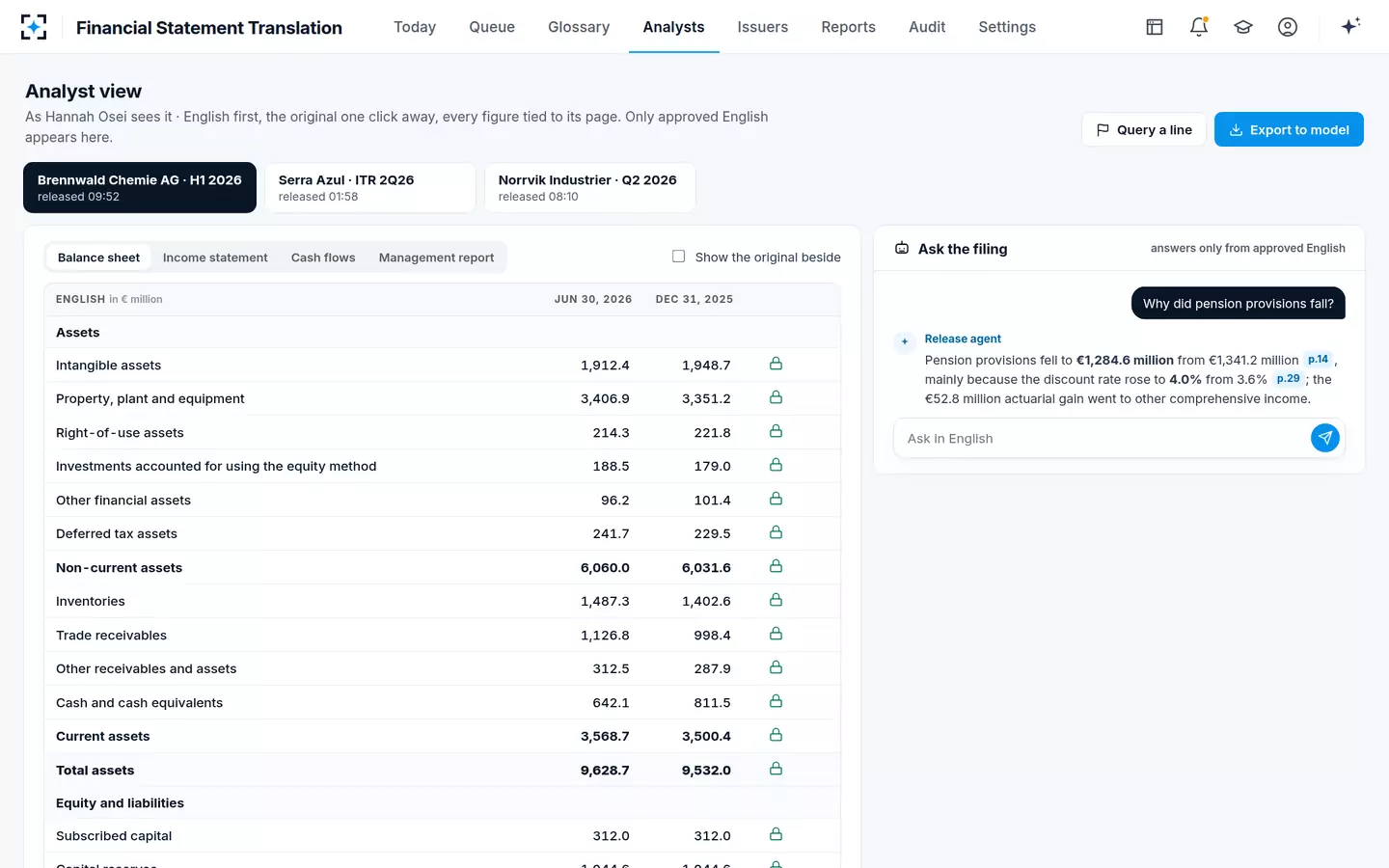
The honest buying conclusion is that price per page is the wrong unit for most of a fund's holdings. For a handful of documents where a certified human translation is required, an agency per page is the right purchase. For the hundreds of filings a global book produces in a results season, the unit that matters is the cost of a checked English version per issuer held, delivered before the analyst needs it. Choosing financial translation services, and switching sets out how to split the work.
What the price buys: approved English an analyst can query, every figure tied to its page
Questions people ask
Is translation priced per source page or per target page?
Public contracts such as the EU Court of Justice's count in the source language, 1,500 characters without spaces per page, so the price is known before the work starts. Commercial providers vary, so ask which text is counted and how tables and figures are treated.
Why do some language pairs cost more than others?
Supply and demand for qualified translators in each pair set the price. In the Court of Justice's 2020 averages into English, Danish and Swedish cost over €47 a page while Czech cost under €31 and Lithuanian about €15.
Does certified translation cost more?
Usually, because a certified translation adds a translator's or agency's statement of accuracy, which some legal and official uses require. Research teams reading filings rarely need certification; they need proof that the figures and terms are right.
How can a research team cut translation costs without losing accuracy?
Reserve per-page human translation for documents that need it, translate the rest with agents that prove every figure and apply the firm's glossary, and spend reviewer time only on what the checks cannot settle. Reusing approved past translations as memory also cuts the new text in recurring reports.
How many pages is a typical half-year report?
It varies widely by issuer; German law sets the minimum contents, condensed statements, an interim management report and a responsibility statement, not a length. The solution's sample half-year report runs to 48 pages, with 38 tables and 412 figures.