Accounting terms in German come from two sources a translator must keep apart: the Handelsgesetzbuch (HGB), the Commercial Code that sets the layout of German single-entity accounts, and the official German text of IFRS, which listed groups use for their consolidated statements. Most terms have a settled English equivalent in one or the other, and the German government and the European Union publish both. The trouble is the handful whose literal English is wrong. Wertberichtigung is an allowance, not a write-up; Rückstellungen are provisions, not reserves; Passiva is equity and liabilities, not just liabilities. Botminds' Financial Statement Translation applies a firm's German glossary, per accounting standard, to every line of every German filing an issuer publishes, and stops to ask a person when a term has no entry.
The terms below are taken from the German government's official English translation of the HGB, by the Language Service of the Federal Ministry of Justice, and from the German and English texts of IFRS as the EU adopted them. Worked examples come from the solution's fictional sample: Brennwald Chemie AG, a German issuer held by Quillfield Capital, a fictional fund manager.
Accounting terms in German, with the English the law and the standards use
| German | Official English | Where it comes from | What to watch |
|---|---|---|---|
| Bilanz; Aktiva / Passiva | balance sheet; assets / (equity and) liabilities | HGB §266 | The official HGB translation heads the Passivseite "Liabilities", though equity sits under it. IFRS statements say "equity and liabilities". |
| Gewinn- und Verlustrechnung | profit and loss account | HGB §275 | IFRS reports call it the income statement or statement of profit or loss. |
| Anhang; Lagebericht | notes; management report | HGB §284; WpHG §114 | The Lagebericht is a separate report, not part of the notes. |
| Gezeichnetes Kapital | subscribed capital | HGB §266 | The issued share capital, the first line of equity. |
| Kapitalrücklage | capital reserve | HGB §266 | A reserve: part of equity. |
| Gewinnrücklagen | retained earnings | HGB §266 | Literally "profit reserves"; the official translation chooses retained earnings. |
| Bilanzgewinn | balance sheet profit | HGB §268(1) | Replaces net income and profit carried forward when the balance sheet reflects partial appropriation of profit. |
| Rückstellungen | provisions | HGB §266 | Not reserves. Rückstellungen für Pensionen = provisions for pensions. |
| Verbindlichkeiten; Schulden | liabilities (HGB); liabilities (IFRS) | HGB §266; IAS 1 (EU text) | The German IFRS text says "finanzielle Schulden" for financial liabilities. |
| Vorräte | stocks; inventories | HGB §266, §268(5); IAS 2 | The official HGB translation uses both words for the same term. |
| Umsatzerlöse | turnover | HGB §275 | Revenue in IFRS English. |
| Abschreibungen | amortisations / depreciations | HGB §275 | Covers write-downs too; context decides. |
| Zuschreibungen | write-ups | HGB §284(3) | An increase in an asset's carrying value. |
| Wertberichtigung | loss allowance | IFRS 9, Appendix A (EU text) | The defined IFRS 9 term. Not a write-up. |
| Wertminderungsaufwand; Wertaufholung | impairment loss; reversal of an impairment loss | IAS 36 (EU text) | The impairment family a literal rendering often loses. |
| Buchwert; erzielbarer Betrag | carrying amount; recoverable amount | IAS 36 (EU text) | Not "book value" in an IFRS report. |
| Rechnungsabgrenzungsposten | prepayments and accrued income (assets); prepaid income (liabilities side) | HGB §266 | One German term, two English renderings by side of the balance sheet. |
What is Wertberichtigung in English?
Wertberichtigung is a loss allowance. In the German text of IFRS 9 as adopted in the EU, "Wertberichtigung" is the defined term for what the English text calls the "loss allowance": "The allowance for expected credit losses on financial assets" measured at amortised cost, lease receivables and contract assets (IFRS 9, Appendix A, EU text; German text). It reduces the carrying amount of receivables. The word that looks like it, Zuschreibung, does the opposite: the official HGB translation renders Zuschreibungen as "write-ups" (HGB §284(3)).
The two are near neighbours on the page and opposites in the accounts, which is exactly the pair a generic translator confuses. In the sample, note 14 of Brennwald's half-year report said "Wertberichtigungen" on trade receivables, and the first English draft said "write-ups". Translated back into German by a second model, the English read Zuschreibungen, and the line went to the reviewer with the fix "Changes in valuation allowances on trade receivables".
What is the German word for balance sheet, and why Passiva misleads
The German word for balance sheet is Bilanz; the consolidated balance sheet is the Konzernbilanz. Its two sides are the Aktivseite, assets, and the Passivseite, which holds equity, provisions and liabilities. The official English translation of the HGB heads that side "Liabilities" (HGB §266(3); official translation), which is a faithful rendering of the code's structure and an unhelpful one for an analyst: equity is not a liability.
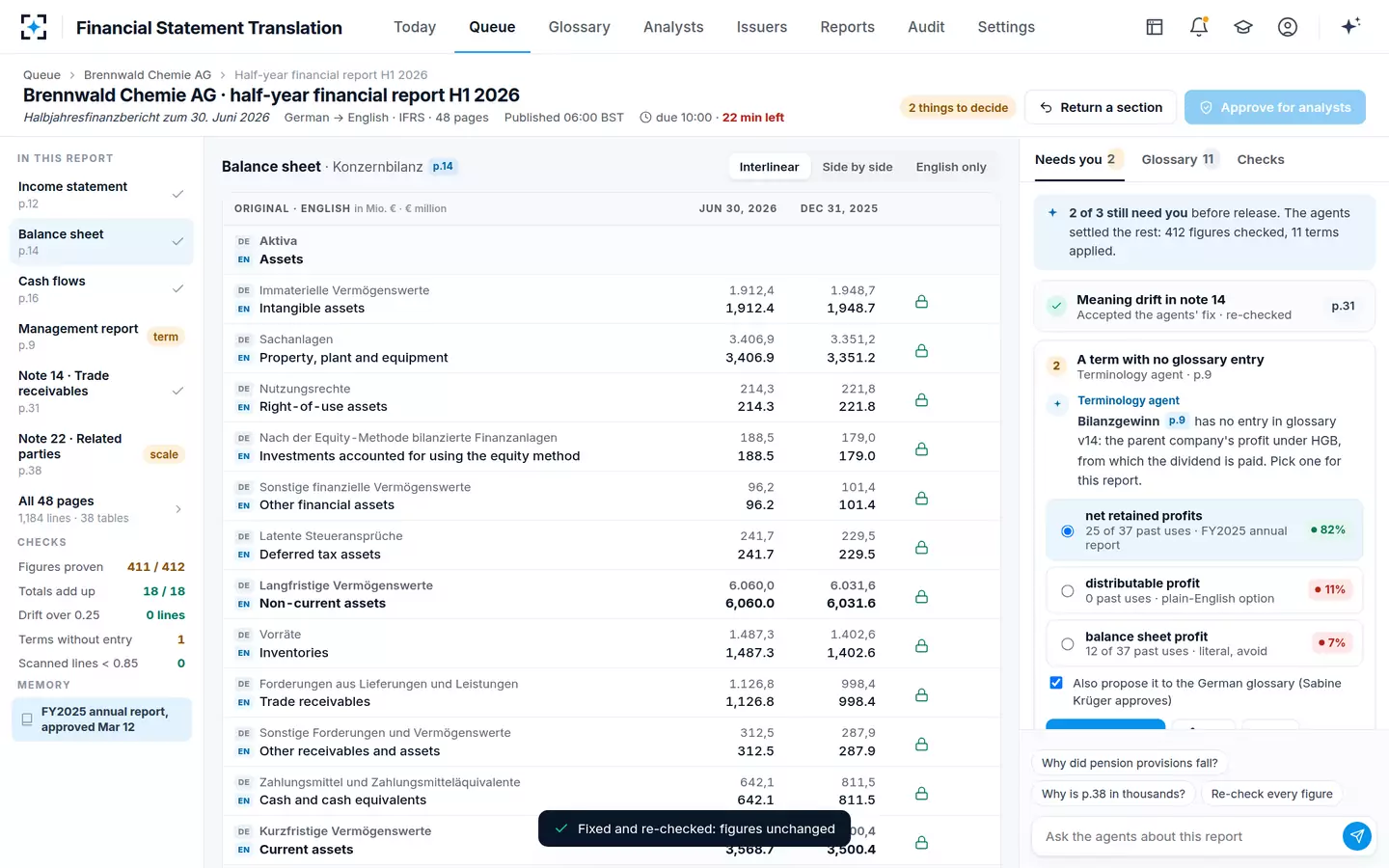
IFRS statements in English use "equity and liabilities" for the same side, and that is the rendering a research glossary should choose for an IFRS report. The sample's interlinear statement shows the pair at the top of the right-hand side: Passiva, Equity and liabilities.
Rückstellungen or Rücklagen: provisions and reserves
Rückstellungen are provisions, obligations of uncertain timing or amount that sit outside equity; Rücklagen are reserves, part of equity. The HGB's balance sheet layout lists "Kapitalrücklage" and "Gewinnrücklagen" under equity and "Rückstellungen" as a separate block, which the official translation renders as capital reserve, retained earnings and provisions (HGB §266).
The false friend is the English word "reserves", which a literal or dictionary rendering offers for Rückstellungen. A translation that renders Rückstellungen für Pensionen as "pension reserves" moves a liability into equity in the reader's mind. In the sample, Brennwald's pension provisions of €1,284.6 million are rendered "Pension provisions and similar obligations", the glossary's entry, every time.
German accounting false friends: the literal English, and the right one
Literal or tempting English: "value correction", or worse, "write-up"
The rendering a glossary should hold: loss allowance, or valuation allowance on receivables
Literal or tempting English: "reserves"
The rendering a glossary should hold: provisions
Literal or tempting English: "liabilities"
The rendering a glossary should hold: equity and liabilities
Literal or tempting English: "profit reserves"
The rendering a glossary should hold: retained earnings
Literal or tempting English: always "depreciation"
The rendering a glossary should hold: depreciation, amortisation or write-down, by asset and context
Literal or tempting English: "book value"
The rendering a glossary should hold: carrying amount, in an IFRS report
Literal or tempting English: "milliard"
The rendering a glossary should hold: billion
What is HGB, and where does IFRS take over?
The HGB, Handelsgesetzbuch, is Germany's Commercial Code. Its third book sets the rules for accounts: §266 lays out the balance sheet and §275 the profit and loss account, each item in a fixed order with a fixed name (HGB, official translation). Those names are why German accounts look so alike, and why an HGB term has one obvious English rendering in the official translation.
For the consolidated statements of a listed group, IFRS takes over. HGB §315e provides that a parent obliged by Article 4 of the EU's IAS Regulation to apply the adopted international standards draws up its group accounts under them. The same issuer's filings can therefore mix IFRS vocabulary in the group statements with HGB vocabulary elsewhere, which is why the sample's German glossary carries both, flagged by standard.
Are there official German translations of IFRS?
Yes, in two forms. The IFRS Foundation publishes an official German translation under a policy that allows "only one translation per language" to protect comparability, produced by professional translators and reviewed by a committee of financial reporting experts whose coordinator signs off before a translation is final (IFRS Foundation). And the EU adopts each standard by regulation, published in the Official Journal in every official language, German included: IFRS 9 arrived as Commission Regulation (EU) 2016/2067 of November 22, 2016.
Those texts are the anchor a glossary should start from. Nobes and Stadler, following "impairment" through 19 official translations of IAS 36 and the English versions of 393 firms' annual reports, advised that "translators of annual reports should not look only at the reports but also consult the terminology in the original regulations" (AAAJ, 2018). The German IAS 36 text uses Wertminderungsaufwand for impairment loss and Wertaufholung for its reversal (EU text).
Why a dictionary is not enough for German accounting terms
39%
peak share of misleading terms for impairment in German and Italian annual reports translated into English, in one year
1
official IFRS translation per language, by IFRS Foundation policy
2
English words, stocks and inventories, for Vorräte in the official HGB translation
What is a Geschäftsbericht, and what is a Halbjahresfinanzbericht?
A Geschäftsbericht is the annual report a German company publishes, the document an English-speaking investor would call the annual report. The legal requirement behind it for a listed issuer is the Jahresfinanzbericht, the annual financial report, which the Securities Trading Act (WpHG) requires to be made public "spätestens vier Monate nach Ablauf eines jeden Geschäftsjahrs", at the latest four months after the end of each financial year (WpHG §114).
The half-year financial report, Halbjahresfinanzbericht, must be published "unverzüglich, spätestens drei Monate nach Ablauf des Berichtszeitraums", without delay and at the latest three months after the period, and contains at least condensed financial statements, an interim management report and a responsibility statement (WpHG §115). Brennwald's sample report is titled "Halbjahresfinanzbericht zum 30. Juni 2026": the half-year financial report to June 30, 2026.
What is Bilanzgewinn in English?
Bilanzgewinn is the balance sheet profit in the official translation of the HGB, the item that replaces "net income for the year" and "accumulated profits carried forward" when a balance sheet is drawn up after partial appropriation of the year's profit (HGB §268(1)). It is a correct rendering and an opaque one for most English readers, which is why firms choose differently.
The sample shows how a firm settles it. Bilanzgewinn on page 9 of the Brennwald report had no entry in the firm's German glossary. The solution offered three candidates with their history in the firm's past approved translations: "net retained profits", used 25 times in 37; "distributable profit", never used; and "balance sheet profit", used 12 times. The reviewer chose the first and proposed it as the glossary entry. The point is not that one rendering is right. It is that the firm picks one and applies it every time, so an analyst comparing years compares like with like.
A German term with no glossary entry: Financial Statement Translation asks the reviewer, with the history
How to keep a German accounting glossary that holds
A glossary holds when it is tied to the accounting standard, owned by a named language lead, changed by two people and applied by something that reads every line. The tie to the standard matters because the same German word can need different English in an HGB note and an IFRS statement. The two-person rule matters because a change re-renders every past translation that used the old term.
A German accounting glossary for research, built to last
- Anchor entries to the official texts
The HGB's official translation and the EU's German and English IFRS texts first; dictionaries last.
- Keep one entry per term, per accounting standard
Mark each as HGB or IFRS; Vorräte and Rückstellungen appear in both.
- Keep a list of rejected renderings
"Write-up" for Wertberichtigung, "reserves" for Rückstellungen: the errors a reviewer should stop on sight.
- Stop on terms with no entry
Offer candidates with their past use; let a person decide for the document in hand.
- Let one person propose and another approve
The proposer cannot approve their own change.
- Show the impact of every change
Which released translations used the old term, and which readers saw them.
- Import and export in a standard format
CSV or TBX, so the glossary is the firm's, not a vendor's.
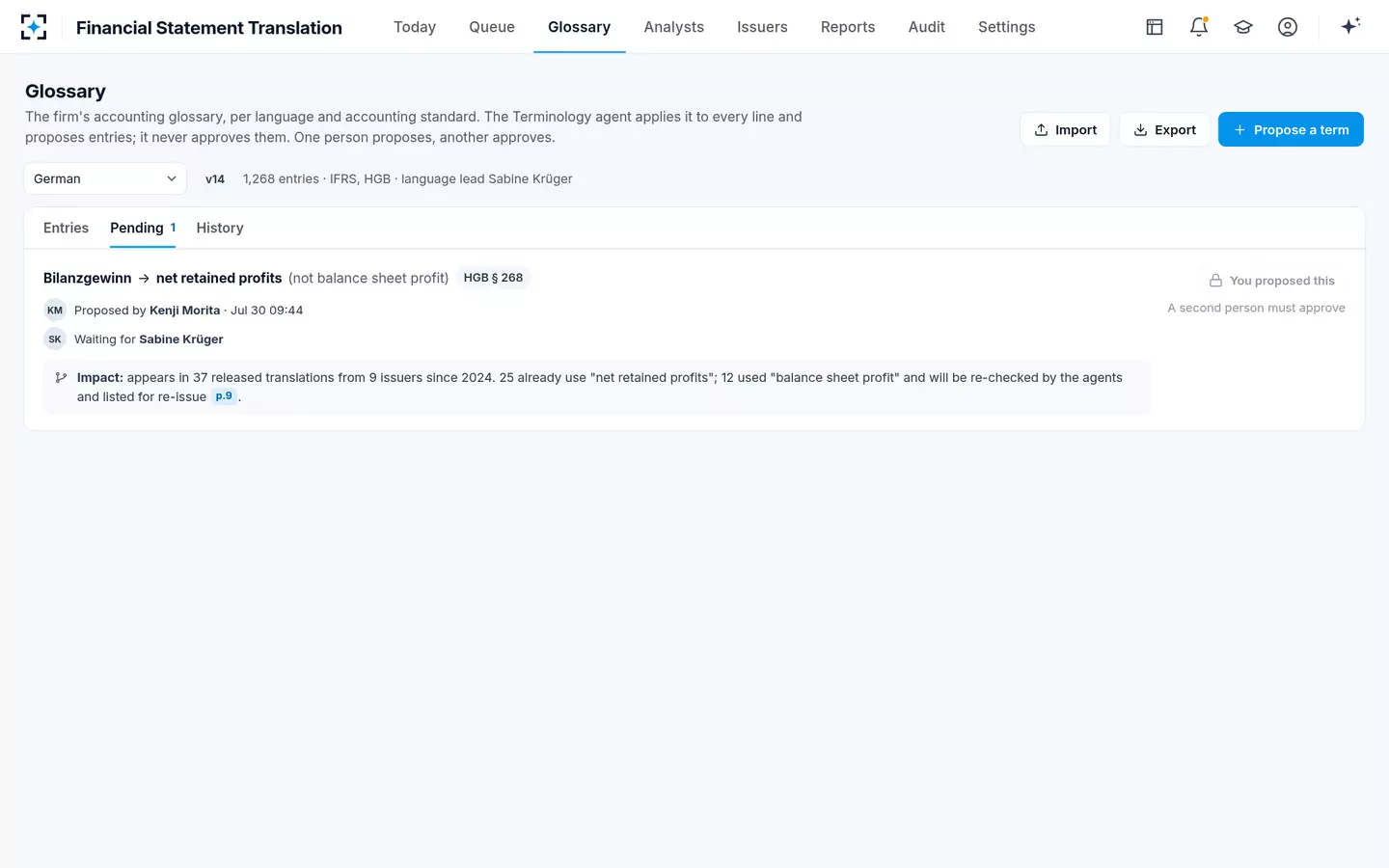
In the sample, the impact view is what made the decision safe. The proposed entry showed that Bilanzgewinn appeared in 37 released translations from 9 issuers since 2024, 12 of them using "balance sheet profit". When the language lead approves, the agents re-check those 12 and list them for re-issue, which itself needs two people, and every analyst who read an affected version is told. Translation memory, termbases and the agents that apply them covers the tooling, and the four tests of translation quality assurance shows where the glossary check sits.
The German glossary in Financial Statement Translation: a proposed term waits for a second person
Questions people ask
What are common German accounting terms?
The core set comes from the HGB's statement layouts: Bilanz (balance sheet), Gewinn- und Verlustrechnung (profit and loss account), Anhang (notes), Umsatzerlöse (turnover or revenue), Abschreibungen (depreciation and amortisation), Rückstellungen (provisions), Verbindlichkeiten (liabilities) and Eigenkapital (equity). IFRS reports add terms such as Wertberichtigung (loss allowance) and Buchwert (carrying amount).
What is the difference between Rückstellungen and Rücklagen?
Rückstellungen are provisions, obligations shown outside equity; Rücklagen are reserves within equity, such as the Kapitalrücklage and the Gewinnrücklagen. Rendering Rückstellungen as "reserves" moves a liability into equity in an English reader's mind.
Is Umsatzerlöse revenue or turnover?
Both are used. The official English translation of the HGB says "turnover", the British term; an IFRS report in English says revenue. A research glossary should pick by standard and apply it consistently.
What does Abschreibungen mean?
Abschreibungen covers depreciation of tangible assets, amortisation of intangibles and write-downs; the official HGB translation renders the profit and loss line "Amortisations / depreciations". The note or asset class decides which English word fits.
Do German companies report under HGB or IFRS?
Both, depending on the statements. A listed group draws up its consolidated statements under IFRS as adopted in the EU, as HGB §315e provides, while HGB governs the layout of accounts it does not displace. Read the standard named on each statement before choosing the terms.
Where can I find the official English version of the HGB?
The German Federal Ministry of Justice publishes it on gesetze-im-internet.de, translated by its Language Service and kept updated. The site states that its translations are intended solely as a convenience and that discrepancies in them are not binding.