Translation of financial statements means one of two things. In accounting it means restating a company's amounts in another currency, which IAS 21 prescribes; in research it means putting a company's statements into another language, English most often, without changing a single figure. The second job has no accounting standard behind it, and its errors look like fluent English: a German decimal comma left in a total, a table in thousands read as millions, an allowance rendered as a write-up. Botminds' Financial Statement Translation is built for that second job. Agents translate each local-language filing of an issuer a fund holds, prove every figure against the original and check each other, and a bilingual reviewer approves before analysts read it.
The worked examples come from the solution's fictional sample: Quillfield Capital, a global fund manager, and issuers such as Brennwald Chemie AG, a German chemicals group whose half-year report runs through the solution below. Rules and research are linked where they are used.
Two jobs share the name “translation of financial statements”
What changes
Currency translationThe amounts: every figure is restated at an exchange rate.
Language translationThe words: every label, note and sentence moves into another language.
What must not change
Currency translationThe relationships the standard prescribes, with exchange differences shown where IAS 21 puts them.
Language translationEvery figure, its scale, its sign and its currency, digit for digit.
The governing text
Currency translationIAS 21 under IFRS; Rule 3-20 of Regulation S-X for a foreign issuer filing with the SEC.
Language translationNo accounting standard. Securities rules ask for a fair and accurate English version where English is required.
Who does it
Currency translationThe preparer, inside the accounts, before the audit opinion.
Language translationThe issuer, an agency, a machine or the reader, often after publication.
How it goes wrong
Currency translationA wrong rate, or a difference booked in the wrong place.
Language translationA decimal comma left in place, a scale header misread, a term rendered by its false friend.
What is translation of financial statements? Currency or language
Translation of financial statements is either a currency exercise or a language exercise, and the word alone does not say which. A treasury accountant who says it means IAS 21. A global equity analyst who says it means an English version of a Japanese earnings summary or a German half-year report. Both use the same three words, and search results mix them, which is why a reader looking for one keeps finding the other.
The difference matters because the two jobs have opposite tests of success. A currency translation is right when the amounts have changed in exactly the way the standard prescribes. A language translation is right when no amount has changed at all, and every label means in English what it meant in the original. The rest of this guide takes six beliefs about the language job and checks each against the rules and the research.
Myth 1: “translation” in accounting always means currency
In the accounting standards, the word is about currency. IAS 21, the IFRS Foundation explains, "prescribes how an entity should: account for foreign currency transactions; translate financial statements of a foreign operation into the entity’s functional currency; and translate the entity’s financial statements into a presentation currency" (IFRS Foundation, IAS 21). The SEC's own accounting rule for foreign issuers uses the word the same way: assets and liabilities "shall be translated into the reporting currency at the exchange rate at the balance sheet date", and the effects land in a "cumulative translation adjustment" in equity (17 CFR 210.3-20).
The myth is that this is the only meaning that has rules. The language job has them too; they simply sit in securities law rather than accounting standards. Regulation S-T requires every electronic filing with the SEC to be in English and, where a filing includes a foreign-language document, a fair and accurate English translation in its place (17 CFR 232.306; when an issuer's own English can be relied on is the subject of convenience translation). Accuracy is the test the rule sets. Nothing in it lets a translator round, restate or tidy a figure.
“IAS 21 permits an entity to present its financial statements in any currency (or currencies).”
IFRS Foundation, summary of IAS 21
Myth 2: an English version should restate the figures in dollars
Should figures change when a financial statement is translated into English? No. The language translation keeps the issuer's currency and its scale, € million stays € million and R$ thousand stays R$ thousand, because the reader's model has to receive the numbers exactly as published. Which currency the statements are presented in is the preparer's decision under IAS 21, which leaves the presentation currency to the entity (IAS 21). It is not the translator's.
Even where a dollar figure would be convenient, the SEC limits it. For a foreign issuer whose reporting currency is not the dollar, dollar-equivalent statements are barred except for a convenience translation of the latest fiscal year and any later interim period, at the rate of the latest balance sheet in the filing, or a more recent rate if materially different (17 CFR 210.3-20(b)(1)). A translated report that quietly converts every column has done something the issuer itself may not do in an SEC filing.
The rule on symbols points the same way. Regulation S-T asks that foreign currency denominations "be expressed in words or letters in the English language rather than representative symbols", subject to the symbols the EDGAR Filer Manual allows (17 CFR 232.306(e)). The currency is named more clearly in English, never changed.
Myth 3: numbers survive machine translation untouched
Numbers do not translate themselves. A German report writes one thousand two hundred and eighty-four point six as 1.284,6, and a general-purpose translation system can leave the separators where they were, or convert the digits and miss the scale word above the column. Wang and colleagues tested commercial and research systems on numbers and listed the stakes plainly: "Numerical errors made in financial document translation, e.g., an extra or omitted digit or decimal point, could lead to significant monetary loss" (Findings of ACL 2021).
The same study found that systems often left separators exactly as they were in the source, and that the standard automatic quality score hardly moves when a number is wrong, because the number is a single token in a long sentence. A translation can therefore score well and still carry a figure a thousand times too large. Translation quality assurance for financial statements sets out the figure proof that catches it.
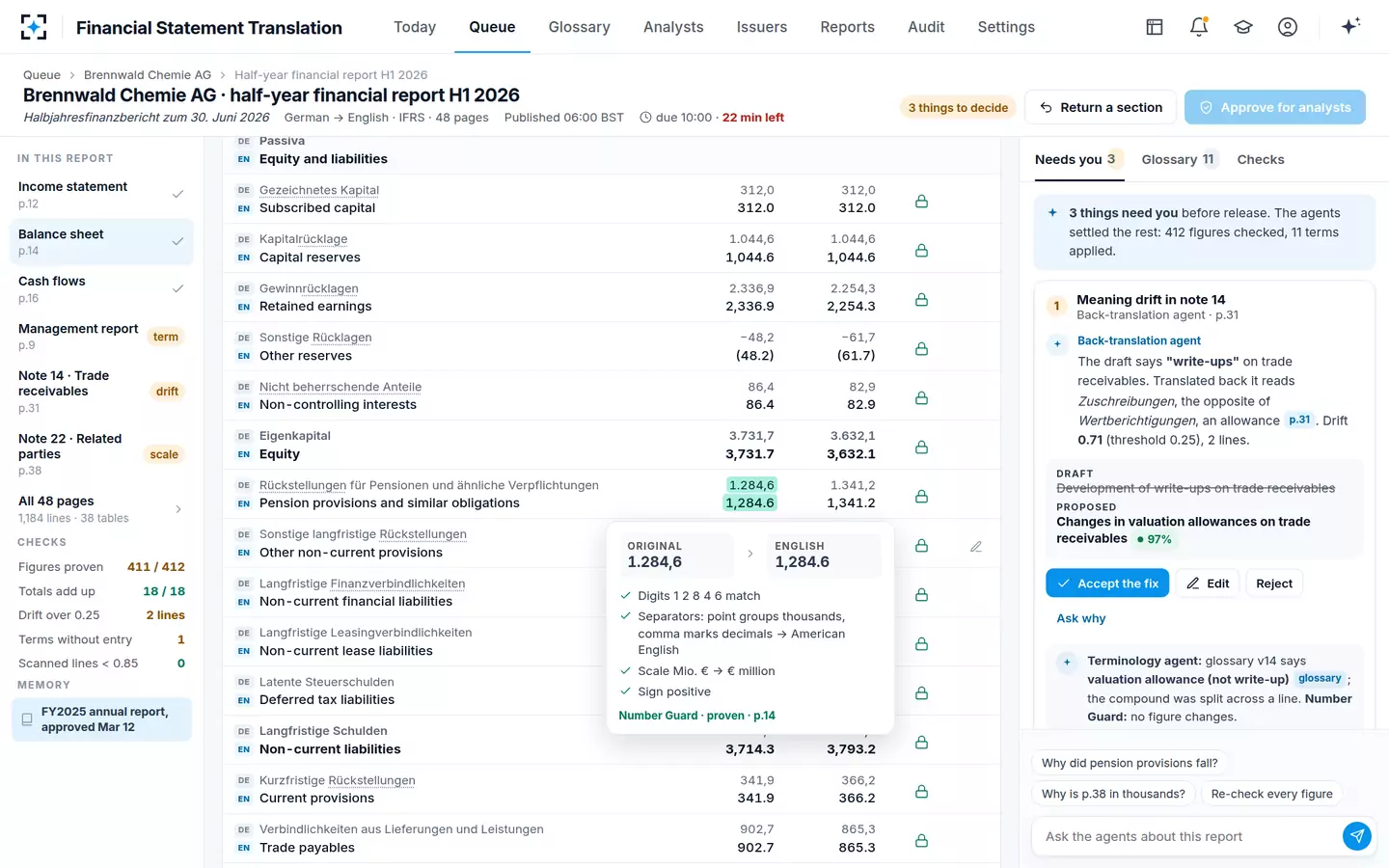
In the sample, Brennwald Chemie's related-party table on page 38 is headed "Tsd. €", thousands of euros, while every other table is in millions. The first English draft said € million, which would have shown sales to joint ventures of €14.9 billion instead of €14.9 million. The solution's Number Guard compares each English figure with the original digit for digit, through separators, scale headers and signs, and stopped it before anyone read it.
Financial Statement Translation shows each German line with its English beneath, every figure locked
Myth 4: a fluent translator will choose the right accounting term
Fluency is not the same as knowing which accounting concept a word carries. Nobes and Stadler followed the English term "impairment" from IAS 36 into 19 official translations and then into the English versions of annual reports from 393 listed firms in 11 countries. In those reports, they found, "many terms are misleading in that they do not mention impairment, peaking at 39 per cent in German and Italian reports in one year" (Accounting, Auditing & Accountability Journal, 2018).
One accounting term, followed through annual reports into English
39%
of terms for impairment in German and Italian reports, in one year, that did not mention impairment
393
listed firms in 11 countries whose English annual reports were read
19
official translations of IAS 36 examined first
The authors' advice to translators of annual reports is to work from the terms in the standards themselves, not only from earlier reports; the German accounting glossary is built that way. That is what an accounting glossary does when it is anchored to the standards. The IFRS Foundation runs its own translations on the same principle: it permits a single official translation per language, to protect comparability, and each is reviewed by a committee of financial reporting experts (IFRS Foundation).
The sample shows the cost of the alternative. In note 14 of the Brennwald report the first English draft said "write-ups" on trade receivables, where the German said Wertberichtigungen, an allowance that reduces the receivables. The words are near neighbours in German and opposites in accounting; the German accounting glossary and its false friends covers the pair in full.
Myth 5: an English summary is as good as a translation
Is an English summary the same as a translation? Under SEC rules it is not, and the filer must say which one it is giving. Rule 12b-12 lets a party file an English summary in place of a translation for some foreign-language exhibits, but the summary must fairly and accurately cover each material provision, say what it left out, and be labelled as a summary or a translation (17 CFR 240.12b-12(d)). Why that label matters to an investor reading an issuer's English is the subject of convenience translation.
What the SEC's rules ask of an English translation, and of an English summary
| English translation | English summary | |
|---|---|---|
| When it is used | The default whenever a filing must include a foreign-language document | Only for some exhibits, and only where the document is not on the rule's list or the form allows a summary |
| Financial statements | Required for audited annual and interim consolidated financial information | Not available for that subject matter unless the applicable form permits a summary |
| What it must do | Translate the whole foreign-language document, fairly and accurately | Summarise each material provision fairly and accurately, and describe what was omitted or abridged |
| Labelling | Identified as an English translation | Identified as an English summary |
| The original | May be filed alongside; must be provided if staff ask | May be filed alongside; must be provided if staff ask |
Outside SEC filings, the English an issuer publishes at home is often shorter than the original, and nothing obliges it to say so. Where the SEC does require home-market English, for a foreign company relying on the Rule 12g3-2(b) exemption, it names the documents: English translations of "Its annual report, including or accompanied by annual financial statements", "Interim reports that include financial statements" and "Press releases", among others (17 CFR 240.12g3-2(b)(3)(ii)). An analyst who needs the notes, not the highlights, should check which kind of English is in hand before relying on it.
Myth 6: the issuer's own English carries the same weight as the original
Usually it does not. The local-language filing is the one the issuer is held to, and the English is offered for convenience. Korea's Financial Supervisory Service says so on the English version of its disclosure system: English disclosures there are made with no legal effect and may not match the Korean originals, so users are advised to refer to the Korean filings for detail (FSS, English DART).
That does not make an issuer's English useless. It makes it a second text to be checked against the first. In the sample, a Japanese company published its English earnings summary alongside the Japanese, and the English showed operating profit of ¥8,421 million where the Japanese said 8,412百万円: two digits transposed, in a line every model reads. What a convenience translation is, and when it can't be trusted, follows that comparison line by line.
How do you translate financial statements into English? A method that changes no figure
To translate financial statements into English, translate the words line by line inside the original table structure, carry every figure across unchanged, and then prove it: digits, separators, scale, sign and totals, against the original page. Terms come from a glossary tied to the accounting standard the issuer reports under, meaning is checked by a second reader, and a person who reads both languages approves before anyone relies on it.
Translating a financial statement into English without changing a figure
- Keep the original table structure
Line for line and column for column, so every English figure sits where its original sits and can be traced to its page.
- Carry figures across; never retype them
Convert notation only: 1.284,6 becomes 1,284.6, a minus or △ becomes a bracket if that is the house style. The digits do not change.
- Read the scale header on every table
Tsd. €, Mio. €, 百万円 and 億円 differ by factors of a thousand or more, and one table in a report can differ from the rest.
- Prove every figure, and re-add every total in both languages
A figure that does not match is stopped, not fixed. An issuer's own arithmetic error is flagged as the issuer's and left as published.
- Take terms from a glossary anchored to the standard
One rendering per term, per language and per standard, changed only when a second person approves.
- Check meaning separately from figures
Back translation on a different model, or a second reader, catches the fluent sentence that says the opposite.
- Have a bilingual reviewer approve, and keep the evidence
Who approved, what was decided and which version each analyst read.
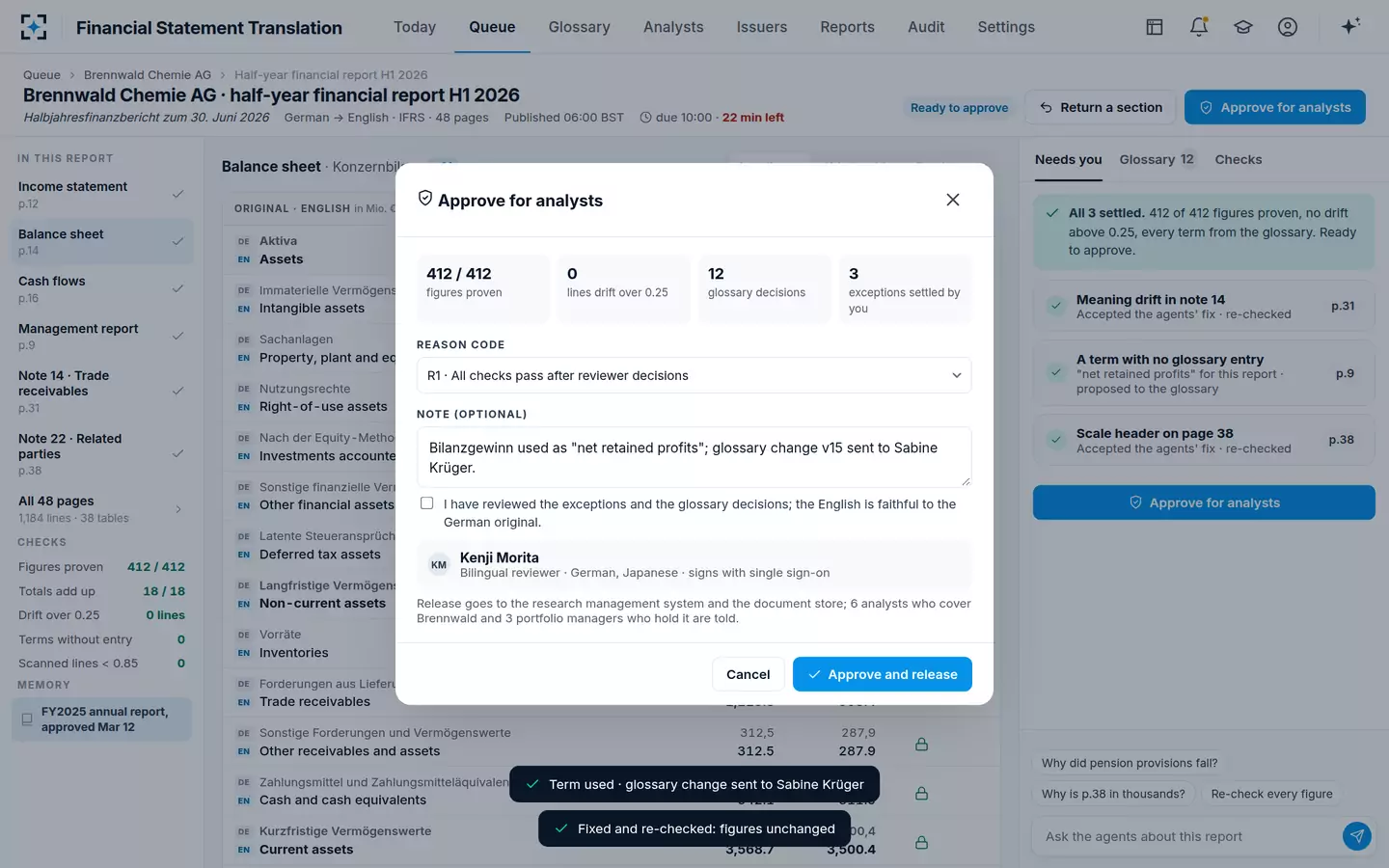
That is the sequence Financial Statement Translation runs. In the sample morning, the Brennwald report was published at 06:00; the agents read its 48 pages, drafted the English, proved 411 of 412 figures and handed the bilingual reviewer three decisions by 06:17: the scale header, the allowance and one German term with no glossary entry. He settled them, the Number Guard re-checked, and he approved at 09:52 with a reason code and an attestation, 3 hours 52 minutes after publication. The four tests of translation quality assurance explains each check in turn.
Approval comes last, from a person, after every figure is proven
Questions people ask
What is the difference between translation and conversion in accounting?
In everyday use, converting means exchanging an amount from one currency into another at a rate. In IAS 21, translating means restating a whole set of financial statements, or a foreign operation's statements, into another currency under the standard's method. A language translation converts nothing: the figures stay in the issuer's currency and scale.
What does IAS 21 say about translation?
IAS 21 prescribes how an entity accounts for foreign currency transactions, translates a foreign operation's statements into its functional currency, and translates its own statements into a presentation currency if that differs. It says nothing about translating statements into another language.
What is a presentation currency?
It is the currency in which an entity presents its financial statements, which IAS 21 allows to be any currency, or more than one. It can differ from the functional currency, which the IFRS Foundation describes as the currency of the primary economic environment in which the entity operates.
Should figures change when a financial statement is translated?
No. A language translation changes notation, such as a decimal comma becoming a point, but never a digit, a scale or a currency. Even in SEC filings, a foreign issuer may show dollar convenience translations only for the most recent year and later interim periods, at a rate the rule specifies.
Can machine translation translate financial statements?
It can draft them, but it cannot be trusted with the numbers unchecked. Research on commercial and research systems found separators left unchanged and scale words mistranslated, errors a standard quality score barely penalises. A draft is usable once every figure has been proven against the original and a bilingual reader has checked the meaning.
Is an English summary the same as a translation?
No. Under the SEC's rules a summary is allowed only for some exhibits, and not for audited financial information unless the form itself permits one; it must describe what it leaves out and be labelled as a summary. An issuer's home-market English carries no such duty, so check whether it is complete before relying on it.