Translation quality assurance is the set of checks that decides whether a translation can be relied on before anyone acts on it. For a financial statement it comes down to four tests: prove every figure equals the original, check meaning by translating the English back on a different model, hold every accounting term to one glossary, and compare the issuer's own English where it exists. Reading the English for fluency is not one of them, because the costly errors in financial translation read fluently. Botminds' Financial Statement Translation runs the four tests on every local-language filing of an issuer a fund holds, and a bilingual reviewer decides only what the tests could not settle.
The examples follow one fictional sample morning in the solution: a 48-page German half-year report from Brennwald Chemie AG and a Japanese earnings summary from Hoshimura Denki K.K., both held by Quillfield Capital, a fictional fund manager.
Four tests, four different catches in one sample morning
1scale error
a table in thousands drafted as € million, caught by the figure proof
2lines
whose meaning drifted, caught by back translation on a second model
1term
with no glossary entry, held for the reviewer to decide
3gaps
between an issuer's own English and its Japanese original
What is translation quality assurance for a financial statement?
Translation quality assurance for a financial statement is the proof, before release, that the English is faithful to the original in figures, meaning and terms. A general translation QA process asks whether the text reads well and follows instructions. A financial one asks narrower questions that can each fail on its own: is 1.284,6 now 1,284.6 and not 1.284,6 or 1,284,600; does "Wertberichtigungen" still mean an allowance; is "Rückstellungen" rendered the way the last three annual reports rendered it.
The standard the SEC applies when English is required is a useful benchmark: a filer must submit "a fair and accurate English translation of the entire foreign language document" (17 CFR 240.12b-12(d)(1)). Fair and accurate is the outcome. The four tests below are one way to show it was reached, for every filing, without a person reading every line.
The four tests of translation quality assurance for a financial statement
Test 1
Every figure provenIs each English number the same number as the original?
HowDigits, decimal and thousands separators, scale header, sign and percentage compared with the original page; every total re-added in both languages.
Passes when100% of figures proven. No exceptions, no override.
Test 2
Meaning checked twiceDoes each English line say what the original says?
HowThe English translated back into the source language by a second model and compared line by line with the original.
Passes whenNo line above the drift threshold without a person's decision.
Test 3
Terms held to one glossaryIs each accounting term rendered the way the firm renders it?
HowEvery term matched to the glossary for that language and accounting standard; terms without an entry listed for a decision.
Passes whenEvery term from the glossary, or decided and proposed for it.
Test 4
Issuer's English comparedWhere the issuer published English, does it match its own original?
HowFigures, omissions and tone compared sentence by sentence with the local-language filing.
Passes whenEvery difference listed for analysts before they read either English.
Why a fluent translation can still be wrong
Fluency hides the two errors that matter most in finance, a wrong number and a reversed meaning, because both leave a well-formed sentence behind. Automatic scores see little of either. In their study of number translation, Wang and colleagues found that the de facto quality metric, BLEU, "may fail to flag a numerical translation error, which only contributes a very minor penalty, as it is typically a single-token mistranslation" (Findings of ACL 2021).
Human judgement depends on who judges. Freitag and colleagues had professional translators, "with access to full document context", annotate errors under the Multidimensional Quality Metrics (MQM) framework, and found "a substantially different ranking of evaluated systems from the one established by the WMT crowd workers" (Transactions of the ACL, 2021). Their wider warning applies to any QA programme: "inadequate evaluation procedures can lead to erroneous conclusions". For financial statements, the evaluator who can tell an allowance from a write-up is an accountant who reads both languages, and that person's time is the scarce input. The four tests are designed to spend it only where it is needed.
Test 1: prove every figure against the original
The first test is mechanical and absolute: every number in the English must be shown to equal the number on the original page, through the notation changes a translation legitimately makes. That means the digits, the decimal and thousands separators, the scale header above the column, the sign convention and any percentage. Then every subtotal and total is re-added in both languages, so a figure dropped from a list shows up as a broken sum.
Research on machine translation explains why the proof cannot be skipped. Wang and colleagues tested two commercial systems and a research model on numbers with separators. Translating German into English, the best passed 97.1% of separator tests; the others passed 68.5% and 65.7%. Their proposed remedy is the test itself: "It is helpful to post-check whether all numbers in a translation are correct by comparing them to the inputs" (Wang et al., 2021).
German to English: how often three systems handled decimal and thousands separators correctly
In the sample, the figure proof stopped one error: the related-party table on page 38 of the Brennwald report is in "Tsd. €" while the draft header said € million, a thousandfold overstatement. The test does one more thing a reviewer would struggle to do consistently: it never corrects the issuer. Where an issuer's own total does not foot, the solution flags the difference as the issuer's and leaves the figure as published. A way to measure any tool's figure accuracy before trusting it, by planting known errors, is in the seeded-error test for LLM extraction.
What is back translation? Test 2, meaning checked on a second model
Back translation means translating the English back into the source language, independently, and comparing the result with the original to see whether the meaning survived. It comes from cross-cultural research, where questionnaires must mean the same thing in two languages. Brislin's 1970 study, in which 94 bilinguals representing ten languages translated or back-translated six essays, concluded that "a functionally equivalent translation can be demonstrated when responses to the original and target versions are studied" (Journal of Cross-Cultural Psychology, 1970).
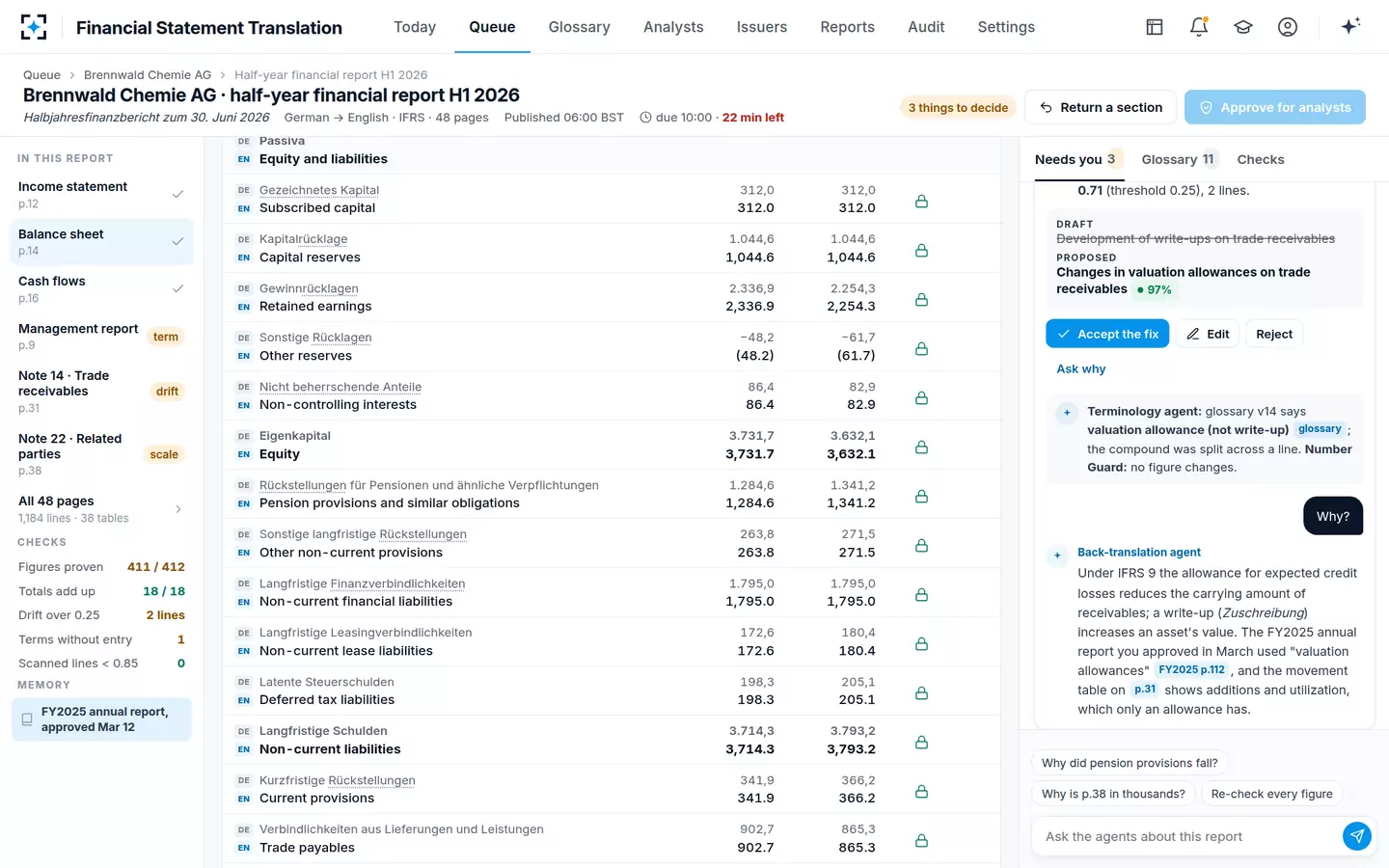
For a financial statement, back translation catches the error that figure checks cannot see: the sentence whose numbers are right and whose meaning is reversed. In the sample, note 14 of the Brennwald report described "write-ups" on trade receivables. Translated back, the English read Zuschreibungen, an increase in an asset's value, where the original said Wertberichtigungen, an allowance that reduces it. The line scored a drift of 0.71 against a threshold of 0.25 and went to the reviewer with a proposed fix and its reasons.
Two design choices make back translation worth running. The back-translation must come from a different model from the one that drafted the English, or it tends to repeat the draft's assumptions. And it must flag lines for a person rather than rewrite them, so the reviewer sees the disagreement instead of a silent second opinion.
Back translation in Financial Statement Translation flags a reversed meaning, and the reviewer asks why
Test 3: hold every term to one glossary
The third test checks that each accounting term is rendered the same way every time, in every document, as the firm decided. Consistency is not pedantry. An analyst comparing "provisions" this year with "reserves" last year may think a line was reclassified when only the translator changed. The IFRS Foundation applies the same logic to its own standards: "only one translation per language is permitted to avoid endangering comparability, transparency, and the long-term sustainability of high quality translations" (IFRS Foundation).
The research says terms drift in practice. Following "impairment" into the English versions of 393 firms' annual reports, Nobes and Stadler found misleading renderings in up to 39% of German and Italian reports in one year (Nobes and Stadler, 2018). The test therefore needs a glossary per language and per accounting standard, and a rule for the term that has no entry: stop and ask, with candidates and their history, rather than guess. German accounting terms and their false friends shows what such a glossary contains.
Test 4: compare the issuer's own English
When an issuer publishes its own English, quality assurance has a second text to test: does the issuer's English match the issuer's original? It often will. When it does not, the analyst reading it needs to know before relying on it. In the sample, Hoshimura Denki's English earnings summary showed operating profit of ¥8,421 million where the Japanese said 8,412百万円, left out a revised exchange-rate assumption and called a 12.4% fall in operating profit a slight decrease.
This test does not replace the issuer's English or correct it. It lists the differences, recommends which English analysts should read and attaches a note explaining why. Any question to the issuer's investor relations team is a person's decision. When an issuer's English can't be trusted covers the legal status of these versions market by market.
What is ISO 17100, and what can't it tell you?
ISO 17100:2015, "Translation services — Requirements for translation services", is the International Organization for Standardization's standard for translation service providers. ISO sells the standard rather than publishing it free, so its detailed requirements are not public; ask a provider for its certificate and the scope it covers.
What a certificate cannot tell you follows from what it certifies: a provider's services, not a particular filing. A certified process can still return an annual report with a table in the wrong scale, because no service standard proves the figures in a specific document. The four tests are document-level evidence. They produce, for each translation, the list of figures proven, lines checked and terms decided that a certificate does not.
Sampling a translation versus testing all of it
QA by sampling: A reviewer spot-checks a handful of tables, usually the primary statements.
Four tests on every filing: Every figure in every table and note, totals re-added in both languages.
QA by sampling: A reader skims for anything that sounds wrong; fluent errors pass.
Four tests on every filing: Every line translated back on a second model; drift above the threshold goes to a person.
QA by sampling: Depends on who translated this time.
Four tests on every filing: Every term against one glossary per language and standard; missing terms decided once.
QA by sampling: Usually read instead of the original, unchecked.
Four tests on every filing: Compared with the original; differences listed before analysts read it.
QA by sampling: A sign-off, rarely what was checked.
Four tests on every filing: What was proven, what was decided, who approved and with what reason.
How do you measure translation accuracy?
Measure translation accuracy by counting errors of defined types, not by scoring overall impressions. For figures the measure is binary: the share of figures proven equal to the original, which must be 100% before release. For meaning, count lines whose back-translated drift exceeds the threshold, and note what the reviewer decided about each. For terms, count glossary hits, terms without an entry and terms the reviewer overrode.
This is the logic of MQM, the error-based framework Freitag and colleagues used, in which professional translators mark each error rather than rate a sentence. It also produces numbers a head of research operations can track by language, issuer and reviewer: in the sample, 1,182 of the Brennwald report's 1,184 lines were within the 0.25 drift threshold before the reviewer's two decisions, and 411 of 412 figures were proven before the scale fix.
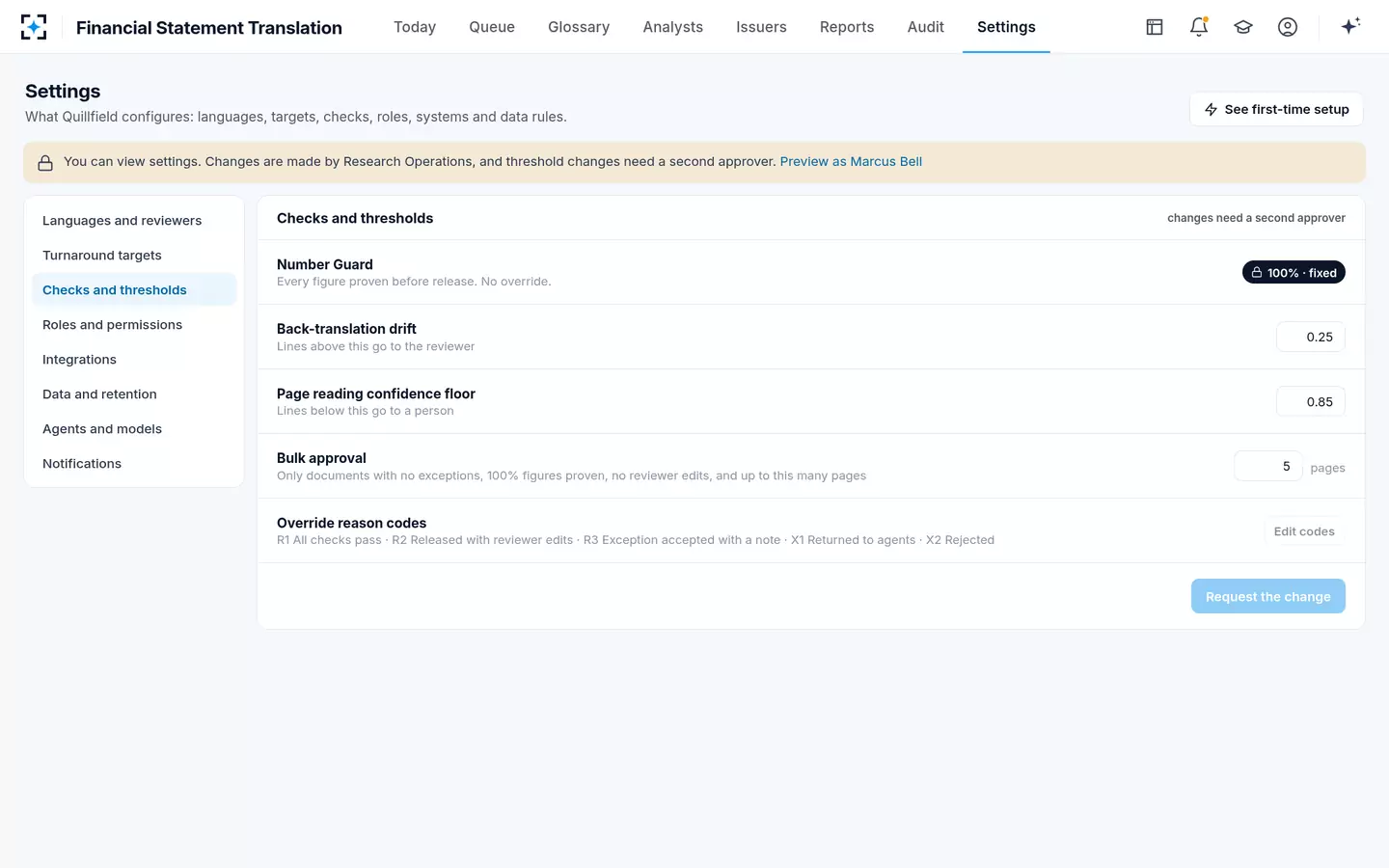
Thresholds in Financial Statement Translation are settings, and changing one needs a second approver
Who should review a financial translation?
A financial translation should be reviewed by someone who reads both languages and knows financial reporting, and approved by a person, not by the system that produced it. The IFRS Foundation's criteria for its translation review committees are a fair job description: a native speaker of the target language, with good English and demonstrable technical knowledge of financial reporting. Its coordinator "signs off on all translations before they can be finalised" (IFRS Foundation).
Questions to put to any translation quality assurance process for financial statements
- Is every figure proven, or only sampled?
Ask for the count of figures proven per document and what happens to the one that fails.
- Are totals re-added in both languages?
A dropped line shows up only as a broken sum.
- Who checks meaning, and with what?
A second model or a second reader; never the drafting system checking itself.
- Is there one glossary per language and accounting standard?
And who may change it: one person proposes, another approves.
- Is the issuer's own English compared with its original?
Differences should reach analysts before they read either version.
- Does the reviewer know financial reporting in both languages?
Fluency alone will pass an allowance rendered as a write-up.
- What evidence is kept?
Each decision with its reason, the approver, and which version each reader saw.
In Financial Statement Translation the agents draft and check but never approve or release. A bilingual reviewer for the language settles the exceptions, approves with a reason code and an attestation, and signs with single sign-on; glossary changes and corrections to released English need a second person. The agents doing the checking are described in why translation memory software is not enough for financial filings.
Questions people ask
What is translation quality assurance?
It is the set of checks that decide whether a translation can be relied on before it is used. For financial statements the decisive checks are that every figure equals the original, the meaning survives a back translation, terms follow one glossary, and any issuer's English matches its own original.
How do you check a translation for errors?
Check figures and meaning separately. Compare every number with the original page, including separators, scale and sign, and re-add totals; then have a second model or reader translate the text back and flag lines whose meaning moved. Fluent reading alone misses both kinds of error.
What are common errors in financial translation?
A decimal comma or thousands point left unconverted, a scale header such as Tsd. € or 百万円 misread, a negative sign lost, and accounting false friends such as a German allowance rendered as a write-up. Research on English versions of annual reports found misleading terms for impairment in up to 39% of German and Italian reports in one year.
What is MQM in translation quality?
Multidimensional Quality Metrics is an error-based framework in which trained evaluators mark each error by type and severity instead of rating a sentence overall. A large 2021 study using professional translators under MQM ranked machine translation systems differently from crowd raters.
Is back translation enough on its own?
No. Back translation compares meaning, and a drift score is built to notice changed sense, not a changed digit or scale. Figures need their own proof against the original page, and the lines back translation flags still need a person to decide what they mean.
Can quality assurance be automated?
The checking can be; the judgement should not be. Figure proofs, back translation and glossary matching run on every line, and the reviewer decides the exceptions they raise and approves the release.