Financial translation services turn a company's financial statements, reports and disclosures from one language into another, and for a research team they come in three forms: a translation agency working by the page, generic machine translation, and agents that draft the English, prove every figure against the original and hand only the exceptions to a bilingual reviewer. Agencies suit the few documents that need a certified human translation; generic machine translation suits nothing a model depends on; agents suit the hundreds of local-language filings a global fund's holdings publish in a results season. Botminds' Financial Statement Translation is the third kind, built for issuers a fund holds, and this guide is honest about where each fits and how to move work between them.
Examples use the solution's fictional sample: Quillfield Capital, a fund manager with filings arriving in 12 languages, and issuers such as Brennwald Chemie AG in Germany and Companhia Serra Azul de Energia in Brazil.
Financial translation services compared: agency, machine translation, agents
Translation agency: Certified translations, legal documents, a few flagship reports a year.
Agents with figure proofs, and a reviewer: Every filing for every issuer held, from annual reports to two-page notices.
Translation agency: Days, set by the provider's queue and capacity.
Agents with figure proofs, and a reviewer: Hours from publication; targets of four business hours for priority results.
Translation agency: As careful as the translator and reviewer that week.
Agents with figure proofs, and a reviewer: Every figure proven against the original before release; issuer arithmetic flagged, not changed.
Translation agency: The agency's glossary or the translator's habit.
Agents with figure proofs, and a reviewer: The firm's own glossary per language and standard, changed by two people.
Translation agency: Not usually checked.
Agents with figure proofs, and a reviewer: Compared with the original; differences listed for analysts.
Translation agency: A delivered file and an invoice.
Agents with figure proofs, and a reviewer: What was proven, decided and approved, and who read which version, kept seven years.
What are financial translation services?
Financial translation services are services that translate financial documents, annual and interim reports, earnings summaries, prospectuses, exchange notices and statements, with the accounting terms and figures intact. "Financial document translation services" and "financial statement translation services" describe the same market. Providers differ less in the languages they offer than in three things a research buyer should ask about: who checks the figures, whose glossary the terms come from, and how fast the English arrives after publication.
The demand side has grown because regulators want more English, not less. Korea's Financial Services Commission is extending mandatory English to every disclosure item in the exchange's rules, all 55 kinds of material information among them, plus fair disclosure and answers to exchange inquiries (FSC, January 28, 2026). Tokyo's Prime Market made English mandatory for financial statements and timely disclosure information from April 2025 (FSA, 2024). The European rule has long left the choice of language to the issuer within limits: regulated information goes out in a language the home authority accepts and, for host markets, in one "customary in the sphere of international finance" (Directive 2004/109/EC, Article 20). Most of a global fund's holdings, though, still report first, or only, in their own language.
More English from issuers, but not for the long tail of a fund's holdings
55items
of Korean material-information disclosures brought under mandatory English
FSC, 2026
Apr 2025
mandatory English for Tokyo Prime Market financial statements and timely disclosures
FSA
64filings
for issuers held, in 12 languages, in one sample night
fictional sample
How do I choose a financial translation agency?
Choose a financial translation agency by testing it on your own past filings and asking how it proves figures, whose glossary it uses and who reviews, rather than by its language list. The IFRS Foundation's criteria for the experts who review its official translations are a sound yardstick for an agency's reviewers: a native speaker of the target language, with good English and proven technical knowledge of financial reporting (IFRS Foundation).
Accounting competence is the criterion most often missing. Nobes and Stadler followed the term "impairment" into the English annual reports of 393 listed firms and found misleading renderings that peaked at 39% of German and Italian reports in one year (AAAJ, 2018). Fluent English is not the test. A sample translation that renders a German allowance as a write-up, or a Rückstellung as a reserve, tells you what the agency's review is worth. ISO 17100 certification describes a provider's translation services; translation quality assurance for financial statements explains what it cannot tell you about a given filing.
Choosing a financial translation provider: the questions that separate them
- Test on 20 of your own past filings
In your languages and issuers, with the originals and any English you already have to compare.
- Ask how every figure is proven
Separators, scale headers, signs and totals; and what happens when one does not match.
- Ask whose glossary is used, and who may change it
Yours, per language and accounting standard, exportable in CSV or TBX.
- Ask who reviews, and what they know
Native in the target language, fluent in the source, competent in financial reporting.
- Ask what is checked besides figures
Meaning, by back translation or a second reader; the issuer's own English, where it exists.
- Ask when the clock starts
At publication, or when you send the file.
- Ask what evidence comes back
Decisions, approver, reason, and which version each reader saw.
Is machine translation good enough for financial documents?
Generic machine translation is good enough to tell an analyst what a filing is about and not good enough to put its numbers in a model. Its weakness is exactly where finance is least forgiving. Testing commercial and research systems, Wang and colleagues found that separators were often left unchanged and scale words mistranslated, and that the standard automatic quality score barely registers a wrong number (Findings of ACL 2021). Its fluency hides the problem: a sentence with the wrong figure reads as well as one with the right figure.
The quality of the output also depends on who judges it. When professional translators with full document context annotated errors, Freitag and colleagues found a ranking of systems substantially different from the crowd raters' ranking, and a clear preference for human over machine translation (TACL, 2021). For financial documents, then, the useful question is not whether machine translation is good enough but what checks turn its draft into something a model can use.
What is the turnaround for financial translation?
Turnaround depends on the provider and the document, and there is no regulatory or academic benchmark for agency times. The useful anchor is the reader's clock, which starts when the filing is published. Regulators set some outer limits for the issuer: a foreign company relying on the SEC's Rule 12g3-2(b) exemption must publish its required English "promptly after the information has been made public" (17 CFR 240.12g3-2(b)(2)(ii)), and Korea's largest listed companies must file English "on the same day" as Korean, in principle (FSC).
Turnaround targets in Financial Statement Translation, from publication to approved English
Can we use AI for annual report translation?
Yes, if the AI's output is proven rather than trusted. An annual report is the longest and most repetitive document an issuer publishes, which suits machine drafting and memory of last year's approved English, and the densest in figures, which demands a proof of each one. The solution's target for an annual report is three business days from publication, with the same rules as for any other document: every figure proven, meaning checked on a second model, terms from the firm's glossary, and a bilingual reviewer's approval.
What AI should not do in annual report translation is decide. It should not choose a term the glossary lacks, accept a figure that fails its proof, release the English or ask the issuer about a difference. In the sample, each of those moments became a decision for a named person, with a proposal and the evidence. Translation memory software and the agents around it sets out each agent's limits.
Where each kind of financial translation service fits
Most research teams will use more than one kind of service, and the split follows the document, not the language. The table below is one way to allocate a fund's filings; the categories are ours, and the boundary between the first two rows is the decision a buyer should make on evidence from a trial.
Matching financial translation services to the filings a fund holds
| Document | Typical need | Agency | Generic machine translation | Agents with checks |
|---|---|---|---|---|
| Documents needing a certified translation | A translator's or agency's statement of accuracy | Fits | No | Draft only |
| Annual and half-year reports of the largest positions | Complete, checked English within days | Fits, slowly | No | Fits |
| Results of the long tail of holdings | Checked English the same day | Rarely affordable | Gist only | Fits |
| Ad hoc notices and timely disclosures | English within the hour | Too slow | Gist only | Fits |
| An issuer's own English | Checked against its original | Not usually offered | No | Fits |
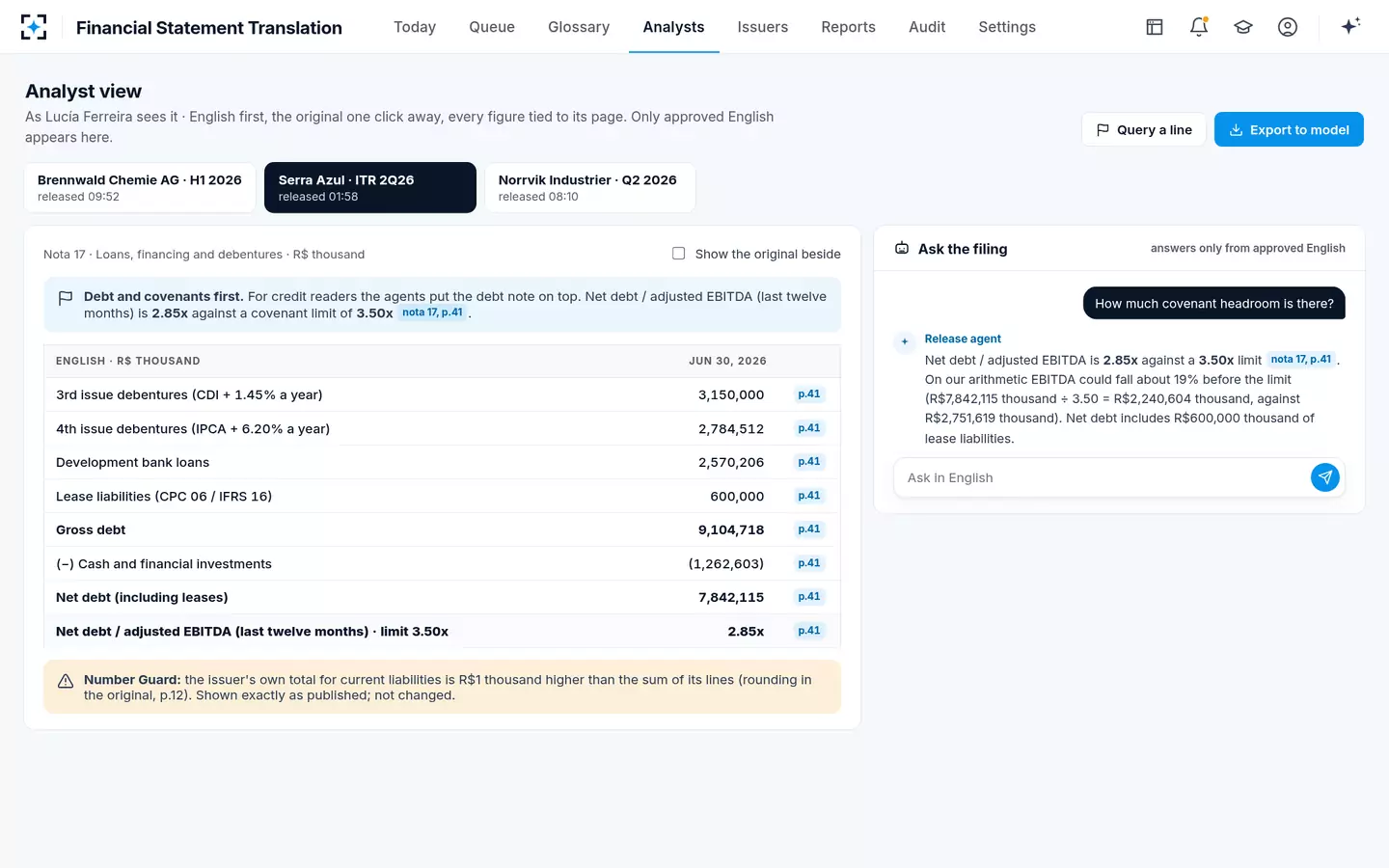
| Credit documents: debt notes, covenants | Figures and definitions exact | Fits | No | Fits, debt note first |
For a credit analyst, Financial Statement Translation opens a Brazilian quarterly form on its debt note
How do you move from an agency to AI?
Move from an agency to AI one slice at a time, starting where the agency never reached: the long tail of holdings whose filings are skimmed in a generic translator or not read at all. That slice carries no switching risk, because nothing is being replaced, and it produces evidence fast: a results season's worth of figures proven, terms decided and turnaround measured. Keep the agency for certified documents and, until the evidence is in, for the flagship reports of the largest positions.
Switching from an agency to agents, in order
- Map holdings by language and filing type
Which issuers report only in their own language, and which publish English worth checking.
- Bring the firm's glossaries and approved past translations
As CSV or TBX glossaries per language and standard, and past English as memory.
- Trial on 20 of your own past filings
Compare the English with the originals and with any agency version: figures proven, drifts flagged, terms decided.
- Set targets, thresholds and reviewers
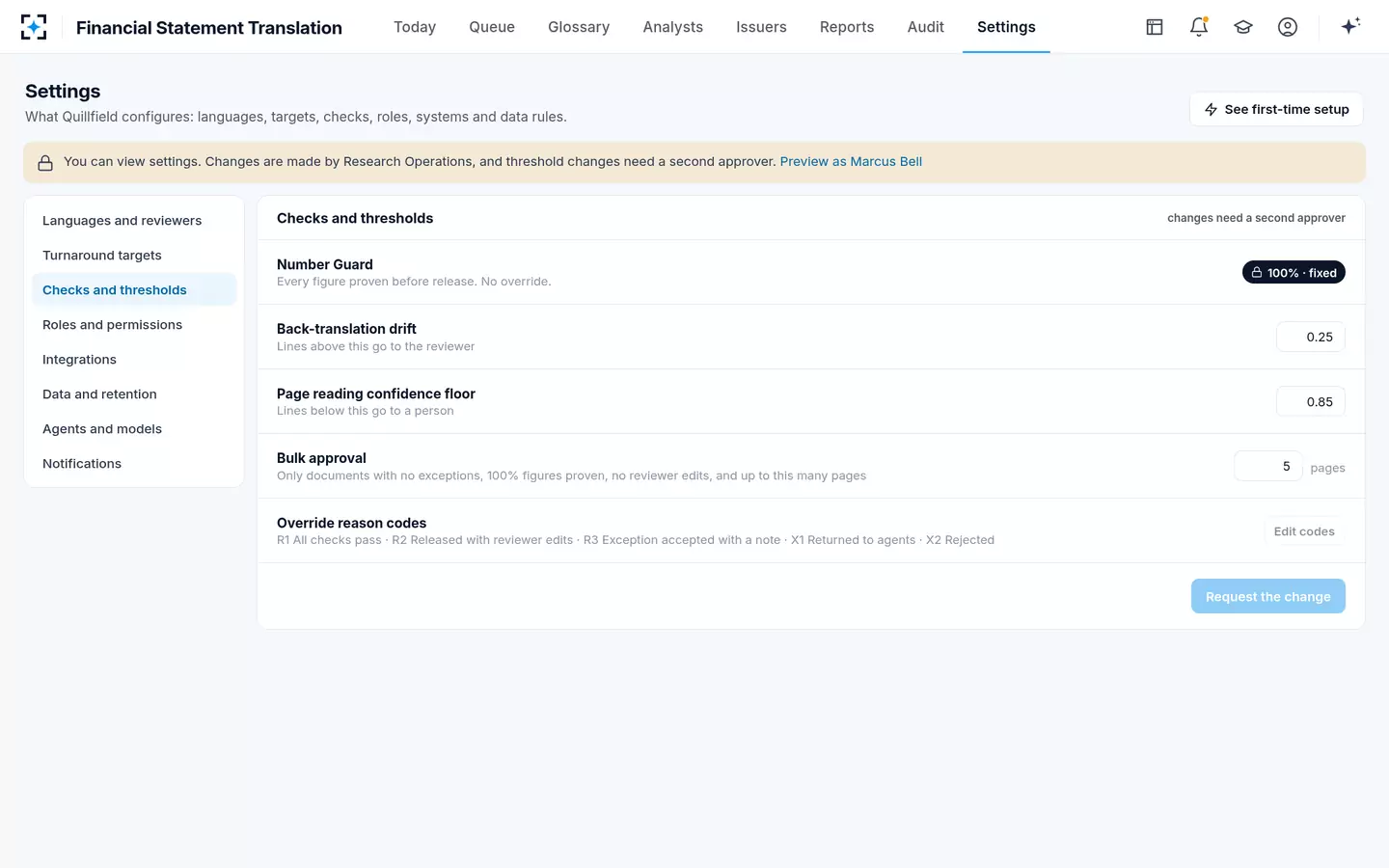
Turnaround by priority, drift threshold, a bilingual reviewer per language; threshold changes need a second approver.
- Start with the long tail in a live season
Every filing for issuers below the agency line, released in approved English.
- Run the largest names in parallel for a season
Agency and agents side by side; compare the evidence, not impressions.
- Move the largest names when the evidence says so
Keep the agency for certified and legal documents.
First-time setup in the solution takes six steps, from languages and sources to holdings and turnaround targets, and ends with that trial. The settings a buyer will want to inspect before going live are the ones the trial exercises: the figure proof fixed at 100%, the drift threshold, the page-reading floor and the bulk-approval rule. What translation costs per page, and what delay costs sets out the economics of the split.
What stays with people when agents translate filings
Judgement, approval and responsibility stay with people. A bilingual reviewer decides the exceptions and approves every release; a language lead approves every glossary change somebody else proposed; the head of research operations sets the thresholds and approves any question to an issuer; research compliance can read every step. The agents never approve, release, change a figure or contact an issuer.
That division is also what makes the switch defensible. When an analyst asks where a figure came from, the answer is a page in the original, a proof, and a named approver.
The checks a buyer should inspect in Financial Statement Translation before going live
Questions people ask
What should a financial translation provider certify?
For research use, a provider should be able to show, per document, that every figure matches the original, which glossary was applied and who approved the English. A provider-level certificate such as ISO 17100 describes its translation services; it does not prove the figures in a particular report.
Are financial document translation services different from financial translation services?
No. The terms describe the same work, translating financial statements, reports and disclosures with figures and accounting terms intact; buyers use them interchangeably.
Do we still need an agency if we use AI?
Usually, for a narrow set of documents: anything that needs a certified translation, and legal documents where a translator's statement of accuracy is required. For research reading of filings, agents with figure proofs and a bilingual reviewer can cover what agencies cannot reach in time.
Should we rely on an issuer's own English instead of translating?
Check it first. An issuer's English is usually a convenience version, and it can omit or soften what the original says. In the solution's sample, a Japanese issuer's English transposed two digits of operating profit and left out an exchange-rate assumption.
How do we measure whether the switch worked?
Track figures proven per document, exceptions per document and how they were settled, time from publication to approved English, and the share of holdings with approved English in a season. In the sample, 41 of 64 overnight filings were already released in English by 09:38.