Translation memory software stores sentences and segments a translator has already translated and approved, and offers them again when the same or similar text recurs. For financial filings that is genuinely useful: accounting policies, standard notes and risk language change little from one report to the next. But a memory only remembers wording. It cannot tell whether a figure in the new report was carried across correctly, whether a reused sentence is still true, whether a new sentence says the opposite of the original, or whether the issuer's own English matches its filing. Botminds' Financial Statement Translation uses the firm's approved past translations as memory and adds agents for each of those jobs, with limits on what each may do, so that a bilingual reviewer approves English that has been proven, not just recalled.
The examples follow the solution's fictional sample: Quillfield Capital, a fund manager, and a German half-year report from Brennwald Chemie AG, one of its holdings.
Translation memory, machine translation and agents: what each does on a financial filing
Finds sentences and segments translated and approved before, and offers them again when the same or similar text recurs.
Strong atRepeated wording: accounting policies, standard notes, risk language that changes little from period to period.
Blind toNew text, figures, and whether last year's approved sentence is still true this year.
Generates a new translation of any sentence, whether or not anyone has translated it before.
Strong atSpeed and coverage: a first draft of a whole filing in minutes.
Blind toNumbers, scale headers and false friends, which it can get wrong while reading fluently.
Use memory and machine translation to draft, then prove each figure, apply the glossary, check meaning on a second model and compare the issuer's English.
Strong atEvidence that the English is faithful, line by line, before a person approves it.
Blind toJudgement on a term or a meaning the checks cannot settle, which goes to a person.
What is translation memory software?
Translation memory software is a computer-assisted translation (CAT) tool that keeps a database of past translations and reuses them. The US Bureau of Labor Statistics describes CAT tools as using "a computer database of previously translated sentences or segments (called a "translation memory")" to translate new text, and says they "allow translators to be efficient and consistent" (BLS, Occupational Outlook Handbook). In financial work the memory sits beside a termbase, the list of approved terms, which is covered below.
The tools are standard equipment for serious translation of accounting text. The IFRS Foundation, which runs the official translations of its standards, "recommends the use of professional translators who will be able to make use of computer-assisted translation software", and its staff give each language team guidance on using it (IFRS Foundation). The question for a research team is not whether to use memory but what else a financial filing needs.
Is translation memory the same as machine translation?
No. A translation memory retrieves what a person has already translated and approved; machine translation generates a new translation of text no one has translated before. Memory is only as good as the past work in it and offers nothing for a new sentence. Machine translation offers something for every sentence and guarantees nothing about any of them. The BLS draws the same line: machine translation software "automatically generates text from the source language into the target language", while CAT tools reuse a translator's own past segments.
In practice the two are combined: memory supplies the matches, machine translation drafts the rest, and a person edits. That combination has evidence behind it. In the first controlled study of post-editing, Green, Heer and Manning found that it "leads to reduced time and, surprisingly, improved quality" for translation from English into Arabic, French and German (CHI 2013). The study measured general text, though, not tables of figures, and the person did all the checking.
What translation memory does well with financial reports
Translation memory does best on the parts of a filing that repeat. An issuer's accounting policies, the descriptions of its segments, its standard risk language and the headings of its notes change little from one half-year to the next. A memory built from the issuer's last approved report turns that text into near-instant, consistent English, and consistency is half of what an analyst comparing periods needs.
In the sample, the solution drafted Brennwald's 48-page half-year report with the firm's German glossary and, as memory, the FY2025 annual report that a reviewer had approved in March. The agents' log shows that 61% of the phrasing was reused from it. The rest had to be drafted fresh, and the memory could vouch for none of the 412 figures: every one was this period's, and every one had to be proven against this period's page.
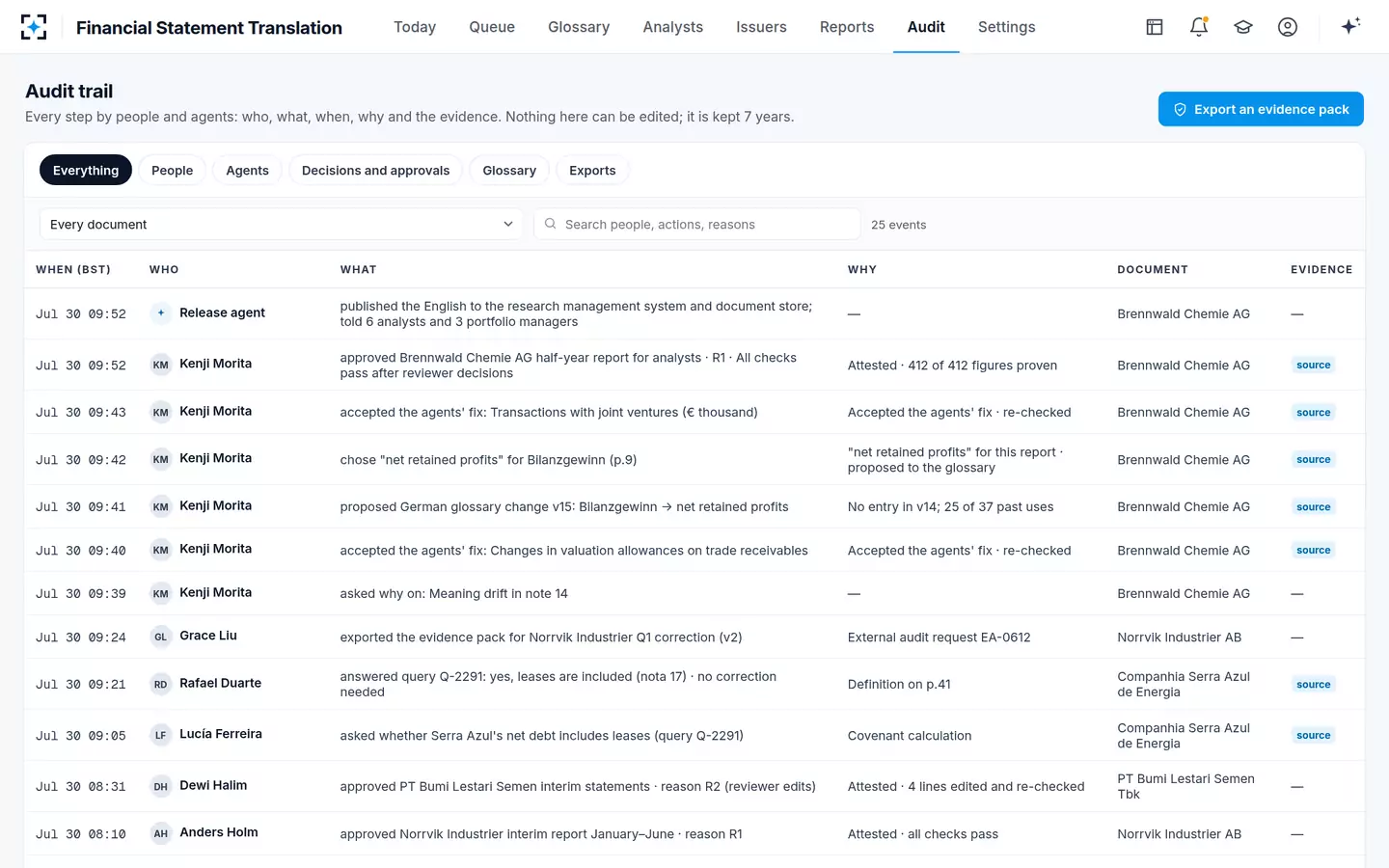
Financial Statement Translation's audit trail: every step by a person or an agent, with the reason and the evidence
Where translation memory stops on a financial filing
Translation memory stops at four things a financial filing always contains. The first is figures: a memory match for "Pension provisions fell to €1,341.2 million" is exactly wrong when this period's figure is €1,284.6 million, and numbers are where machine translation is weakest too: Wang and colleagues found that standard quality scores barely penalise a wrong number, because it is usually a single token in a long sentence (Findings of ACL 2021).
The second is meaning in new text, where there is no match to reuse and a fluent draft can reverse the sense. The third is terms with no glossary entry, which a memory cannot invent and a machine will guess. The fourth is the issuer's own English, which a memory never sees. Each needs a different check, and each check needs a clear rule about what it may change, because a tool that silently corrects is harder to trust than one that flags.
Eight agents for a financial filing, and the line each may never cross
Financial Statement Translation splits the work among eight agents, each with a job and an explicit limit, and puts a bilingual reviewer at the one point where judgement is needed. The limits are the design: the agents may draft, check and propose, but none of them may approve, change a figure, release or contact an issuer.
The eight agents in Financial Statement Translation, and where the reviewer decides
Agent
Intake agentWatches the exchange feeds and the issuer mailbox, matches each filing to holdings, sets priority by position size and starts the clock at publication.
Never: drop a filing for an issuer held, or guess the period
Agent
Page readerReads every page, tables and scans included, with a confidence for each line, anchored to its page and position.
Never: pass a line below 0.85 confidence without a person
Agent
TranslatorDrafts the English line by line inside the table structure, using the firm's glossary and the issuer's approved past translations as memory.
Never: change a figure, or summarise a statement
Agent
Terminology agentApplies the glossary per language and standard, lists every term decision, and asks when a term has no entry, with candidates and their past use.
Never: approve a glossary change
Agent
Number GuardProves every English figure equals the original through separators, scales, signs and percentages, and re-adds totals in both languages.
Never: fix an issuer's arithmetic, or let anything out below 100% proven
Agent
Back-translation agentTranslates the English back on a different model and flags lines whose meaning drifts above the threshold.
Never: edit the English itself
Agent
Gap checkerCompares the issuer's own English with its original for figures, omissions and tone.
Never: replace the issuer's English, or contact the issuer
A person decides
Bilingual reviewerSettles only what the agents could not, then approves with a reason code and an attestation, signed with single sign-on.
Agent
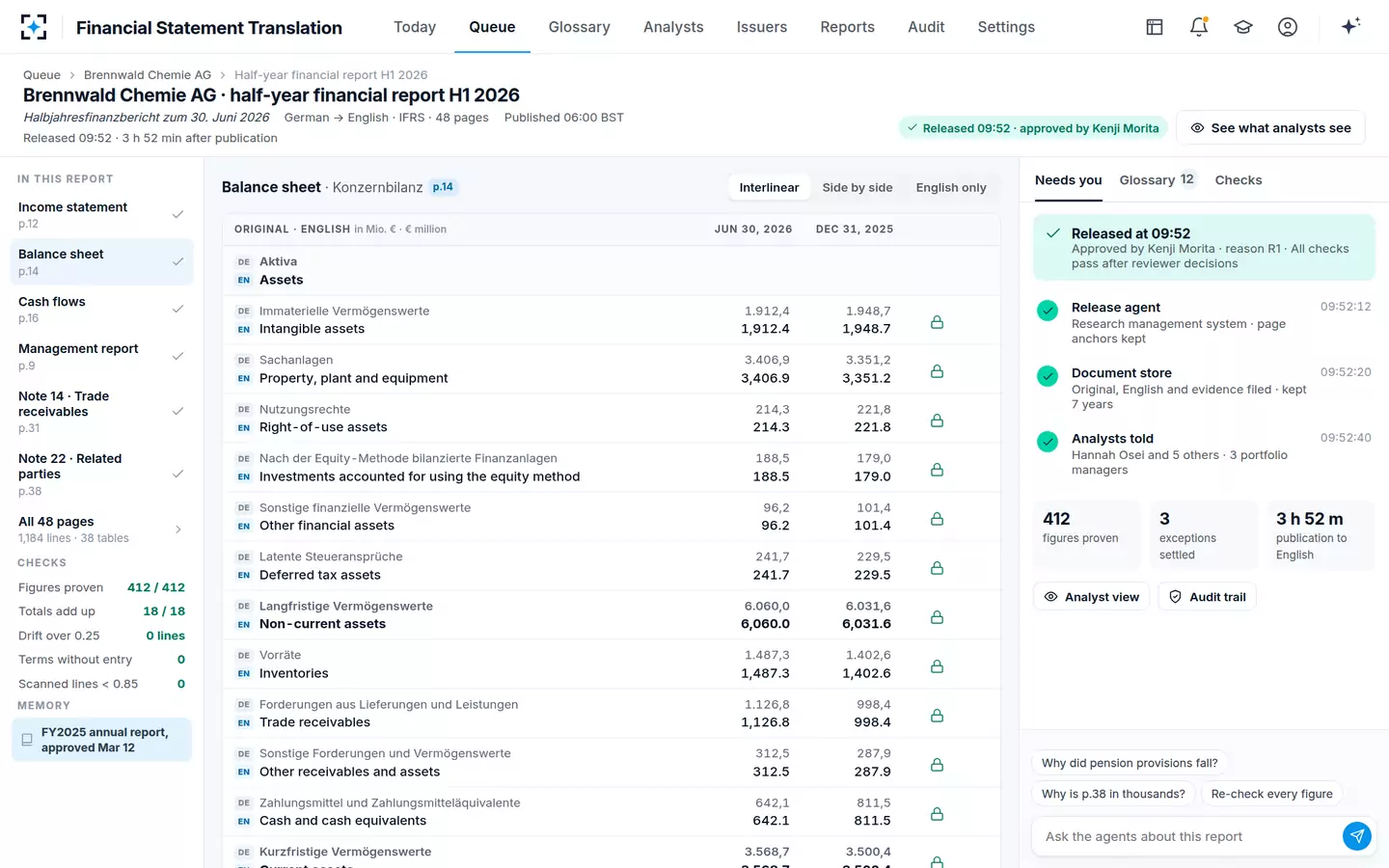
Release agentPublishes approved English to the research management system with page anchors, tells the analysts who need it, and answers their questions from it.
Never: release without approval, or answer from an unapproved draft
Can AI translate financial statements accurately?
AI can draft financial statements accurately enough to be worth checking, and the checking is what makes the result accurate. The research supports both halves. Post-editing machine output saved time and improved quality in Green and colleagues' controlled study. But how good machine output is depends on who judges it: when Freitag and colleagues had professional translators annotate errors with full document context, they found that the ranking of systems changed, and that the experts clearly preferred human translation to machine output, where crowd raters had not (TACL, 2021; the four tests that follow from it are in translation quality assurance for financial statements).
For figures, the remedy the number-translation researchers propose is mechanical: treat numbers as a separate process and check every number in the output against the input (Wang et al., 2021). That is the Number Guard's job, run on every figure rather than a sample. Accuracy, on this view, is not a property of the model. It is a property of the evidence attached to each line.
“It may be worth separating numerical translation out into an individual process.”
Wang et al., Findings of ACL 2021, on mitigating numerical mistranslation
What should AI never do in a translation?
An AI system translating a financial filing should never change a figure, approve its own work, change the firm's glossary, release text to readers or speak to the issuer. Each of those is either an act a person must answer for or a change that would make the evidence worthless. A figure the agent "corrected" can no longer be proven against the original; a glossary the agent edited can no longer be trusted to be the firm's.
The sample shows the limits working. When a Brazilian issuer's own current-liabilities total, in the sample's Serra Azul quarterly form, was R$1 thousand higher than the sum of its lines, the Number Guard flagged it as the issuer's rounding and left it as published. When Bilanzgewinn had no glossary entry, the Terminology agent offered three candidates and stopped. When the issuer's English differed from its Japanese in a Hoshimura Denki summary, the Gap checker listed the differences and drafted nothing to the issuer.
One sample morning: what the agents settled, and what they left for a person
412figures
proven digit for digit in a 48-page German report, after one scale header was fixed
61%
of the phrasing reused from the approved FY2025 annual report as memory
3decisions
left for the reviewer: a scale header, a reversed meaning and a term with no entry
Who approves an AI translation?
A person who reads both languages and knows financial reporting approves it, and the approval should be kept with what was checked. The IFRS Foundation's own model for translating its standards ends the same way: professional translation, then "Review by a committee of experts", with a named coordinator who signs off before any translation is final (IFRS Foundation).
In the solution, the bilingual reviewer for the language approves each release with a reason code, R1 when all checks pass after the reviewer's decisions, and an attestation that the English is faithful to the original. Short documents can be bulk-approved only when there are no exceptions, every figure is proven and the reviewer made no edits. Glossary changes and corrections to released English need a second person.
What is a termbase, and who should own it?
A termbase is the list of approved terms a translation tool applies: the German "Rückstellungen" always as "provisions", the Japanese "親会社の所有者に帰属する" always as "attributable to owners of the parent". In finance it should be organised by language and by accounting standard, because an HGB term and an IFRS term can need different English, and it should belong to the firm, not to a tool.
Ownership is practical, not legal. A firm should be able to import its glossary, in CSV or the TermBase eXchange (TBX) format, and export it again, and every change should be proposed by one person and approved by another. Regulators are building the same kind of shared vocabulary: Korea's Financial Services Commission, widening mandatory English disclosure, committed to "providing a glossary on English disclosure" alongside the exchange's translation assistance (FSC, January 28, 2026). A German accounting glossary and its false friends shows what a well-anchored termbase contains.
What to ask before buying translation memory software for filings
The best translation memory software for financial documents is the one whose output can be proven, not just recalled. Before buying, ask what the tool does with numbers, with new text, with terms it does not know and with the issuer's own English, and ask to see the evidence it leaves behind. Most memory tools will answer the first question about consistency well and the others not at all; that is not a flaw in the tool, but it decides what else the workflow needs.
Questions for any translation memory or AI translation tool for financial filings
- Does it prove every figure against the original?
Including separators, scale headers, signs and totals re-added in both languages; and what happens when one fails.
- Does it keep the original table structure?
So each English figure can be traced to its page and position.
- How does it check meaning in new text?
A second model or reader, not the drafting system checking itself.
- What does it do with a term that has no entry?
Stop and ask, with candidates and history, or guess.
- Is the glossary the firm's, per language and standard?
Importable and exportable (CSV, TBX); changed only by two people.
- Does it compare the issuer's own English?
And report differences without replacing or correcting the issuer.
- Who approves, and what is kept?
A named reviewer, a reason, an attestation, and which version each reader saw.
- What is the AI never allowed to do?
Change a figure, approve, release, edit the glossary or contact an issuer.
Financial Statement Translation answers those questions with settings a buyer can inspect: the figure proof fixed at 100% with no override, the drift threshold, the reading floor and the bulk-approval rule, each changed only with a second approver. A first engagement is a trial on 20 of the firm's own past local-language filings, so the evidence comes from the firm's issuers, not a demonstration set. Choosing financial translation services and switching covers how such a trial fits beside an agency.
Released English in Financial Statement Translation, with the reviewer named and the readers told
Questions people ask
What is a CAT tool?
A computer-assisted translation tool helps a human translator rather than translating on its own. Its core is usually a translation memory of past translated segments and a termbase of approved terms, which the BLS says make translators efficient and consistent.
What is the best translation memory software for financial documents?
The one that fits a workflow able to prove its output. For filings, judge a tool by what it does with figures, new text, unknown terms and the issuer's own English, and by the evidence it keeps, rather than by match rates alone.
Does translation memory work for Japanese or Korean filings?
It works for repeated wording in any language pair, including Japanese and Korean results documents, which repeat headings and policy text from period to period. The scale words and sign conventions of those markets, such as 百万円 and △, still need the figure proof.
Is machine translation post-editing faster than translating from scratch?
In the first controlled study of post-editing, translators were faster and produced better quality when correcting machine output than when translating from scratch, from English into Arabic, French and German. The study used general text; financial tables add the need to prove every figure.
Can the agents learn from a reviewer's corrections?
A reviewer's approved translation becomes memory for the next report from that issuer, and an approved glossary decision applies to every later document. Changes to an agent's model or prompt are versioned, evaluated on 240 past statements and made only after two approvals.