A convenience translation is a translation provided for the reader's convenience, with the original-language text remaining the one that governs. In financial reporting the phrase has two uses. In SEC filings it means restating a foreign issuer's amounts in US dollars at a single rate, which the rules restrict. More widely, it describes the English version an issuer publishes of a filing it made in its own language, which the issuer is not held to in the way it is held to the original. For an analyst, the second meaning is the one that bites: the English may be complete and faithful, or shorter, later or softer than the original, and nothing on its face says which. Botminds' Financial Statement Translation checks an issuer's English against the original for figures, omissions and tone before analysts read it, and gives them a proven English of its own when the issuer's falls short.
The rules and notices below are the regulators' own. The worked example is from the solution's fictional sample: an English earnings summary published by Hoshimura Denki K.K., a Tokyo-listed company held by Quillfield Capital, a fictional fund manager.
The original filing and the issuer's convenience translation are not equals
The original-language filing: The disclosure the issuer is held to under its home rules.
The issuer's English (convenience translation): Usually offered for convenience; governments and regulators that publish English say discrepancies are not binding.
The original-language filing: The full document.
The issuer's English (convenience translation): Full text, an extract or a summary; it may not say which.
The original-language filing: Published first.
The issuer's English (convenience translation): At the same time, later, or not at all, depending on market and company.
The original-language filing: Auditors and regulators, for the parts they cover.
The issuer's English (convenience translation): Often nobody but the reader.
The original-language filing: The original governs.
The issuer's English (convenience translation): The reader needs to know, before relying on the English.
What is a convenience translation?
A convenience translation is a version of a document in another language, provided so that readers who do not read the original can follow it, on the understanding that the original prevails. The clearest statement of the idea comes from a government that publishes its own. Germany's federal law portal, which carries official English translations of statutes such as the Commercial Code, says its translations "are intended solely as a convenience to the non-German-reading public" (gesetze-im-internet.de).
“Any discrepancies or differences that may arise in translations of the official German versions of these materials are not binding and have no legal effect for compliance or enforcement purposes.”
Germany's federal law portal, notice on its English translations
Regulators label their own English the same way. Japan's Financial Services Agency marks its English policy documents as provisional translations of the Japanese originals. An issuer's English annual report or earnings summary is, in most markets, a convenience translation in exactly this sense: useful, often accurate, and not the text anyone is held to.
Convenience translation in financial statements: the SEC's currency meaning
In SEC financial statements, a convenience translation means something else: showing a foreign issuer's figures in dollars, at one exchange rate, alongside the reporting currency. Regulation S-X restricts it. If the reporting currency is not the dollar, "dollar-equivalent financial statements or convenience translations shall not be presented, except a translation may be presented of the most recent fiscal year and any subsequent interim period presented using the exchange rate as of the most recent balance sheet included in the filing", or a more recent rate where materially different (17 CFR 210.3-20(b)(1)).
The two meanings share a principle: the convenience version is not the measure. A dollar column at one rate is not a set of dollar accounts, and an English text is not the filing. The language meaning is the subject of the rest of this guide. Translation of financial statements, language or currency separates the two in full.
Which version prevails in a translated annual report?
The original-language version prevails, unless a law or the document itself says otherwise. That is the default the German government states for its own translations and the default Korea's regulator states for English disclosures on its system. For a filing made with the SEC the position is different, because there the English is the filing: Regulation S-T requires electronic filings to be in English and, where a foreign-language document must be included, "a fair and accurate English translation of the foreign language document" instead (17 CFR 232.306).
Which text counts, market by market
| Where | The rule or notice | What it means for the English |
|---|---|---|
| US, SEC filings | Filings must be in English; a foreign-language document is replaced by "a fair and accurate English translation" (17 CFR 232.306) | The English is the filed text; summaries must be labelled and describe what they omit (Rule 12b-12) |
| EU, regulated information | Disclosed in a language the home authority accepts and, for host markets, possibly a language commonly used in international finance (Directive 2004/109/EC, Art. 20) | Any additional English is the issuer's choice; the version in the accepted language is the regulated one |
| Japan, Prime Market | English mandatory for financial statements and timely disclosure information from April 1, 2025 (FSA, 2024) | English required for those documents; for others, including the annual securities report, English is voluntary |
| Korea, English DART | English disclosures "made voluntarily with no legal effect" (FSS disclaimer); mandatory English widening from May 2026 (FSC) | Refer to the Korean filing for detail |
| Germany, translated statutes | Translations "intended solely as a convenience"; discrepancies "not binding" (federal law portal) | The German text governs |
Is the English version of a filing legally binding?
Outside an English-language filing regime such as the SEC's, an issuer's English is generally not the binding text; the local-language filing is. Even under the SEC's regime, the rules distinguish a translation from a summary: a summary must "Fairly and accurately describe the terms that have been omitted or abridged" and must be identified "as either an English summary or English translation" (17 CFR 240.12b-12(d)). Home-market English carries no such labelling duty.
For a research team, the legal point turns into a practical one. If an analyst's model takes a figure from the issuer's English and the original says something different, the original is right and the model is wrong, whatever the English said. Compliance will want to know which version the analyst read. That is why the solution keeps, for every analyst, which version of which English they opened.
What is DART in Korea, and what does it say about English?
DART is Korea's electronic disclosure system, run by the Financial Supervisory Service: companies file online and the filing is public at once (FSS, English DART; a night on DART is followed in a rights offering in Seoul, minute by minute). Its English site carries companies' English disclosures, and its disclaimer is one of the plainest statements of a convenience translation's status a regulator publishes.
"The FSS neither affirms nor certifies the accuracy or the correctness of disclosures posted on the FSS English DART", it says, and "Because disclosures in English are made voluntarily with no legal effect and may not correspond to the original disclosures in Korean due to mistranslation, the user is advised to refer to the original filings in Korean for specific details" (FSS, English DART). Korea is also making more English mandatory for large KOSPI companies, so more English will arrive; the disclaimer is a reminder of what kind of English it is.
Do Japanese companies publish English annual reports?
Many do, voluntarily, and the largest must now publish English results. The statutory annual securities report has no English requirement; the FSA instead publishes a list of companies that post an English version, as a nudge to translate (FSA; how that list and the exchange's English rules fit together is in kessan tanshin explained). For Prime Market companies, English became mandatory for financial statements and timely disclosure information from April 1, 2025 (FSA, 2024).
Mandatory English is not the same as checked English. The FSA's materials describe a requirement to disclose, not a requirement that the English match the Japanese line for line, and the English an issuer publishes under time pressure is the one most likely to slip. How to read a kessan tanshin covers the Japanese document itself.
Why do English and local filings differ?
English and local filings differ for four reasons: the English is a summary, it was produced later or in a hurry, the translator chose different terms, or the issuer wrote it for a different audience. The research gives weight to the last two. Nobes and Stadler found that in English versions of annual reports from 393 firms, terms for impairment were misleading in up to 39% of German and Italian reports in one year (AAAJ, 2018). Lundholm, Rogo and Zhang found that foreign firms listed in the US tend to write clearer text with more numerical data than their US peers, and that more readable disclosure is associated with more US institutional ownership (The Accounting Review, 2014): English written to attract investors is written with a purpose.
The incentive to publish English at all is real. Jeanjean and colleagues found European firms that began issuing English annual reports gained foreign ownership and analyst following, consistent with the language of the annual report acting as a barrier to investment for some investors (JIBS, 2015). That makes issuers' English more common and more important, and checking it more worthwhile.
One issuer's English, checked against its Japanese original
286figures
compared between the Japanese summary and the issuer's English
398sentences
aligned, original to English
3differences
a transposed figure, an omission and softened wording
Checking an issuer's English against the original
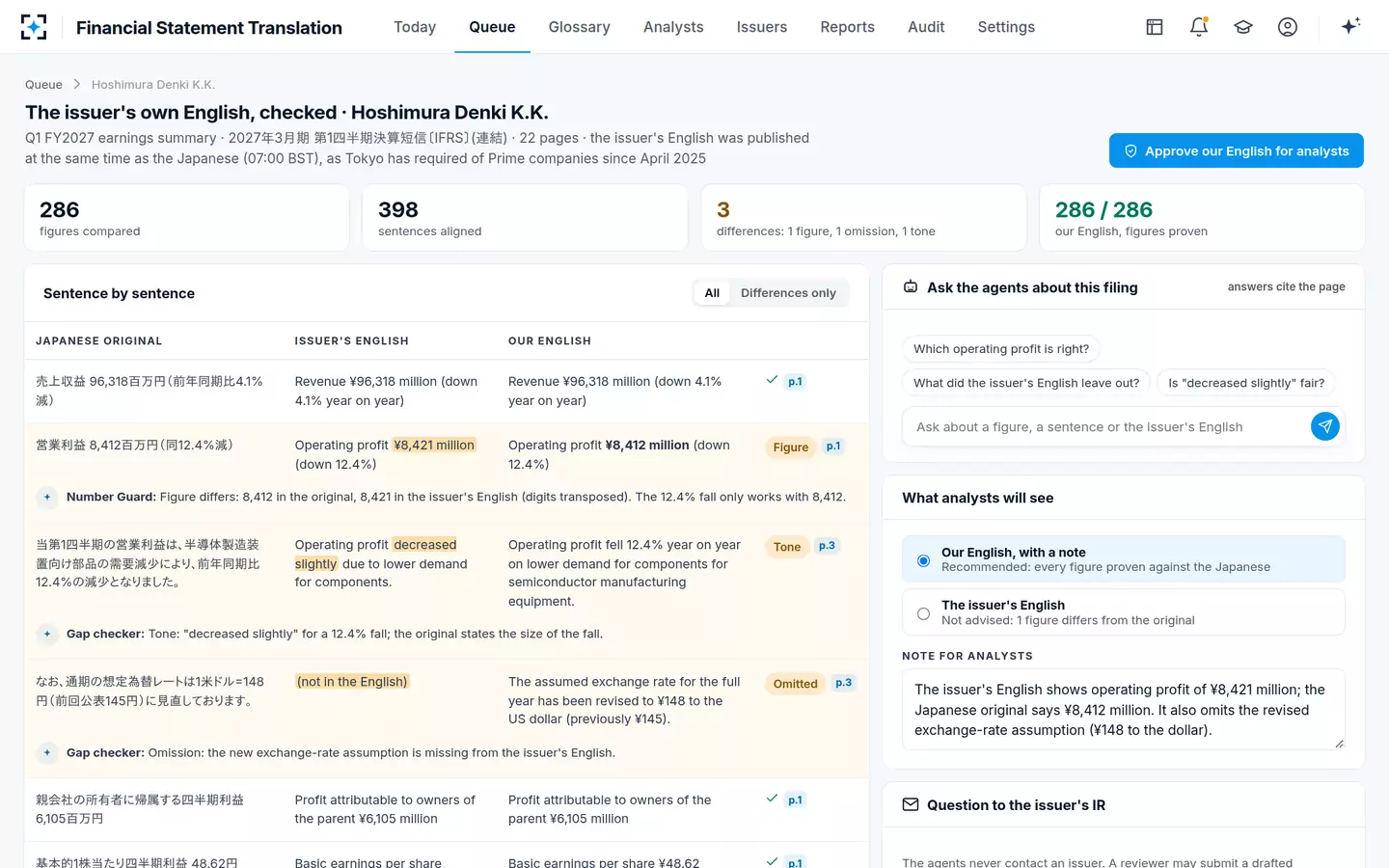
Checking an issuer's English means comparing it with the original on three counts: every figure, every omission and the tone of what is said about the figures. In the sample, the Japanese summary reported operating profit of 8,412百万円, down 12.4%; the issuer's English said ¥8,421 million. Only 8,412 is consistent with a 12.4% fall, so the error is in the English. The Japanese also said the full-year exchange-rate assumption had been revised to ¥148 to the dollar from ¥145; the English left it out. And the English said operating profit "decreased slightly" where the original stated the 12.4% fall.
The solution's Gap checker reports such differences; it never replaces or corrects the issuer's English and never contacts the issuer. The reviewer chooses what analysts see, in the sample the solution's own English with every figure proven and a note on the issuer's differences, and any question to the issuer's investor relations team is sent only after the head of research operations approves it.
Financial Statement Translation compares an issuer's English with its Japanese original, sentence by sentence
What analysts and compliance should do with an issuer's English
Treat an issuer's English as a second source to be reconciled with the first, not as the filing. The checks are quick for one document and impossible by hand for a season's worth across hundreds of issuers, which is where they belong in a workflow rather than on an analyst's to-do list.
Before relying on an issuer's convenience translation
- Find the original and note which text governs
Look for a statement of which version prevails; absent one, assume the original does.
- Check whether it is a translation or a summary
Compare page counts and sections; a summary may drop the notes you need.
- Prove the figures you will use against the original
Including scale headers and signs; a transposed pair of digits reads as plausibly as the right ones.
- Look for omissions in forecasts and assumptions
Exchange-rate assumptions and forecast revisions are easy to leave out.
- Read the adjectives against the numbers
"Slightly" for a 12.4% fall is a tone difference worth a note.
- Keep track of which version each reader used
If the two differ, compliance will ask.
- Route questions to the issuer through one owner
Never from an analyst's inbox on the strength of an unverified difference.
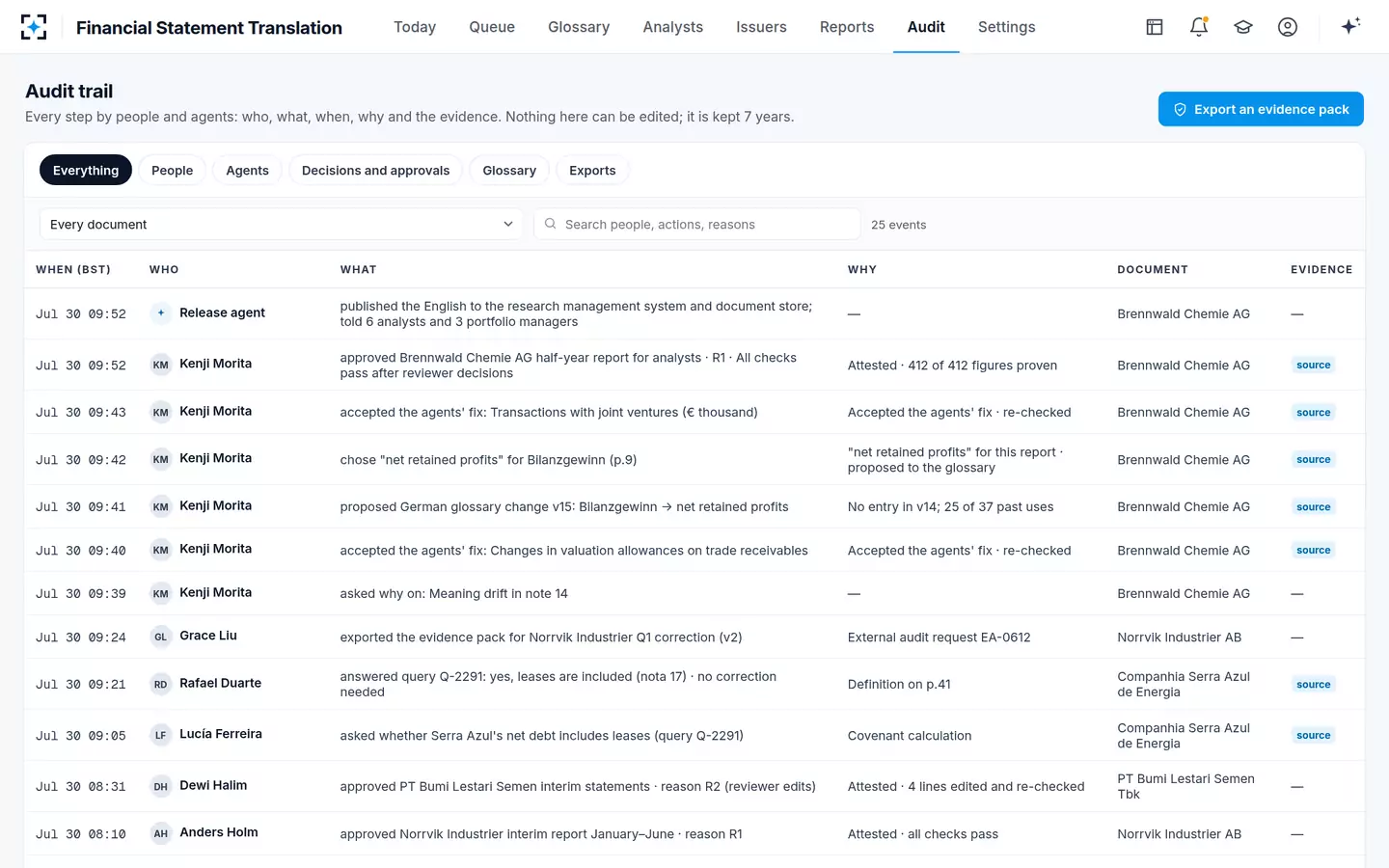
The audit trail is the compliance half of the same discipline. In the solution, every comparison, decision and release is kept for seven years with who, what, when and why, and an evidence pack per document or period can be exported for an auditor. The four tests of translation quality assurance places the issuer-English comparison among the other checks.
Every decision about an issuer's English is on the audit trail in Financial Statement Translation
Questions people ask
What does convenience translation mean?
It means a translation offered so that readers of another language can follow a document, on the understanding that the original text prevails. In SEC financial statements it also means a dollar restatement of a foreign issuer's figures at one rate, which Regulation S-X allows only for the latest year and later interim periods.
What is a convenience translation in financial statements?
In US filings, it is the presentation of a foreign issuer's amounts in dollars at a single exchange rate. Regulation S-X permits it only for the most recent fiscal year and any later interim period, at the rate of the latest balance sheet in the filing or a more recent rate if materially different.
Is a convenience translation certified?
Not usually. A convenience translation carries no statement of accuracy, which is the point of the label; a certified translation adds a translator's or agency's attestation, which some legal uses require.
Can an analyst rely on an issuer's English for a model?
Only after its figures have been checked against the original. Issuer English can be accurate, but it can also transpose digits, omit assumptions or soften wording, and when it differs the original governs.
Why would an issuer's English leave things out?
Because it may be a summary rather than a full translation, produced under time pressure, or written for an international audience. Outside SEC filings there is usually no duty to label an English text as a summary or to describe what it omits.