A field exam fee is, almost entirely, a bill for hours: an examiner's time reading a borrower's data, tying it to the general ledger, building workpapers, visiting the site and writing a report a manager then has to review before it reaches credit. There is no separate "exam product" being sold — the fee is the labor, priced at a loaded hourly rate, and that is exactly why it changes so much when the hours themselves change. A borrower who understands which hours a fee is paying for is the borrower best placed to ask a useful question about it.
The worked figures below come from a fictional sample exam run through Field Exam Automation, Botminds' software for asset-based lending field exams: Tamsin Industrial Supply, a Toledo distributor on a $35.0 million revolver. Tamsin and its fee figures are invented for this walkthrough; the regulatory language is quoted from the OCC, linked where it appears.
What a field exam fee pays for, line by line
Six kinds of work make up a typical field exam, in the order they happen: reading the borrower's download and tying the aging to the general ledger and the certificate; working through credits, dilution and ineligible receivables; choosing and testing samples against shipping and verification evidence; the site visit itself — counts, documents, meetings; writing the report; and a manager's review and sign-off before it goes anywhere else. Every one of those six is billable time, and a fee schedule that only lists "field exam fee: $X per exam" is compressing all six into a single number a borrower cannot see inside.
None of the six is optional, and none belongs only to the lender's side of the relationship. The site visit exists because some things — a physical inventory count, a conversation with the controller, a document only visible in person — cannot be confirmed any other way; the report and its review exist because a finding that changes a borrowing base has to survive a second set of eyes before a credit officer acts on it.
What the regulator expects those hours to buy
The fee is easier to judge against the work a field audit is supposed to contain, and the OCC's handbook spells that out. A field audit "helps detect fraud and financial weakness and is a customary way to confirm the quality of the borrower’s financial data, receivables, inventory, and internal controls". The auditor "should obtain written account verifications and perform sufficient reconciliations and testing to ensure that the borrower’s financial records are accurate", which means "physically inspecting the collateral, testing its validity and value as reported on financial statements and borrowing base certificates, and examining original invoices and other supporting documentation", and should "carefully review credit memo documentation, testing for both reasonableness and accuracy". It calls the field audit "usually the best means of evaluating internal controls, information systems, and operating systems" (OCC, Asset-Based Lending).
Mapped onto a bill, that list is the six phases. Reconciliations and tie-outs are the reading phase; credit memo testing is the dilution phase; account verifications and invoice examination are the sampling phase; physical inspection is the site visit; and the written findings and their review are the last two. A borrower comparing two fee quotes can ask each lender which of those tests its exam actually performs, and on how much of the book. A cheaper exam that skips account verifications or credit memo testing is not the same product at a lower price; it is less of what the handbook describes, and the bank's own examiners are told to "assess the effectiveness of field audits for individual ABL borrowers" and evaluate their scope.
Why the borrower pays, even though the lender orders the exam
The arrangement can look backwards at first: the lender decides when and how an exam happens, sets its scope, and receives its findings — yet the borrower is the one billed. The OCC's own description of smaller banks' practices makes the convention explicit: "smaller banks may have staff lenders that are independent of the transaction perform the audit; others outsource. Regardless, the cost is generally passed on to the borrower" (OCC, Comptroller's Handbook: Asset-Based Lending).
The logic underneath the convention is that the exam exists to verify collateral the borrower has pledged, in support of a facility the borrower is drawing on — it is a cost of the credit, not a service rendered to the lender alone. A borrower who finds the fee frustrating is usually better served asking what drives it up than asking why it exists at all, because the second question has one answer across the industry and the first has several, each one somewhat within a borrower's own control.
Where the hours go: before fieldwork, on site, and after
Tamsin's own exam, run by hand, splits roughly as six days before fieldwork (reading and tying out, two days; credits, dilution and ineligibles, two days; choosing samples, one day), three days on site, and eight days after (five writing the report, three for manager review). The on-site three days barely move between approaches — counts, documents and meetings take the time they take regardless of what prepared the file — but the eleven days on either side of it are almost entirely preparation and write-up, which is exactly the work a borrower never sees happening and has the least visibility into when it is billed.
Where a quarterly exam's working days go, by hand and with agentic preparation
By hand (days, of 16)
- Reading & tying out · 13%
- Credits, dilution, ineligibles · 13%
- Samples · 6%
- On site · 19%
- Writing the report · 31%
- Review & sign-off · 19%
With agentic preparation (days, of 5.5)
- Reading & tying out · 9%
- Credits, dilution, ineligibles · 9%
- Samples · 9%
- On site · 55%
- Writing the report · 9%
- Review & sign-off · 9%
What drives the fee up: frequency, complexity, and findings
Four things move the total more than any schedule's base rate does. How often the borrower is examined matters most — a workout-grade credit examined monthly pays for twelve exams a year where a stable credit examined annually pays for one, and the OCC's guidance ties frequency directly to risk: "a field audit should be conducted before a new account is booked and regularly thereafter — often quarterly but more frequently if risk dictates. In a high-risk relationship or workout situation, weekly or daily audits may be appropriate" (OCC, Comptroller's Handbook: Asset-Based Lending). The companion handbook on accounts receivable and inventory financing sets the lighter end of the same range: "field audits should be conducted before a new account is booked and regularly thereafter — at least annually and, if risk dictates, quarterly or monthly" (OCC, Comptroller's Handbook: Accounts Receivable and Inventory Financing).
Complexity is the second driver: more customers, more SKUs, more credit memos all mean more hours in the reading-and-tying phase regardless of how fast that phase runs. Findings are the third — an exam that turns up ineligible receivables or an inventory exclusion gap takes longer to write up and review than a clean one, because every finding needs its own workpaper and its own explanation in the report. The fourth, and the one borrowers have the most direct control over, is how clean and complete the data download arrives: a download with consistent formats and no missing files moves through the reading phase in a fraction of the time one with gaps and inconsistencies does.
Frequency multiplies everything else: exams a year at each cadence the OCC describes
A worked cost example, hours times a loaded rate
There is no published wage figure for "field examiner" specifically — the U.S. Bureau of Labor Statistics does not track the role under its own occupation code. The nearest published analog is loan officers, whose "median annual wage... was $76,690 in May 2025" (U.S. Bureau of Labor Statistics, Occupational Outlook Handbook, Loan Officers) — a base salary figure, not the loaded rate a fee reflects, which also has to cover overhead, benefits, training and the manager's review time on top of the examiner's own hours. Pricing the by-hand version of Tamsin's exam at an illustrative loaded rate of $165 an hour for examiner time and $195 an hour for manager review time — well above the raw wage figure, for exactly those reasons, and not a published fee schedule — gives a line-by-line sense of where a bill like this comes from.
A worked field exam bill, by-hand baseline
| Phase | Hours | Rate | Cost |
|---|---|---|---|
| PhaseReading the download and tying out | Hours16 | Rate$165/hr | Cost$2,640 |
| PhaseCredits, dilution and ineligibles | Hours16 | Rate$165/hr | Cost$2,640 |
| PhaseChoosing and pre-testing samples | Hours8 | Rate$165/hr | Cost$1,320 |
| PhaseOn site: counts, documents, meetings | Hours24 | Rate$165/hr | Cost$3,960 |
| PhaseWriting the report | Hours40 | Rate$165/hr | Cost$6,600 |
| PhaseManager review and sign-off | Hours24 | Rate$195/hr | Cost$4,680 |
| Total | $21,840 |
What changes when 32 of 39 steps are already done
On Tamsin's own exam, agentic preparation finished 32 of 39 exam program steps before Owen Castellano, the field examiner, arrived on site — the reading, tying out, dilution analysis, sample selection and a first draft of the report, all done in the time it took him to drive there. The seven steps left needed a person regardless: the opening meeting, bills of lading, credit memo approvals over $10,000, the physical count, slow-moving inventory, bank statements and the exit meeting. The site visit itself did not get shorter. What got shorter is everything around it: across the fictional sample lender's exams this year, the median from fieldwork to report is 3 days, against 19 days in 2025.
One lender's own before-and-after
19days
median fieldwork-to-report in 2025
32of 39
exam program steps finished before the visit
3days
median fieldwork-to-report on exams run with agentic preparation
Fewer hours before and after fieldwork is, in the end, a lower bill for the same six kinds of work — not a different kind of exam, and not a reason to skip any of the seven steps a person still has to do on site. A borrower evaluating a lender's move to agentic preparation should expect the on-site days to stay roughly flat and the fee's pre- and post-fieldwork components to shrink, in that order, rather than expecting the whole fee to collapse at once.
Can a borrower ask for a lower exam frequency?
Frequency is set by the loan agreement and the borrower's risk rating, and both OCC handbooks tie frequency to risk rather than to a borrower's preference — annual at the low-risk end, quarterly in the middle, weekly or daily for a workout credit. A borrower whose risk rating has genuinely improved can ask a relationship manager whether a reduction in frequency is warranted at the next review, but the request is heard as a credit conversation, not a billing one, and it is decided on the numbers the next exam itself produces, not on the fee alone.
"Regardless, the cost is generally passed on to the borrower."
OCC, Comptroller's Handbook: Asset-Based Lending
What a fee schedule should disclose
A fee schedule that names only a total per exam leaves a borrower unable to tell a high-complexity exam from an inefficient one. A disclosure worth asking for breaks out the hourly rate for examiner and manager time, states (or estimates) hours by phase the way the worked example above does, names the frequency the loan agreement requires and what would change it, and discloses whether findings, travel, or an unusually incomplete data download can add hours beyond the base estimate. None of this is unusual to ask for; it is the same breakdown any professional-services invoice ought to be able to produce, and a lender using agentic preparation should be able to show, concretely, which of the six phases got shorter and by how much.
A borrower comparing schedules across lenders should also ask how each treats an exam that turns up nothing. A flat per-exam fee bills the same whether the file is clean or full of findings, while an hours-based fee should, in principle, run lower on a clean file, because the writing and review phases have less to document. A schedule that charges the same either way is pricing for the worst case every quarter, which is worth knowing before signing rather than after the first invoice arrives.
32 of 39 steps done before the site visit
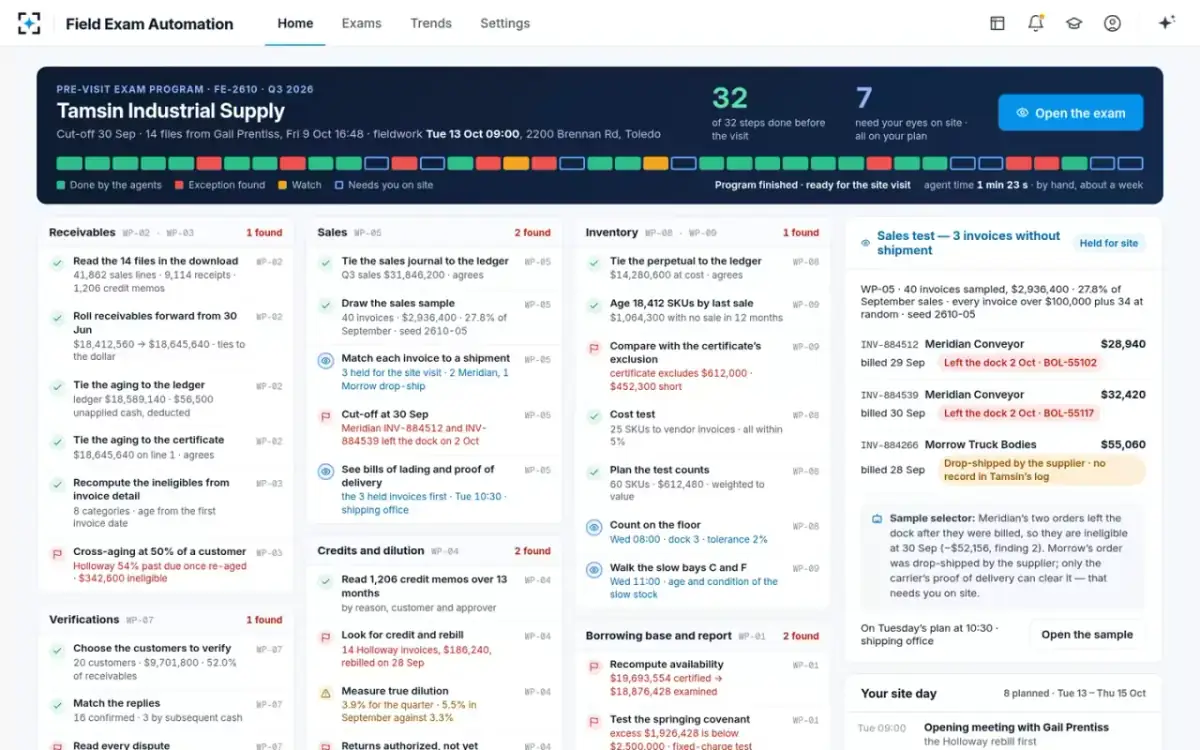
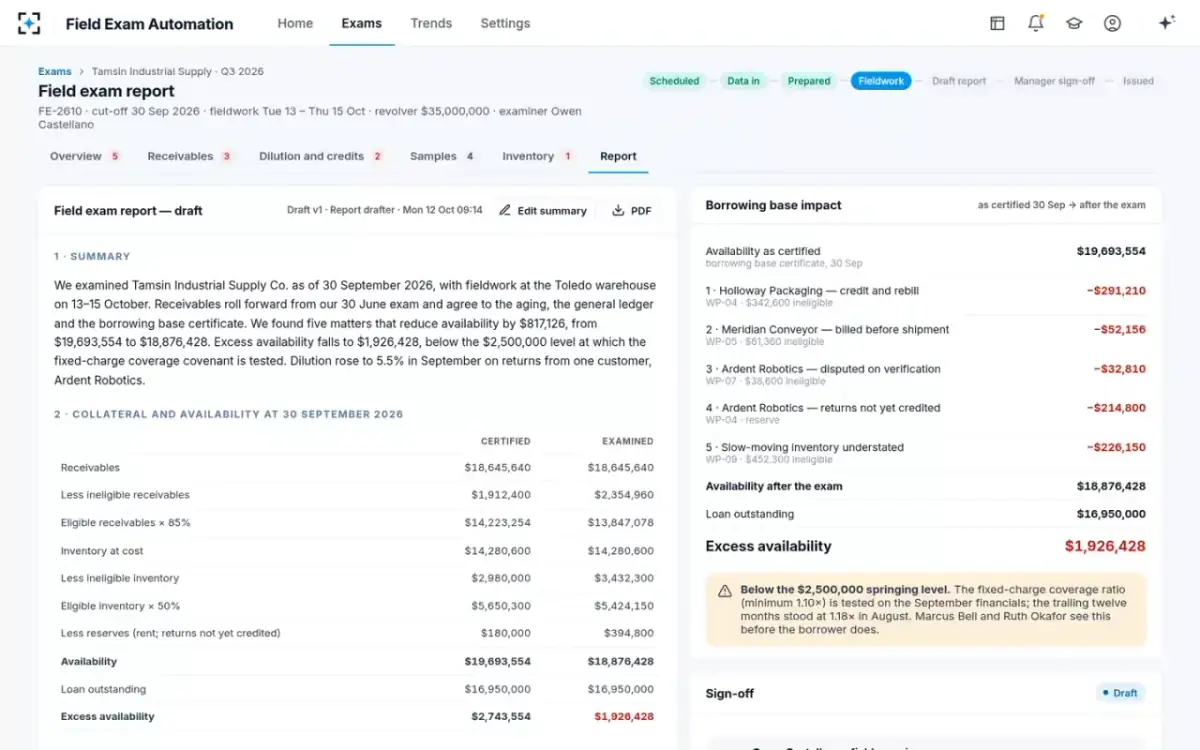
The report, with its findings and workpapers
For how the examiner's site day is built from what agents finish first, see what a field examiner does, seat by seat. For how to judge whether a tool's preparation is actually accurate before trusting the hours it claims to save, see verifying an AI-drafted exam's accuracy. To see the full program on a sample file, start from Field Exam Automation.
Questions people ask
What is a field exam fee?
A bill for the hours a field exam takes: reading and tying out the borrower's data, analyzing credits and ineligibles, selecting and testing samples, the site visit, writing the report, and a manager's review before it is signed. It is priced at a loaded hourly rate for examiner and manager time, not a flat product fee.
Who pays for a field exam, the borrower or the lender?
The borrower, even though the lender orders and controls the exam. The OCC describes the convention directly: whether a bank uses dedicated staff or outsources the work, "the cost is generally passed on to the borrower," because the exam verifies collateral pledged in support of the borrower's own facility.
How is a field exam fee set?
By the hours each phase is expected to take, at the lender's or its examiners' hourly rates, scaled by how often the loan agreement requires an exam. Frequency, in turn, is set by the borrower's risk rating under OCC guidance — more often for higher-risk credits, less often for stable ones.
What makes a field exam take longer?
More customers, more inventory SKUs, more credit memos to review, and any findings that need their own workpaper and explanation in the report. A data download that arrives incomplete or inconsistently formatted also adds hours to the reading-and-tying phase before any findings work even starts.
Does software change what a field exam costs?
It changes which hours the fee is paying for, not whether the exam happens. On the sample exam in this walkthrough, the hours before and after fieldwork fell sharply once agentic preparation finished most of the exam program in advance; the on-site hours, which need a person regardless, stayed about the same.
Can a borrower dispute a field exam fee?
A borrower can ask for the fee broken down by phase and hours, and can raise whether the frequency still matches its current risk rating. What a borrower generally cannot dispute is that an exam happens at all, or that its cost is passed through, since both are standard terms of an asset-based facility.