Commercial lending software built for an asset-based lender exists, at exam time, to do one thing before fieldwork starts: read a borrower's data download and tell an examiner what it found, so the site visit goes to judgment instead of to building workpapers from scratch. How well it does that differs sharply between three approaches a lender might run — entirely by hand, with a rules-based spreadsheet or macro, or with agents that read every file before a person looks at any of it — and the honest way to compare them is to run the same exam through each, not to take a vendor's word for the difference.
The comparison below uses a fictional sample exam from Field Exam Automation, Botminds' agentic software for asset-based lending field exams: Tamsin Industrial Supply, a Toledo distributor on a $35.0 million revolver, examined for its third quarter. Tamsin and its figures are invented for this walkthrough. The regulatory language is quoted from the OCC and NIST, linked where it appears.
The same exam, three ways
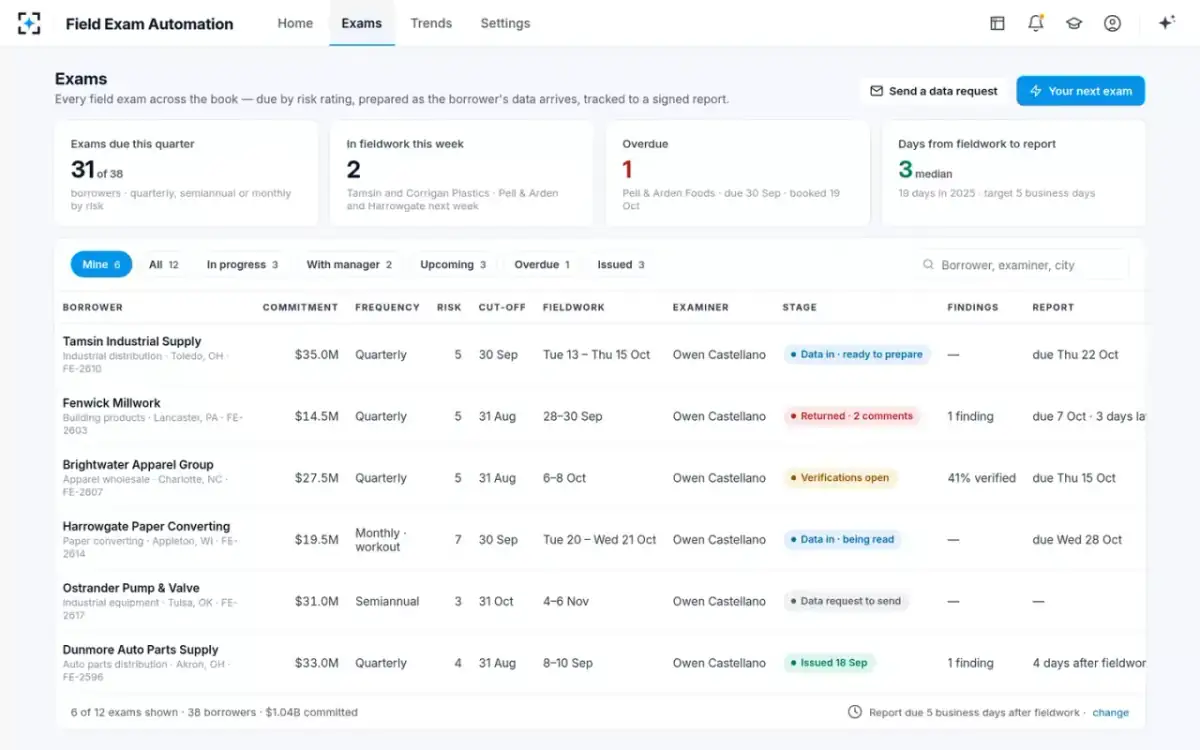
Picture one examiner's book: Owen Castellano, a senior field examiner, has 31 of 38 borrowers due this quarter, one already overdue. Tamsin's data download — fourteen files, a general ledger, agings, a perpetual inventory record, shipping and returns logs, and the borrowing base certificate — arrived Friday afternoon. Fieldwork starts Tuesday morning. The question every approach has to answer the same way is: by Tuesday, what does Owen know about this file that he did not know on Friday?
Three approaches to the same download
| By hand | Rules-based software | Agentic review | |
|---|---|---|---|
| Coverage of the data | By handWhatever a sample reaches — typically a few dozen invoices out of thousands. | Rules-basedWhatever the macro is written to scan, usually every row of a defined column. | AgenticEvery file in the download read before fieldwork, not just the sampled rows. |
| Speed to a first draft | By handDays, most of it reading and tying out before any judgment happens. | Rules-basedFast once set up, but brittle — a changed export format breaks it quietly. | AgenticMinutes, with every number tied to the file and row it came from. |
| What it catches | By handWhatever the examiner thinks to look for, limited by time on the file. | Rules-basedExactly what the rule was written for — nothing it wasn't told to check. | AgenticPatterns it was trained to flag across the whole file, not just a rule's literal match. |
| What it misses | By handAnything outside the sample, or caught too late in a long week. | Rules-basedAnything that doesn't fit the macro's assumptions about the file's shape. | AgenticAnything genuinely novel that looks unlike any pattern it has seen. |
| Who is accountable | By handThe examiner, for everything in the report. | Rules-basedThe examiner, for everything the macro did and did not check. | AgenticThe examiner, who confirms every finding before it stands. |
By hand: what a skilled examiner catches, and what takes a week
A good examiner working entirely by hand catches almost everything a trained eye is built to catch — an invoice that looks odd against its shipping date, a customer whose balance has crept past where it should sit, a credit memo that reads strangely next to the invoice it touches. What a skilled examiner cannot do is read every line of a download the size of Tamsin's: 41,862 sales lines, 9,114 cash receipts, 1,206 credit memos, 18,412 inventory SKUs. A week of fieldwork gives time for a sample, not a full read of every line, and the OCC's own description of the unassisted process is blunt about the cost: "tracking, monitoring, and reporting ABL collateral can be a manual, time-intensive process prone to human error and fraud" (OCC, Comptroller's Handbook: Asset-Based Lending).
The honest strength of hand review is judgment applied to whatever it reaches. The honest weakness is reach itself — a credit-and-rebill pattern buried in one customer's account among hundreds, or a inventory exclusion gap spread across thousands of SKUs, is exactly the kind of thing a sample can miss entirely, not because the examiner is careless, but because nobody can read everything in a week.
Rules-based software: what a spreadsheet macro can and cannot flag
A rules-based tool — a macro, a template with formulas, a script that scans for a defined pattern — fixes the reach problem for exactly the rules it was written to check. A macro that flags every receivable past 90 days will flag every one, every time, without getting tired on line forty thousand. That is real, useful coverage, and it is why rules-based templates and macros came into field exams long before any agent read a file.
What a rules-based tool cannot do is notice something it was not told to look for. A macro built to flag past-due receivables has nothing to say about a credit-and-rebill pattern unless someone has separately written a rule for exactly that shape of problem, and once someone has, the macro only catches the shape they anticipated — a rebill issued the same day as the credit, say, but not one issued three days later with a slightly different amount. Export formats change, column orders shift, and a brittle rule can silently stop matching anything at all, passing a file clean not because the file is clean but because the rule no longer sees it.
Agentic review: what changes when six agents read the download first
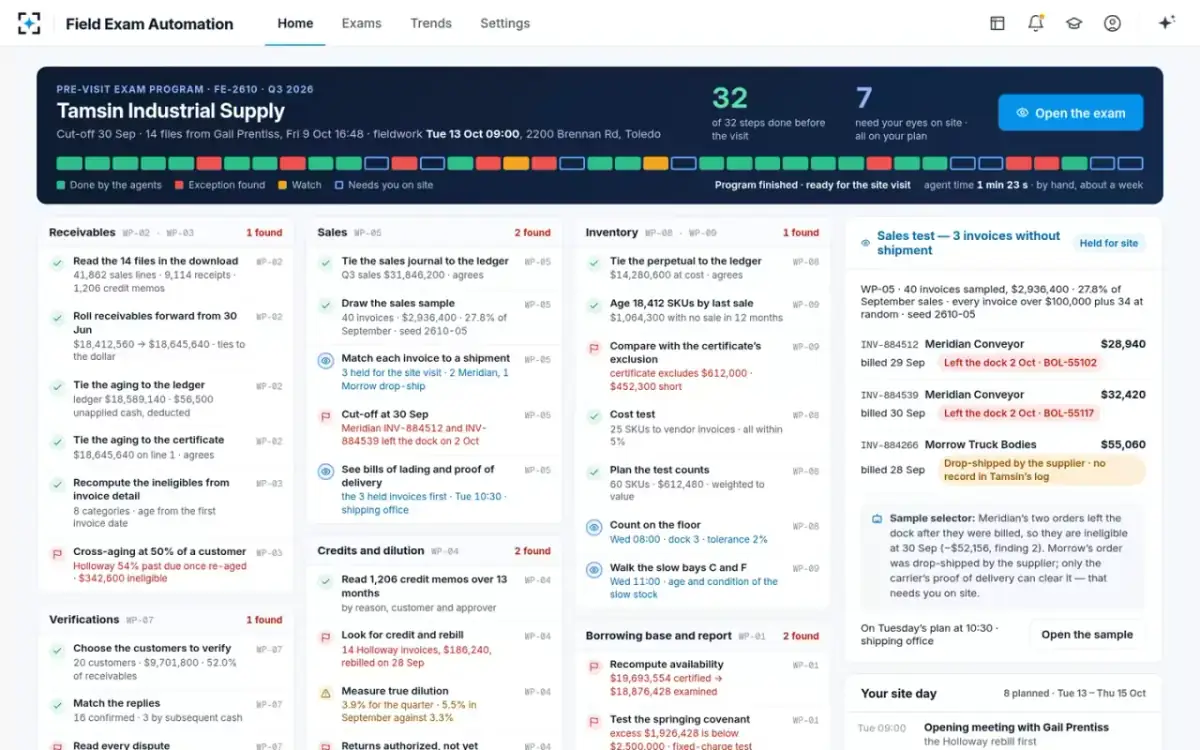
Field Exam Automation runs six agents — reading the download, rolling receivables forward and tying them out, analyzing dilution and credit memos, selecting samples, aging inventory, and drafting the report — across every file before fieldwork, not a sample of it. On Tamsin's exam, that meant all 41,862 sales lines, all 9,114 receipts, all 1,206 credit memos and all 18,412 SKUs, in 83 seconds, with 32 of 39 exam program steps finished before Owen got in the car.
The difference from rules-based software is not speed alone — it is that an agent trained to recognize dilution patterns, eligibility exceptions and tie-out breaks can catch a variant it was never explicitly programmed for, the way the Holloway credit-and-rebill surfaced from matching a credit memo to a same-day new invoice rather than from a rule written in advance for that exact pattern. The difference from hand review is reach: every file, every time, with nothing left to a sample's luck. Neither difference makes the result a verdict. It makes it a flagged pattern, for a person to confirm.
What none of the three approaches should ever do
The line that matters is the same regardless of which approach produces a finding: none of the three should ever decide on its own that a pattern is fraud, change a borrowing base, or issue a report. A spreadsheet that auto-adjusts eligibility without a credit officer's sign-off is as risky as an agent that would do the same — the risk is in the automation deciding, not in which technology does the automating. Field Exam Automation's agents are built with that line explicit in their own limits: the dilution and credit memo analyst never calls a pattern fraud, only raises it for the examiner; the report drafter never issues a report or changes a borrowing base.
NIST's framework for AI systems names the property that matters here as robustness: "the ability of a system to maintain its level of performance under a variety of circumstances" (NIST, Artificial Intelligence Risk Management Framework, NIST AI 100-1). A tool — rules-based or agentic — that performs well on the files it was tested against and badly on files shaped differently is not robust, whatever its headline accuracy looked like in a demonstration. That is exactly why a tool of either kind earns trust through a pilot against a lender's own past exams, not through a vendor's own test set; backtesting an AI model before it runs your field exam sets out how.
Where the examiner's judgment still has to happen, in every approach
Seven things on Tamsin's exam needed a person on site regardless of which approach prepared the file: the opening meeting, verifying bills of lading, approving credit memos over a set dollar threshold, the physical inventory count, inspecting slow-moving stock, reviewing bank statements, and the exit meeting. No software — rules-based or agentic — removes any of these, because each one requires either a conversation, a physical observation, or a judgment call about what a document actually proves. What changes across the three approaches is how much of the other thirty-two steps are already finished by the time the examiner arrives, which determines how much of the site day the seven irreducible steps get to consume on their own.
Where a quarterly exam's working days go, by hand and with agents preparing
- Reading, tying out, dilution, samples5 d
- On site3 d
- Writing and review8 d
- Preparation, checked by the examiner1.5 d
- On site3 d
- Writing and review1 d
What to ask before you believe a vendor's time-saved number
A vendor's hours-saved figure is only as honest as the baseline it is measured against, and the baseline is usually left out of the pitch. Five questions narrow it down fast: saved against what baseline — an unassisted exam, or an already rules-assisted one; measured on whose files — a vendor's own curated demo data, or a messy real download with inconsistent column headers; does the number include the examiner's confirmation time on site, or only the preparation before it; what happens when the exam finds nothing — does the tool still earn its keep on a clean file, or only on one with findings to showcase; and can the vendor show the same exam run twice, on two different borrowers' real downloads, with the same reported savings both times.
Questions to ask before trusting a vendor's time-saved claim
- What was the baseline exam it was measured against?
Unassisted, or already using a spreadsheet template? The honest comparison names it.
- Whose data was the demonstration run on?
A vendor's own clean sample file proves less than your last messy quarterly download.
- Does the figure include the examiner's time, or only the software's?
Preparation time saved means little if confirmation on site takes just as long as before.
- What happens on a file with no findings?
A tool should still save the reading and tying-out time, even when nothing is wrong.
- Can it be run twice, on two different borrowers' real files?
One showcase file is a demonstration; a second, different file is evidence.
- What does it do when it cannot explain a pattern?
A tool that forces an answer on an ambiguous file is a bigger risk than one that says it needs a person.
Which approach fits a one-examiner shop vs a 38-borrower book
The right approach is not the same at every scale. A one-examiner shop with a handful of borrowers, examined once or twice a year, may reasonably run entirely by hand — the volume never reaches the point where reach becomes the binding constraint, and the overhead of any software, rules-based or agentic, can outweigh what it saves. A rules-based spreadsheet earns its place once a few dozen borrowers are on a shared template and the rules are simple enough to stay stable as files change — cross-aging thresholds and past-due flags, for instance, which rarely need judgment beyond the number itself.
Manual vs agentic on the same sales-to-shipping test
By hand, sampled: A sample of a few dozen invoices out of thousands, chosen by rule or judgment.
Agentic, full file: The same sample size and method, pre-tested against the shipping log before fieldwork.
By hand, sampled: Would likely catch the same 3 exceptions, if the sample happened to include them.
Agentic, full file: 37 of 40 sampled invoices agreed with the shipping log; 3 did not, with each exception named and sourced.
By hand, sampled: Hours of manual tracing against the shipping log, during or before fieldwork.
Agentic, full file: Pre-tested before fieldwork; the examiner spends site time on the 3 exceptions, not the 37 that agreed.
By hand, sampled: Judging what the exceptions mean, and confirming them with the borrower.
Agentic, full file: The same judgment and confirmation — the agent never decides the exceptions, only finds and pre-tests them.
A 38-borrower book, examined quarterly, is where agentic review earns its clearest case: the volume of data per exam is large enough that full-file reach matters, the number of exams per year is high enough that preparation time compounds across the book, and the findings that matter most — a credit-and-rebill, an inventory exclusion gap — are exactly the ones a sample can miss and a rule can be blind to. Owen's own book shows the shape of that case: a median of 3 days from fieldwork to report this quarter, against 19 days in 2025, across 31 of 38 borrowers due.
The exam program, 32 of 39 steps done before the visit
Owen's book: 31 of 38 due, one overdue
For what the six agents actually do and the limits each one carries, see what none of the six agents may do. For how to prove any tool's accuracy before trusting it with a live file, see verifying an AI-drafted exam's accuracy. To see the full program run on a sample file, start from Field Exam Automation.
Questions people ask
What is asset-based lending software?
Software built to prepare an ABL field exam from a borrower's data download — reading files, tying out the receivables roll-forward, testing eligibility, and drafting findings — before or in place of a fully manual review. It ranges from rules-based spreadsheets to agentic tools that read an entire download rather than a sample of it.
Do I need software for field exams?
It depends on scale. A small book examined infrequently may not need it; a book of dozens of borrowers examined quarterly usually benefits, because the volume of data per exam makes full-file reach — which only software provides — the binding constraint on what a review can catch.
How is agentic software different from a rules engine?
A rules engine flags exactly what it was explicitly told to check, reliably, but misses any pattern outside its written rules. An agentic tool is built to recognize a pattern's shape — a credit-and-rebill, an eligibility exception — even in a variant it was not given an exact rule for, though it still needs a person to confirm what it finds.
Can a bank still use a human field examiner with software?
Yes, and it should. No current approach removes the examiner's role — confirming findings on site, approving borrowing-base changes, and the physical and conversational parts of an exam, such as inventory counts and the opening and exit meetings, stay with a person regardless of what prepared the workpapers.
What should I ask a field exam software vendor?
What baseline its time-saved figure was measured against, whose data the demonstration used, whether the figure includes the examiner's confirmation time, what it does on a file with no findings, and what it does when it cannot explain a pattern with confidence.
How long does a manual field exam take vs a software-assisted one?
There is no single industry figure; it depends on the borrower's size and the lender's own process. In this walkthrough's sample lender, the median time from fieldwork to report was 19 days in 2025 and is 3 days this year with agentic review — a comparison against the lender's own prior quarters, not an industry benchmark.