A springing covenant in an ABL revolver sleeps through most of a loan's life. It carries no financial test to pass every quarter, no ratio to report, nothing that shows up in a routine compliance certificate — until one number, excess availability, falls below a line the loan agreement sets. The moment it does, a covenant that was never being tested starts being tested, often on financial statements the borrower assumed were already behind it. A field exam matters here because the number the covenant watches is exactly the number a field exam recomputes every quarter, and getting it wrong in either direction either springs a covenant that should have stayed asleep or misses one that should have woken up.
The example below follows a fictional sample exam through Field Exam Automation, Botminds' software for asset-based lending field exams: Tamsin Industrial Supply, a Toledo distributor on a $35.0 million revolver, examined for its third quarter ended 30 September. Tamsin and its numbers are invented for this walkthrough; the mechanics and the regulatory language are quoted from the OCC, linked where they appear.
What a springing covenant is, and why ABL revolvers use them
The OCC's Comptroller's Handbook on asset-based lending describes the structure directly: "some lenders originate ABL facilities with springing covenants, meaning the covenants are operable only when certain conditions defined in the loan agreements are not met. For example, cash dominion may not be required unless excess availability falls below an established threshold" (OCC, Comptroller's Handbook: Asset-Based Lending). The appeal to a borrower is real: "a springing covenant arrangement is advantageous to the borrower as fewer restrictions provide more freedom to operate," the same handbook notes — no quarterly ratio test, no cash sweep, no extra reporting, so long as the business stays comfortably above the line.
The appeal to a lender is narrower, and the handbook says so too: "such arrangements can, however, adversely affect the controls that are the strength of an ABL credit," which is why it tells banks offering them to set "clear guidelines outlining the appropriate use of such arrangements and effective risk mitigating requirements." A revolver secured by receivables and inventory is already monitored collateral-first; a springing structure trades some of that ongoing monitoring for a single trigger, and the trigger has to be measured correctly or the trade does not hold.
Excess availability: the number the covenant watches
Excess availability is the amount still open to borrow, and the OCC defines it precisely: "additional funds a borrower may draw under the terms of the credit facility," typically "the lower of the borrowing base or loan commitment less the outstanding balance of the credit facility" (OCC, Comptroller's Handbook: Asset-Based Lending). It is not the borrowing base itself, and it is not the loan commitment — it is whichever of the two is smaller, minus whatever the borrower currently owes. A revolver can have a large borrowing base and still have thin excess availability, if the balance drawn against it is already close to that base.
Because excess availability moves with three separate inputs — the borrowing base, the commitment and the drawn balance — it is also the single number a field exam has the most leverage over. Every ineligible receivable the exam finds, and every inventory exclusion it corrects, reduces the borrowing base and, with it, excess availability, whatever the drawn balance happens to be doing that quarter.
Soft block, hard block: two different lines
Most springing structures use two thresholds, not one, and they trigger different things. A soft block is "an ABL revolver covenant that establishes excess availability thresholds that, when violated, permit the lender to execute springing covenants, such as minimum financial ratio standards or cash dominion," and it "serves as a warning of potential deterioration" (OCC, Comptroller's Handbook: Asset-Based Lending). A hard block is stricter: it "establishes a minimum amount of excess availability that must be maintained at all times," and "additional borrowing under the revolver is prohibited on violation of a hard block covenant."
Soft block and hard block, side by side
Soft block: Springs a covenant — a ratio test, cash dominion, more frequent reporting.
Hard block: Blocks any further draw on the revolver.
Soft block: Yes, subject to the new covenant now in force.
Hard block: No, until availability recovers above the line.
Soft block: Always set higher than the hard block, if one exists.
Hard block: Always lower than the soft block, if one exists.
Soft block: Early warning — time to look, not yet to stop.
Hard block: The line the agreement will not let anyone cross.
The handbook's own risk-rating example shows both at once on an illustrative facility: a $150 million revolver with "availability blocks of $32 million (soft) and $15 million (hard)," where falling below the soft block springs "minimum earnings before deduction for interest, taxes, depreciation, and amortization (EBITDA) of 90 percent of projections" together with "quarterly field examinations, semiannual collateral appraisals, and cash dominion" (OCC, Comptroller's Handbook: Asset-Based Lending, Appendix B). The field exam itself can be one of the things a springing covenant adds — a facility that examined annually can step up to quarterly the moment availability gets thin.
Springing cash dominion: the control that wakes up with the covenant
The covenant that springs is often paired with a control that springs with it. The OCC defines cash dominion as an arrangement in which "the borrower’s receivable receipts are sent by customers to a lockbox controlled by the lender", and under full dominion "the bank controls the cash collections and applies the proceeds to the borrower’s loan account before releasing any funds". It adds that "cash dominion relationships may also be springing": the receipts flow straight to the borrower until a trigger, and only then does the bank "control and apply the proceeds" (OCC, Asset-Based Lending).
The handbook's second risk-rating example, a hypothetical $435 million revolver, pairs the two on the same line: "springing cash dominion if excess availability declines below $120 million for five consecutive days", and a "minimum fixed charge coverage ratio of 1.0x if availability declines below $120 million, tested quarterly". The five-day condition matters: it keeps a single bad day from flipping the borrower's cash into the lender's hands, while a sustained shortfall does. The same handbook lists "low excess availability thresholds for springing cash dominion and springing covenant testing" among the weaknesses that make a revolver's cash flow worth a closer look, alongside "infrequent asset appraisals and field exams". A threshold only protects a lender if the availability it is measured against is right, which brings the argument back to the exam.
A worked example: how $2,743,554 becomes $1,926,428
Tamsin's revolver carries a single springing level on excess availability, set at $2,500,000, below which the fixed-charge coverage covenant is tested. Before the third-quarter exam's findings, Tamsin's certified excess availability stood at $2,743,554 — above the line, comfortably enough that the covenant had not been tested in over a year.
From certified availability to the springing level
Certified excess availability
as reported by Tamsin, 30 Sep
Before the exam's findings are applied.
Cross-aging and past-due findings
ineligible receivables reclassified on re-aging
Reduces the borrowing base, dollar for dollar.
Inventory exclusion gap
slow-moving stock the certificate under-excluded
A second, separate reduction to the base.
Examined excess availability
$1,926,428
Below the $2,500,000 springing level.
The fixed-charge coverage covenant now springs.
One revolver, one line crossed
$2,743,554
excess availability as certified
$2,500,000
the springing level in the loan agreement
$1,926,428
excess availability as examined
What happens the quarter a covenant springs
Nothing about the revolver stops working the moment a springing covenant activates — the facility does not default, and the borrower keeps drawing against whatever availability remains. What changes is the testing the loan agreement now requires: in Tamsin's case, the fixed-charge coverage ratio, which was dormant while availability stayed above $2,500,000, is now calculated on the September financials and measured against its minimum. If it holds, the quarter ends with a covenant tested and passed, visible on the record where it was not before. If it does not hold, the borrower is in default on a covenant it had never had to satisfy, triggered by an availability number a field exam, not a missed payment, produced.
That second outcome is why the order of events matters. Tamsin's findings go from the examiner to Ruth Okafor, the senior credit officer, for approval before any borrowing-base change takes effect, and from there to Marcus Bell, the portfolio manager, who tells the borrower — never the other way around, and never automatically. A springing covenant that activates on an exam's findings is a credit decision with real consequences for the relationship, and the exam's job stops at presenting the number correctly, with the workpaper behind it.
Fixed charge coverage ratio, and why it's tested only sometimes
The ratio itself is simple to define: "EBITDA divided by fixed charges," measuring "the capacity of earnings to pay fixed charges" (OCC, Comptroller's Handbook: Asset-Based Lending). Fixed charges typically bundle scheduled debt service, cash interest, and sometimes capital expenditures or distributions — whatever the loan agreement's own definition lists, which is why two lenders' "fixed charge coverage" numbers on the same borrower can differ if their definitions differ.
Testing it "only sometimes" is the whole point of a springing structure: a maintenance covenant tests every reporting period regardless of performance, while a springing fixed-charge coverage test tests only once a trigger — here, availability under $2,500,000 — has already fired. For a borrower comfortably above its springing level for years, that can mean a ratio the loan agreement defines in detail but has never once been calculated against the borrower's actual financials, until the quarter it suddenly is.
Springing vs incurrence covenants: what each actually restricts
A springing covenant and an incurrence covenant are sometimes confused because both can sit quietly for long stretches, but they restrict different things. An incurrence covenant "requires that if a borrower takes an action (paying a dividend, making an acquisition, issuing more debt, etc.), the resulting position would need to remain in compliance with the loan agreement" — and critically, "if an issuer found itself above [a] threshold simply because its earnings had deteriorated, the issuer would not have violated the covenant" (OCC, Comptroller's Handbook: Asset-Based Lending). It only bites when the borrower chooses to act.
A springing covenant bites on a measurement, not an action: Tamsin did nothing to make its availability fall below $2,500,000 beyond operating its business and having an exam find what the certificate had missed. The handbook's related term, a maintenance covenant, tests "every reporting period, usually quarterly," whether or not anything changed — the borrower "would violate the covenant if debt increased or earnings deteriorated sufficiently to breach the specified level," with no action required at all. A springing structure sits between the two: dormant like an incurrence test, but triggered by a measured condition rather than a chosen action, and once triggered, it can impose a maintenance-style test on top.
Why an exam finding can trip a covenant nobody saw coming
The uncomfortable case is the one Tamsin's quarter illustrates: a borrower that believed itself safely above a springing level, because its own certificate said so, discovers only when the exam's findings land that it was not. Nothing about the business changed between the certificate and the exam — the receivables that became ineligible on re-aging were already ninety days old when the certificate was filed, and the inventory the certificate under-excluded was already slow-moving. The exam did not create the shortfall; it found a borrowing base that had been overstated all along, and the springing level responded to the corrected number, not the business's actual quarter.
"Covenants and controls: The following covenants will spring into effect if excess borrowing availability falls below the $32 million soft block."
OCC, Comptroller's Handbook: Asset-Based Lending, Appendix B
That is the argument for running the exam before the covenant decision rather than after it: a springing level set against a certified number that nobody has independently tested is a line drawn on a figure that might already be wrong. Field Exam Automation's report drafter computes both figures — certified and examined — side by side and tests the springing covenant against the examined one specifically, so the question of whether a covenant has sprung is answered once, with the corrected number, instead of twice.
The timing matters for the borrower as much as for the lender. A covenant that springs on a certificate the borrower filed in good faith, only to be corrected weeks later by an exam, puts the borrower in the position of having been technically out of compliance without knowing it — through no fault beyond a borrowing base its own staff believed was accurate. Running the recomputation before the covenant decision, rather than discovering the gap after the fact, turns a surprise into a conversation that starts while both sides still have the full quarter's facts in front of them.
The drafted report: the springing level crossed
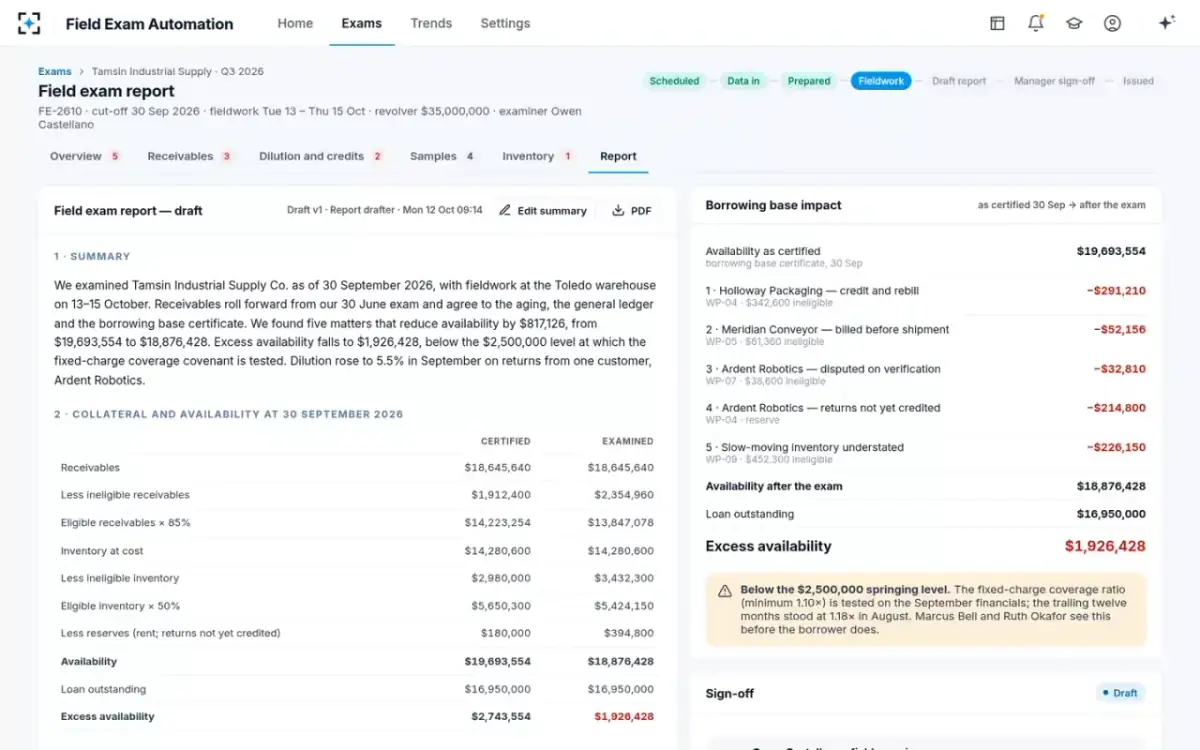
Availability against the springing level, quarter by quarter
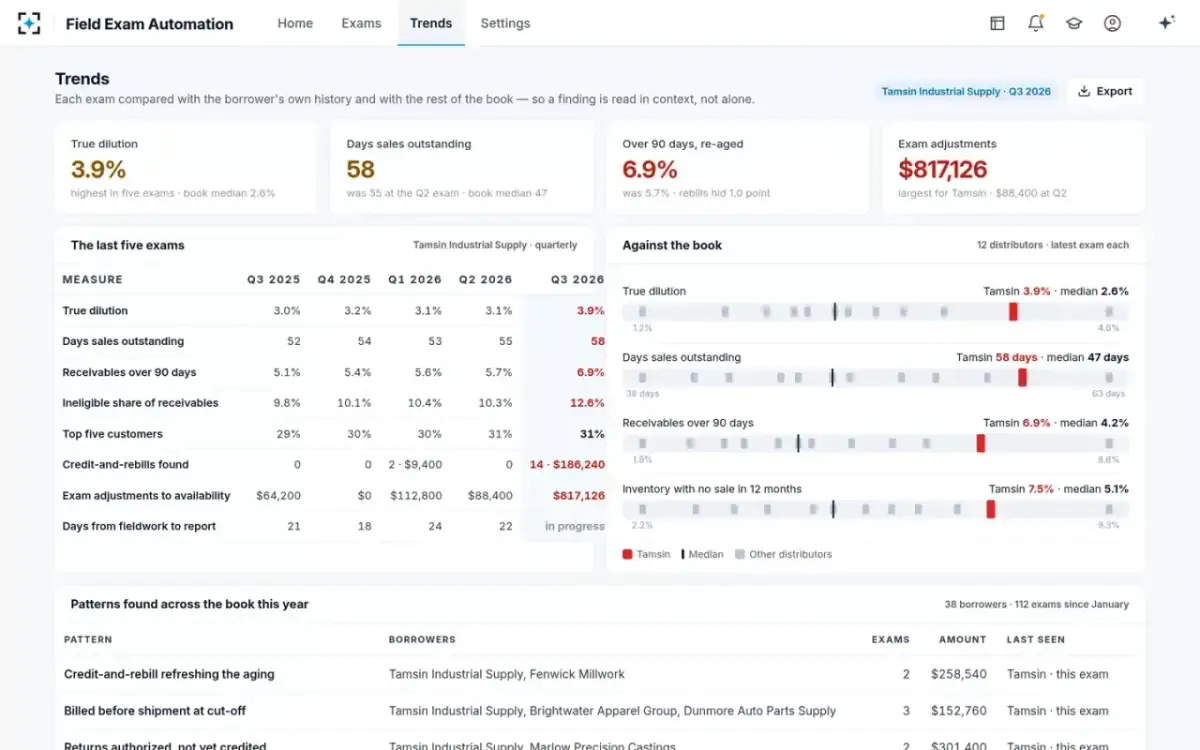
For how the borrowing base that feeds excess availability is built in the first place, see how a borrowing base is calculated, step by step. For the ineligible-receivable findings behind this quarter's drop, see cross-aging and ineligible receivables. To see the whole exam, certified and examined numbers together, start from Field Exam Automation.
Questions people ask
What is a springing covenant?
A covenant that is "operable only when certain conditions defined in the loan agreements are not met," in the OCC's words — most often, when excess availability falls below a level the loan agreement sets. Above the level, the covenant imposes nothing; below it, a ratio test, cash dominion or more frequent reporting can all activate.
How does a springing covenant test work?
The loan agreement names a trigger, usually excess availability against a dollar threshold, and a result, usually a financial ratio test or an operational requirement like cash dominion. The test applies only in the periods after the trigger has been crossed, calculated on the financials for that period.
What is a soft block vs a hard block?
A soft block springs a covenant when crossed but still allows further borrowing. A hard block is a stricter, lower threshold that prohibits any additional draw on the revolver once availability falls below it. A facility can carry either, both, or neither.
Springing covenant vs incurrence covenant: what's the difference?
An incurrence covenant only applies when the borrower takes a specific action, such as paying a dividend or issuing debt, and is not breached by deteriorating performance alone. A springing covenant activates on a measured condition — availability crossing a line — regardless of any action the borrower takes.
What happens when excess availability falls below the springing level?
The dormant covenant becomes active for that and future periods. In a fixed-charge coverage case, the ratio is calculated on the relevant financials and measured against its minimum; a result below the minimum is a covenant default, separate from the trigger that made the test apply in the first place.
Can a field exam finding trip a covenant on its own?
Yes, when the finding reduces the borrowing base and, with it, excess availability below the agreement's springing level. The exam does not create the shortfall — it corrects a certified number that understated how much was already ineligible — but the correction is what the covenant responds to.