Accounts receivable verification in ABL field exams means checking that a borrower's reported receivables actually exist and are collectible, by comparing them against evidence the borrower did not produce itself — a shipping log, a customer's own confirmation, a bank statement. It is the oldest discipline in a field exam, and it is also the right discipline for judging whether an AI-drafted exam is accurate. "Accurate" is not a feeling a credit team gets from a clean-looking report; in Field Exam Automation it is a sample agreement rate, measured the same way verification has always been measured, plus three further rates built for a tool that cites its sources rather than simply asserting a number.
The examples on this page come from a fictional sample lender's exam of Tamsin Industrial Supply, a Toledo, Ohio distributor, run through Field Exam Automation and confirmed on site by Owen Castellano. The research figures come from NIST, the OCC and the federal banking agencies, linked where they appear.
The Tamsin exam's scorecard
37of 40
September invoices agreed with the shipping log on the sales test
5findings
each citing the workpaper it came from
0
findings with no workpaper behind them
4samples
drawn and pre-tested before fieldwork started
What verification means in a field exam, and what it does not mean
Verification does not mean the borrower's numbers look plausible, foot correctly, or match last quarter's trend. It means an independent source — one the borrower did not supply for this purpose — confirms what the borrower reported. The OCC's Asset-Based Lending handbook states the standard plainly: "The field auditor should obtain written account verifications and perform sufficient reconciliations and testing to ensure that the borrower's financial records are accurate." A written account verification, in its classic form, is a letter to the customer asking them to confirm the balance they owe. A sales-to-shipping test is the same idea turned inward: instead of asking the customer, it checks the borrower's own shipping log, a record the sales system did not generate, against the invoice.
An AI-drafted exam's accuracy should be judged by the same standard, not a looser one invented for software. A tool that recomputes a borrowing base correctly from the numbers the borrower already gave it has verified nothing; it has only done arithmetic. What makes a finding verified is that it rests on a document the borrower's own summary did not control — the shipping log, the bank statement, the carrier's bill of lading — exactly as a field auditor's own testing has always required.
The sample agreement rate: 37 of 40 is a number, not a feeling
On Tamsin's Q3 exam, the sales-to-shipping test sampled 40 September invoices: every invoice over $100,000, plus 34 drawn at random. Thirty-seven agreed with the shipping log — billed on or after the date the goods actually left the dock. Three did not. Two Meridian Conveyor invoices, billed 29 and 30 September, shipped on 2 October. A Morrow Truck Bodies invoice for $55,060 was drop-shipped by the supplier, so the borrower's own shipping log had no record to agree or disagree with, and only the carrier's proof of delivery could resolve it.
A 92.5% agreement rate (37 of 40) is a specific, falsifiable number precisely because the three exceptions are not hidden inside it. Two were cleared once Owen confirmed the bills of lading on site; the Morrow invoice needed the carrier's record. A vendor who reports only the headline rate, without naming what the exceptions were and how each was resolved, is not reporting an agreement rate at all — it is reporting a rate it chose not to let anyone check.
What an unsourced finding looks like, and why it should be rare
An unsourced finding is a conclusion with no file and row behind it — a sentence that sounds like a finding but that nobody could trace back to the borrower's own documents if asked. In Field Exam Automation, every number on a workpaper cites the file and row it came from, and every finding in a report names the workpaper it rests on; of the five findings on Tamsin's exam, none was unsourced, because the design does not let a finding exist without its citation attached.
That constraint is worth testing adversarially, not taking on trust. A desk evaluating any AI-drafted exam, Field Exam Automation included, should ask to open the workpaper behind a finding at random, not just read the report's summary sentence. A finding that cannot be traced to a specific row in a specific file is not a smaller version of a sourced finding; it is a different kind of claim, and it should be treated as unverified until it is.
Why a stale citation is worse than a missing one
A missing citation is an obvious gap — a reviewer notices it immediately and asks for the source. A stale citation is worse because it looks like evidence while pointing at numbers the current download no longer contains: a prior quarter's aging, a certificate that has since been restated, a shipping log from before a system migration. A finding built on a stale citation can read as fully sourced and still be wrong, because the source itself answered a different question than the one being asked this quarter.
The defense is dating every citation to the download it came from, and checking that date against the exam's own cut-off before a finding counts. Tamsin's exam cites the 30 September aging against the 30 June aging it rolled forward from — two distinct, dated files, not one that silently stood in for both. A desk measuring a stale rate is asking a narrow, answerable question: of the findings raised, how many cite a file older than the current exam's own cut-off date? That number should be at or near zero on every exam that passes review, and a vendor who cannot produce it has not built the check.
What NIST's "valid and reliable" actually asks for
NIST's framework for AI risk management is explicit that validity is demonstrated, not declared. It defines validation as "confirmation, through the provision of objective evidence, that the requirements for a specific intended use or application have been fulfilled," and it is equally explicit about what that evidence has to look like: "Accuracy measurements should always be paired with clearly defined and realistic test sets — that are representative of conditions of expected use — and details about test methodology."
Four rates a field exam tool should be able to report, every exam
Agreement rate
items confirmed on site ÷ items sampled
The share of a sample where the agent’s proposed finding matches independent evidence once a person checks it.
Target: as close to 100% as the evidence allows.
Unsourced rate
findings with no cited workpaper ÷ findings raised
A finding naming no file or row is unsourced.
Target: at or near zero.
Stale rate
findings citing data older than the exam’s cut-off ÷ findings raised
A citation that points at numbers the current download does not contain.
Target: at or near zero.
Refusal rate
items the agent declines to resolve ÷ items sampled
How often the tool stops and asks a person, rather than guessing past a gap.
Measured, not minimized.
Applied to a field exam, that test set is exactly the sample a sales-to-shipping or inventory test already draws, and the test methodology is the pre-test the sample selector runs before fieldwork. NIST's own standard does not ask a bank to invent a new evaluation; it asks the bank to insist the agreement rate is measured against evidence the tool itself did not generate, on a sample representative of the exam the tool will actually run.
How to build a gold set from exams you have already signed
A gold set does not need a research budget; it needs exams a bank has already closed. Bank model-risk guidance describes the move under the name outcomes analysis, which "compares model outputs to corresponding real-world outcomes", with back-testing as one of its forms (Federal Reserve, OCC and FDIC, SR 26-2, April 2026). That guidance replaced SR 11-7 and puts agentic AI outside its own scope, so a bank applying the idea to a field-exam tool is borrowing a discipline, not following a rule. For a field exam tool, that means re-running last year's signed exams — the ones Denise Haugland already signed off and Ruth Okafor already approved the borrowing-base changes for — and comparing the agent's findings against the findings the human team actually reached, without telling the tool the answer in advance.
Where the two disagree, the disagreement is the useful result, not a failure on its own. Sometimes the human team missed something the re-read catches; sometimes the re-read flags a pattern the human team had context to dismiss, such as a legitimate reissue the controller explained on site at the time. Either way, a gold set built from exams a bank already trusts is a stronger evaluation than any vendor demo, because every one of its answers is already known.
What a good refusal rate looks like
A refusal is not a failure; it is the tool declining to guess past a gap the evidence does not close. The Morrow Truck Bodies invoice on Tamsin's exam is a clean example: the sample selector did not infer that the drop-shipped goods had probably shipped on time, because the borrower's own shipping log had nothing to confirm or deny it. It flagged the invoice as unresolved and named exactly what would resolve it — the carrier's proof of delivery.
A tool with a refusal rate of zero is a warning sign, not an achievement: it means every ambiguous case got an answer anyway, from somewhere. A healthy refusal rate rises with the genuine ambiguity in a borrower's file — a distributor with several drop-ship arrangements should produce more refusals than one that ships everything from its own warehouse — and a desk evaluating a tool should ask not "how often does it refuse" in the abstract, but whether its refusals land on the cases a human examiner would also want to see in person.
Can you trust an agent that confirms on 90% of files?
That question is not answerable on its own, because 90% confirms almost nothing about the 10% that did not. The number that matters is what happened to the files the agreement rate did not cover: were they refused with a named reason, flagged as findings for a person to confirm, or silently passed as if they had agreed? Field Exam Automation's design makes the third option structurally unavailable — the sample selector can decline to resolve an item, but it cannot mark an unresolved item as resolved — and a desk evaluating any tool, not only this one, should confirm that the same is true before trusting a 90% figure, or any figure, at face value.
A written account verification, and what the agent checks before fieldwork
A written account verification: A customer’s own statement that it owes the invoiced balance.
What the agent checks before fieldwork: The borrower’s own shipping log, checked against the invoice date, for the same question: did the sale actually happen when billed.
A written account verification: The customer — fully independent of the borrower.
What the agent checks before fieldwork: The borrower’s shipping records — independent of the sales system, though not of the borrower itself.
A written account verification: A customer who does not reply, or disputes the balance.
What the agent checks before fieldwork: A drop-shipped order with no shipping log entry of its own — flagged, not guessed at.
A written account verification: The field examiner follows up with the customer or the borrower.
What the agent checks before fieldwork: The field examiner confirms the finding on site before it counts.
What to demand before trusting a finding, from any AI-drafted exam
- Ask for the sample agreement rate on a gold set of exams you already signed, not a sales demo.
A rate measured on a vendor’s own curated example proves little about your borrowers.
- Ask what share of findings cite no workpaper.
An unsourced finding is a different kind of claim than a sourced one, however confident it reads.
- Ask whether every citation is dated to the download it came from.
A stale citation can look exactly like a current one until someone checks the date.
- Ask how often the tool refuses rather than guesses, and on what kind of file.
A zero refusal rate across a mixed book of borrowers is a warning, not a feature.
- Open the workpaper behind one finding at random, not just the report.
The summary sentence is the easy part to get right; the row-level citation behind it is not.
- Ask who confirms a finding before it reaches the borrowing base.
If the answer is “nobody, it’s already confirmed,” that is the finding.
The workpaper behind the number
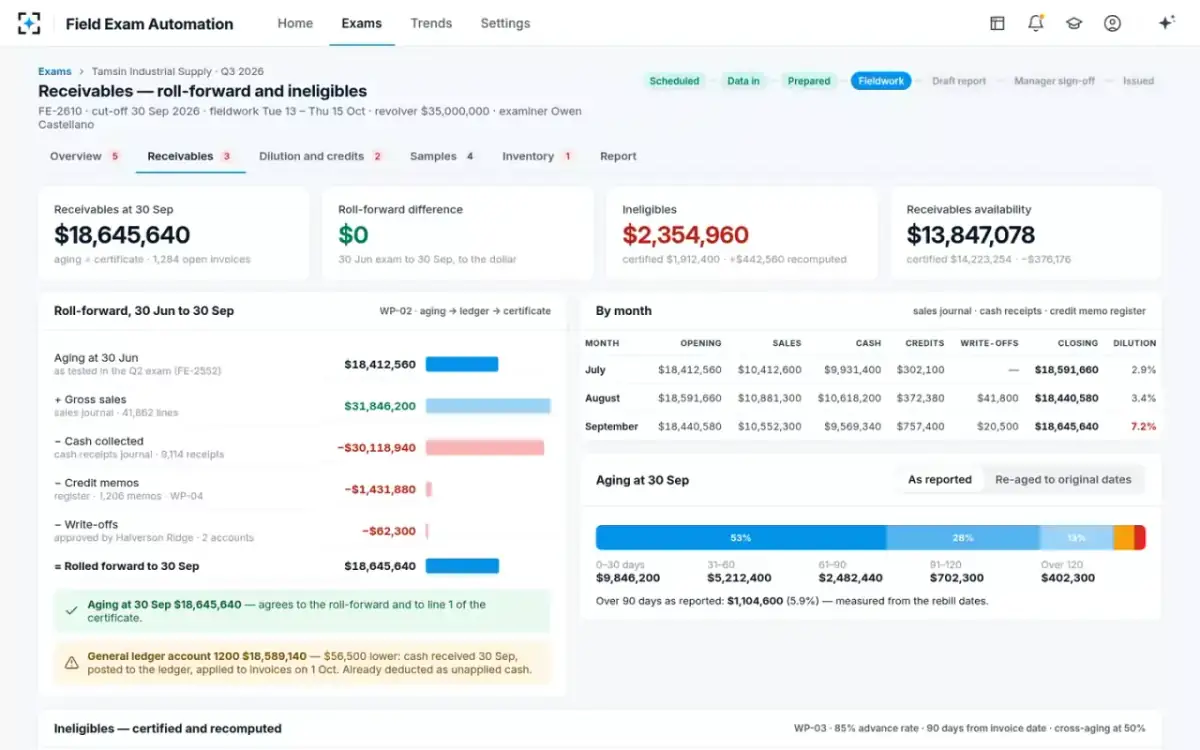
Verification of accounts receivable and the verification of an AI-drafted exam are, in the end, the same discipline aimed at the same question: does the evidence, independent of the borrower's own summary, actually agree. What none of Field Exam Automation's six agents may do covers the boundaries that keep a proposed finding from becoming a confirmed one without a person's involvement, and the same exam run by hand, by rules-based software and by agents compares what each approach actually verifies. To see a sample agreement rate on a real exam, start from Field Exam Automation.
Questions people ask
What is verification of accounts receivable?
It is confirming that a borrower's reported receivables exist and are collectible, using evidence the borrower did not produce for this purpose — a customer's written confirmation, a shipping log, a bank statement — rather than taking the borrower's own summary at face value.
What does confirmation of accounts receivable prove?
A written confirmation to a customer proves that an independent party agrees it owes the invoiced balance, or reveals a dispute if it does not. It does not, by itself, prove the receivable is eligible collateral under a loan agreement's own definitions; that is a separate test a field exam runs alongside it.
How many invoices should a sales-to-shipping test cover?
There is no single regulatory number. On the sample exam in this guide, the test covered every invoice over $100,000 plus 34 drawn at random, 40 invoices in total, which is a setting a lender chooses and can widen or narrow based on its own risk appetite and the borrower's history.
What is a good sample agreement rate?
There is no published industry threshold; what matters is that the rate is measured against independent evidence, that every exception is named and resolved rather than averaged away, and that the rate is tracked over time per borrower and per tool, not reported once as a headline.
How do you know if an AI finding is accurate?
By checking that it is sourced to a specific file and row, that the source is current rather than stale, and that a person has confirmed it against independent evidence before it is treated as a finding — the same three checks a field exam has always applied to a human examiner's own work.
What is an unsourced finding?
A conclusion presented as a finding with no citation to the file and row it came from. An exam tool that can produce one has not been built to the standard a field audit requires, whatever its headline accuracy figure claims.