This borrowing base calculation example starts from a number that looks simple — the receivables aging — and gets complicated exactly where a lender needs it to: every receivable the loan agreement rules ineligible comes out, an advance rate is applied to what is left, and reserves come out after that. The result, not the aging total, is what a borrower can actually draw against. Botminds' Field Exam Automation recomputes every step of that calculation from the borrower's own invoice detail rather than trusting the certificate's arithmetic, which is how a borrowing base "as examined" ends up different from the one "as certified."
The example on this page is a fictional sample lender's Q3 exam of Tamsin Industrial Supply, a Toledo, Ohio distributor on a $35.0 million revolver, run through Field Exam Automation. The research figures come from the OCC and the FDIC, linked where they appear.
Where Tamsin's availability moved
$19.69M
availability as certified by the borrower
$817,126
lower, once five findings were applied
$18.88M
availability as examined
5findings
each citing the workpaper behind it
The borrowing base formula, in one line
A borrowing base is the eligible value of a borrower's collateral, discounted by an advance rate, less reserves. The OCC's Asset-Based Lending handbook defines the calculation itself, in its glossary, as "a calculation to determine the borrowing base in which a margin or advance rate is applied to each type of collateral. This may occur before or after specific reserves or blocks are considered in the borrowing base." Every borrowing base, however many pages its certificate runs to, is built from the same three moves: start from the aging, strip out what the agreement says cannot count, and discount and reserve what is left.
What a borrowing base formula combines
Eligible receivables, advanced
eligible AR × the agreement’s advance rate
Receivables that pass every eligibility test, discounted by the rate the agreement sets — commonly 70–90% for accounts receivable.
Eligible inventory, advanced
eligible inventory, at NOLV × its own advance rate
Inventory the agreement allows, valued at net orderly liquidation value, discounted by a separate, usually lower, rate.
Dilution reserve
− a reserve sized to the borrower’s own dilution rate
Protects against credits, returns and write-offs the aging has not yet reflected.
Other reserves and blocks
− rent, customs, warehouseman’s liens, other agreed blocks
Whatever the loan agreement specifically reserves against, on top of dilution.
What "eligible" means, and the ways a receivable fails it
Eligibility is the line a receivable has to clear before an advance rate ever touches it. The OCC's handbook puts the baseline simply: to count, "the receivable must be generated in the ordinary course of business and be subject to a perfected first-priority security interest in favor of the bank." From there, most loan agreements add their own disqualifiers on top of that baseline — age past due, concentration with a single customer, affiliate status, re-aging, foreign or government counterparties — and the FDIC's own examination guidance confirms that a receivables aging is "typically reviewed by management to identify trends, concentrations, ineligible accounts (e.g., inter-company transactions, receivables from foreign transactions), and compliance with formula borrowing base."
On Tamsin's Q3 exam, the ineligibility test that moved the most money was cross-aging: fourteen Holloway Packaging invoices, credited and rebilled on 28 September, re-aged from their original June dates rather than the rebill date. Measured correctly, 54% of Holloway's balance was over 90 days old — past the loan agreement's 50% cross-aging limit — which took the entire $342,600 balance out of the eligible pool, not just the aged portion. How cross-aging turns one late customer into a whole-balance swing works through that mechanism on its own.
The receivables examiners expect to see ruled ineligible
Loan agreements write their own eligibility tests, but the OCC's handbook lists the categories an examiner expects to find among them, and each one has a reason that a field exam can test. The list is the practical checklist behind the "eligible" line of every borrowing base.
Receivables the OCC lists as commonly ineligible, and why each is excluded
- Delinquent past a set age
Receivables "delinquent for a period that calls into question the receivables’ collectability".
- Over a concentration limit
Balances that exceed the agreement’s cap on any one customer.
- Affiliate receivables
They "may deteriorate simultaneously" and "can also increase the potential for fraud".
- Re-aged receivables
Rebilled or re-dated invoices "for which the probability of collection is reduced", the category the Holloway balance fell into.
- Government receivables
The Assignment of Claims Act adds perfection and documentation steps, and payment terms "often exceed normal trade terms".
- Foreign receivables
Legal, price and country risk; lenders that allow them often require a letter of credit or credit insurance.
- Contra accounts
The customer also sells to the borrower and can "set off" what it owes, paying only the net.
- Insolvent customers and unbilled receivables
Neither is a collectible, invoiced claim yet.
The handbook draws the consequence plainly: "a borrowing base that includes receivables generally classified as ineligible, has heightened risk", and so does "a loan with an advance rate higher than industry norms or historical benchmarks". It also warns about the opposite signal: "very low advance rates may also warrant added scrutiny because an ABL lender often reduces advance rates to build a collateral cushion if the bank thinks liquidation may be imminent" (OCC, Asset-Based Lending).
Advance rates: why 70–90%, and who sets the number
An advance rate is the discount a lender applies to eligible collateral before counting it toward the borrowing base, and it is set by risk appetite, not by regulation. The OCC's handbook describes the typical range: "Common advance rates range from 70 percent to 85 percent of eligible accounts receivable. Some banks establish advance rates of up to 90 percent of eligible business-to-business accounts receivable." The gap between 70% and 90% is not arbitrary; it reflects how collectible a lender believes a given borrower's receivables actually are, which in turn depends on dilution history, customer concentration and how much of the book is business-to-business rather than consumer-facing.
A higher advance rate is not free money for the borrower; the handbook also notes that "these banks' effective advance rates are often lower after subtracting historic dilution and minimum reserve levels" — a nominal 90% can function closer to 80% once reserves are netted out. The rate on any specific loan agreement, and the reserves that erode it, are terms the borrower and lender negotiated at closing, not a figure a field exam sets; what a field exam does is confirm the inputs the rate is applied to are correct.
Inventory carries its own, usually lower, advance rate, for a reason that has nothing to do with the borrower's creditworthiness: inventory is harder to turn into cash than a receivable is. The OCC's handbook puts a typical range on it: "A bank typically advances up to 65 percent of the book value of eligible inventory, or 80 percent of the NOLV" — net orderly liquidation value, what the inventory would likely fetch in an organized sale, rather than its retail price or even its cost. On Tamsin's exam, the inventory analyst's job was not to set that rate; it was to make sure the inventory the rate gets applied to is the inventory the loan agreement actually allows, which is exactly where the certificate's 18-month slow-moving exclusion fell short of the agreement's 12-month rule.
Reserves: the dilution reserve and the returns reserve
A reserve is money a lender holds back from an otherwise-eligible balance because it expects some of that balance to evaporate before it is ever collected. The OCC's definition of excess availability names one reason reserves matter beyond the calculation itself: "Loan covenants may require a borrower to maintain a minimum amount of availability, thereby reducing the funds available." A reserve set too thin can let a borrower's real availability erode past a covenant threshold nobody noticed moving.
On Tamsin's exam, the clearest reserve candidate was not a finding at all: nine Ardent Robotics returns totaling $214,800, authorized but not yet credited by Tamsin's own accounting. Until a credit memo is actually issued, the receivable still sits on the aging as if it were fully collectible, even though both sides have already agreed it is worth less. A field exam that only checks the aging against the general ledger would miss this; checking the returns log against the aging is what catches it, and it is exactly the kind of gap a reserve exists to cover until the borrower's own books catch up.
Excess availability: the number that trips a covenant
Excess availability is what is left for a borrower to draw after the borrowing base is calculated and the outstanding balance is subtracted — the OCC defines it as "additional funds a borrower may draw under the terms of the credit facility. Excess availability is typically calculated as the lower of the borrowing base or loan commitment less the outstanding balance of the credit facility." It is the number a springing covenant watches, because it is the single figure that tells a lender whether a borrower still has room, or is drawing against collateral that may not really be there.
On Tamsin's exam, excess availability fell from $2,743,554 to $1,926,428 once the findings were applied — below the $2,500,000 level that springs the fixed-charge coverage covenant into effect for the quarter. What trips a springing covenant, and what happens once it does follows that consequence from here.
A worked borrowing base, rolled forward to the dollar
Every step below is a number from the fictional sample exam of Tamsin's third quarter as the solution runs it, carried through to the dollar rather than rounded to make the arithmetic come out even.
Tamsin Industrial Supply, Q3: from the aging to the examined availability
| Step | What happened | Result |
|---|---|---|
| 1. Receivables rolled forward from 30 Jun | $18,412,560 aging + $31,846,200 of Q3 sales, less cash, credit memos and write-offs | $18,645,640 |
| 2. Tied to the general ledger and the certificate | Equal to the 30 Sep aging and line 1 of the certificate; a $56,500 unapplied-cash difference against the general ledger control is left open, not forced | $18,645,640 confirmed |
| 3. Holloway Packaging ruled ineligible | Cross-aging: 54% of the balance over 90 days from its first invoice date, past the agreement’s 50% limit | −$342,600 of eligible receivables |
| 4. Inventory exclusion gap found | Certificate excludes SKUs with no sale in 18 months; the loan agreement’s own rule is 12 months | $452,300 more ineligible at cost, −$226,150 of availability |
| 5. All five findings applied | Including the receivables, inventory and sales-test findings together | −$817,126 of availability |
| 6. Availability, certified vs examined | What Tamsin reported vs what the exam supports | $19,693,554 → $18,876,428 |
Two findings, two kinds of ineligible dollars
Why the borrowing base as certified and as examined can differ
The certificate and the exam are not two independent measurements of the same fixed fact; they are two different people's application of the same loan agreement to the same invoice detail, and the gap between them is almost always a gap in which facts each side actually checked. Tamsin's own accounting had Holloway's invoices dated by their rebill date, which is the invoice date their system shows; the exam re-aged them from the original June invoices, because that is what the loan agreement's cross-aging test actually requires. Neither side was lying about what its own system said. Only one of the two readings is what the agreement calls for.
The same pattern holds on the inventory exclusion: Tamsin's certificate excluded slow-moving stock using an 18-month no-sale window, which may be entirely consistent with how the company tracks its own inventory internally. The loan agreement's own definition is 12 months. A $452,300 gap is not evidence of bad faith; it is evidence that a borrower's internal convention and a loan agreement's specific definition were never reconciled until a field exam checked both against the actual SKU-level data.
What happens when the formula and the certificate disagree
On Tamsin's exam, every disagreement became a finding with a workpaper behind it, sent to the people whose job is to decide what it means. Owen Castellano confirmed each one against what he saw on site — Gail Prentiss, Tamsin's controller, confirmed the June invoices were reissued at Holloway's own request with terms still running from June. Denise Haugland signed off the report the next morning. Ruth Okafor, the senior credit officer, then approved the five changes to eligibility and reserves, each with its finding and workpaper attached, before the new $18,876,428 availability figure became the number Tamsin could actually draw against.
The certificate's arithmetic, and the exam's recomputation
As Tamsin's certificate had it: Dated by the 28 September rebill; inside the 90-day cross-aging window.
As the exam recomputed it: Re-aged to its 15 June–1 July original invoices; 54% past 90 days, over the 50% limit.
As Tamsin's certificate had it: Excluded only SKUs with no sale in 18 months.
As the exam recomputed it: Applied the loan agreement’s own 12-month rule: $452,300 more ineligible.
As Tamsin's certificate had it: $19,693,554, as the borrower reported it.
As the exam recomputed it: $18,876,428, once every finding was confirmed and approved.
For a borrower's own controller or CFO, the practical lesson is not to treat the certificate as the final word between exams. Every finding on Tamsin's exam traced back to a difference between how the borrower's own accounting handled a date or an exclusion and how the loan agreement actually defines it — not to an error in the underlying sales, cash or inventory records themselves. A borrower that re-ages its own aging the way its lender's agreement requires, and checks its own slow-moving inventory window against the agreement rather than its internal convention, can see most of a field exam's findings coming before the examiner ever opens the file.
Receivables tied, ineligibles recomputed, to the dollar
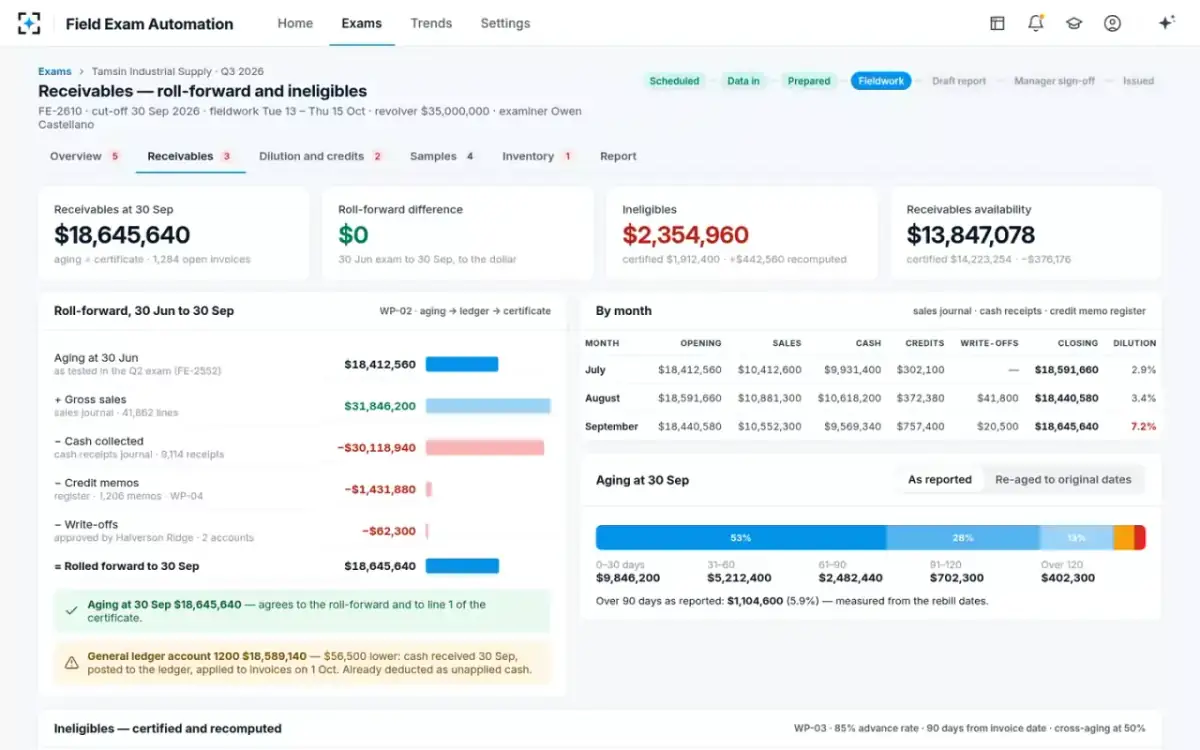
A borrowing base is only as reliable as the two numbers behind it: which receivables and inventory are actually eligible, and what the agreement says to do with the ones that are not. Cross-aging, explained with the Holloway case worked in full, and how to verify an AI-drafted exam's own accuracy, both follow from here. To see a certified-versus-examined borrowing base on a real exam, start from Field Exam Automation.
Questions people ask
How is a borrowing base calculated?
Start from the collateral aging, remove everything the loan agreement rules ineligible, apply the advance rate the agreement sets to what remains, and subtract any reserves the agreement requires. The result, not the aging total, is the borrowing base.
What is a borrowing base certificate?
A periodic statement, usually weekly or monthly, in which the borrower reports its own calculation of the borrowing base from its current aging and inventory records, typically with an officer's attestation that it is accurate and that the loan is in compliance.
What is an advance rate?
The percentage of eligible collateral a lender will count toward the borrowing base. The OCC describes common accounts-receivable advance rates of 70–85%, with some banks going as high as 90% for eligible business-to-business receivables; inventory advance rates are typically set separately and lower.
What makes a receivable ineligible?
Common reasons include being too far past due, exceeding a customer concentration limit, being owed by an affiliate, having been re-aged, or being owed by a foreign or government customer — plus whatever further rules a specific loan agreement adds on top of those baseline categories.
How is excess availability calculated?
As the lower of the borrowing base or the loan commitment, minus the outstanding balance already drawn. It is the figure a borrower can still draw, and the one most springing covenants are written against.
Why doesn't my borrowing base match the certificate?
Usually because the certificate applied the borrower's own convention to a judgment call — an aging date, an exclusion window, a concentration test — where the loan agreement's actual definition calls for something stricter. A field exam's job is to find exactly where the two readings diverge and show the workpaper behind each one.