Cross-aging accounts receivable is the practice of ruling an entire customer's balance ineligible for a borrowing base once a specified share of what that customer owes is delinquent — not just the overdue invoices, but every invoice from that customer, current ones included. It is one of the quieter mechanisms in asset-based lending, because it can move six figures of availability from a single customer relationship going bad, and most borrowers do not know their loan agreement contains the rule until a field exam applies it. Botminds' Field Exam Automation recomputes cross-aging from invoice-level detail on every exam, which is how a quarter's biggest swing in availability can turn out to be one customer, not a portfolio-wide problem.
The example on this page is a fictional sample lender's Q3 exam of Tamsin Industrial Supply, a Toledo, Ohio distributor, run through Field Exam Automation and confirmed on site by Owen Castellano. The research figures come from the OCC and the FDIC, linked where they appear.
One customer, one cross-aging swing
54%
of Holloway Packaging’s balance, re-aged to its first invoice dates, was over 90 days old
50%
the loan agreement’s own cross-aging limit
$342,600
of Holloway’s balance ruled ineligible — the whole balance, not just the late part
14invoices
credited and rebilled, which triggered the re-aging
What cross-aging means, in the regulator's own words
The OCC's Asset-Based Lending handbook defines cross-aging in its glossary as "the practice of making all of the accounts receivable from a single account party (the obligated party for an account receivable) ineligible to be included in the borrowing base if a specified proportion of the total accounts receivable from that party is delinquent." The handbook's body text puts the same idea more plainly: "most underwriting agreements specify that all of a party's accounts are designated ineligible collateral when any (or some percentage) of that customer's receivables become ineligible. This is referred to as cross-aging."
The mechanism, not the number, is what makes cross-aging different from ordinary delinquency. An individually overdue invoice reduces the eligible pool by its own face value. Cross-aging reduces it by that customer's entire balance, current invoices and all, because the rule's premise is that a customer behind on part of what it owes is a worse credit risk on all of what it owes — not just the invoices that happen to be late today.
The ways a receivable is commonly ruled ineligible
Cross-aging is one of several disqualifiers a loan agreement typically layers on top of the baseline eligibility test, and most of the others turn on how old a receivable is, not on who owes it.
Age-based disqualifiers, before cross-aging even applies
- Past the invoice’s own terms
A collection-risk signal the lender watches, not ineligible on its own.
- Past due by three times the terms
The OCC’s convention: “normally, an account is considered ineligible collateral when it is past due by three times the terms, e.g., 90 days for 30-day terms and 21 days for seven-day terms.”
- Over a customer concentration limit
When one customer’s balance exceeds the share of the pool a loan agreement allows, the excess above the limit is excluded.
- Cross-aged with the rest of that customer’s balance
Once enough of a customer’s balance is delinquent, the loan agreement can take the whole balance out — the subject of this guide.
What's a common cross-aging threshold, and why it isn't universal
There is a genuine surprise in how the OCC itself describes the common threshold. Its glossary entry for cross-aging adds that the rule is "sometimes referred to as the '10 percent rule' because 10 percent of an individual party's accounts is a common delinquency threshold." Ten percent is a strict trigger — it takes very little of a customer's balance going bad before the agreement pulls the whole relationship out of the base.
Tamsin Industrial Supply's own loan agreement sets its cross-aging threshold at 50%, with the lender able to choose anywhere from 25% to 75% as a plain setting in Field Exam Automation's rules. That is not a contradiction of the OCC's "10 percent rule" description; it is evidence that the actual number in any given file is a negotiated term, not an industry constant. A borrower whose book runs long-dated, lower-risk receivables might negotiate a looser 50% or 60% threshold; a lender financing a riskier concentration of customers might hold the line at 10% or 15%. The number that counts in an exam is always the one written into that borrower's own agreement, never a convention from a handbook.
For a credit analyst drafting a loan agreement, that gap between the regulator's common convention and the number a specific file actually needs is worth treating as a deliberate choice, not an afterthought copied from the last deal's documents. A looser threshold gives a borrower more room before one difficult customer can swing availability, which may be appropriate for a borrower whose receivables are genuinely diversified; a tighter threshold catches concentration risk earlier, at the cost of more false alarms on otherwise healthy accounts. Writing the number down, and the reasoning behind it, is what lets a field examiner apply the agreement as written rather than guessing at what the lender probably meant.
A worked cross-aging case: how $342,600 became ineligible
On 28 September, fourteen Holloway Packaging invoices were credited and rebilled with new dates — a pattern the dilution and credit memo analyst in Field Exam Automation caught by comparing the credit memo register to the new invoices issued the same day for the same customer and amount. How that pattern was found is a separate story; what matters here is what it did to Holloway's age. Re-aged from the original invoices' first dates of 15 June through 1 July, rather than the rebill date, 54% of Holloway's balance was suddenly over 90 days old.
The practice of making all of the accounts receivable from a single account party ineligible to be included in the borrowing base if a specified proportion of the total accounts receivable from that party is delinquent.
OCC, Comptroller's Handbook: Asset-Based Lending
Fifty-four percent is past Tamsin's own 50% cross-aging limit. The consequence is not that 54% of Holloway's balance became ineligible; it is that all $342,600 of it did, current invoices included, because that is what the agreement's cross-aging clause requires once the threshold is crossed. Owen Castellano confirmed the finding on site: Gail Prentiss, Tamsin's controller, confirmed the invoices were reissued at Holloway's own request, with terms still running from the original June dates. Denise Haugland signed off the finding the next morning, and Ruth Okafor, the senior credit officer, approved the change to eligibility before it reached the borrowing base.
Restarts: what examiners call a rebilled invoice
Holloway's rebilled invoices have a name in the examiners' own checklists. The FDIC's examination modules for commercial and industrial lending, listing the receivables an examiner should check are excluded from an asset-based borrowing base, include "restarts (i.e., new AR issued by borrower to replace an AR that is over 90 days past due)", alongside chronic delinquents, ineligible affiliate and inter-company receivables, and sales dilution from returns and credits (FDIC, Commercial and Industrial Lending). The OCC's handbook adds the examiner's reaction when the convention is not applied: accounts past due by three times the terms "and not excluded from the borrowing base should raise examiner concern" (OCC, Asset-Based Lending).
A restart is hard to see in an aging, because the aging dates each invoice by when it was issued, and a reissued invoice is issued today. It shows up only when the credit memo register and the new invoices are read together: the same customer, the same amounts, credited and reissued on the same day. That is the comparison that found Holloway's fourteen invoices, and it is why a cross-aging test run on the borrower's own invoice dates can pass a balance that the agreement, read properly, rules out.
Delinquent vs ineligible: two different lines
"Delinquent" and "ineligible" are often used as if they were the same thing, and a field exam has to keep them apart, because a receivable can be delinquent without being ineligible, and cross-aging is the clearest case where the gap between the two actually costs money.
Delinquent, and ineligible, are not the same line
Delinquent: The moment a receivable passes its own trade terms, such as net 30.
Ineligible: Only once it crosses the loan agreement’s own disqualifying line, often three times the trade terms.
Delinquent: A collection-risk signal a lender watches; the receivable may still count toward the borrowing base.
Ineligible: The receivable, or under cross-aging the customer’s whole balance, is removed from the base entirely.
Delinquent: Ordinary trade practice — payment terms agreed at the sale.
Ineligible: The loan agreement’s own definitions, which a field exam applies, not a rule of thumb.
Contra-accounts, affiliates and government receivables: the quiet disqualifiers
Some disqualifiers have nothing to do with how old a receivable is; they turn on who owes the money. The OCC's glossary defines a contra-account as "situations in which an entity is both a customer and a supplier, creating accounts receivable and accounts payable that may offset each other," and notes plainly that "these accounts are usually considered ineligible collateral." The FDIC's own examination guidance names the related category directly in its core analysis steps: "ineligible affiliate and inter-company receivables."
Disqualifiers that turn on who owes the money, not how old the balance is
- Contra-accounts
A customer that is also a supplier can offset what it owes against what it is owed, so the receivable is usually excluded outright.
- Affiliate receivables
Related entities can deteriorate together, and affiliate transactions carry a higher risk of being used to disguise a borrower’s own financial weakness.
- Re-aged receivables
Any receivable whose aging has been reset in a way that lowers the real probability of collection, as Holloway’s was before the exam corrected it.
- Government receivables
Payment and assignment rules for government counterparties differ enough from ordinary trade terms that many agreements exclude them, or require specific evidence of an established payment pattern before counting them.
- Foreign receivables
Currency, legal and collection risk across borders is usually enough that an agreement requires a letter of credit or insurance before a foreign receivable counts.
How a loan agreement's own definition overrides a rule of thumb
Every number in this guide — the 90-day delinquency convention, the "10 percent rule," Tamsin's own 50% threshold — exists in a hierarchy, and the hierarchy only has one binding level: the loan agreement in front of the examiner. Regulatory handbooks describe common practice so an examiner can recognize when an agreement's terms are unusually loose or unusually tight; they do not substitute for the agreement itself. In Field Exam Automation, the cross-aging setting on Tamsin's book is a plain choice — 50%, selectable anywhere from 25% to 75% — read from the loan agreement once, versioned, and applied consistently on every exam rather than re-interpreted each quarter.
Three cross-aging thresholds, and what each would have done to Holloway
| Threshold | Where it comes from | What it would do to Holloway’s $342,600 |
|---|---|---|
| 10% | The OCC’s own description of a common delinquency threshold | Ineligible — 54% is well past a 10% line. |
| 50% | Tamsin Industrial Supply’s actual loan agreement | Ineligible — 54% crosses the 50% line the agreement sets. |
| 60% | A looser threshold, shown for comparison | Still eligible — 54% would fall short of a 60% line. |
What happens when cross-aging and dilution hit in the same month
Holloway's case did not start as a cross-aging problem; it started as a credit-and-rebill pattern that happened to push the balance's re-aged share over the line. That sequence is not a coincidence worth ignoring: a customer whose invoices get credited and rebilled is, almost by definition, a customer whose true age is older than its current invoices suggest, which is exactly the condition cross-aging exists to catch. How the credit-and-rebill pattern itself gets found covers that mechanism; the point for this guide is that a dilution finding and a cross-aging finding on the same customer in the same month are not two unrelated problems — one is frequently the cause of the other, and a field exam that checks both against the same re-aged dates is how Tamsin's exam caught it in one pass rather than two.
That order of operations matters for how a credit analyst reads the two findings together. A dilution rate measured from rebill dates would have understated Holloway's true age and left the cross-aging test blind to the very balance it exists to catch; a cross-aging test run without the dilution analyst's work to re-age the invoices first would have had nothing to test against but the borrower's own, already-reset dates. Neither check is a substitute for the other, and a field exam that runs them separately, on different dates, risks missing exactly the kind of customer-level pattern Holloway turned out to be.
Dilution and credit memos: where the rebill pattern was found
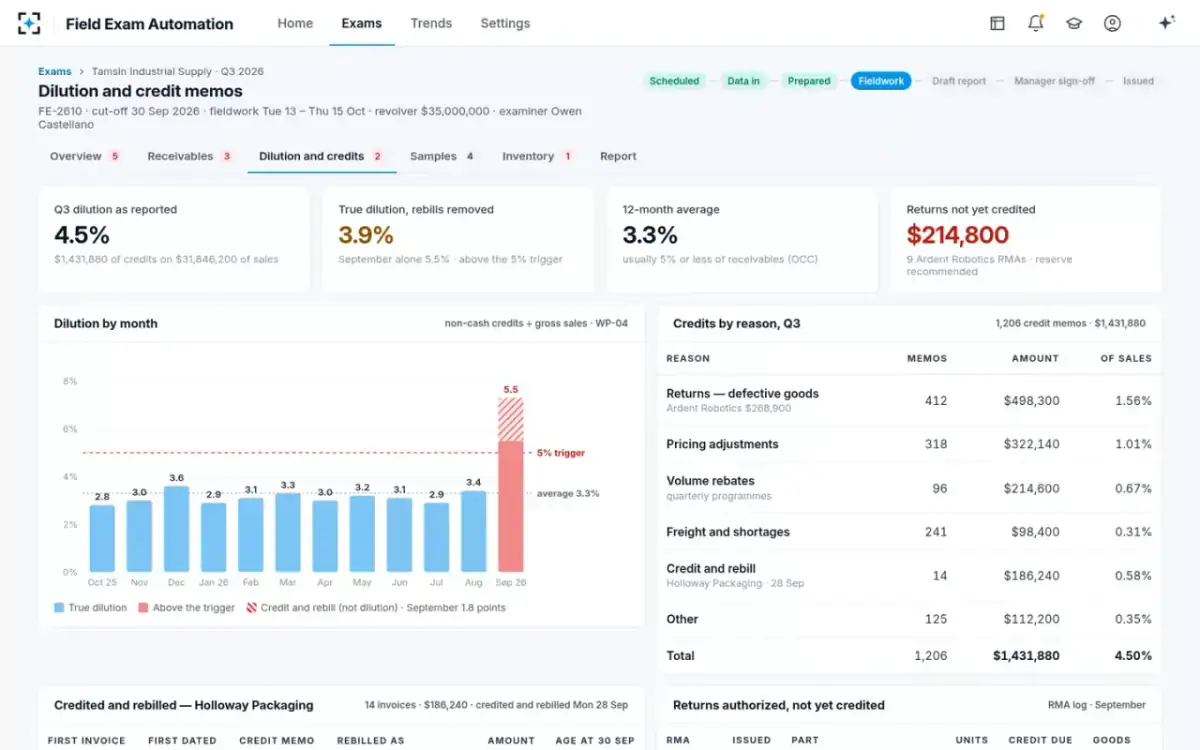
Holloway's balance, ruled ineligible on the receivables workpaper
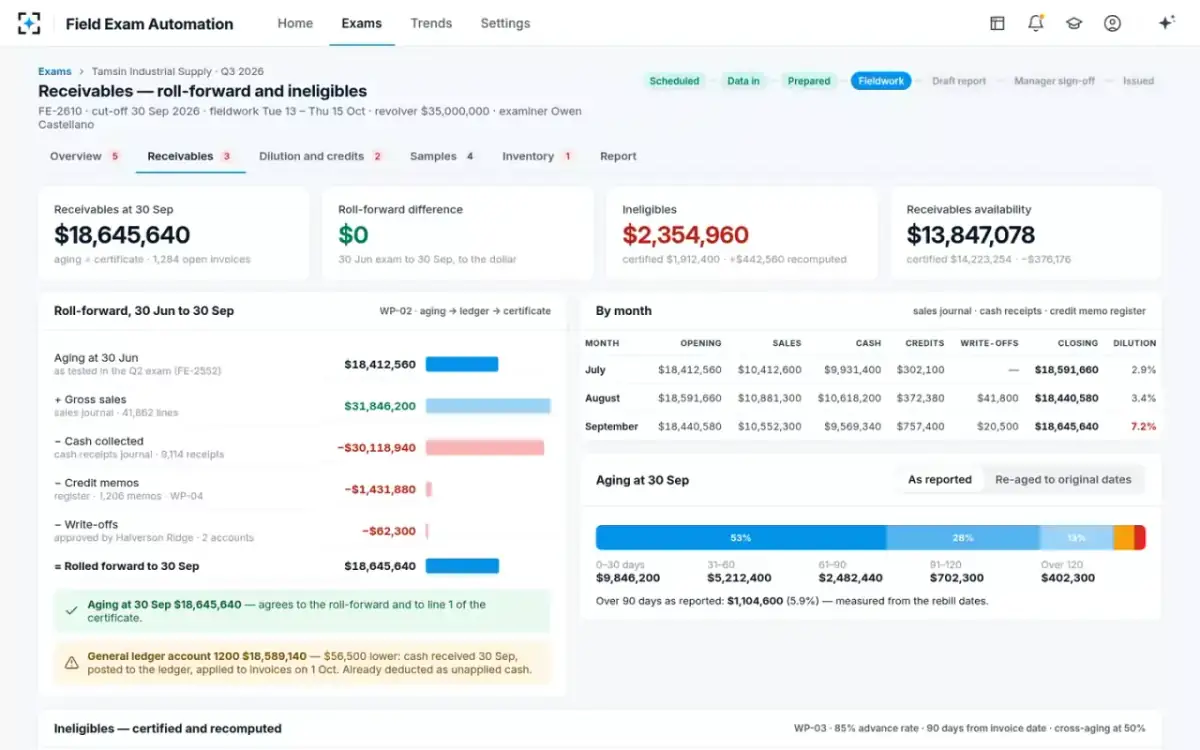
A borrowing base's biggest single-quarter move is often exactly this kind of customer-level event, not a portfolio-wide trend. How a borrowing base is calculated, step by step shows where Holloway's $342,600 sits inside Tamsin's full availability waterfall, and who actually confirms and approves a finding like this one follows the decision from Owen's site visit to Ruth's approval. To see a cross-aging finding worked on a real exam, start from Field Exam Automation.
Questions people ask
What is cross-aging in accounts receivable?
Cross-aging is a loan agreement provision that rules an entire customer's receivable balance ineligible for a borrowing base once a specified share of that customer's balance is delinquent — not just the late invoices, but the current ones from that customer too.
How does cross-aging make a whole account ineligible?
The loan agreement sets a delinquency share — the OCC describes 10% as a common convention, though actual agreements vary widely. Once the delinquent share of one customer's balance crosses that line, the agreement's own terms remove the customer's entire balance from the eligible pool, regardless of how current any individual invoice is.
What is the difference between delinquent and ineligible?
Delinquent describes a receivable past its normal trade terms; it is a risk signal, and the receivable may still be eligible. Ineligible means the loan agreement's own rules — age, concentration, cross-aging, or who owes the money — exclude the receivable from the borrowing base entirely.
Can a lender set its own cross-aging threshold, and what percentage triggers it?
Yes. There is no single percentage; it is a term of the specific loan agreement, negotiated between the lender and the borrower, not a figure set by regulation. The OCC's handbook describes a "10 percent rule" as a common convention, while the sample lender's agreement in this guide sets its own threshold at 50%, selectable from 25% to 75%. A field exam applies whatever threshold the agreement in front of it actually states.
What are common ineligible receivable categories?
Beyond cross-aging, common categories include receivables delinquent past a set number of days, balances over a customer concentration limit, contra-accounts, affiliate receivables, re-aged receivables, and foreign or government receivables, each for a different underlying risk.
Is a government receivable eligible collateral?
Sometimes, but it is treated more carefully than an ordinary trade receivable. Government counterparties follow different assignment and payment rules, and a lender that allows them typically requires evidence of an established, reliable payment pattern first.