Agentic AI in lending, as Field Exam Automation applies it to asset-based lending, means six specialists that divide one field exam the way an experienced team already divides it: one reads the borrower's download, one rolls the receivables forward and ties the aging to the general ledger, one measures dilution and finds credit-and-rebill patterns, one chooses and pre-tests the samples, one ages the inventory, and one drafts the report. None of the six replaces the field examiner, the field exam manager or the credit officer. Each one has a boundary it was built not to cross, and those boundaries — not the work the agents do inside them — are what a bank's own risk function should ask about first.
The examples on this page come from a fictional sample lender running Field Exam Automation on one borrower's exam: Tamsin Industrial Supply, examined by Owen Castellano, with findings reviewed by Denise Haugland and approved by Ruth Okafor. The research figures come from the federal banking agencies, NIST and the OCC, linked where they appear.
Six agents, and what stays with a person
6
agents, each with a boundary it was built not to cross
41,862lines
sales lines six agents read in under two minutes
18,412SKUs
aged by last sale, every one, before fieldwork
0
reports an agent may issue on its own
What six agents actually do, in order
The division of labor is ordinary before it is automated. A general ledger and aging reader opens the borrower's download — the general ledger, sales journals, agings, the inventory perpetual, shipping and RMA logs, the prior certificate — and maps every file to the exam. A roll-forward and tie-out builder takes it from there: rolling receivables forward from the last exam, tying the aging to the general ledger and to line 1 of the borrowing base certificate, and recomputing every ineligible category from invoice detail rather than trusting the certificate's own math. A dilution and credit memo analyst reads twelve months of credit memos and the returns log for patterns a borrower's own numbers can hide. A sample selector draws and pre-tests the sales, cash, verification and inventory samples. An inventory analyst ages every SKU by its last sale date and plans the physical counts. A report drafter turns the findings into a document, with the borrowing base impact computed and the springing covenant tested.
On Tamsin's Q3 exam, that sequence read 41,862 sales lines, 9,114 receipts, 1,206 credit memos and 18,412 SKUs, drew four samples and raised five findings — in 83 seconds. Speed is not the argument this page is making, though; what each of the six will not do is.
What none of the six may ever do
Six agents, six jobs, six limits
Agent
General ledger and aging readerReads the download and maps every file to the exam.
Never: edit the borrower’s data
Agent
Roll-forward and tie-out builderRolls receivables forward and ties the aging to the general ledger and the certificate.
Never: force a tie — an unexplained difference stays open
Agent
Dilution and credit memo analystMeasures dilution and finds credit-and-rebill patterns in the RMA log.
Never: call a pattern fraud — it raises it for the examiner
Agent
Sample selectorChooses and pre-tests each sample against the shipping log and verification replies.
Never: drop a selected item without a recorded reason
Agent
Inventory analystAges every SKU by last sale and plans the test counts.
Never: value inventory — it measures quantity, cost and age only
Agent
Report drafterDrafts the report, each finding citing its workpaper, and tests the springing covenant.
Never: issue the report, or change the borrowing base
A person decides
Owen Castellano, field examinerConfirms every finding against what he sees on site before any of it counts.
Two of the six limits are worth reading twice. The dilution analyst's job is to notice that fourteen Holloway Packaging invoices were credited and rebilled with new dates on the same day, which is exactly the shape of a pattern a bank would call fraud if a person called it that — and the agent does not call it that. It raises the pattern, with the dates and amounts, for Owen to confirm against what Gail Prentiss, Tamsin's controller, actually says happened. The roll-forward builder's refusal to force a tie works the same way in the other direction: when the general ledger control came out $56,500 lower than the rolled-forward aging, the workpaper left the difference open rather than plugging it, because an unexplained $56,500 is a fact an examiner needs to see, not a rounding error to make disappear.
What each agent does, and the one thing it may not do
| Agent | What it does | What it may never do |
|---|---|---|
| General ledger and aging reader | Reads the download — the general ledger, journals, agings, perpetual, shipping and RMA logs, certificates. | Edit the borrower’s data; it flags files that do not foot instead. |
| Roll-forward and tie-out builder | Rolls receivables forward and ties the aging to the general ledger and certificate, with every number cited to its row. | Force a tie — an unexplained difference stays open on the workpaper. |
| Dilution and credit memo analyst | Measures dilution by month and reason, and reads the RMA log for credit-and-rebill and uncredited returns. | Call a pattern fraud — it raises the pattern for the examiner to confirm. |
| Sample selector | Chooses each sample with its method and seed, and pre-tests it against the shipping log. | Drop a selected item without a recorded reason. |
| Inventory analyst | Ties the perpetual to the general ledger, ages every SKU by last sale, plans the test counts. | Value inventory — it measures quantity, cost and age, nothing more. |
| Report drafter | Drafts the report with every finding citing its workpaper, and tests the springing covenant. | Issue the report, or change a borrowing base. |
Where a person must look — and why the program stops there
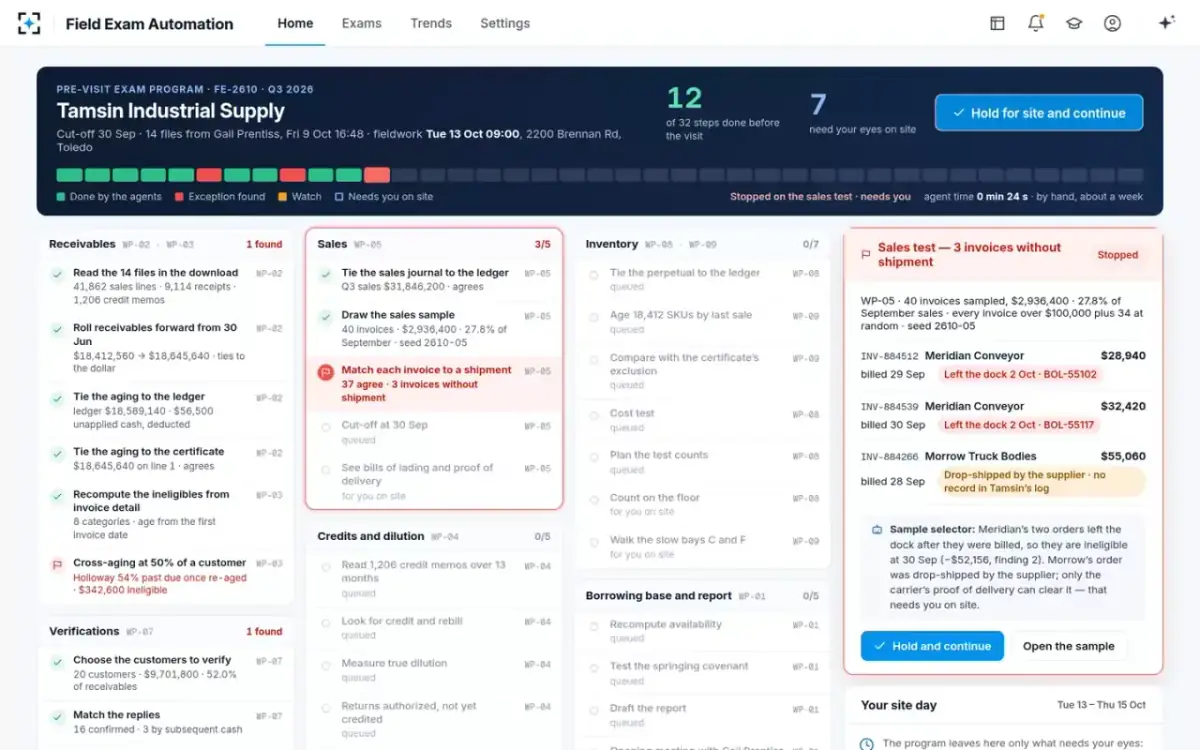
The limits above describe what an agent will not do; a field exam also needs a working answer for what it cannot do, which is different. Twelve steps into Tamsin's exam, the program stopped on the sales test: of 40 September invoices sampled, 37 agreed with the shipping log and three did not. The sample selector did not try to resolve the three; a document that shows no shipment at the billing date is not evidence the shipment never happened, and whether it did is a fact that only a bill of lading, a phone call or a site visit can settle.
What an agent proposes, and what a person decides
What an agent proposes: Flags three invoices where billing does not match the shipping log.
What a person decides: Owen holds them for Tuesday and clears two once the carrier’s bill of lading confirms the date.
What an agent proposes: Finds 14 invoices credited and rebilled, and re-ages them from their first date.
What a person decides: Owen confirms it against Gail Prentiss’s own account before it counts, and Ruth approves the change.
What an agent proposes: Measures $1,064,300 at cost with no sale in 12 months, against the certificate’s $612,000.
What a person decides: Owen plans a count of 60 SKUs on site; Ruth decides whether the $452,300 gap changes the reserve.
What bank model-risk guidance says about agents, and what it doesn't
A bank evaluating agents will reach first for its model-risk rulebook, and the rulebook changed this year. On 17 April 2026 the Federal Reserve, the OCC and the FDIC issued revised guidance on model risk management that "supersedes and replaces SR letter 11-7", the 2011 letter most bank model-risk functions were built around. The new guidance is explicit about its edge: "Generative AI and agentic AI models are novel and rapidly evolving. As such, they are not within the scope of this guidance." It adds that "a banking organization’s risk management and governance practices should guide the determination of appropriate governance and controls for any tools, processes, or systems not covered" (Federal Reserve, SR 26-2).
So there is no agent-specific supervisory rulebook to comply with yet, and a bank has to borrow principles rather than copy rules. The one that transfers most directly is the guidance's idea of "effective challenge": critical analysis "performed by individuals with the appropriate expertise", "sufficient independence to maintain objectivity" and "the organizational standing and influence to effect any change". In a field exam, that is the examiner who confirms each finding on site, the manager who signs the report and the credit officer who approves the change: three people who did not build the agents and have standing to overrule them.
Generative AI and agentic AI models are novel and rapidly evolving. As such, they are not within the scope of this guidance.
Federal Reserve, OCC and FDIC, Revised Guidance on Model Risk Management (SR 26-2, April 2026)
NIST's framework for AI risk management makes the companion point about what a tool has to demonstrate before that independent check even starts: "Reliability is defined ... as the 'ability of an item to perform as required, without failure, for a given time interval, under given conditions.'" An agent that reliably reads a shipping log is not the same claim as an agent that reliably decides whether a shipment happened; Field Exam Automation's agents are built to the first claim, and the second is left to a person on purpose.
Can AI do a field exam under bank supervisory guidance?
Not on its own, and the regulators' own description of what a field audit is for explains why. The OCC's handbook states that "field audits are integral to monitoring and controlling ABL. A field audit helps detect fraud and financial weakness and is a customary way to confirm the quality of the borrower's financial data, receivables, inventory, and internal controls." Detecting fraud is explicitly part of the job, and nothing in current supervisory guidance hands that judgment to a system; the 2026 model-risk guidance leaves agentic AI outside its scope altogether. What agents can do under existing supervisory guidance is the groundwork — the reading, the tying out, the pattern-finding — provided every finding that could matter to the borrowing base still passes through a person who confirms it, a manager who signs it, and a credit officer who approves what it changes.
What happens when an agent finds something it cannot explain?
It raises the pattern and stops, rather than guessing at a cause. The dilution and credit memo analyst's finding on Holloway Packaging is the clearest example: fourteen invoices, first dated 15 June through 1 July, credited on 28 September and rebilled the same day for the same $186,240. The agent's output names the dates, the amounts and the customer, and states what it implies — that re-aged from their first dates, the invoices are old enough to matter — without asserting why Tamsin's own accounting did it. The OCC's handbook describes exactly the kind of borrower conduct a field audit exists to catch: "A fraudulent borrower can submit falsified sales and collection documentation, use the same receivables as collateral to obtain financing from more than one bank, divert cash or collateral proceeds, misrepresent purchase orders, or overstate inventory levels." A credit-and-rebill pattern can be exactly that, or it can be an ordinary reissue at a customer's request. Only the examiner's conversation with the borrower tells the two apart, which is why the agent's output is a pattern raised, not a conclusion reached.
Who is accountable when an agent's finding is wrong?
The field examiner who confirmed it, then the manager who signed the report, then the credit officer who approved the change. None of the three can point back at an agent, because none of the agents issues a report, calls a pattern fraud, or changes a borrowing base on its own; every one of those actions belongs to a named person, and every agent step that fed into it cites the file and row it came from. That is also why a dropped finding does not vanish: when Owen untethers a flagged item from the report, it stays on the workpaper with his stated reason, so the record of the decision — not just its outcome — survives for Denise's review and, if it ever comes to it, an examiner's.
How does this compare with a rules engine or a spreadsheet macro?
A rules engine and a spreadsheet macro can both recompute a borrowing base formula correctly; neither reads a shipping log against a sample invoice, matches a credit memo to a same-day rebill by customer and amount, or ages 18,412 SKUs against a certificate's own stated exclusion window, which on the sample exam took the agents 83 seconds in total. The difference is less about speed than about what counts as an input. A fixed rule catches an ineligible receivable it was told to look for; it does not notice that a borrower's credit-and-rebill pattern refreshes an aging that the rule would otherwise have flagged as past due, because nobody wrote a rule for a pattern no one had seen on this borrower before. Six agents reading the actual documents, rather than a formula consuming the borrower's own summary numbers, is the difference between re-deriving the borrowing base and re-checking that it was calculated correctly.
What a rules engine does keep, and what Field Exam Automation keeps too, is the limit that matters most: nothing in either approach should ever issue a report or move money on its own. The same exam, run by hand, by rules-based software and by agents, lays out what each of the three actually catches before fieldwork starts. How to verify an AI-drafted exam's accuracy covers the sample agreement rate a desk should ask any of the three for. To see the six agents on a real exam, start from Field Exam Automation.
Stopped on the sales test, with the reasoning shown
Questions people ask
How does AI work in asset-based lending field exams?
In Field Exam Automation, six agents each do one part of the reading and tying-out work a field exam has always required — rolling receivables forward, measuring dilution, drawing samples, aging inventory and drafting the report — from the borrower's own documents, citing the file and row behind every number. None of the six decides what a finding means for the borrowing base; that stays with the examiner, the manager and the credit officer.
Can AI do a field exam by itself?
No. The agents prepare the exam; they never issue a report, confirm a finding in place of the examiner, or change a borrowing base. A field exam under this design still ends with a field examiner's site visit, a manager's signature and a credit officer's approval.
What can an AI agent not do in lending, specifically on a field exam?
In Field Exam Automation, no agent edits the borrower's data, forces a tie that does not reconcile, calls a pattern fraud, drops a sampled item without a recorded reason, values inventory, issues a report, or changes a borrowing base. Each limit maps to a decision the industry has always kept with a person.
Is AI allowed to change a borrowing base?
Not in this design, and not under ordinary bank governance either way. A change to eligibility or reserves is a credit officer's approval, made against the loan agreement's own definitions; an agent's output is the evidence the change is based on, not the change itself.
How many agents does it take to run a field exam?
Field Exam Automation uses six, divided by the kind of work: reading the download, rolling receivables and tying out, dilution and credit memos, sample selection, inventory, and report drafting. The number is a design choice tied to how the work naturally splits, not a figure any regulation sets.
Do agents replace the field examiner?
No. On the sample exam in this guide, agents finished 32 of 39 program steps before the examiner arrived on site, and the seven steps left were the ones needing a person present: an opening meeting, bills of lading, memo approvals, a floor count, bank statements and an exit meeting. The examiner's site day got shorter in scope and no less necessary.