In the ABL field exam process, the field examiner reads a borrower's general ledger, agings, credit memos and inventory records, rolls the receivables forward from the last exam, and spends several days on site testing samples, counting inventory and confirming what the files say against what is actually there. In practice, the exam's roles are carried by four people, not one: the field examiner who does the testing, the field exam manager who signs the report, the credit officer who approves what it does to the borrowing base, and the portfolio manager who tells the borrower. The friction in a slow exam usually sits in the handoff between those four seats, not in any one of them. Botminds' Field Exam Automation does the reading and the tying out before anyone picks up a file, and leaves each of the four seats with less paper and the same decision it always had.
The examples on this page come from a fictional sample lender as it runs Field Exam Automation on one borrower's exam: Tamsin Industrial Supply, a Toledo, Ohio distributor on a $35.0 million revolver, examined by Owen Castellano. The research figures come from the OCC, the Federal Reserve and the Bureau of Labor Statistics, linked where they appear.
What is done before anyone picks up a file
32of 39
exam program steps finished before the visit
83s
of agent time to read 14 files and build 11 workpapers
5findings
$817,126 off availability, each citing its workpaper
1day
from the end of fieldwork to a signed report
Who actually touches a field exam
Four people's names are on a finished exam, and each one is accountable for a different question. The field examiner answers whether the collateral is what the borrower says it is. The field exam manager answers whether the exam itself was done right. The credit officer answers whether the borrowing base should actually change. The portfolio manager answers what the borrower needs to hear, and from whom. None of the four can do another's job: a credit officer who skips straight to approving a finding has not asked whether the field examiner saw what he needed to see, and an examiner who tells the borrower about a finding before the credit officer has approved it has given away a decision that was never his to give.
The same exam, four seats
Today
Spends the first days of every exam building workpapers from the borrower’s download, and the site visit finishing them.
With agents
Arrives on site with 32 of 39 steps done and a site day made of only what needs his eyes.
Still theirs: Confirming every finding against what he sees on site.
Today
Reviews each report weeks after fieldwork, and tracks which exams are slipping past their due date.
With agents
Sees every exam’s stage and due date across 38 borrowers, and signs a cited report the day after fieldwork.
Still theirs: The signature that lets a report reach credit or the borrower.
Today
Gets eligibility and reserve changes in a report written weeks after fieldwork, and has to trace each one to its workpaper.
With agents
Gets each change to the borrowing base with its finding, its workpaper and its effect on availability.
Still theirs: Approving the change to the borrowing base.
Today
Learns what an exam does to availability late, often close to when the borrower hears it.
With agents
Sees the findings and what they do to availability before the borrower does.
Still theirs: The conversation with the borrower.
What the field examiner decides on site
Before Owen gets in the car, the exam program has already run 39 steps across eight areas of the file: receivables rolled forward and tied to the general ledger and the certificate, ineligibles recomputed from invoice detail, dilution measured by month, samples drawn and pre-tested against the shipping log and verification replies, inventory aged by last sale. Twelve steps into Tamsin's Q3 exam, the program stopped on the sales test: of 40 September invoices sampled, 37 agreed with the shipping log and three did not. Two Meridian Conveyor invoices, billed 29 and 30 September, left the dock on 2 October. A Morrow Truck Bodies invoice for $55,060 was drop-shipped by the supplier, so only the carrier's proof of delivery, not Tamsin's own shipping log, can clear it — and that needs someone standing in the shipping office.
Thirty-two of thirty-nine steps done before he gets in the car
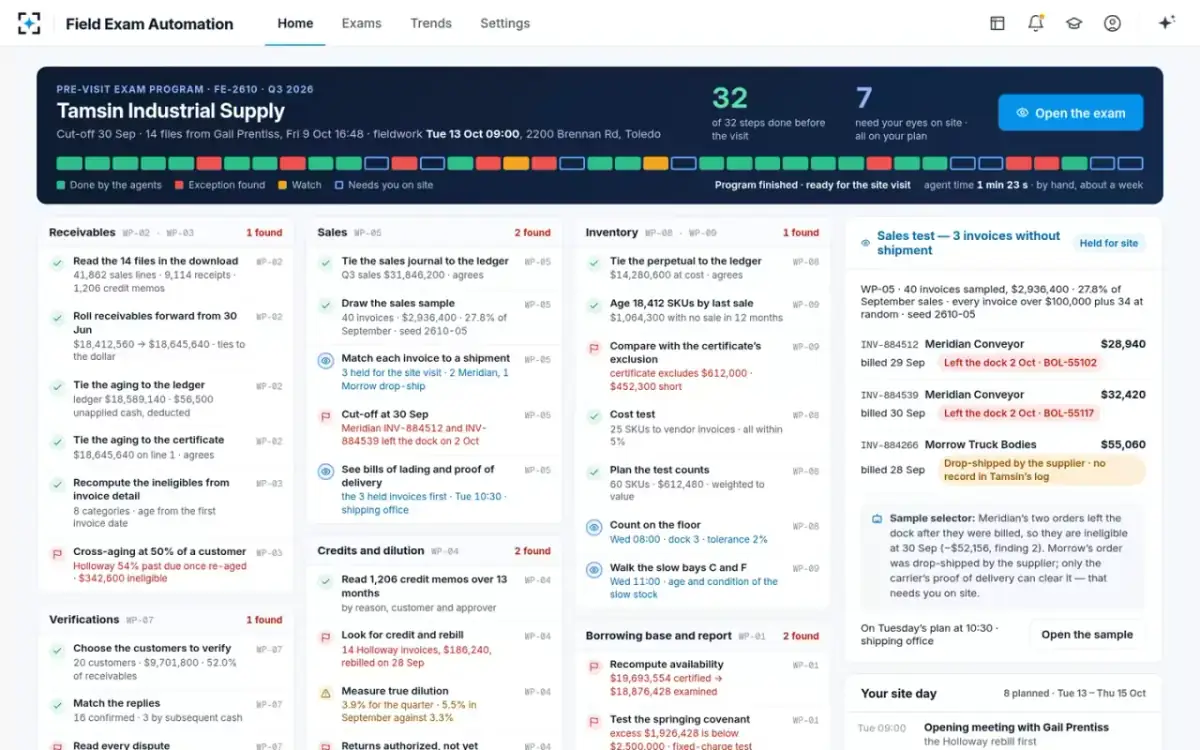
That is the examiner's seat: not building the workpaper, but deciding what a document cannot settle on its own. Owen holds the three invoices for the shipping office at 10:30 on Tuesday, and the program finishes. What is left — the opening meeting, the bills of lading, memo approvals over $10,000, the floor count, the slow bays, the bank statements and the exit meeting — becomes his three-day site visit. Every one of those seven needs a person physically present: a document that only exists on paper at the borrower's office, a count that only a count can confirm, a conversation that only a meeting can have. A field examiner's judgment is not replaced by finishing the workpapers first; it is aimed at exactly the seven things that still need it.
What the field exam manager signs — and what the signature means
Denise Haugland signs every report Tamsin's book produces, and her signature is not a rubber stamp on Owen's work; it is a second, independent look at whether the exam supports what it concludes. On Thursday 15 October, after three days on site, Owen confirmed each finding against what he actually saw — Gail Prentiss, Tamsin's controller, had the June invoices reissued at Holloway's own request with terms still running from June; both bills of lading for Meridian were signed by the carrier on 2 October; seven of the nine Ardent Robotics returns were sitting in the receiving bay. He submitted at 17:20. Denise signed off at 08:42 the next morning, one day after fieldwork ended.
Four signatures, and what each one means
| Seat | What they sign or approve | What the signature means |
|---|---|---|
| Owen Castellano, field examiner | Submits the exam, with every finding he confirmed on site. | The findings are real: he saw the invoice, the bay or the bank statement himself. |
| Denise Haugland, field exam manager | Signs off the report before it reaches credit or the borrower. | The report is complete, and its findings are supported by their workpapers. |
| Ruth Okafor, credit officer | Approves each change to eligibility or reserves. | The new borrowing base is the one the loan agreement, correctly applied, produces. |
| Marcus Bell, portfolio manager | Tells Tamsin what changed, and why. | The borrower hears the finding from the relationship, not from a report alone. |
A finding Owen drops does not simply disappear. Unticking it removes it from the report, but it stays on the workpaper with his reason, and Denise sees it when she reviews. That is what her signature is actually certifying: not that every flagged item became a finding, but that every decision not to treat something as a finding is visible and reasoned, not quietly deleted.
The credit officer's line: approving the borrowing base, not the exam
Ruth Okafor's seat is easy to misdescribe as a rubber stamp on Denise's sign-off, and it is the opposite. A credit officer does not re-perform the field exam; she takes the exam's findings as given and decides what they should do to the number the borrower can draw against. On Tamsin's Q3 exam, Owen sent Ruth five borrowing-base changes with the workpapers behind each one: the Holloway cross-aging finding, the credit-and-rebill adjustment, the inventory exclusion gap, and two smaller items. Availability as certified was $19,693,554; after the findings, it is $817,126 lower.
What makes that approval meaningful is that Ruth is deciding a credit question, not an accounting one. The field exam establishes the facts — this receivable is 91 to 107 days old measured from its first invoice date, this SKU has had no sale in 12 months. Whether those facts change the borrowing base is a question the loan agreement answers, and applying the loan agreement correctly is the credit officer's responsibility, not the examiner's. Keeping that line matters: a bank whose examiners could change the borrowing base on their own would have no independent check on the number that decides how much a borrower can draw.
The portfolio manager's seat: the one who talks to the borrower
Marcus Bell is the only one of the four who has an ongoing relationship with Tamsin, and he is deliberately the last to act, not the first to know. The exam findings and what they do to availability reach him before they reach the borrower, because once Ruth has approved the changes, someone still has to have the conversation — explaining why $291,210 of Holloway Packaging's balance is now ineligible, and what Tamsin can do about it, in a way a report alone does not.
That sequencing protects both sides. The borrower does not hear a finding secondhand from a draft report, and the lender does not let a relationship manager soften a finding before credit has approved what it does to the number. Marcus's seat is judgment of a different kind than Owen's: not whether a receivable is eligible, but how to tell a customer their availability just fell by over $800,000 without it reading as a surprise attack.
How big should a field exam team be?
There is no published staffing ratio for a field exam desk, and the regulators' own language explains why: the requirement is a function, not a headcount. The OCC's Asset-Based Lending handbook says an ABL unit "should have dedicated field audit staff that includes skilled accountants," and its older Accounts Receivable and Inventory Financing handbook put the same requirement slightly differently: "ABL units should have dedicated field audit staffs that include certified public accountants." Neither sets a number of examiners per borrower, a number of borrowers per examiner, or a team size by book value. What they specify is the skill — accounting — not the count.
One examiner's book: 31 of 38 due, one overdue
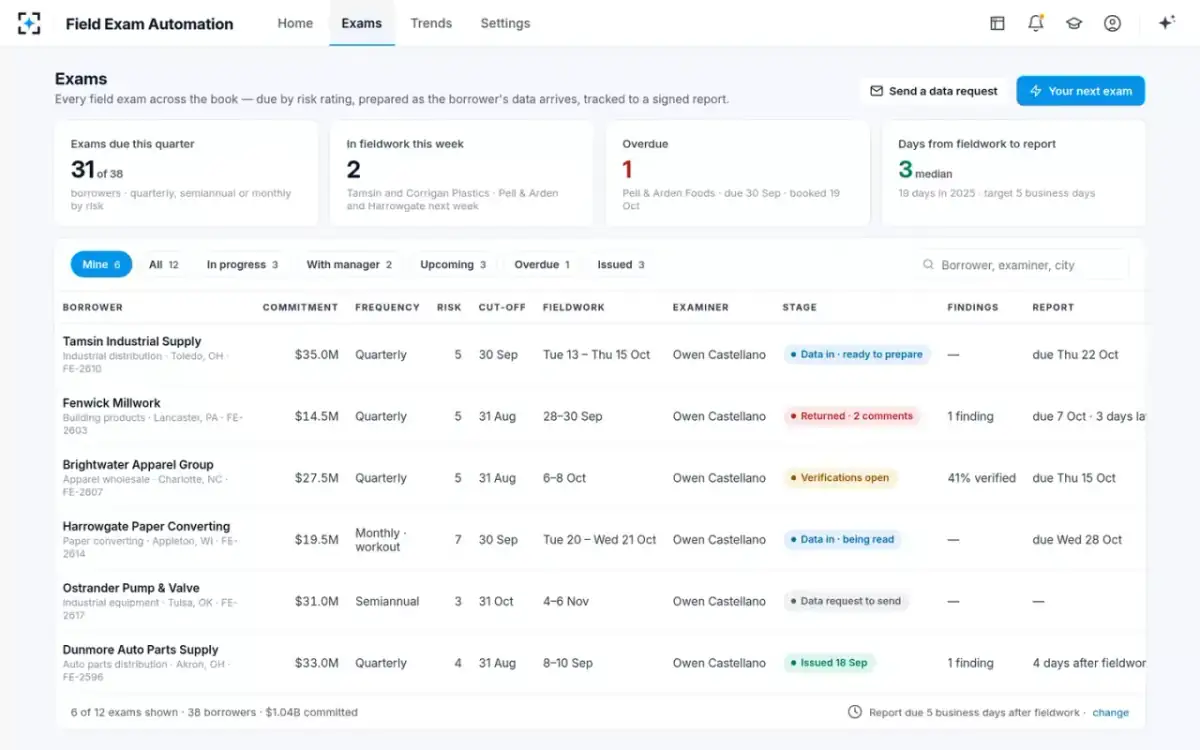
The Bureau of Labor Statistics does not track field examiners as their own occupation either; there is no separate code for the role, and so no public benchmark for how large a desk should be. What a bank can measure instead is capacity on its own book: Owen's 38 borrowers, 31 of them due this quarter, is one examiner's real load at one sample lender, and it is a number every field exam desk already has for itself.
What changes when the workpapers are already built
The four seats do not disappear when the workpapers arrive already built; the work inside each seat changes shape. Six agents read Tamsin's 14 files, build the eleven workpapers, and draft the report's findings — and then stop, because none of the four decisions that matter is theirs to make.
From six agents to four signatures
Agent
Six agentsRead the download, roll the receivables forward, measure dilution, draw the samples and draft the findings.
Never: issue the report or change the borrowing base
A person decides
Owen Castellano, field examinerConfirms each finding against what he sees on site; a dropped finding keeps its reason.
A person decides
Denise Haugland, field exam managerReviews the confirmed findings and signs the report.
A person decides
Ruth Okafor, credit officerApproves each change to eligibility or reserves against its workpaper.
A person decides
Marcus Bell, portfolio managerTells Tamsin what the findings mean for its availability.
Where the hours actually went, and where they go now, is visible in the exam's own working-day estimate. Reading the download and tying out, working the credits and dilution, and choosing samples are the mechanical parts of the job — the parts a document already contains the answer to, if someone reads carefully enough. On-site testing is the part no document can do by itself.
Where a quarterly exam's working days go, by hand and with the solution
By hand, about 16 working days
- Reading the download and tying out · 13%
- Credits, dilution and ineligibles · 13%
- Choosing and pre-testing samples · 6%
- On site: counts, documents, meetings · 19%
- Writing the report · 30%
- Manager review and sign-off · 19%
With Field Exam Automation, about 5.5 working days
- Reading the download and tying out · 9%
- Credits, dilution and ineligibles · 9%
- Choosing and pre-testing samples · 9%
- On site: counts, documents, meetings · 55%
- Writing the report · 9%
- Manager review and sign-off · 9%
That is the honest shape of the change. On-site time does not get automated away, because it is the part that is on-site for a reason. What shrinks is the five days of report writing and the three days of credits-and-dilution analysis that sat between the data arriving and the examiner having something to test — and what that leaves behind is a week where the on-site day, not the paperwork around it, is most of what an examiner's time goes on.
What does a field examiner's week actually hold?
For Owen, in the week this page follows, the answer is: a Monday reviewing a book of 38 borrowers and confirming Tamsin's exam program has already stopped where it should; a Tuesday morning resolving the three held sales-test invoices and then three days of fieldwork; a Thursday evening submitting a report with every finding confirmed against what he saw; and a Friday morning where the report is already signed before he is back at his desk. The field exam fee a borrower pays is, in the end, a pass-through of hours like these — the OCC's Asset-Based Lending handbook notes plainly that for the cost of dedicated field audit staff, "the cost is generally passed on to the borrower."
Signed the day after fieldwork
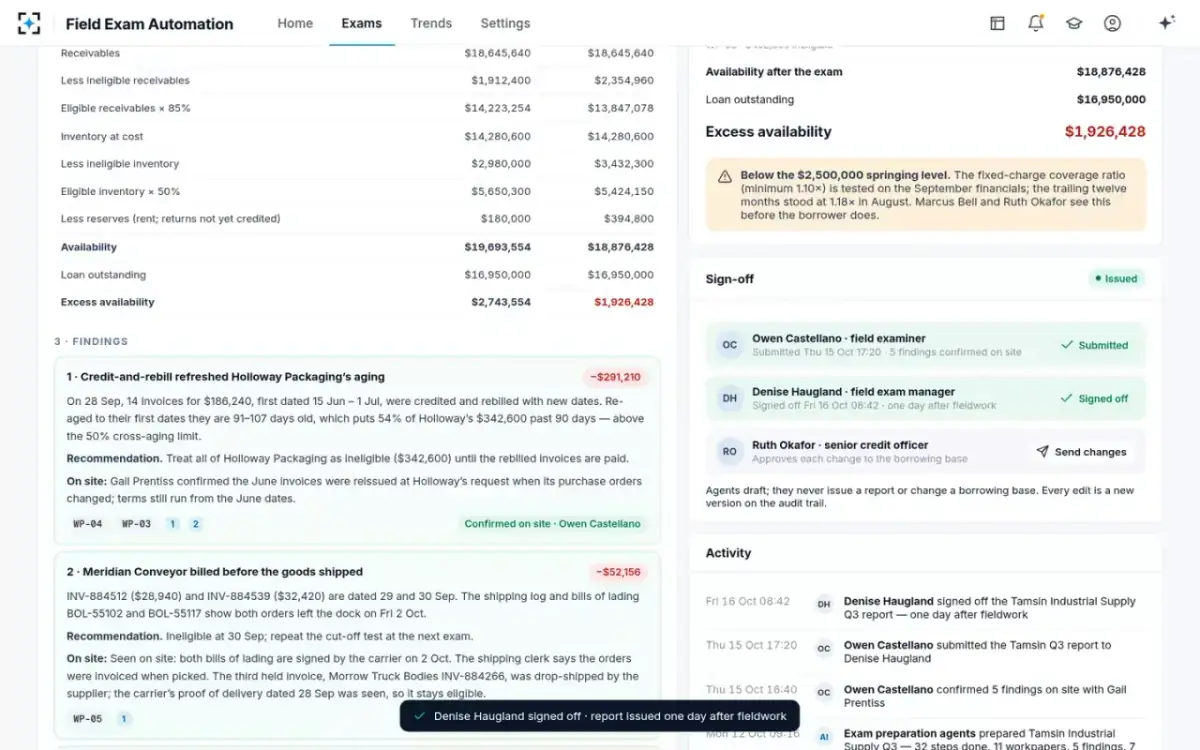
What has not changed is who is accountable for what. Agents prepare; they never issue a report or change a borrowing base. The desk this page describes is Tamsin's one exam; the same exam run by hand, by rules-based software and by agents shows what each approach actually catches before fieldwork starts, and what a field exam fee pays for, line by line follows the hours behind the number a borrower is billed. To see this desk screen by screen, start from Field Exam Automation.
Questions people ask
What does a field exam manager do, if not the testing itself?
A field exam manager reviews a finished exam for whether it supports what it concludes, and signs it off before it reaches credit or the borrower. At the sample lender in this guide, that review happened the morning after fieldwork ended, because the report arrived with every finding already confirmed on site and cited to its workpaper.
What does a credit officer do in asset-based lending that a field examiner does not?
A credit officer approves what an exam's findings do to the borrowing base — the eligibility and reserve changes the loan agreement allows once a finding is confirmed. A field examiner establishes the findings; the credit officer decides, under the agreement, what they change. Keeping those two decisions with two different people is what makes the approval a check rather than a formality.
What background should a lender look for on its field exam staff?
There is no single licensed path; the OCC's handbooks describe the staffing requirement as skilled accountants on dedicated field audit staff, which makes accounting or audit the natural background for the role rather than a lending-specific credential. What distinguishes a senior examiner is less a certification than the judgment to know which of a file's thousands of lines need a document checked in person.
What does an ABL portfolio manager do on a field exam?
A portfolio manager does not perform or approve the exam; the relationship is theirs, and once credit has approved a change to the borrowing base, telling the borrower what changed and why is their seat, not the examiner's or the credit officer's.
Field examiner vs auditor: what is the difference?
In asset-based lending the terms largely overlap — a field examiner performs what the industry also calls a field audit, testing a borrower's receivables, inventory and the records behind a borrowing base certificate. "Auditor" without qualification more often means a financial-statement auditor working to different standards; a field examiner's work serves the lender's own borrowing-base decision, not an opinion on the borrower's financial statements as a whole.
How many borrowers can one field examiner cover?
There is no published figure. At the sample lender in this guide, one senior field examiner's book holds 38 borrowers, 31 due in the current quarter, which is closer to a snapshot of one desk's real capacity than a staffing rule any bank should copy without checking its own mix of borrower size, risk rating and exam frequency.