Invoice fraud detection in factoring comes down to three failure patterns that each pass a casual read as a perfectly ordinary invoice: the same shipment billed twice under a new invoice number, a PDF edited after it was issued, and a shipment billed before it ever left the warehouse. None of the three announces itself. A duplicate has a real bill of lading number. An altered PDF opens cleanly in any reader. A pre-billed invoice has a real purchase order behind it. Catching any one of them takes a different, specific check — not a more careful read of the same document.
The three examples on this page are fictional sample invoices from one schedule: Pinecrest Packaging Co.'s Schedule 1187, processed through Botminds' Factoring Invoice Verification. All three were held before funding, each for a documented reason a person could verify.
Why a bad invoice looks clean on its own
A single invoice, read in isolation, can only be judged against itself: does the math add up, does it look professionally formatted, does it have the right purchase order number printed on it. All three of the patterns below pass that test easily, because none of them is a fabrication from nothing — each starts from a real document and changes, omits or mistimes exactly one fact that a reader checking the invoice alone has no way to see. Catching them requires comparing the invoice against something outside itself: every other invoice ever funded, the document's own edit history, or an independent delivery record.
This is also why a spot check, by its nature, catches less than its name implies. A verification specialist with twenty minutes and a schedule of forty-six invoices cannot cross-reference every one of them against a year of funding history, open every PDF's metadata, and call every debtor to confirm a delivery date — not without missing the cut-off entirely. A spot check catches whatever the specialist happens to look at closely, which means it is most effective exactly where it is least needed: on the invoices that were always going to be clean. The three checks below are built to run on all forty-six, every time, specifically because a sample can never promise that.
Three ways an invoice fails, and what each needs to be caught
The same shipment, billed under a new invoice number and date.
Caught by: fingerprinting against every invoice ever funded, for every client.
A real invoice, edited in a PDF editor after it was first issued.
Caught by: reading the document's own edit history.
Invoiced before the goods actually shipped.
Caught by: comparing invoice and delivery dates, and requiring a signature.
Duplicate: the same shipment, invoiced twice
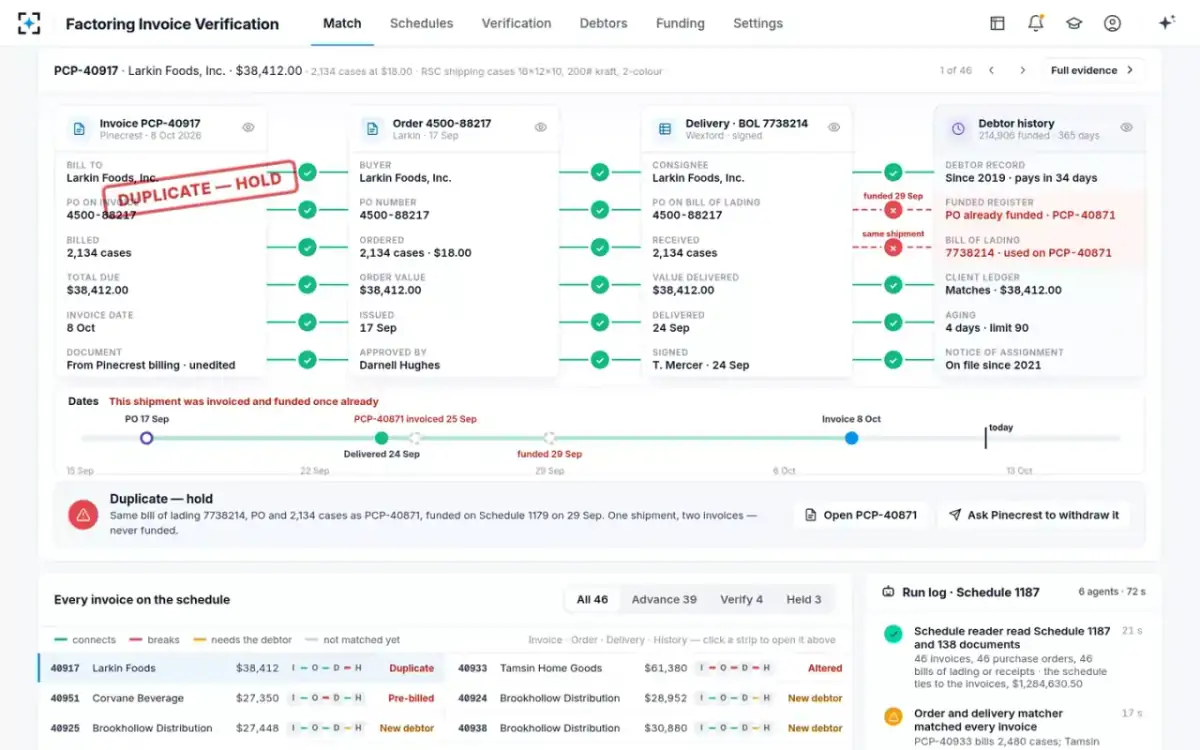
A duplicate invoice re-bills a shipment that has already been funded, under a new invoice number and a new date, while every other fact — the bill of lading, the purchase order, the case count — stays the same, because it is the same real shipment. On Schedule 1187, invoice PCP-40917 billed Larkin Foods $38,412.00 for 2,134 cases, dated 8 October. Its bill of lading, 7738214, and its purchase order, 4500-88217, were identical to invoice PCP-40871 — dated 25 September, and already funded on an earlier schedule, 29 September. Only the invoice number and the date had changed.
Read alone, PCP-40917 is indistinguishable from a legitimate invoice: it has a real bill of lading number, a real purchase order, a real case count. The tell only appears once it is compared against the factor's own funding history, not against itself.
Altered: a PDF edited after it was issued
An altered invoice starts as a genuine document and is changed after the fact — usually the billed quantity or amount, raised past what was actually agreed or delivered. On Schedule 1187, invoice PCP-40933 billed Tamsin Home Goods for 2,480 cases at $24.75, totaling $61,380.00. The PDF's own metadata showed it was edited on 9 October, two days after it was first created. Tamsin's receiving clerk had signed for only 1,860 cases, and Pinecrest's own accounting records carried the invoice at $46,035.00 — the value of the 1,860 cases actually delivered, not the 2,480 billed.
What a clean invoice shows, against what PCP-40933 showed
A clean invoice: Matches both the purchase order and the signed delivery receipt.
PCP-40933, altered: 2,480 cases billed; only 1,860 signed for on delivery.
A clean invoice: Agree with the invoice face amount.
PCP-40933, altered: Carry the invoice at $46,035.00 — the delivered 1,860 cases, not the $61,380.00 billed for 2,480.
A clean invoice: No edits after the document was first issued.
PCP-40933, altered: PDF metadata shows an edit on 9 Oct, two days after the invoice was created on 7 Oct.
Pre-billed: invoiced before the goods ship
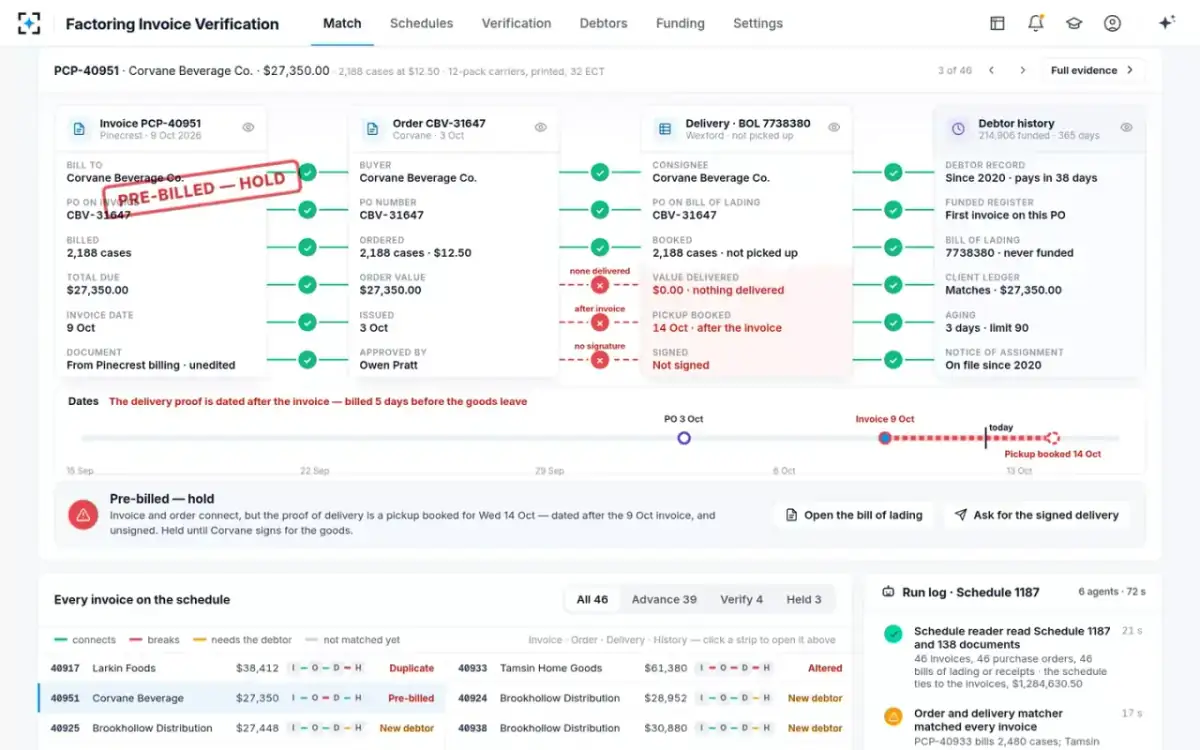
A pre-billed invoice is dated and submitted before the shipment it bills for has actually gone out — sometimes an honest administrative habit, sometimes a way to draw an advance against goods that may never ship at all. On Schedule 1187, invoice PCP-40951 billed Corvane Beverage Co. $27,350.00 for 2,188 cases, dated 9 October. Its only delivery record was a pickup booking for 14 October — five days after the invoice — and the booking was not signed. Nothing had actually moved.
The purchase order on PCP-40951 agreed with the invoice perfectly: same buyer, same quantity, same price. That agreement is exactly what makes a pre-billed invoice easy to miss without checking dates specifically — the only fact out of place is the order in which two documents happened, and an invoice that arrives looking complete rarely gets its dates cross-checked by hand.
Billed 9 October, picked up — maybe — on the 14th
What catches a duplicate that a one-off check misses
A duplicate cannot be caught by looking harder at the duplicate invoice itself, because nothing on it is fabricated — it is a real shipment's real paperwork, resubmitted. It can only be caught by fingerprinting: comparing the new invoice's bill of lading, purchase order, quantity, amount, ship-to and carrier reference against every invoice the factor has already funded, for every client, not just this one. A check scoped to one client's own history would miss a duplicate deliberately routed through a second, unrelated client — which is exactly why Botminds' duplicate and alteration detector agent fingerprints against 365 days of funding history across the entire book, not per client.
The look-back window is a deliberate setting, not a fixed limit. A shorter window, say 90 days, is cheaper to search but misses a shipment re-billed after a slow season; Halvorsen Trade Capital runs a full year, against every client, specifically because PCP-40871 sat funded for five weeks before its duplicate, PCP-40917, surfaced on a different schedule. A fingerprint field list matters just as much as the window: matching on invoice number and amount alone would miss this duplicate entirely, since both of those changed; matching on bill of lading, purchase order, quantity, amount, ship-to and carrier reference together is what caught it, because none of the fields that actually describe the shipment had changed at all.
One shipment, two invoice numbers, side by side
The duplicate's quieter cousin: an invoice that was already paid
A duplicate re-bills a shipment that was funded once. Its quieter cousin re-reports an invoice that was already paid. A federal case in New Jersey shows how far that runs. Vincent Galano's company, PF Funding, was itself a factor, financed by a lender's credit line. To keep drawing on it, he "mischaracterized invoices that had already been paid and collected as outstanding and capable of being factored, in essence double-counting to drive up the outstanding receivables", and misrepresented uncollectible invoices "as collectible on reports he routinely provided to the factoring lender". The pattern ran for nearly a decade, from 2011, until PF Funding defaulted in 2020 owing about $50 million; Galano was sentenced in October 2022 to 63 months in prison and ordered to pay $50 million in restitution (U.S. Attorney's Office, District of New Jersey).
Read alone, a paid invoice re-presented as open looks exactly like an open one: same debtor, same amount, same real shipment. What exposes it is the same thing that exposes a duplicate, a record outside the document: the factor's own record of what has been funded and collected, and the debtor's own answer to "is this still open?". That is why the fingerprint runs against funded history and why a confirmation call asks about credits and payments, not only about delivery.
What catches an altered PDF
An altered PDF is caught by reading the document's own history, not its printed content. Modern PDF files carry metadata — creation date, last-modified date, and often a record of which application made the most recent edit — that a casual viewer never opens but that a document-reading agent can check on every invoice, every time. A two-day gap between an invoice's creation date and its last edit is not proof of fraud by itself, but it is exactly the kind of fact that belongs next to the delivered quantity and the client's own accounting records before a specialist decides whether to fund, split or hold the invoice — which is what happened with PCP-40933: fund the 1,860 cases genuinely delivered, hold the rest.
What makes this check hard to do by hand is that it requires three separate facts to line up, each sourced differently: a metadata read on the PDF itself, a quantity comparison against an independent signed receipt, and a total comparison against a record the client keeps for its own purposes, not for the factor. A verification specialist working from the invoice alone sees none of the three; the document-reading agent surfaces all three together, next to each other, so the specialist's only job is the judgment call — fund the delivered portion, or hold the whole invoice until the gap is explained.
What catches a pre-billed invoice
A pre-billed invoice is caught by comparing dates and requiring a real signature, not by trusting that a delivery document exists at all. The rule Botminds' order and delivery matcher agent applies is explicit: it never accepts an unsigned or future-dated delivery as proof, regardless of how well everything else on the invoice lines up. A pickup booking with no signature and a date after the invoice is treated exactly like having no delivery document — the invoice is held until a signed, dated receipt actually exists.
The reason this needs to be a rule rather than a judgment call is that a pre-billed invoice is often entirely innocent — a client's billing system issues invoices on a schedule that runs ahead of its shipping department, with no intent to mislead anyone. Treating every pre-billed invoice as suspected fraud would hold far more good invoices than bad ones. Treating the gap as simply unproven, and waiting for the proof rather than guessing at intent, is what lets the same rule catch both the honest timing mismatch and the deliberate one without a person having to decide which is which before the documents exist.
What two real prosecutions looked like
These three patterns are not hypothetical risks invented for a sales page. A six-day federal trial in Idaho concluded with Douglas Worman convicted on seventeen counts of wire fraud for a factoring scheme built on invoices that were, in the government's description, "inflated and entirely false and fraudulent," purportedly for work his business had performed for its customers — Worman was sentenced to 46 months after defrauding the factor of more than $2.5 million (U.S. Attorney's Office, District of Idaho, 2025). A separate case in New Jersey went further: the customers named on the invoices owed nothing at all.
"Rodriguez submitted to Victim-1 fraudulent invoices for millions of dollars in future accounts receivable that Rodriguez falsely represented were owed to Old American."
U.S. Attorney's Office, District of New Jersey, describing the scheme
Neither case maps precisely onto the three patterns described on this page. Worman's invoices were "inflated" as well as fictitious, which is the altered pattern at its crudest; Rodriguez's were receivables that did not exist, a simpler fraud than editing a real document. What the two cases share with the three patterns above is the same underlying lesson: an invoice that looks complete, professionally formatted and internally consistent is not evidence that the shipment behind it was real. What invoice fraud costs a factor works through what each of these cases cost, and what catching a bad invoice before the wire is worth against catching it after.
False invoices are among the costliest common frauds: median loss per case by scheme
To see all three held invoices, side by side with what cleared on the same schedule, start from Factoring Invoice Verification. The control that catches most of what a three-way match alone cannot is covered in the three-way match a factor runs before it pays an invoice.
Questions people ask
What is invoice fraud?
Any invoice submitted for payment that misrepresents the underlying transaction — because the shipment never happened, was already paid for once, was altered after issuance, or was billed before it occurred. In factoring, three patterns that pass a casual read are the duplicate, the altered and the pre-billed invoice, each of which looks like an ordinary invoice without a targeted check; the bluntest fraud invents the receivable outright.
How to spot a duplicate invoice?
Compare its bill of lading, purchase order, quantity, amount and ship-to against every invoice already funded — for every client, not just the one submitting it — rather than relying on the invoice number alone, since a duplicate is usually resubmitted under a new number and date.
How to tell if an invoice has been altered?
Check the PDF's own metadata for a last-modified date later than its creation date, and compare the billed quantity against both the signed delivery record and the client's own accounting records. An altered invoice often agrees with itself perfectly while disagreeing with everything around it.
What is a pre-billed invoice?
An invoice dated and submitted before the goods it bills for have actually shipped or been delivered — caught by comparing the invoice date against the delivery date, and by never accepting an unsigned or future-dated delivery document as proof.
What are common invoice fraud schemes?
In factoring specifically: duplicate invoices for a shipment already funded, invoices altered after issuance to inflate the billed amount, invoices submitted before goods actually ship, and — in the most serious cases — invoices for receivables and debtors that do not exist at all.
How do fake invoices get past accounts payable?
Because each pattern is designed to pass a document-level read: the paperwork looks complete, the numbers tie out to themselves, and nothing about the invoice's printed face reveals that it has been seen before, edited, or dated out of order. Catching them needs a check against something external to the document — funding history, edit metadata, or an independently confirmed delivery.