How accurate is AI at catching a fraudulent invoice? The honest answer is that the question is usually asked backwards. A single accuracy percentage from a vendor says little on its own — it depends on the mix of invoices it was tested on, what counts as a catch, and what a false hold costs a client waiting on a wire. Factoring Invoice Verification's own design assumes this: six agents flag what looks wrong, and a person, not a model, clears or holds every match. The measures below are what to ask for instead of a single number, and the baseline they have to beat.
How accurate is AI at catching a fraudulent invoice?
There is no single published accuracy figure for AI invoice fraud detection, because accuracy depends entirely on what is being measured against what. A system that flags every invoice over $10,000 for review will "catch" nearly all large fraud at the cost of reviewing everything; a system tuned to flag almost nothing will show a flattering false-positive rate while missing real schemes. The only honest answer is: it depends on the catch rate, the false-hold rate and the time to flag, measured on a factor's own invoices — not a vendor's demonstration set.
The baseline it has to beat: how fraud is actually caught today
Before asking whether AI is accurate, it is worth knowing how fraud is caught without it. The ACFE's 2024 Report to the Nations, drawn from 1,921 cases, found that "tips were the most common way frauds came to light, with 43% of cases being uncovered due to a tip from a whistleblower", while external audit uncovered 3%. Internal audit (14%) and management review (13%) together accounted for another 27%, and automated transaction or data monitoring for just 3%. In other words, most occupational fraud today is still found by a person noticing something, or being told, not by a system checking a rule.
How fraud is actually detected today, before any automation is added
43%
of cases first came to light through a tip from a whistleblower
3%
were found by an external audit
17%
of organisations use AI against payments fraud at all
That is the baseline a fingerprint-and-match system has to beat: not zero, but a tip 14 times more likely than an external audit to be the thing that works. A system that checks every invoice against every invoice ever funded, on every schedule, every morning, does not need to be perfect to improve on a detection method that depends on someone deciding to speak up.
The earlier a check runs, the smaller the loss: median loss and duration by how the fraud was found
It is also worth being precise about what a tip actually catches. A whistleblower tip usually surfaces a scheme a colleague, a customer or a competitor has already noticed something wrong about — which means, by definition, it tends to catch fraud that has already been running long enough for someone outside the scheme to see a pattern. A standing, automated comparison does not wait for a pattern to become visible to a bystander; it runs the same comparison on the first invoice of a new scheme as it does on the five-hundredth. That is a different kind of coverage from a tip, not simply a faster version of the same thing.
Why a single accuracy percentage isn't a measure
"95% accurate" answers a question nobody asked. Accurate at distinguishing what from what? On what mix of clean and fraudulent invoices? Over what time window? A detector that never flags anything is highly "accurate" against a test set where almost nothing is fraudulent, because it agrees with the majority class by doing nothing. The number that matters is not overall accuracy but what happens on the cases that matter: the fraudulent ones it is supposed to catch, and the clean ones it must not hold without reason.
The measures that matter: catch rate, false-hold rate, time to flag
Three measures, applied to a factor's own invoices rather than a vendor's sample, say more than any single percentage.
Three measures to ask for, instead of one accuracy number
- Catch rate
Of the fraudulent or duplicate invoices known to exist in a closed, already-funded period, how many did the system flag? Measured on real history, not a synthetic test set.
- False-hold rate
Of everything the system flagged, how many were actually clean? A high false-hold rate means clients wait longer on invoices that were never a problem.
- Time to flag
How long between the invoice entering a schedule and the system raising it — before the wire cut-off, or after.
A system that catches 90% of known duplicates but holds 40% of clean invoices to do it is not obviously better than a lower catch rate with a tight false-hold rate — the right trade-off depends on what a false hold actually costs a factor's relationship with its clients, which only the factor can weigh.
Time to flag matters on its own terms, separately from the other two. A detector that eventually surfaces a duplicate two weeks after it funded is correct, but too late to matter — the advance is already out, and the only thing left to measure is the catch rate of a process that no longer has a wire to stop. The useful version of this measure is not "does it ever catch it" but "does it catch it before the same cut-off that the invoice itself is trying to make," which is why Factoring Invoice Verification's own design runs the fingerprint check on every invoice in a schedule before any lane is assigned, not as a follow-up pass afterward.
Put in round numbers, on a 1,000-invoice month where five invoices are genuinely duplicate or altered: a detector with a 90% catch rate and a 2% false-hold rate finds four or five of the five real problems, and also holds roughly twenty clean invoices that turn out fine on review. A detector tuned tighter, with an 80% catch rate and a 0.2% false-hold rate, finds four of the five real problems and holds only two clean invoices. Neither number is "more accurate" in the abstract; they trade a slightly higher miss rate for a much smaller number of clients waiting on a held invoice that was never actually a problem. Which trade a factor should accept depends on how much a held clean invoice costs against how much a missed duplicate costs — exactly the judgment a single accuracy percentage hides.
The mix of invoices a system is tested on moves these numbers more than most buyers expect. A test set built from a single large client with an unusually clean record will show a flattering false-hold rate that says little about a smaller, messier client with more legitimate quantity variances and partial shipments. Asking what the test population actually looked like — how many clients, how many industries, how skewed toward large or small invoices — is as important as asking for the percentages themselves, because the same detector can report two very different numbers depending on which invoices it was pointed at.
What a framework like NIST's AI RMF asks before you trust a metric
The National Institute of Standards and Technology's AI Risk Management Framework makes the same point at the level of principle, not just invoices: "human judgment should be employed when deciding on the specific metrics related to AI trustworthiness characteristics and the precise threshold values for those metrics." There is no framework-supplied number for what counts as accurate enough; that threshold is a decision a factor's own credit and operations leadership has to make, informed by what a miss and a false hold each cost.
Why every match still goes to a person, not an approval
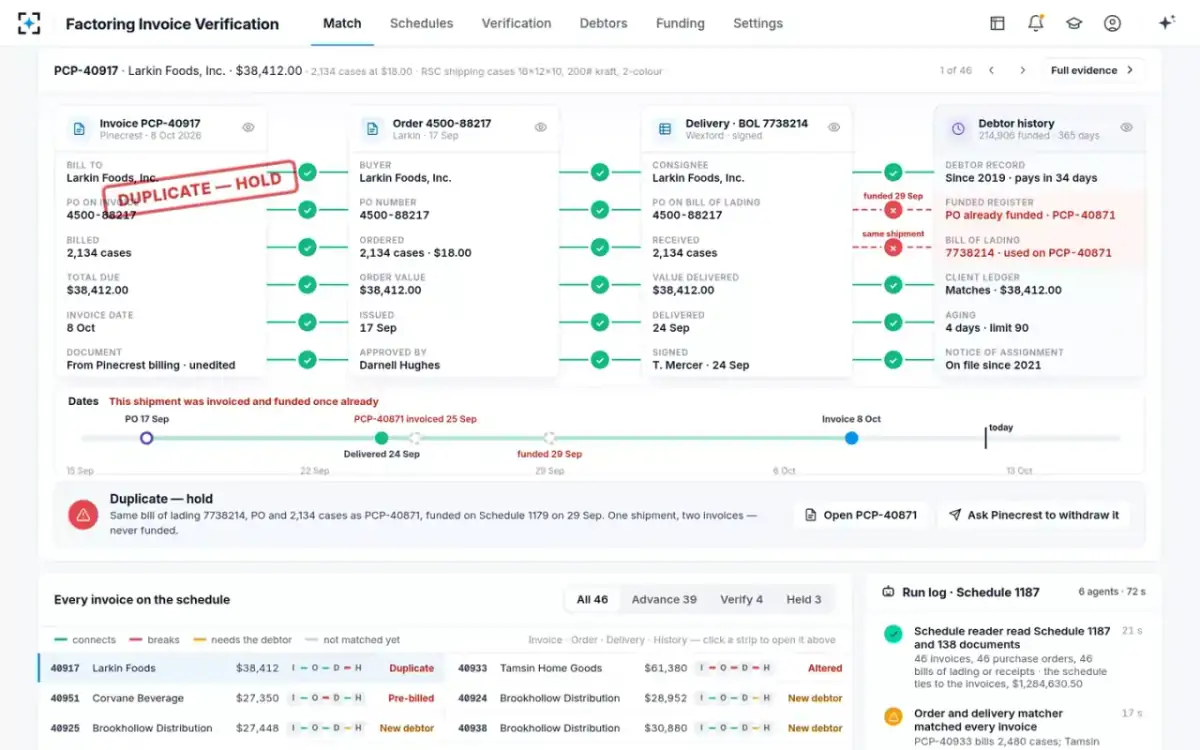
Factoring Invoice Verification's own duplicate and alteration detector is built around this limit explicitly: it fingerprints every invoice against everything funded in the last 365 days, for every client, but "a match is never cleared by an agent; it goes to a person." The detector's job is to surface the comparison — the same bill of lading, the same purchase order, the same case count, only the invoice number and date changed — and a verification specialist decides whether it is in fact the same shipment billed twice.
Where a flagged match goes, and who decides
Agent
Duplicate and alteration detectorFingerprints the invoice against every invoice funded for any client in 365 days, and reads the document’s own edit history.
Agent
Funding recommenderPuts the matched invoice into the hold lane with the reason, rather than the fund-now lane.
Never: does not approve or release funding
A person decides
Verification specialistReads the match, decides whether it is the same shipment or a coincidence, and holds or clears it by name.
This is not a limitation grafted on after the fact; it follows directly from the measurement problem above. A fingerprint match is strong evidence, not proof — two invoices can share a purchase order and quantity by legitimate coincidence on a client that splits large orders across several bills of lading. A person who can ask the client, or pull the actual documents side by side, resolves that ambiguity in a way no accuracy percentage can stand in for.
A fingerprint match, flagged and waiting on a person
How to test it on your own closed schedules first
The only test that answers the accuracy question honestly is a replay against a factor's own history. Taking schedules already funded and closed — where the outcome is already known, including any invoices that later turned out to be duplicate, altered or disputed — and running the detector against them shows the catch rate and false-hold rate on real data, with no risk to a live wire. Disagreements between what the system flags and what the factor's own records show are the ones worth scoring by hand, one by one, rather than averaging into a single number.
A short pilot, before a system touches a live schedule
- Pull 90 days of closed, already-funded schedules
Including any invoices known, after the fact, to have been duplicate, altered or disputed.
- Replay them through the system unmodified
No tuning to the known answers first — that is the test the catch rate is supposed to measure.
- Score every disagreement by hand
A miss (fraud the system didn’t flag) and a false hold (clean invoices it did) cost different things; keep them separate.
- Only then set the confirmation and fingerprint-field settings
Look-back window, fields compared, and how often clean invoices are randomly re-checked are all settings, not fixed behaviour.
What "demo" and "target" numbers in a vendor's materials actually mean
A number drawn from a vendor's own demonstration — one sample schedule, one run — is not evidence of a catch rate, and a reputable vendor should label it as such. Factoring Invoice Verification's own glance figures do exactly this: a 72-second run across a 46-invoice sample schedule, reading 138 documents and finding 4 exceptions, is marked as a demonstration on sample data, not a measured accuracy rate across a client base. The 100% figure for "every invoice matched to order, delivery and every funded invoice before the advance" is marked as a design target — what the system is built to do on every schedule, not a statistic about how often fraud is actually caught, which only a factor's own pilot can measure.
"In fact, the customers listed in the invoices Rodriguez provided to Victim-1 did not owe money to Old American for outstanding invoices and there were no accounts payable to turn over."
U.S. Attorney's Office, District of New Jersey, October 2026, on invoices submitted from February to July 2023
That case is a reminder that no detection method, automated or not, is free of the basic limitation: it can only check what it is shown against what it already knows. A fingerprint match catches a shipment billed twice; it does not, on its own, confirm that a debtor exists and owes the money, which is why a factor independently verifies new or unusual debtors as a separate check, not a substitute for this one.
It is also why "accuracy" for a fraud-detection system and "accuracy" for a data-entry or OCR tool mean different things, even though vendors sometimes quote both as a single percentage. A tool that reads a scanned invoice's amount correctly 99.5% of the time is solving a different problem from a tool that correctly distinguishes a genuine resubmission from a duplicate fraud attempt. The first is a reading-accuracy claim, checkable against a known-correct transcription. The second depends on a definition of "correct" that is itself a judgment call on the harder cases — which is exactly why Factoring Invoice Verification keeps that judgment with a named person rather than folding it into the agent's own confidence score.
Questions people ask
Can AI replace manual invoice review entirely?
No reputable design does this today, and Factoring Invoice Verification does not: agents read, match and fingerprint every invoice, but a verification specialist clears or holds every flagged match, and a funding officer releases every wire. The agents remove the mechanical reading and comparing; they do not remove the decision.
What is a false positive in fraud detection?
A clean invoice the system flags as suspicious — a false hold. It costs a client time waiting on money it was owed, and enough of them erode trust in the system faster than a missed fraud erodes trust in the absence of one. A useful pilot measures this rate explicitly, not just the catch rate.
How do I test AI fraud detection software before relying on it?
Replay it against 60–90 days of already-closed, already-funded schedules where the real outcome is known, unmodified by any tuning to those known answers, and score every disagreement by hand. That gives a catch rate and a false-hold rate specific to a factor's own invoices, rather than a vendor's demonstration set.
How is fraud normally caught today, without AI?
Mostly by a tip: 43% of cases in the ACFE's data, more than ten times the 3% found by external audit, and frauds found by automated monitoring were caught after a median 6 months, against 12 for tips. That is the baseline an automated check has to beat: it does not need to be flawless to improve on a detection method that depends on someone deciding to come forward.
Does AI invoice verification make mistakes?
Yes — any detection method does, on both sides: it can miss a fraud and it can flag a clean invoice. The design question is not whether mistakes happen but how they are caught, which is why every fingerprint match in Factoring Invoice Verification goes to a named person before an invoice is held or cleared, rather than being decided automatically.