AI invoice verification, in the way Factoring Invoice Verification builds it, is not one model making one decision about one invoice. It is six specialist agents, each doing one part of the work a verification specialist used to do alone — reading documents, matching them to each other, fingerprinting for duplicates, checking a debtor, checking limits, and recommending a lane — and each one carrying a stated limit on what it may never do. None of the six approves a wire. This guide goes through each agent, what it does, and where the line sits between what it may do and what stays with a person.
What can an AI agent do in invoice verification, and what can't it?
An AI agent in this kind of system can read, compare, fingerprint and recommend. It cannot approve funding, raise a credit limit, or clear a fraud match on its own authority. That distinction is not a safety feature bolted on afterward; it follows from what each agent is actually built to check, which is a narrow, specific comparison — not a judgment about whether to trust a client or pay a debtor's invoice. The table below lays out the six, each with its explicit never.
The six agents, what each checks, and what it may never do
| Agent | What it does | Never |
|---|---|---|
| Schedule reader | Reads the schedule of accounts and every invoice, purchase order and delivery proof in any layout, and ties the schedule to its documents. | never alters a submitted figure |
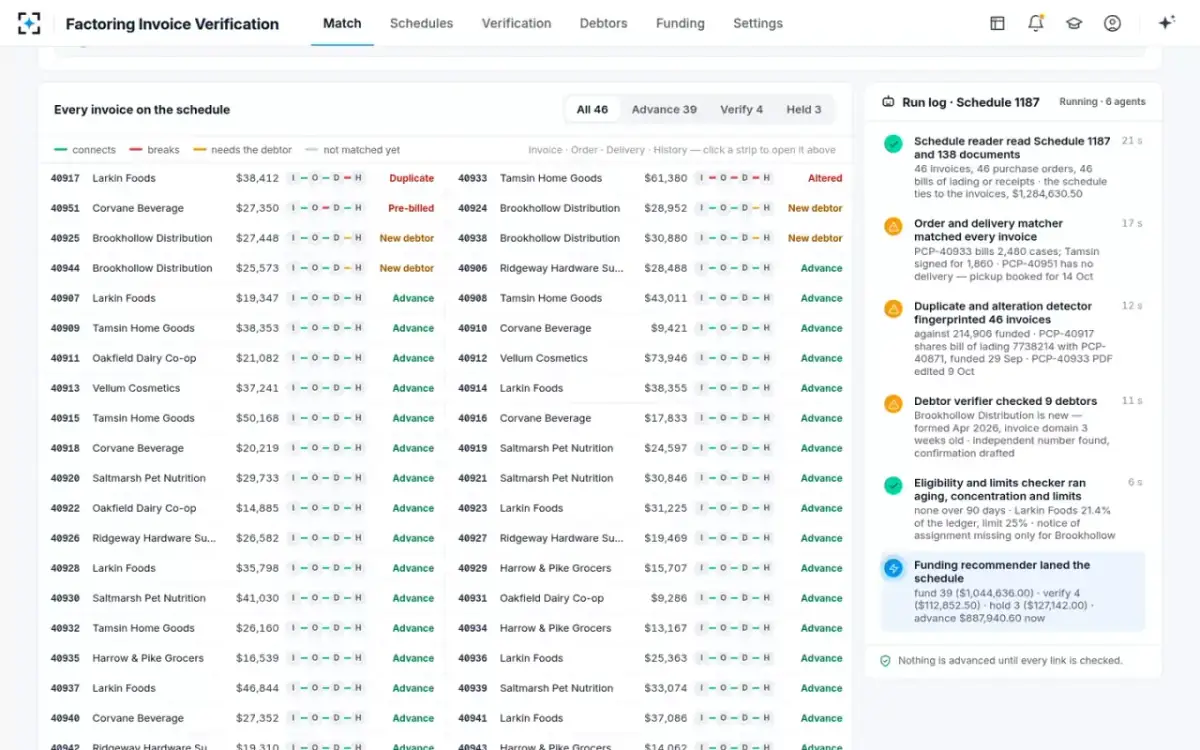
| Order and delivery matcher | Three-way match: invoice against purchase order against signed delivery or bill of lading — quantity, price, dates, ship-to. | never accepts an unsigned or future-dated delivery as proof |
| Duplicate and alteration detector | Fingerprints every invoice against every invoice funded for any client in 365 days, and reads the document’s edit history. | never clears a fingerprint match on its own |
| Debtor verifier | Checks each debtor’s history and, for new debtors, its registration, address and domain; finds an independent contact. | never uses a contact supplied on the invoice |
| Eligibility and limits checker | Checks aging, cross-aging, concentration, debtor credit limits, notice of assignment on file and the filing position. | never raises a limit |
| Funding recommender | Puts every invoice in a lane — fund, verify or hold — with its reason, and computes the advance. | never approves funding or moves money |
The schedule reader: reading documents, never altering a figure
Every schedule of accounts arrives in whatever layout a client uses — a spreadsheet, a scanned PDF, a photographed stack of invoices and bills of lading. The schedule reader's job is narrow: read every invoice, purchase order and delivery proof, and tie the schedule's totals to the documents behind them, citing the page and field for every value it reads. It never alters a submitted figure, even one that looks like an obvious typo — a number that is wrong is a reason to flag it for a person, not to quietly correct it.
This matters more than it first sounds, because the easiest-looking fix is often the wrong one. An invoice total that is a cent off a quantity-times-price calculation, for instance, could be a rounding difference, a typo, or a sign that a figure was changed after the invoice was generated. An agent that "helpfully" reconciled the cent and moved on would erase the one signal that something about the document does not quite add up. Citing the page and field for every value, rather than just presenting a clean summary, is what lets a specialist go back to the actual document when a number looks off, instead of trusting a reading they cannot check.
The order and delivery matcher: the three-way match, automated
Once the documents are read, the order and delivery matcher runs the three-way match: invoice against purchase order against signed delivery or bill of lading, checking quantity, price, dates and ship-to address all agree. Its stated limit is specific and important: it never accepts an unsigned or future-dated delivery as proof, and when a delivery is short, it reports the invoice at the delivered quantity rather than guessing that the rest is coming. A pickup booked for next week is not evidence that goods already shipped, however confidently an invoice states it.
The duplicate and alteration detector: fingerprinting, never clearing
This agent compares every new invoice against everything funded for any client in the last 365 days — not just the same client — on its bill of lading, purchase order, quantity, amount, ship-to and carrier reference, and separately reads the document's own edit history for signs of a post-issuance change. Its explicit limit: "a match is never cleared by an agent; it goes to a person." A fingerprint match is strong evidence that two invoices describe the same shipment, but confirming that, rather than a legitimate coincidence, is a judgment call a specialist makes, not the detector.
The debtor verifier: sourcing an independent contact, never the invoice's own
For a new or unusual debtor, the debtor verifier checks its registration, address and email domain, and — critically — sources a phone number independently of anything printed on the invoice itself, from a landlord's lease filing or a state business registration. Its limit: it never uses a contact supplied on the invoice, and it records where every contact came from. A phone number on a fraudulent invoice is exactly as fraudulent as the invoice; calling it only confirms that whoever wrote the invoice can also answer a phone.
The signals this agent weighs rarely condemn a debtor on their own. A business formed recently, an email domain registered only weeks ago, or a VoIP line on an invoice can each have an innocent explanation — a new entity set up for a single project, a fast-growing company that has not yet built out its own domain history, a remote accounts team that only uses VoIP. What the agent does is put several such signals next to each other and next to the signals that cut the other way, such as a signed delivery receipt at a real address or a lease with a named landlord, so the specialist who ultimately decides is working from the full picture rather than any one flag in isolation.
The eligibility and limits checker: checks, never raises, a limit
This agent checks an invoice against the rules that make it eligible to fund at all: aging, cross-aging against the same debtor, concentration against a client's whole book, the debtor's credit limit, and whether a notice of assignment is on file. Its limit is a single sentence: it never raises a limit. If an invoice would push a debtor's exposure over its approved ceiling, the agent reports that — it does not decide the ceiling should move to let the invoice through.
Concentration is worth dwelling on, because it is the eligibility check most easily missed by eye. A client whose schedule looks diversified across nine debtors can still be dangerously concentrated if one debtor accounts for a disproportionate share of the purchased book once every open schedule is added up, not just the one in front of a specialist that morning. The eligibility and limits checker runs this comparison across everything currently funded for a client, not just the day's schedule, which is exactly the kind of running total a person re-adding by hand, schedule after schedule, is most likely to let drift.
The funding recommender: recommends a lane, never approves funding
The last agent in the chain puts every invoice into one of three lanes — fund now, verify with the debtor, or hold — with the reason stated, computes the advance for the clean ones, and drafts the funding report and the client notice. Its own stated limit: "never approves funding or moves money. Recommends; the specialist decides and the funding officer releases." In Factoring Invoice Verification's own worked example, 39 of 46 invoices on one schedule were recommended for the fund-now lane — a recommendation the specialist still had to approve before anything moved.
Six agents, one chain, one person at the end of it
Agent
Schedule readerReads every invoice, order and delivery proof, citing page and field.
Agent
Order and delivery matcherThree-way match on quantity, price, dates and ship-to.
Agent
Duplicate and alteration detectorFingerprints against 365 days of funded invoices, for every client.
Agent
Debtor verifierSources an independent contact and drafts the confirmation.
Agent
Eligibility and limits checkerChecks aging, concentration and debtor limits.
Agent
Funding recommenderRecommends a lane and computes the advance.
A person decides
Verification specialistDecides every verify and hold, and approves the schedule.
What none of the six agents can see
Every agent in the chain works on documents and records that exist before the wire. That defines the edge of what they can catch. They cannot see goods that were never on the invoice at all, a client's cash position next week, or what a client does with a debtor's payment if the payment reaches the client instead of the factor. The last gap is the expensive one. In a federal case in Minnesota, a factor bought more than $2.6 million of a medical services company's receivables in 2018; the executives then failed "to pay over the receivables as they were collected", told the factor "that no funds had been received", and wired more than $5 million overseas. Both pleaded guilty to wire fraud in December 2023 (U.S. Attorney's Office, District of Minnesota).
No document check on the morning of funding could have caught that, because nothing was wrong with the invoices. What closes it is the structure around the agents: the debtor verifier's confirmation call and the notice of assignment it drafts, which tell the debtor to pay the factor directly, and the eligibility checker's watch on aging and days to pay, which turns money that should have arrived into a flag. The agents narrow the risk on the paper; the payment path is a decision the factor builds into the deal.
Why a person decides, and a person releases
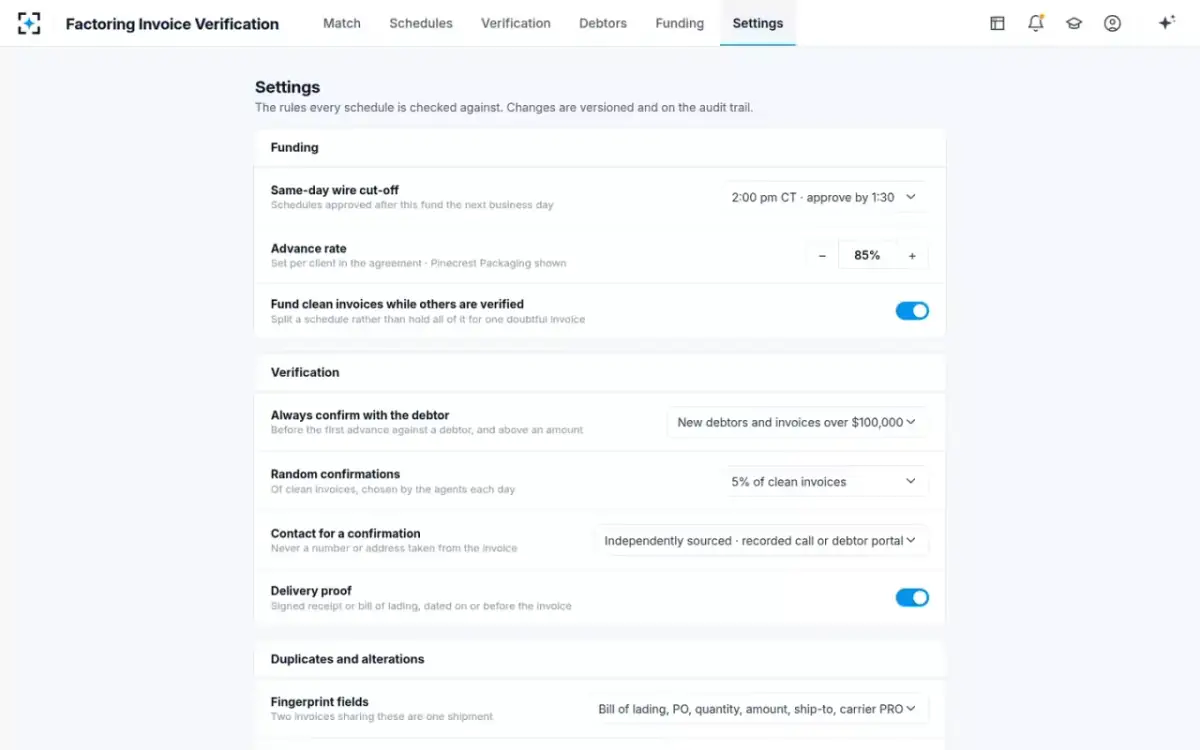
The pattern across all six agents is the same: each does a specific, checkable comparison, and none of them crosses into a decision that commits the factor's money or its relationship with a client or debtor. That split tracks established guidance on automated decisioning in lending more broadly, not something specific to invoice verification. The OCC's Comptroller's Handbook, describing automated credit approval generally, states that "decision criteria for auto approvals and manual reviews should adhere to the bank's written guidelines and be approved by the appropriate level of management according to internal policy delegations," and that "a clear audit trail should document the approval process." Factoring Invoice Verification's own governance follows the same shape: the verification specialist decides every verify and hold, the funding officer releases every wire, and above $1,500,000 the credit manager releases alongside them.
The same handbook, quoting the interagency guidelines on internal controls that apply to any bank, states that an institution should have "an organizational structure that establishes clear lines of authority and responsibility for monitoring adherence to established policies" — a requirement that exists independently of whether the work behind it is done by a person or a chain of agents. Automating the comparison does not change who is accountable for the decision built on top of it.
It is worth being specific about what "a person decides" buys that a confidence score alone does not. A person can ask a question the agent cannot: calling a client about a flagged invoice, checking whether a debtor has a reasonable explanation for a short delivery, or simply noticing that two held invoices on the same morning share a detail none of the six agents happened to compare. The agents narrow a large schedule down to the handful of things worth a specialist's attention; they do not, and are not meant to, replace the judgment a specialist applies once that handful is in front of them.
What changed when six agents took the first pass, and what didn't
Before: A specialist reads every invoice, order and delivery proof by hand.
With six agents: The schedule reader ties the schedule to its documents in seconds, citing page and field.
Before: Spot checks, and a few calls to debtors in business hours.
With six agents: Every invoice matched to its order and delivery automatically, with a short list to verify.
Before: Only the invoices a specialist happens to remember or look up.
With six agents: Every invoice fingerprinted against 365 days of funded invoices, for every client.
Before: The specialist, after doing the checking themselves.
With six agents: The specialist still decides — now starting from the agents’ findings, not a blank schedule.
Before: The funding officer, on the specialist’s word.
With six agents: The funding officer, on the specialist’s approval — unchanged.
Human judgment should be employed when deciding on the specific metrics related to AI trustworthiness characteristics and the precise threshold values for those metrics.
National Institute of Standards and Technology, AI Risk Management Framework 1.0
That line, from NIST's AI Risk Management Framework, is the general case of what each of these six agents already does narrowly: setting the threshold for "this looks like the same shipment" or "this delivery looks short" is a judgment a person makes, informed by what the agent found, not a number the agent is trusted to decide alone. A real case shows why that judgment still matters even when a check exists: in Idaho, a federal jury "convicted Worman of 17 counts of wire fraud relating to his factoring scheme after a six-day trial in August 2024" — a scheme of "inflated and entirely false and fraudulent" invoices that ran from at least 2015 to September 2018 (U.S. Attorney's Office, District of Idaho). Each check in this chain exists so that a scheme that long meets a standing comparison on its first invoice, not a reviewer's memory on its hundredth.
The run log: six agents, each finding attributed
Where the rules the agents check against live
Questions people ask
What can AI do in accounts receivable, specifically?
In Factoring Invoice Verification, AI reads documents, runs a three-way match, fingerprints invoices for duplicates, sources an independent debtor contact, checks eligibility rules, and recommends a funding lane. It does not approve funding, raise a credit limit, or clear a fraud match without a person's decision.
Can AI approve a wire payment?
No. The funding recommender computes the advance and proposes a lane, but the verification specialist approves the schedule and the funding officer releases the wire — above $1,500,000, the credit manager releases alongside them. No agent in the chain can move money.
Who is responsible when AI makes a mistake in finance?
The person who approved the decision built on the agent's finding, which is exactly why each agent's output is a recommendation with its evidence attached, not an autonomous action. The OCC's guidance on automated credit decisioning expects clear accountability and an audit trail regardless of what tooling produced the recommendation.
Can AI raise a credit limit on its own?
No. The eligibility and limits checker's stated limit is that it never raises a limit — it reports when an invoice would exceed a debtor's approved ceiling, and raising that ceiling is a decision for the credit manager.
How does AI check a debtor before an invoice is funded?
The debtor verifier checks the debtor's registration, address and email domain for anything unusual, and for a new or flagged debtor it sources a phone number independently — never one printed on the invoice itself — and records exactly where that contact came from.
What is an AI agent in finance, in practical terms?
A narrow, specific check — a comparison, a lookup, a fingerprint match — performed consistently on every case rather than occasionally by a person with limited time. The agent's value is in doing one thing the same way every time; the decision built on what it finds still belongs to a person.