A notice of assignment is a short, specific letter that does one thing: it tells a debtor — the factoring client's own customer — that an invoice it owes has been sold to a factor, and that payment now has to go to the factor, not the vendor it has always paid. It sounds like a formality. Under Article 9 of the Uniform Commercial Code it is closer to a legal switch: once a debtor receives a valid notice of assignment, paying anyone else simply does not discharge the debt, no matter how long the debtor has done business with the original vendor.
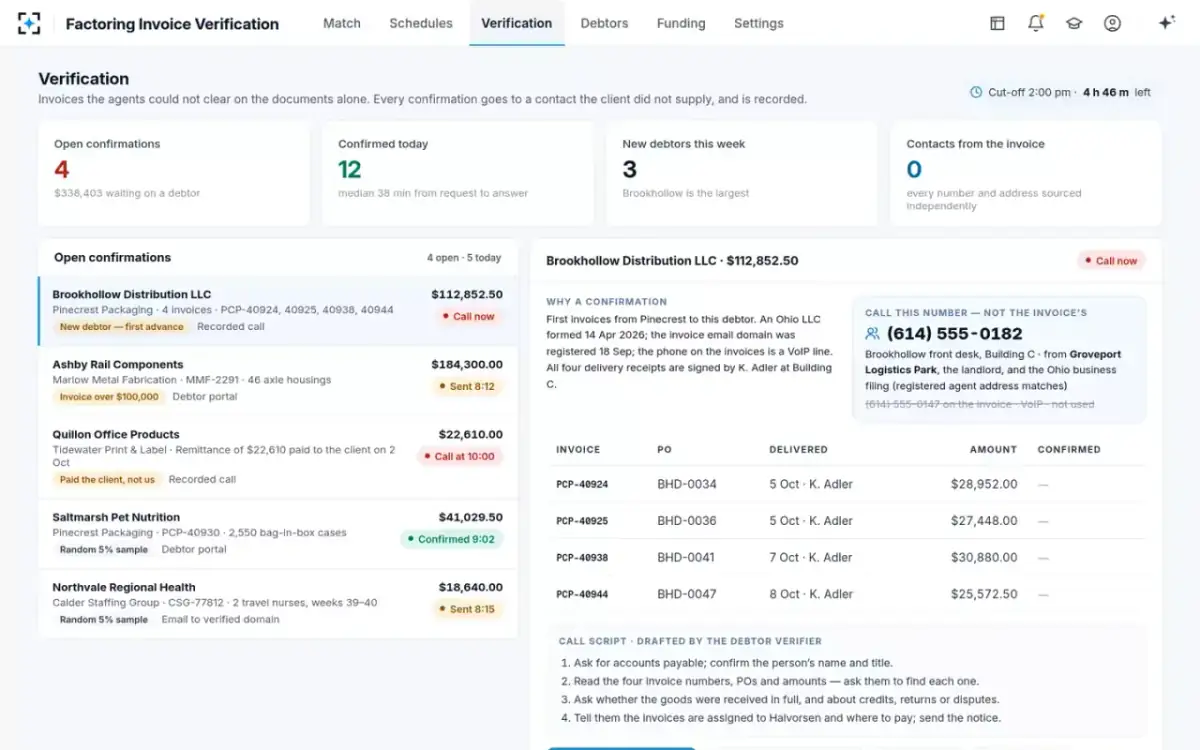
Botminds' Factoring Invoice Verification treats the notice as a precondition, not a formality: its debtor verifier agent drafts one for every new debtor and every new invoice relationship, built from a contact it found independently — never a phone number or email taken from the invoice itself. The example below is a fictional sample case from Halvorsen Trade Capital, the factor, funding invoices for its client Pinecrest Packaging Co.
What is a notice of assignment, in plain words?
A notice of assignment is written confirmation, sent to a debtor, that its vendor has sold a specific invoice or set of invoices to a factor, with instructions to pay the factor directly from that point forward. It is not a request. It is not negotiable with the debtor, who had no say in whether its vendor chose to factor its receivables. It exists to solve one problem: without it, a debtor has no way of knowing that paying its usual vendor no longer satisfies the debt, and a factor has no way of proving the debtor was told.
What a notice of assignment has to establish
"Authenticated by the assignor or the assignee": the vendor or the factor, not a third party.
A notice is ineffective if it does not "reasonably identify the rights assigned": the invoices or account, by number and amount.
That the amount "has been assigned and that payment is to be made to the assignee", with where and how. A notice asking for less than the full installment can be ignored at the debtor's option.
That paying the old vendor will no longer discharge the debt, and how to ask for proof of the assignment.
UCC 9-406: the rule that makes it binding
The rule comes from Article 9 of the Uniform Commercial Code, adopted with only minor variation in every US state, and it is unusually direct for a statute. Cornell's Legal Information Institute publishes the operative text: a debtor "may discharge its obligation by paying the assignor until, but not after, the account debtor receives a notification, authenticated by the assignor or the assignee, that the amount due or to become due has been assigned and that payment is to be made to the assignee". The moment that changes is receipt, not agreement — the debtor does not have to accept, sign or acknowledge anything for the rule to apply.
What happens on the other side of that moment is just as direct: "After receipt of the notification, the account debtor may discharge its obligation by paying the assignee and may not discharge the obligation by paying the assignor" (UCC § 9-406(a)). Not "should not." May not. A debtor that keeps paying its old vendor after a valid notice has not paid the debt at all, as far as the factor is concerned — it has simply made a payment to someone who was no longer entitled to receive it.
What happens if a debtor keeps paying the old creditor?
The debt to the factor stays open. If a debtor pays its old vendor after receiving a valid notice of assignment, that payment does not count against what it owes the factor — the debtor can, in principle, be made to pay twice, once to the wrong party and once, correctly, to the assignee. In practice this rarely needs to be litigated to the end, because a debtor facing that exposure has every reason to pay the factor once it understands the notice is real. The incentive the statute creates is exactly what makes the notice work without the factor having to chase every payment by hand.
This is also why the timing of the notice matters more than its wording. A notice sent after a client's business has already collapsed, or after a debtor has already paid in good faith, protects nobody — the money is gone, and proving a technical right to it after the fact is a legal cost, not a recovery. A notice sent before the first advance means the debtor's payment obligation is redirected before there is any money at risk of going to the wrong address.
What proof can a debtor demand before paying the factor?
A debtor is not required to take a notice of assignment on faith, and the statute gives it a specific right to ask for confirmation. Under UCC § 9-406(c), "if requested by the account debtor, an assignee shall seasonably furnish reasonable proof that the assignment has been made" — and until the factor does, the debtor may keep paying the old vendor without penalty. This cuts both ways: it protects a debtor from acting on a fraudulent or mistaken notice, and it gives a factor a clear, narrow obligation — produce proof promptly, or lose the protection the notice was supposed to provide.
What counts as reasonable proof is not fixed by the statute, which is deliberate; a signed assignment agreement, a copy of the factoring agreement covering the specific account, or a call back to a verified contact at the factor are all common. What should never count, on either side of the relationship, is a number or address printed on the invoice or the notice itself — exactly the channel a fraudulent notice would also use. Why a bad invoice looks clean goes through how invoices and their supporting documents get faked in ways that look identical to the real thing.
Sourcing a number the invoice never offered
Worthy Lending v. New Style Contractors: what the court decided
New York's highest court read the rule broadly in Worthy Lending LLC v. New Style Contractors, Inc., decided on 22 November 2022. Worthy was not a factor but a lender with a security interest in its borrower Checkmate's receivables, and its notice told New Style, Checkmate's customer, that "payments of accounts made by New Style to Checkmate or to anyone other than Worthy Lending will not discharge any of New Style's obligations with respect to such Accounts". After Checkmate defaulted, Worthy sued New Style for amounts it alleged were paid to Checkmate after the notice. The lower courts dismissed the claim because Worthy held a security interest rather than an outright assignment. The Court of Appeals reversed: "for purposes of New York's Uniform Commercial Code § 9-406, an 'assignee' includes the holder of a presently exercisable security interest in an assignor's receivables", and it sent the case back for further proceedings.
Two lessons follow for a factor. A notice redirects payment whether the factor bought the invoice outright or lent against it, so the paperwork form of the deal is not the debtor's escape. And the notice that reached the state's highest court did what a good notice should: it told the debtor in bold type what the law required of it, in language a non-lawyer at an accounts-payable desk could act on. The court also noted the debtor's side of the bargain: one "in doubt, can seek proof" under 9-406(c) "and withhold payment in the interim".
Why a factor sends the notice before the first advance, not after
A notice of assignment sent after the money has already gone out protects a factor's legal position but not its cash. If a debtor pays the old vendor before ever receiving notice — because the factor advanced first and planned to notify later — the factor has no 9-406 claim against that specific payment at all; notice has to precede the payment it is meant to redirect. Halvorsen Trade Capital's rule, built into the solution's verification settings, is that every new debtor is confirmed and sent a notice before the first advance against it, not after.
A notice is also worthless against the worst version of this risk: a debt that was never real to begin with. A federal case in New Jersey shows both halves. Joseph Rodriguez's company, Old American, had a factoring agreement under which it "retained control over customer relationships and debt collection" — no notice went to the customers — and from February to July 2023 he submitted invoices for receivables where, in the government's words, "the customers listed in the invoices Rodriguez provided to Victim-1 did not owe money to Old American for outstanding invoices and there were no accounts payable to turn over". The factor advanced more than $4.6 million; Rodriguez pleaded guilty to wire fraud in October 2026 (U.S. Attorney's Office, District of New Jersey). No notice of assignment can bind a debtor who owes nothing; confirming that the debtor exists, is a real operating business, and actually owes the amount billed has to come before the notice is worth sending at all — which is precisely what an independently sourced confirmation call checks for.
From a new debtor to a protected advance
Agent
Debtor verifierChecks whether the debtor is new; if so, sources an independent contact from public records, never the invoice.
Agent
Debtor verifierDrafts the confirmation call script and the notice of assignment for the specialist to send.
A person decides
Verification specialistCalls the independently sourced number, confirms the invoices, and sends the notice.
A person decides
Credit managerApproves the new debtor's credit limit before the first advance against it.
On the fictional sample schedule, Brookhollow Distribution LLC was new to Pinecrest Packaging. Gloria Benet, its accounts payable manager, confirmed all four invoices on a recorded call at 11:20 am and acknowledged the notice of assignment in the same call; Walt Brennan, Halvorsen's credit manager, approved a $150,000 credit limit eleven minutes later, before any of the $112,852.50 those invoices represented was advanced. The sequence — verify, notify, then fund — is what turns 9-406 from a legal right into an actual protection.
What a notice changes, the moment it's received
Before
the debtor may pay the old vendor and the debt is discharged
After
the debtor may not discharge the debt by paying the old vendor
Can an anti-assignment clause block a factor?
Usually not, for an ordinary invoice. Many commercial contracts include a clause barring either party from assigning its rights without the other's consent, and a debtor sometimes points to one to argue a factoring sale was invalid. UCC § 9-406(d) answers this directly for accounts receivable: a contract term that "prohibits, restricts, or requires the consent of the account debtor" to an assignment is, with narrow exceptions, simply ineffective. The same subsection goes further than most people expect: a term is also ineffective to the extent it "provides that the assignment ... may give rise to a default, breach, right of recoupment, claim, defense, termination" or other remedy. So the clause neither stops the assignment nor turns it into a breach the debtor can use against the vendor.
The exception matters for what a factor is actually buying. Section 9-406(e) carves out "the sale of a payment intangible or promissory note" from this override — but ordinary trade invoices are "accounts" under Article 9's definitions, not payment intangibles or notes, so routine invoice factoring falls squarely inside the rule that makes anti-assignment clauses unenforceable, not the narrower exception.
What a factor's own notice has to say
A notice that merely states "this invoice has been assigned" leaves a debtor's accounts-payable desk with more questions than it answers. A complete notice identifies the specific invoices or account by number, names both the assignor and the assignee, states where and how to send payment going forward, and — as Worthy Lending's did — tells the debtor plainly what the law requires: that paying anyone else no longer discharges the debt. It should also tell the debtor how to request proof of the assignment under 9-406(c), since a debtor that already knows it can ask has less reason to stall.
Confirmed, and the notice acknowledged in the same call
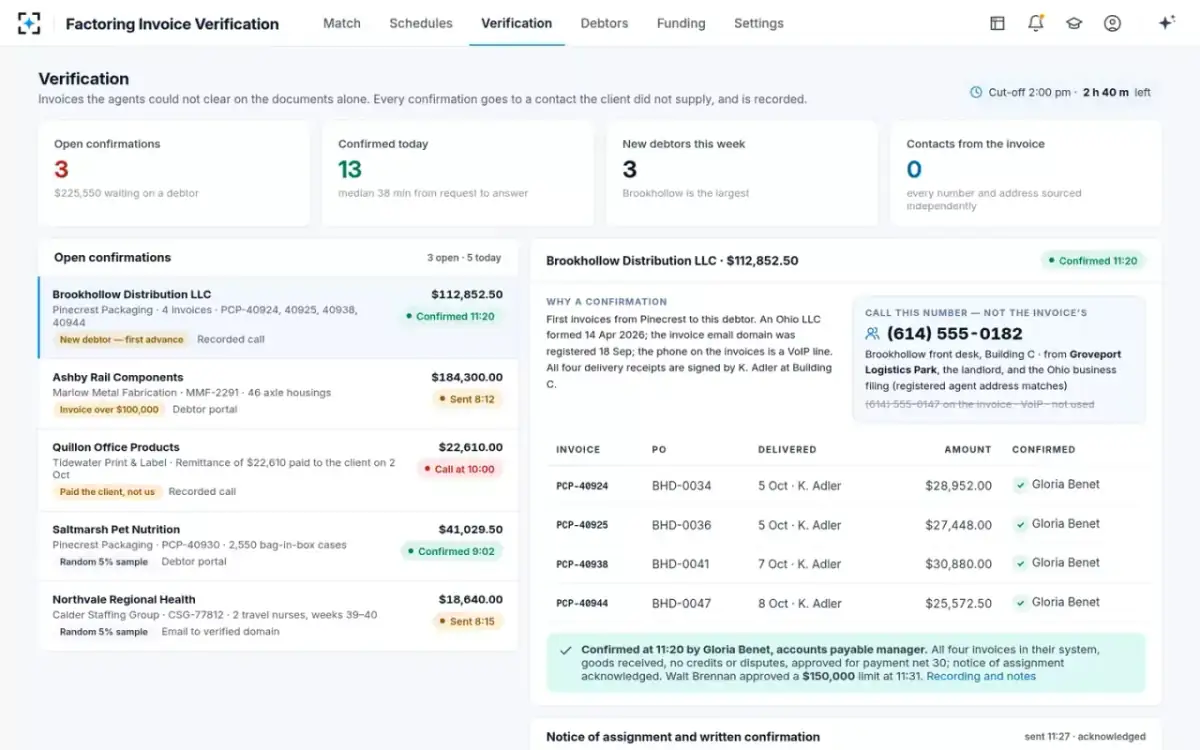
What a factor cannot control is whether the debtor pays promptly even after a valid notice — invoice fraud and plain non-payment are different risks, and what invoice fraud costs a factor covers the first. The notice of assignment only answers who has the right to be paid; it does not make the debtor pay on time. To see the confirmation call, the notice and the credit decision together on one debtor, start from Factoring Invoice Verification.
Questions people ask
What is a notice of assignment?
A written notice telling a debtor that an invoice or account it owes has been sold to a factor, with instructions to pay the factor, not the original vendor, from that point on. Under UCC 9-406, it becomes binding the moment the debtor receives it, whether or not the debtor agrees to it.
What happens if I pay the wrong company after a notice of assignment?
The payment does not discharge the debt. UCC 9-406 states that once a debtor receives a valid notice, it "may not discharge the obligation by paying the assignor" — meaning the debtor can still be required to pay the factor, even though it already paid someone else in good faith.
Can a debtor demand proof of an assignment?
Yes. UCC 9-406(c) gives a debtor the right to ask the factor for "reasonable proof that the assignment has been made," and until the factor provides it, the debtor may keep paying the original vendor without being in breach.
Can a contract block assignment of an invoice?
Generally no, for an ordinary trade invoice. UCC 9-406(d) makes most contract clauses that prohibit or restrict assigning an account ineffective, and it also makes a clause ineffective to the extent it would treat the assignment as a default or breach. Consumer debts and sales of payment intangibles and promissory notes follow different rules.
Do I have to pay the factor instead of my original vendor?
Once you have received a valid, properly supported notice of assignment, yes — continuing to pay the original vendor does not count as paying the debt. You can ask the factor for reasonable proof of the assignment first, and should verify any contact details independently rather than trusting what the notice itself provides.
What is an account debtor?
The party that owes payment on an invoice or account — in factoring, the factoring client's own customer, not the client itself. UCC 9-406 uses this term specifically because its rules govern the debtor's payment obligation once that account has been assigned to a factor.