Invoice verification software for factoring has moved through three generations, and most factors still running the first one do not know a better baseline exists. Spot checks catch whatever a specialist happens to look at closely on a busy morning. Rules engines and OCR catch what someone thought to write a rule for. The newer generation — Factoring Invoice Verification among it — fingerprints every invoice against everything a factor has ever funded, for every client, and keeps a person clearing every match. This guide sets out what actually changed, and the tests to put to any vendor, including this one, before switching.
What to look for in invoice verification software for factoring
Three things separate a system that catches fraud from one that merely looks like it does: whether it checks against every client's funded history or only the one in front of it, whether a person clears every flagged match or the software decides alone, and whether changing a rule — an advance rate, a confirmation threshold — leaves a record of who changed it and when. Everything below expands on those three, because they are the questions a demonstration rarely answers on its own.
Spot checks: what the old way catches, and misses
A spot check is a specialist reading an invoice, a purchase order and a bill of lading, and deciding by eye whether they agree. It catches what is obviously wrong — a quantity that does not match, a date that makes no sense — on the invoices a specialist has time to look at closely. It does not catch a shipment invoiced twice to two different schedules weeks apart, because no person holds every invoice a factor has ever funded in memory. It is also the slowest method, which is why it tends to concentrate on the largest invoices and let smaller ones through with less scrutiny, precisely where a scheme can hide.
Spot checks also do not scale with volume the way a factor's book does. A specialist who can carefully review a set number of invoices a day reviews that same number, however many more the clients send; the rest get a lighter look, or wait. When a factor adds clients, the choice is usually to hire more specialists at the same thoroughness, or keep the same team and let thoroughness slip. Neither option changes the ceiling on how many invoices one person can hold in memory well enough to notice a pattern across schedules weeks apart.
Rules engines and OCR: what improved, and what didn't
Optical character recognition and rules engines automated the reading: a system extracts the fields from a scanned invoice and checks them against a list of conditions someone configured — flag anything over $50,000, flag a new debtor, flag a date more than 30 days old. This is real progress over a spot check, because it applies consistently and does not tire by the end of a shift. What it did not solve is the comparison problem: a rules engine checks an invoice against a static list of conditions, not against every other invoice a factor has ever funded, so a duplicate with a changed invoice number still passes if nothing on the rule list catches it.
Rules engines also age in a particular way: every new scheme a fraud examiner sees gets added as one more condition, so the rule list grows every year without anyone going back to check whether the older rules still earn their keep. A list long enough eventually flags too much to review carefully, which pushes staff toward rubber-stamping flagged invoices rather than reading them — the opposite of what the rule was added to achieve. A comparison against a rolling history of funded invoices does not have this failure mode, because it does not depend on someone having anticipated the specific pattern in advance.
Agentic verification: what actually changed
The newer generation adds two things a rules engine does not do on its own: a fingerprint comparison against a rolling history of every invoice funded for every client, not a fixed rule list, and documents read and compared to each other automatically rather than merely extracted into fields. Factoring Invoice Verification's own duplicate and alteration detector compares a new invoice's bill of lading, purchase order, quantity, amount, ship-to and carrier reference against 365 days of funded invoices across every client, and separately reads a PDF's own edit history for a change made after issuance. Neither comparison is the kind of thing a rule list specifies in advance, because the thing being checked against — every other invoice already funded — changes every day.
Three generations of invoice verification, row by row
Spot checks / rules engine: A static rule list, or whatever a specialist remembers.
Agentic verification: Every invoice funded for every client in a rolling window — 365 days, in Factoring Invoice Verification’s own default.
Spot checks / rules engine: Only if a specialist happens to recognise it, or a rule catches the exact pattern.
Agentic verification: A fingerprint comparison on bill of lading, purchase order, quantity, amount, ship-to and carrier reference.
Spot checks / rules engine: Not unless someone opens the file’s properties by hand.
Agentic verification: The document’s own edit history is read as part of the check.
Spot checks / rules engine: Whoever configured the rule, implicitly, when the invoice passes.
Agentic verification: A named person, every time — the software never clears a match on its own.
Spot checks / rules engine: Often an unlogged configuration change.
Agentic verification: A versioned setting, on the audit trail, with who changed it and when.
The fingerprint test: does it check every client, or only yours?
This is the single most revealing question to put to any vendor, because it is easy to overstate in a demonstration. A system that compares a new invoice only against the same client's own history will miss a shipment that was invoiced once to one factoring client and then, months later, invoiced again under a different company name to a different client of the same factor — exactly the kind of scheme a cross-client fingerprint is built to catch. Factoring Invoice Verification's own default checks 365 days, across all clients, and the look-back window and fingerprint fields — bill of lading, purchase order, quantity, amount, ship-to, carrier reference — are both settings a factor can widen or narrow, not fixed behaviour.
A demonstration is also the easiest place for this distinction to get blurred without anyone intending it: a vendor showing a system catch a duplicate within one client's own schedule has shown something real, but not the harder case. Asking to see the same system fail to find a match when asked, on a pair of invoices from two different clients that share no obvious connection beyond the underlying shipment, is a more honest test than asking it to find the easy, same-client duplicate it was likely tuned to demonstrate.
Why the comparison has to be wide, not just automated
22%
of occupational fraud cases are billing schemes, where a false or inflated invoice gets paid
100K
median loss on a billing scheme, which runs a median 18 months before it is caught
17%
of organisations use AI against payments fraud of any kind, today
The control test: does a person clear every match, or does the software?
A system that resolves its own fingerprint matches — silently clearing anything below a confidence threshold — is making a credit decision without anyone at the factor having made it. This is the same principle government auditing standards apply to any control: the GAO's Standards for Internal Control in the Federal Government states that management "considers the need to separate control activities related to authority, custody, and accounting of operations to achieve adequate segregation of duties," and, where that separation is not practical, "designs alternative control activities to address the risk." A fingerprint detector that both finds a match and clears it collapses exactly the separation that standard describes. Factoring Invoice Verification's detector is built the other way: "a match is never cleared by an agent; it goes to a person."
The audit-trail test: are rule changes versioned?
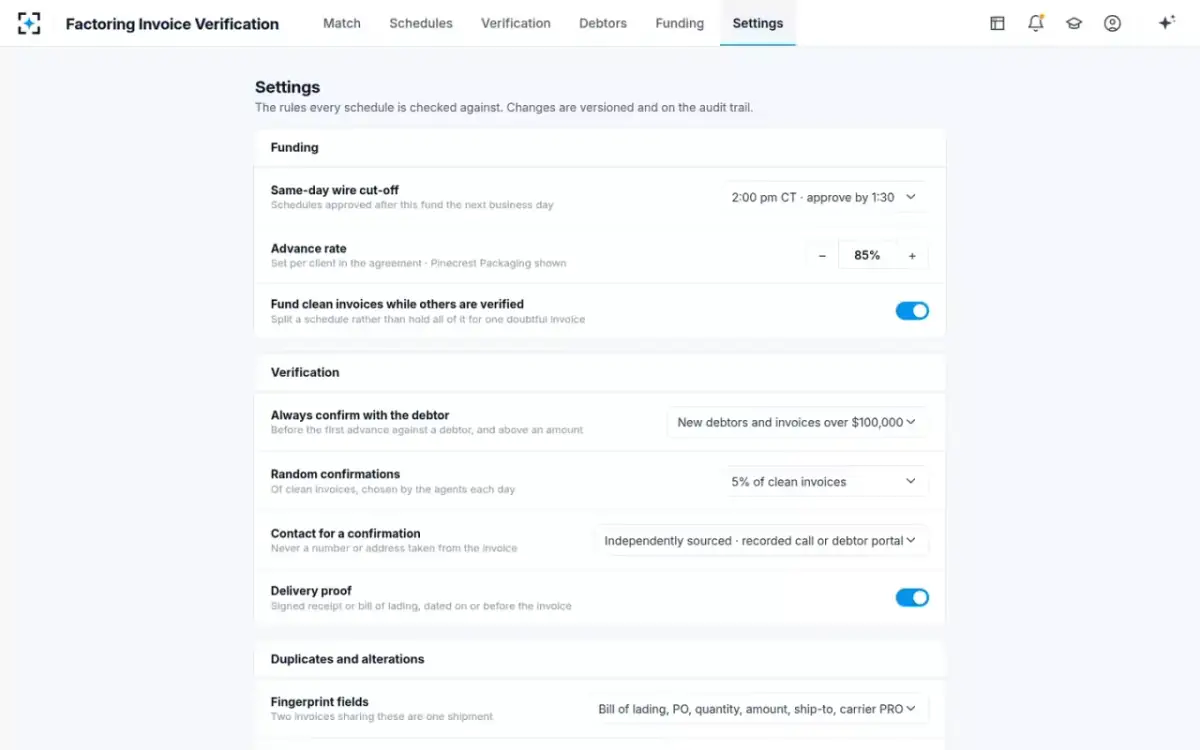
An advance rate, a confirmation threshold, a fingerprint field list, or who may release a wire alone up to what amount — these are policy, and policy changes. The question for any system is whether changing one of them leaves a record: who changed it, from what, to what, and when. Factoring Invoice Verification treats its entire rules panel this way — cut-off, confirmation thresholds, random confirmation rate, fingerprint fields, look-back, ineligibility window, concentration limit and release authority are all settings, and "changes are versioned and on the audit trail."
This matters most on the day something goes wrong, not the ordinary day. If a debtor disputes an invoice months after it funded, or an examiner asks why a particular schedule was treated differently from the policy on file, the useful answer is not "here is what the setting is today" but "here is what the setting was on the day that invoice was checked, and who set it there." A factor that cannot answer the second question is relying on memory and good faith to reconstruct a decision that should have been recorded the moment it was made.
A factor's own rules, as settings rather than a project
| Setting | Sample value | Other options |
|---|---|---|
| Same-day wire cut-off | 2:00 pm CT · approve by 1:30 | 3:00 pm CT, or 12:00 pm CT |
| Fingerprint fields | Bill of lading, PO, quantity, amount, ship-to, carrier PRO | A narrower set, down to invoice number and amount only |
| Look-back for duplicates | 365 days · all clients | 180 days, or limited to one client |
| Funding officer releases alone | Up to $1,500,000 | $1,000,000, or $2,500,000 |
The report test: can the numbers be traced back to records?
A factor's verification system also produces the numbers it reports upward, to its own credit committee and, often, to the bank that finances its book. Those reports are only as honest as the link between each figure and the invoice records behind it. The Galano case in New Jersey is the warning. Vincent Galano's factoring company drew for years on a lender's credit line while he "routinely distributed to lenders over that prolonged period fabricated reports that overstated the number and value of outstanding invoices", counting invoices already "paid and collected as outstanding"; by 2020 the company owed its lenders about $50 million, and he was sentenced to 63 months in prison (U.S. Attorney's Office, District of New Jersey, October 2022).
The question to put to a vendor follows directly: is every figure in the portfolio report computed from the invoice-level records, with each invoice's status traceable to the document or confirmation that set it, or can a summary be edited after the fact? A system in which held, funded and collected are states on the invoice itself, changed only with a name and a time on the audit trail, gives a factor's lender something it can test, not just a spreadsheet it has to trust.
How to pilot it on your own last schedules before switching
The fairest test of any invoice verification software is a replay against schedules a factor has already closed, where the real outcome — including any invoice that later turned out to be duplicate, altered or disputed — is already known. Running a candidate system against 60 to 90 days of that history, unmodified, shows what it would have flagged without any risk to a live wire, and every disagreement between the system and the factor's own record is worth a specialist's time to read by hand.
A pilot worth running has three stages, not one. First, replay against history with the vendor's default settings, to see how a system behaves before anyone has tuned it to a factor's own book. Second, replay again after setting the factor's actual advance rates, confirmation thresholds and fingerprint fields — a system that only performs well on its own defaults is a system a factor has not actually tested. Third, run a short period live, in parallel with the existing process rather than replacing it, so a specialist still makes every decision while the two methods are compared side by side. Only after that third stage has it been proven on live schedules, not just historical ones.
The parallel-run stage is where most of the genuine surprises show up, because it is the first point at which the new system sees invoices nobody has already resolved by hand. A factor that skips straight from a historical replay to a full cutover is betting that nothing about live schedules differs from the closed ones used to test it — a bet that a short period of running both side by side, at the cost of a little extra review time, removes entirely.
Questions to put to any vendor before buying
- Does the fingerprint check cross every client, or only the one invoice’s own client?
A cross-client comparison catches a scheme a single-client rule list cannot.
- Can a match be cleared without a named person signing off?
If the answer is yes under any condition, ask exactly what that condition is.
- Is a rule change — advance rate, threshold, fingerprint fields — versioned and attributable?
Ask to see an actual change history, not a description of the feature.
- How long does it take to go live on our own policy, not a default?
A factor’s own advance rates, cut-off and eligibility rules should be configuration, not a re-implementation.
- Can we replay it against our last 90 days before committing?
A vendor confident in its own catch rate should welcome this test.
A factor's own rules panel, not a vendor default
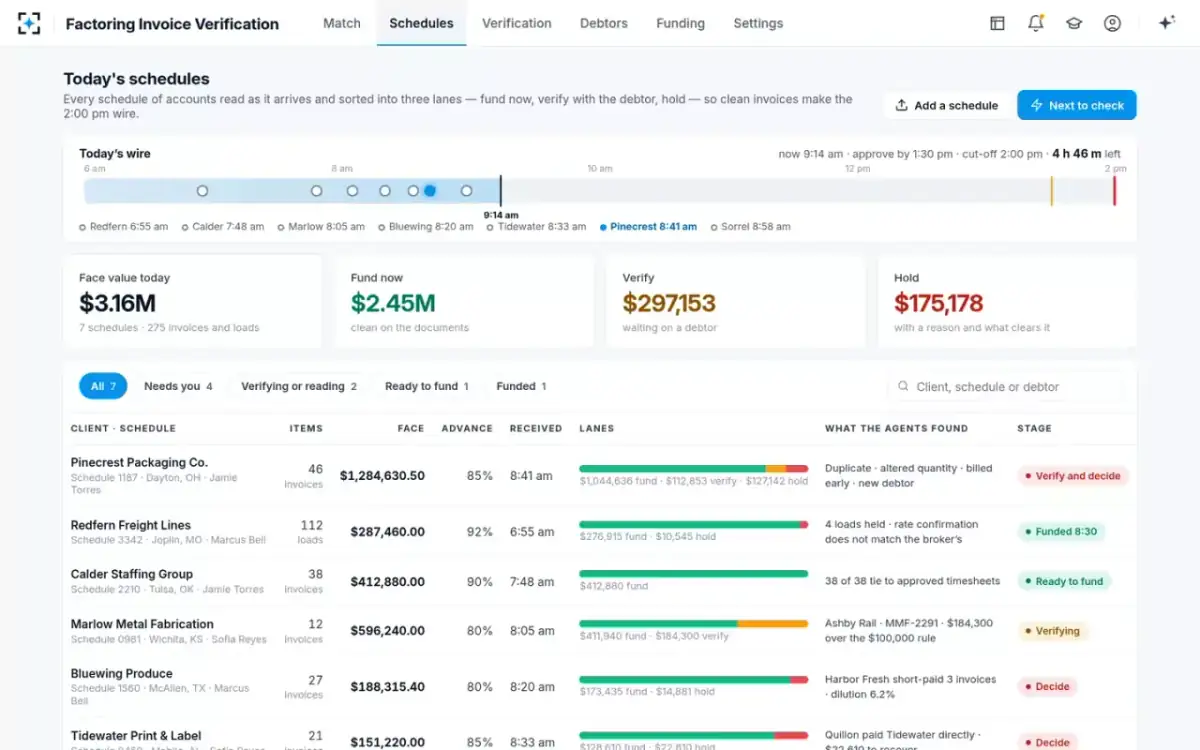
The schedule, sorted into lanes before a single invoice is wired
Questions people ask
How do I evaluate invoice verification software before buying it?
Ask whether its fingerprint check compares a new invoice against every client's funded history or only the one in front of it, whether a person clears every flagged match, and whether a rule change is versioned and attributable. Then replay it against 60 to 90 days of a factor's own already-closed schedules before committing to a live one.
Does invoice verification software check for duplicates across clients?
It should, and it is worth confirming explicitly — a system that only compares an invoice against the same client's own history misses a shipment invoiced once to one client and again, later, to a different one. Factoring Invoice Verification's default look-back is 365 days across all clients.
What should factoring software check before funding an invoice?
At minimum: a three-way match against the purchase order and signed delivery, a fingerprint against every invoice already funded, the debtor's eligibility and credit limit, and — for a new or unusual debtor — an independently sourced confirmation, before any of that clears into an advance.
How long does it take to go live with new verification software?
That depends mainly on whether a factor's own advance rates, cut-off time and eligibility rules are configuration the system already supports, or a custom build. Piloting against closed schedules first, before any live schedule touches the new system, adds time up front but removes the risk of a first live mistake.
Can we keep our own advance rates, cut-off and eligibility rules?
In a system built around settings rather than a fixed workflow, yes — advance rate per client, wire cut-off, confirmation thresholds, fingerprint fields and look-back, and who approves at what dollar amount should all be changeable without a development project, each change versioned on the audit trail.