What does the factoring invoice verification process actually involve between the moment a client's invoices land and the moment the wire goes out? It is not one undifferentiated back office reading paperwork. A schedule of accounts — a batch of invoices a client wants advanced against — is carried by exactly four people, each with a different question to answer and a different kind of authority, and Botminds' Factoring Invoice Verification does not remove any of the four. What it changes is what each one spends the morning doing.
The examples on this page come from a fictional sample factor, Halvorsen Trade Capital, as it runs Pinecrest Packaging Co.'s Schedule 1187 through the solution: 46 invoices to 9 debtors, $1,284,630.50 of face value, at an 85% advance, against a 2:00 pm CT same-day wire cut-off. The people, the company and every invoice on it are invented for the demo. The four roles, and the questions each one owns, are not.
The desk that still does this work by hand
14,290
Credit Authorizers, Checkers, and Clerks employed in the US, May 2023
2%
of US employer firms used factoring regularly in the 2023 survey
Federal Reserve Banks, Small Business Credit Survey
What does a factoring company actually do between an invoice and the wire?
Factoring is a business selling its unpaid invoices to a factor for same-day cash, at a discount, instead of waiting thirty or sixty days for its own customers to pay. The factor's return depends on two things holding up: the invoice has to be real, delivered and not already paid or pledged elsewhere, and the debtor named on it — the client's customer, who owes the money — has to actually pay when it comes due. Between a client uploading a schedule and the factor wiring money against it sits the work of checking both, and the US Department of Labor's own description of the nearest classified occupation is blunt about what that work is: to "authorize credit charges against customers' accounts" and "investigate history and credit standing of individuals or business establishments applying for credit."
At Halvorsen Trade Capital that work is split four ways, not spread evenly across a pool. The verification specialist reads the documents and decides what is clean enough to fund. The account executive owns the client and answers for what that client sees. The credit manager owns the debtor — the question of whether the money will actually come back — and the loss if it does not. The funding officer owns the wire itself: nothing leaves the bank until she releases it. A factor that treats these as one job loses the separation that catches a mistake one person made alone; a factor that treats them as four silos loses the speed a 2:00 pm cut-off demands. Botminds' agents are built around the second problem, not the first.
The verification specialist: the first and last word on every invoice
Renee Okafor is Halvorsen's verification specialist on Pinecrest's book. Before the agents, her day was spot checks: open a schedule, sample a handful of invoices against whatever documentation came with them, call a debtor or two if something looked odd, and move on to the next client before 1:30 pm, because anything approved after that misses the 2:00 pm wire. On a good day she could clear seven to ten schedules and call around twenty debtors. A duplicate invoice with a new number and date, or a shipment billed before it left the dock, looks clean to a five-minute read; it surfaces later, after the money is already gone.
Renee's morning: seven clients, sorted before she opens the first one
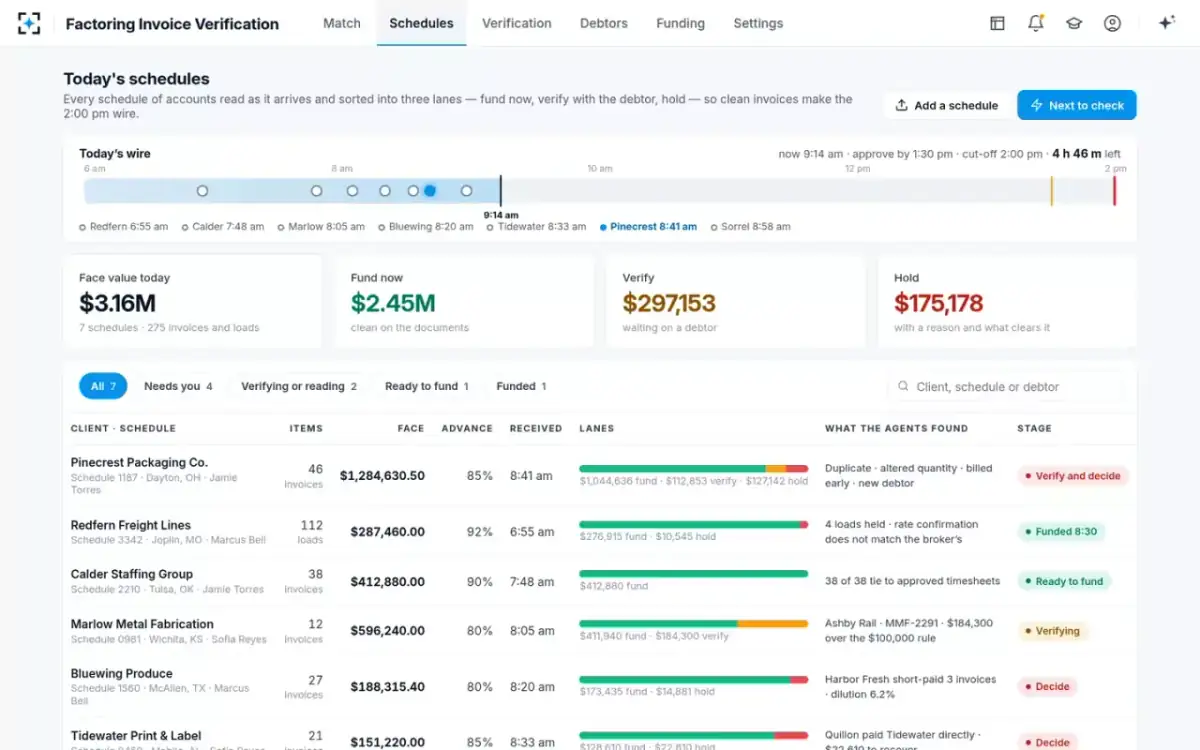
With the agents doing the first pass, her day starts from that sorted queue instead of a blank inbox. On Schedule 1187, 39 of the 46 invoices already connect — invoice, purchase order and signed delivery agree, and nothing matches anything Halvorsen has funded before — so $1,044,636.00 sits in a green lane ready to advance. Four invoices to one new debtor wait on a confirmation call. Three are held, each for a different documented reason: a duplicate, a shipment billed before it shipped, and a quantity that does not match what the receiver signed for. Renee still decides every one of the seven that are not clean. The agents narrowed the morning from forty-six documents to seven decisions; they did not make any of the seven for her.
The account executive: whose client is waiting on the money
Jamie Torres is the account executive on Pinecrest Packaging and Calder Staffing Group. Her stake in the schedule is different from Renee's: Pinecrest makes payroll on Friday, and from where Jamie sits, a hold on three doubtful invoices should never be a reason the other forty-three also wait. Before the agents, a schedule was usually verified or it was not — a client found out its money was late only when Jamie called to explain why, often after the cut-off had already passed.
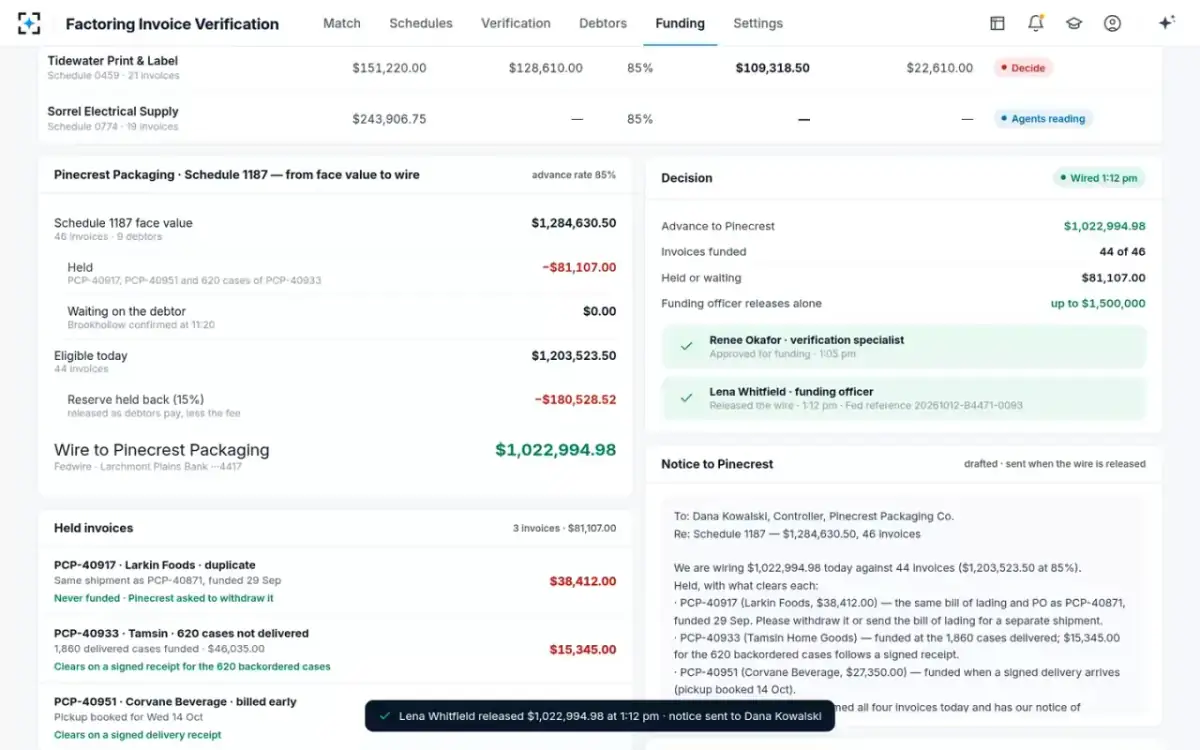
What changed for her is visibility, not authority. She can see exactly which of her clients' schedules are funded, which are still verifying and which are held, and the notice Halvorsen sends Pinecrest states what clears each held invoice by name — withdraw the duplicate, send a signed delivery receipt, or send a corrected invoice — instead of a general "under review." On Schedule 1187, Jamie's clean answer to Pinecrest is the one Renee's sorting makes possible: $1,203,523.50 of the $1,284,630.50 face is eligible the same day, a wire of $1,022,994.98 at the 85% advance, with the exact reason the held $81,107.00 is not. The account executive owns that conversation; nothing about the agents changes who has it.
The credit manager: who owns the debtor limit, and the loss if it's wrong
Walt Brennan is Halvorsen's credit manager, and his question is the one the invoice itself cannot fully answer: will this debtor actually pay? He sets the verification policy — when a confirmation call is required, what counts as proof of delivery, how far back to check for a duplicate — and he is the one who explains a fraud loss to the board if the policy fails. His authority is narrow and specific: he is the only person, and the only seat agents are built never to touch, who can approve or raise a debtor's credit limit.
On Schedule 1187 that authority mattered once, directly. Brookhollow Distribution LLC was a debtor new to Pinecrest — an Ohio LLC formed in April, an invoice email domain registered in September, a VoIP phone number printed on the invoices themselves. The debtor verifier agent found an independent number from the landlord's records and the state's business filing, drafted a call script, and Renee got Brookhollow's accounts payable manager on a recorded line to confirm all four invoices. Walt then approved a $150,000 credit limit for the new debtor at 11:31 am, before a dollar of the $112,852.50 those four invoices represent was advanced. The agents sourced the number and found the filing; Walt set the number they could not set for themselves.
The funding officer: who releases the wire, and by when
Lena Whitfield is the funding officer, and hers is the simplest authority to describe and the hardest to delegate: she is the only person who can send Halvorsen's money out the door, alone, up to $1,500,000 per release. Above that threshold the credit manager releases with her. Before the agents, her afternoon was a race against everyone else's approvals landing in time — she needed Renee's sign-off by 1:30 pm to make the 2:00 pm wire, and a late approval on one client could cost every client on her list that day's cut-off.
Schedule 1187, from 8:41 am to the 1:12 pm wire
- Agents match, Renee verifies Brookhollow, Walt approves its limit at 11:312 h 50 m · to 11:31 am
- Renee approves the schedule at 1:05, Lena releases the wire at 1:121 h 41 m · 1:12 pm wire
What changed for Lena is the shape of the information she releases against. She does not see one lump sum; she sees the schedule's face value broken into held, waiting, eligible and reserve, with both the specialist's and (where it applies) the credit manager's approval already attached and timestamped — not a verbal confirmation she has to chase. On Schedule 1187 she released $1,022,994.98 to Pinecrest at 1:12 pm, inside her own limit, with a Fedwire reference on the record, while $81,107.00 stayed held and the client notice explaining why went out with it. The duplicate invoice, PCP-40917, was never in that number at all.
What Lena released, and what she didn't
What changes for each seat once six agents do the first pass
The four roles above are the people; what sits between them and the schedule is six specialist agents, each with one job and an explicit limit on what it may decide alone. None of the six approves anything by itself — every agent's output is a recommendation, a flag or a sourced fact that a named person then acts on.
The same schedule, before the agents and with them
Today
Clears 7–10 schedules a day before the 2:00 pm cut-off, and can call about twenty debtors, not two hundred.
With agents
Starts from three lanes with the reason for every hold, and calls only the debtors that need it — at a number the agents sourced, never the one on the invoice.
Still theirs: Decides every verify and every hold.
Today
Pinecrest makes payroll on Friday, and a clean invoice should not wait behind a doubtful one on someone else's schedule.
With agents
Sees which of her clients’ schedules are funded, verifying or held, and the client notice that says exactly what clears each hold.
Still theirs: Owns the client relationship and the call when a hold runs long.
Today
Owns the fraud-loss line: the duplicate the team misses is the loss he explains to the board.
With agents
Sets the verification rules once, approves every new debtor's limit before the first advance, and watches days to pay and dilution across the book.
Still theirs: The only seat that can raise a debtor limit.
Today
Releases every client wire, and needs approvals in hand by 1:30 pm to make the 2:00 pm cut-off.
With agents
Sees the schedule from face value to wire — held, waiting, eligible, reserve — and releases with the specialist’s approval already on the record.
Still theirs: The only seat that can release money, alone up to $1,500,000.
How a schedule moves: six agents, then a person, for every seat
Agent
Schedule readerReads the schedule and every invoice, purchase order and delivery document in it, and ties the schedule to its documents.
Never: alters a submitted figure
Agent
Order and delivery matcherThree-way matches invoice against purchase order against signed delivery.
Never: accepts an unsigned or future-dated delivery as proof
Agent
Duplicate and alteration detectorFingerprints every invoice against every invoice funded for any client in the last 365 days.
Never: clears a fingerprint match on its own
Agent
Debtor verifierSources an independent contact and drafts the confirmation and the notice of assignment.
Never: uses a contact supplied on the invoice
Agent
Eligibility and limits checkerChecks aging, concentration and the debtor’s credit limit.
Never: raises a limit
Agent
Funding recommenderPuts every invoice in a lane and computes the advance.
Never: approves funding or moves money
A person decides
Verification specialistDecides every verify and every hold.
A person decides
Funding officer (with the credit manager above $1.5M)Releases the wire.
How many schedules, and how many invoices, one desk carries a day
The volume a desk like this carries is not small. On the morning Schedule 1187 arrived, Halvorsen's four seats also had six other client schedules in flight — from Redfern Freight Lines at 6:55 am to Sorrel Electrical Supply at 8:58 am — totaling $3.16 million of face value and 275 invoices and loads before 9:00 am. Pinecrest's own schedule alone carried 138 separate documents: 46 invoices, 46 purchase orders and 46 bills of lading or signed receipts, each needing to agree with the other two before a dollar moves.
Factoring itself is a small, specialised corner of how firms finance themselves day to day. In the Federal Reserve Banks' Small Business Credit Survey (2024 Report on Employer Firms, 6,131 employer firms answering in the 2023 survey), factoring was used on a regular basis by 2% of employer firms, far behind credit cards (56%), loans (53%) and lines of credit (34%), and behind merchant cash advances (5%). That scale is exactly why the work concentrates on specialists rather than a general accounts-payable team: a desk of four at Halvorsen's size can carry several million dollars of face value a morning precisely because each invoice gets a specific, accountable check, not a glance.
The stakes behind that check are rising, not falling. More than three-quarters of US organizations, 76%, reported attempted or actual payments fraud in 2025, and the losses scale with size: 48% of organizations under $1 billion in revenue reported a financial loss from it, against 66% of organizations over $1 billion (Association for Financial Professionals, 2026 Payments Fraud and Control Survey). A factor sits downstream of exactly that exposure — it is paying out against invoices it did not create, from a client it is trusting, against a debtor it may never have dealt with before.
Why none of the four seats disappears
It would be cheaper, on paper, to let an agent that can already fingerprint 46 invoices in seventy-two seconds also clear the duplicate it finds, or let the funding recommender release the wire it has already computed. Halvorsen's rules do neither, on purpose. A fingerprint match goes to a person because the fingerprint can be a false positive — a legitimately re-invoiced partial shipment looks identical to a duplicate on paper — and the cost of wrongly holding a clean invoice is a phone call, while the cost of wrongly funding a duplicate is the money. A funding recommendation goes to a person because the recommender cannot see what the credit manager knows about a debtor's pattern this quarter, or what the account executive knows about a client relationship under strain.
The four seats also check different things, not the same thing twice. Renee owns whether the documents hang together. Jamie owns what the client is told. Walt owns whether the debtor is worth the exposure. Lena owns whether the wire actually goes. Collapsing any two of those into one role would remove the separation that catches the case where one of them is wrong — the entire reason a four-eyes structure exists in a business built on moving other people's money same-day. Six agents changed how fast each of the four gets to a decision worth making. They did not change how many decisions a schedule needs.
To see the schedule, the lanes and the four seats together on one client's file, start from Factoring Invoice Verification. The three-way match each invoice has to pass before any of the four signs off on it is worked through line by line in the three-way match a factor runs before it pays an invoice.
Questions people ask
What does a verification specialist do at a factoring company?
Reads every invoice on a client's schedule against its purchase order, delivery proof and the debtor's history, decides which invoices are clean enough to fund, and calls or messages a debtor when something needs independent confirmation. At Halvorsen Trade Capital, the verification specialist is also the only person who decides every verify and every hold — an agent can sort and flag, but it does not decide.
What does an account executive do in factoring?
Owns the client relationship: which of that client's invoices are funded, verifying or held, and what the client is told about any delay. The account executive does not check documents or set credit limits; their stake is that a client's clean invoices move on time, even when a few doubtful ones on the same schedule do not.
What does a credit manager do at a factoring company?
Sets the verification and credit policy, approves or raises every debtor's credit limit before the first advance against it, and owns the fraud-loss line if a bad invoice gets funded. It is the one authority in the four seats that an AI agent is built never to exercise: the eligibility and limits checker can flag a limit as a constraint, but it never raises one.
What is a funding officer?
The person who releases the wire itself, once the verification specialist has approved a schedule for funding. At Halvorsen Trade Capital the funding officer can release up to $1,500,000 alone; above that, the credit manager releases with her. Nothing in the solution moves money without this named approval attached.
How many invoices can one person check in a day?
There is no published industry figure; it depends on schedule size and how many invoices need a debtor call. In the fictional sample file, a single 46-invoice, 138-document schedule took a verification specialist from 8:41 am to a 1:05 pm approval, most of it spent on the seven invoices the agents could not clear alone rather than on the thirty-nine they could.
Do AI agents replace the verification specialist?
No. Six agents read, match, fingerprint and check every invoice before a person sees the schedule, but every one of them is built with an explicit "never": the duplicate detector never clears a match alone, and the funding recommender never approves funding. The verification specialist still decides every verify and every hold; the account executive, credit manager and funding officer keep their own decisions too.