A three way match is the check that an invoice, the purchase order behind it and proof the goods were actually delivered all agree, before anyone pays. Most accounts-payable teams run it on their own purchases, against their own records. A factor runs the same match on someone else's: the client's invoice, the client's purchase order, and a delivery document from a carrier or a debtor the factor has never dealt with before. Botminds' Factoring Invoice Verification runs it on every invoice, automatically, before a dollar of the advance goes out.
The example on this page is a fictional sample schedule: Pinecrest Packaging Co.'s Schedule 1187, 46 invoices funded through Halvorsen Trade Capital. Two of its invoices failed the match in different ways, and both are worked through below, field by field.
What a three-way match actually checks
Three documents, three different authors, one question: did this shipment happen the way the invoice says it did? The invoice is the client's own claim for payment. The purchase order is the debtor's record of what it agreed to buy, at what price. The delivery document — a bill of lading, a signed packing slip, a proof-of-delivery scan — is the only one of the three created by someone with no financial stake in whether the factor pays: a carrier, a warehouse, or the debtor's own receiving dock. A three-way match lines up all three on the fields that matter — quantity, price, dates and ship-to — and funds only when they agree.
Three documents, one question: did this shipment happen as billed?
| Field | Invoice PCP-40933 | Purchase order TH-20614 | Delivery, BOL 7738494 |
|---|---|---|---|
| Quantity | Invoice2,480 cases | Order2,480 cases | Delivery1,860 cases signed for |
| Price | Invoice$24.75 / case | Order$24.75 / case | Delivery— |
| Ship-to | InvoiceTamsin Home Goods | OrderTamsin Home Goods | DeliveryTamsin Home Goods, signed M. Ortiz |
| Dates | InvoiceIssued 7 Oct | OrderIssued 1 Oct | DeliveryDelivered 7 Oct, before the invoice |
| Amount | Invoice$61,380.00 | Order$61,380.00 | DeliveryClient's own books: $46,035.00 |
Invoice and purchase order already agreeing is the easy half: both come from paperwork the client controls, so a mismatch there is usually a typo, not a fraud. The harder half is order against delivery, because the delivery document is the one piece of evidence the client did not write. Who runs this match day to day, and the three other seats around it, are covered on their own page; this one is about the check itself.
Invoice against purchase order: what has to agree
The invoice and the purchase order have to agree on quantity, unit price, total amount and the buyer named on both. A factor is buying the right to collect a specific, already-earned debt, so if the invoice bills for 2,480 cases at $24.75 and the purchase order authorized exactly that, the first leg of the match clears cleanly — as it did on PCP-40933. Where this leg usually breaks is simpler than fraud: a price typed in without the agreed discount, a quantity rounded up, or an invoice issued against a purchase order that was later revised and the invoice never updated. None of those are necessarily dishonest, but every one of them means the factor would be advancing against a number the debtor never actually agreed to owe.
Order against delivery: what counts as proof, and what doesn't
The second leg is where a three-way match earns its name, because an order and an invoice can agree perfectly while nothing has actually shipped. Proof of delivery has to be a document created by a party other than the one presenting the invoice: a bill of lading signed by a carrier, a packing slip signed by the receiving dock, or a debtor portal confirmation. Cornell's Legal Information Institute, publishing the Uniform Commercial Code, defines a bill of lading plainly: "a document evidencing the receipt of goods for shipment issued by a person engaged in the business of transporting or forwarding goods" (UCC § 1-201(b)(6)). The operative word is receipt — someone outside the transaction has to confirm they took physical custody of the goods.
On PCP-40933, the delivery document said Tamsin Home Goods' receiving clerk, M. Ortiz, signed for 1,860 cases on 7 October — not the 2,480 the invoice billed. Pinecrest's own books, meanwhile, carried the invoice at $46,035.00, not the $61,380.00 face amount. Three numbers, three sources, and only one of them — the signed receipt — was created by someone with no reason to inflate it.
Why an unsigned or future-dated delivery is never proof
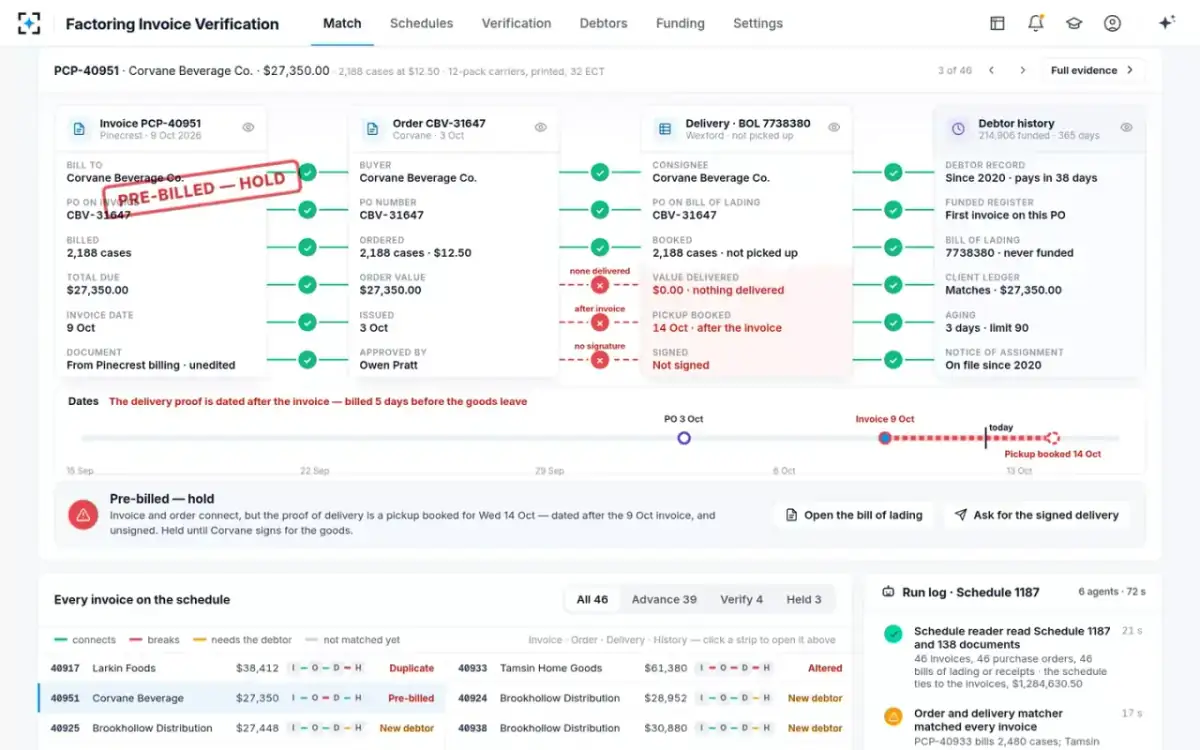
Not every document that looks like a delivery record is one. A pickup booking is a carrier agreeing to collect goods on a future date; it is not evidence the goods left, let alone arrived. A bill of lading dated after the invoice it supports is a sign the paperwork, not necessarily the shipment, came first. Botminds' order and delivery matcher agent is built around one explicit rule: it never accepts an unsigned or future-dated delivery as proof, no matter how closely the quantities otherwise line up. A booking with no signature is treated the same as no delivery document at all, and the invoice stays held until a signed, dated receipt arrives.
Why PCP-40951 didn't clear: booked, not delivered
Is a bill of lading proof of delivery?
A bill of lading is proof of two different things, and a three-way match needs to tell them apart. Issued at pickup, it proves a carrier took custody of the goods — it is proof of shipment, not proof of arrival. Signed again at the destination, by the consignee or its receiving dock, it becomes proof of delivery: evidence the goods actually reached the debtor, in the quantity the signature states. An unsigned bill of lading, or one that only shows pickup, answers a different question than the one a factor needs answered before it pays. Corvane Beverage's PCP-40951 had a real bill of lading number on file — but it documented a booking, not a completed delivery, which is exactly why the match held it rather than clearing it on the strength of the paperwork alone.
What happens when the match fails
A failed match does not mean a fraud; it means a question that has to be answered by someone other than the invoice before money moves. On PCP-40933, the actual answer was partial delivery — 1,860 of 2,480 cases arrived — and Botminds' solution let the specialist split the invoice rather than hold the whole thing: $46,035.00 for the 1,860 cases that were genuinely delivered and confirmed against the client's own books, advanced immediately, with $15,345.00 for the remaining 620 backordered cases held until a signed receipt for them arrives. A three-way match that can only pass or fail an entire invoice forces a factor to choose between funding too much or making a client wait for goods it already shipped; one that can match at the line level does neither.
A clean match against the two ways PCP-40933 and PCP-40951 didn't clear
What a clean match looks like: Invoice, order and signed delivery all state the same number of units.
What held, and why: PCP-40933 billed 2,480 cases; the signed receipt covers 1,860. The gap, 620 cases, is exactly what stayed held.
What a clean match looks like: Invoice total matches the client's own bookkeeping entry for the same shipment.
What held, and why: PCP-40933's $61,380.00 face does not match the $46,035.00 Pinecrest's own books carry for it — the books reflect the delivered quantity, the invoice doesn't.
What a clean match looks like: Delivery is dated on or before the invoice that bills for it.
What held, and why: PCP-40951 is dated 9 Oct; its only delivery record is a pickup booked for 14 Oct — five days later, and not yet signed.
What a clean match looks like: A named person at the receiving dock signed the delivery document.
What held, and why: PCP-40951 carries no signature at all; a booking is not a receipt.
Matching a services invoice, where there is no bill of lading
Not every factored invoice ships a pallet. Staffing, transport, repair, forestry and medical services are invoiced for work, and the third leg of the match is proof the work was accepted rather than proof goods arrived: a timesheet approved by the customer, a signed work order or job ticket, a customer portal's acceptance. The rule from goods carries over unchanged: the proof has to come from the party that owes the money, not the party asking to be paid. Two federal cases show what happens when it does not. Douglas Worman's factoring scheme in Idaho rested on invoices, in the government's words, "purportedly for work Worman’s business had performed for its customers" that were "inflated and entirely fictitious"; a federal jury convicted him on 17 counts of wire fraud and he was sentenced to 46 months (U.S. Attorney's Office, District of Idaho, January 2025). In Minnesota, the receivables of a medical services company were factored for more than $2.6 million in 2018 and the collections diverted, ending in guilty pleas to wire fraud in December 2023 (U.S. Attorney's Office, District of Minnesota).
For a services invoice, then, the match asks: is there a record of acceptance written by the customer, dated on or before the invoice, for the hours or the job billed? A work order the client wrote itself is the services equivalent of an unsigned bill of lading, and it earns the same treatment: held until the customer's own confirmation exists.
Why the match alone doesn't catch a duplicate
A three-way match answers one question well — did this shipment happen as billed — and a different question badly: has this exact shipment already been paid for once, under a different invoice number? A duplicate invoice can pass every leg of a three-way match perfectly, because the duplicate's purchase order and delivery document are often the same real documents, re-submitted with a new invoice number and date. Catching that requires comparing the new invoice against every invoice the factor has already funded — for any client, not just this one — which is a fingerprinting problem, not a matching problem. Why a bad invoice looks clean works through duplicate, altered and pre-billed invoices side by side, and what catches each.
The distinction matters because the two controls protect against different failures, and billing schemes are not rare. In the Association of Certified Fraud Examiners' 2024 global study of 1,921 cases, billing schemes accounted for 22% of occupational fraud cases, with a median loss of $100,000, and ran a median 18 months before they were detected. A three-way match and a duplicate check are both needed because a document that looks complete and a document that has been seen before are two different kinds of lie.
Who runs the match, and who the exception goes to
Nothing in a three-way match is designed to run unsupervised through to a funding decision. Botminds' order and delivery matcher agent runs the match on every invoice automatically and reports a short delivery at the delivered quantity, never at the billed one — but it never decides what happens next. A clean match moves to the funding lane; anything that doesn't match goes to the verification specialist, the person who decides whether to split an invoice, hold it, or ask the client to correct it.
From 46 documents to one decision: the match, then a person
Agent
Schedule readerTies the schedule to its 46 invoices, 46 purchase orders and 46 bills of lading or receipts.
Agent
Order and delivery matcherChecks quantity, price, ship-to and dates across all three documents.
Never: accepts an unsigned or future-dated delivery as proof
Agent
Order and delivery matcher, on a short deliveryReports the delivered quantity so a specialist can fund exactly what arrived.
A person decides
Verification specialistDecides whether to split, hold or ask for a correction on anything the match flags.
Why the match is one person's decision, not the agent's
22%
of occupational fraud cases are billing schemes
$100,000
median loss per billing-scheme case
A six-day federal trial in Idaho showed what happens when that separation is missing for long enough. Douglas Worman was convicted on 17 counts of wire fraud after submitting, in the government's words, invoices that were "inflated and entirely false and fraudulent," purportedly for work his business had performed for its customers, from at least 2015 to September 2018. His invoices billed forestry work rather than shipped goods, so the independent proof a match needs there is the customer's own confirmation of the work, not a bill of lading; the principle is the same: test the invoice against a record its author did not write (U.S. Attorney's Office, District of Idaho, January 2025). Worman was sentenced to 46 months after defrauding the factor of more than $2.5 million.
Forty-six invoices, every match checked, before any of them is advanced
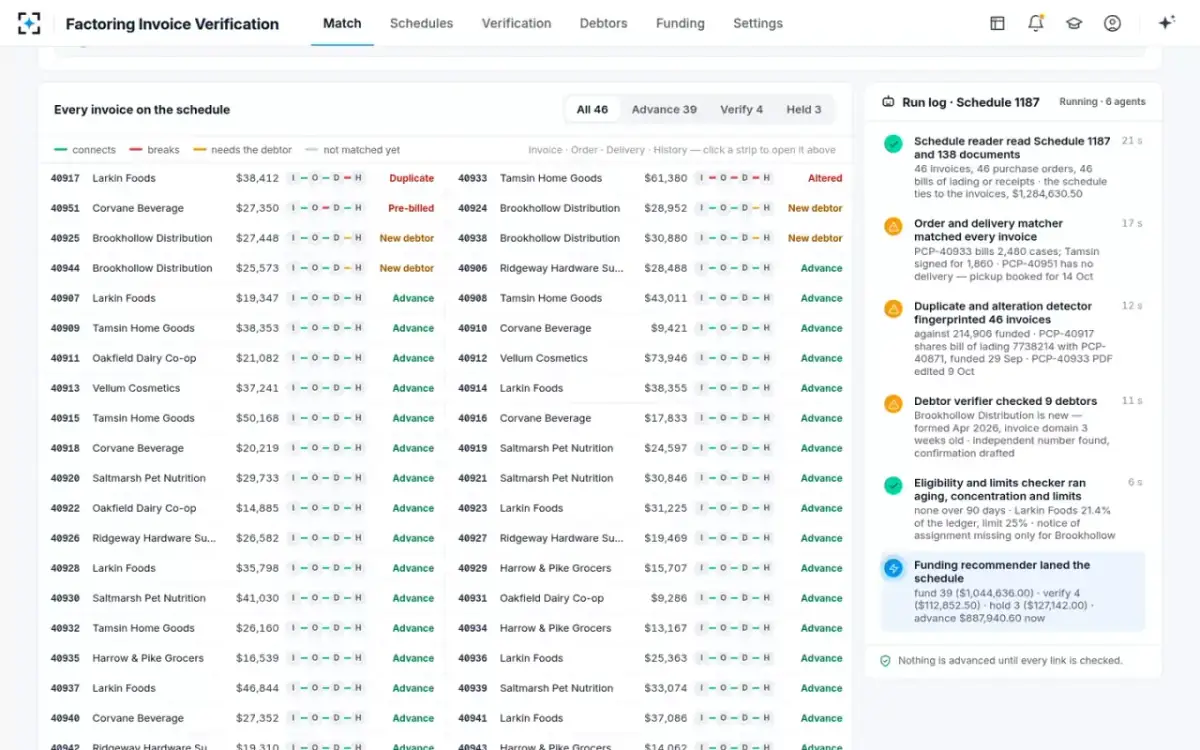
To see the match, the fingerprint check and the four people who act on what each finds, start from Factoring Invoice Verification. What makes a notice of assignment binding on the debtor — the control that sits downstream of a clean match — is covered in what a notice of assignment does, and why a debtor must honor it.
Questions people ask
What is a three way match?
A check that an invoice, its purchase order and proof the goods were delivered all agree on quantity, price, dates and the party involved, before a payment is made. In factoring, the invoice and the copy of the purchase order both reach the factor through the client; only the delivery document — a signed bill of lading or receipt — is created by someone else, which is why it carries the most weight.
What is the three way matching process?
First, the invoice is checked against the purchase order for quantity, price and buyer. Second, the order is checked against proof of delivery — a document the client did not write. Where all three agree, the invoice clears; where any one does not, it goes to a person to decide whether to fund the delivered portion, hold the invoice, or ask for a correction.
How do I verify an invoice before paying it?
Confirm it against a purchase order the buyer actually issued, and against a delivery document signed by someone other than the party being paid — never the invoice's own claim about what shipped. A dated, signed receipt or bill of lading is the standard; an unsigned booking or a delivery dated after the invoice is not proof of anything yet.
What counts as proof of delivery?
A document created by an independent party — a carrier, a warehouse or the receiving dock — showing what was actually received, signed and dated. A purchase order shows what was agreed to; only a signed delivery record shows what actually arrived, and in what quantity.
Is a bill of lading proof of delivery?
Only once it is signed at the destination. Issued at pickup, a bill of lading proves a carrier took custody of goods for shipment — proof of shipment, not of arrival. The Uniform Commercial Code defines it as a document "evidencing the receipt of goods for shipment," which is why an unsigned or future-dated one is treated as no proof at all until it is signed again on delivery.
Why do purchase orders matter in invoice verification?
A purchase order is the debtor's own record of what it agreed to buy and at what price, so matching an invoice to it catches billing errors and unauthorized charges before they reach a delivery check. It is the easier of the two legs precisely because both documents usually come from the same source; the harder, more important check is still against delivery.