Freight factoring fraud concentrates on one document other kinds of factoring do not depend on nearly as much: the bill of lading, the carrier's own receipt for a load. A furniture wholesaler's invoice can be checked against a signed delivery slip from a warehouse clerk a factor can call. A truckload's bill of lading is issued by a carrier a factor has usually never met, for a shipment it cannot see, and double brokering — where the carrier named on the paperwork and the carrier that actually hauled the load are two different companies — means even a real-looking bill of lading does not guarantee the load it describes was ever picked up by whoever is asking to be paid for it.
Why the bill of lading is the one document freight factoring can't do without
A bill of lading is, by definition, "a document evidencing the receipt of goods for shipment issued by a person engaged in the business of transporting or forwarding goods," under the Uniform Commercial Code. For most freight invoices, it is the only independent evidence that a shipment existed at all — there is no warehouse to call, no separate purchase order in the usual sense, and the pickup and delivery can be hundreds of miles from the factor's own office. When Factoring Invoice Verification's order and delivery matcher runs its three-way match on a freight invoice, the bill of lading is doing the job a signed delivery receipt does on any other kind of invoice, which is exactly why a forged one is so much more damaging here than elsewhere.
Freight factoring also compresses the usual gap between a shipment and the invoice for it. A manufacturer's invoice can sit for weeks before a factor sees it, giving a receiving clerk time to notice a shortage and raise it before anyone asks a factor for money against it. A trucking company commonly factors the same week it hauls the load, sometimes the same day, precisely because the business runs on fuel and payroll that cannot wait thirty or sixty days for a shipper to pay. That speed is the product's whole value to a carrier, and it is also exactly why there is so little time for an error, a short delivery or a forged document to surface on its own before the advance already went out.
What double brokering is, and why it matters to a factor
Double brokering happens when a broker re-brokers a load to a second carrier without the shipper's knowledge, often after the load has already been assigned once, and sometimes using another company's identity to do it. The Federal Motor Carrier Safety Administration describes the broader pattern plainly: "fraud and identity theft occurs when entities use another motor carrier's assigned USDOT number, when not authorized to do so, or when someone acts as a broker and is not registered with FMCSA," and states outright that "fraud and identity theft are criminal acts." For a factor, the practical risk is that the carrier named on a bill of lading, and the carrier that actually hauled the load, can be two different companies — which means a phone call to confirm the load, made to the wrong number, confirms nothing.
What makes this specific to freight, rather than a general accounts-receivable problem, is how little independent documentation usually exists around a single load. A factored invoice for manufactured goods typically has a purchase order written weeks earlier, a receiving clerk who can be asked about the delivery, and sometimes a separate shipping confirmation from a third-party carrier. A spot-market truckload can be booked, hauled and delivered within a single business day, often by a carrier the shipper found through a load board rather than a standing relationship, leaving the bill of lading as close to the only paper trail the load ever generates.
How a bill of lading gets faked
A forged bill of lading does not have to be an obvious fabrication. The easiest version reuses a real one: a genuine bill of lading from an earlier, already-paid load, with the dates, invoice number or carrier details altered, submitted against a new, fictitious shipment. A harder-to-catch version uses a real carrier's identity without its knowledge — a stolen USDOT number, or a broker who was never actually registered with FMCSA — so that a lookup of the carrier's name alone finds a real, legitimate business that has nothing to do with the load in question. Either way, the document can look entirely correct in form while describing a shipment that never happened, or happened under a different carrier's name.
The economics of double brokering make it worth a fraudster's effort in a way a one-off forged invoice is not. A re-brokered load is often still paid by the original shipper or broker in good faith, at the agreed rate, while the fraudulent intermediary pays the actual carrier that hauled it far less — or not at all — and pockets the difference. Layer a factor into that chain and the same load can generate an advance against an invoice for work billed by a company that was never the one that drove the truck, which is why the carrier's identity, not just the shipment's existence, is the thing worth confirming independently.
What FMCSA tells carriers and brokers to check before they trust a counterparty
FMCSA's own guidance to carriers and brokers is specific and checkable, not a general warning. It recommends "confirming phone numbers of brokers and carriers using SAFER," the agency's public Safety and Fitness Electronic Records system, and warns that "if the number you were given by the carrier/broker does not match the number posted, call the number posted in SAFER for the company to discuss the load." It adds a warning that applies directly to a factor's own debtor-verification step: "when using a search engine to confirm numbers, emails and websites, keep in mind the top search returns may be fake profiles created by the scammers," and that even insurance certificates "can be fraudulent."
FMCSA's own steps, before trusting a counterparty's paperwork
- Look the carrier or broker up in SAFER directly
Not a number supplied on the invoice or bill of lading itself — the number posted against the company’s own USDOT or MC number.
- Call the number in SAFER, not the one you were given
If the two numbers differ, that mismatch is itself the finding worth acting on.
- Treat a search-engine result as unverified
FMCSA itself warns that top search results “may be fake profiles created by the scammers.”
- Do not trust a document alone
FMCSA notes that “even insurance certificates can be fraudulent” — the same caution applies to a bill of lading.
A century-old case about a forged bill of lading, paid by a factor
The U.S. Supreme Court dealt with a forged bill of lading a hundred years before double brokering had a name, and the victim was a factor. In Gleason v. Seaboard Air Line Railway Co., decided 2 January 1929, the petitioner was "a cotton factor in Savannah". A railway employee whose job was to tell the cotton trade when shipments arrived told the factor that a load had arrived under a named bill of lading; the same day a bank presented that bill of lading, "regular in form and properly indorsed", with a $10,000 draft, and the factor paid. The bill and the draft "eventually proved to have been forged" by the employee himself, and the factor "would not have paid the draft without that assurance" that the cotton had arrived.
The lower court had let the railway off, relying on the earlier Friedlander case, in which the Court held there was "no implied authority in the agent to issue bills of lading for merchandise not actually received". The Supreme Court reversed. Giving arrival notices was squarely the employee's job, so the railway was liable for his false notice "however flagrant the agent's act", even though he lied for his own benefit. The opinion also notes that the old Friedlander rule on bills of lading "has now been modified by statute": the Federal Bills of Lading Act makes a carrier liable in certain cases even when its agent issued a bill for goods never received. The lesson for a factor has not aged: the paper looked perfect, and what made the factor pay was a confirmation through a channel it trusted. A confirmation is only as good as the independence of the channel it comes through.
There was evidence also plainly indicating that petitioner would not have paid the draft without that assurance.
Gleason v. Seaboard Air Line Railway Co., 278 U.S. 349 (1929), on the cotton factor's payment
What a factor can check about a carrier before it trusts a bill of lading
Two checks do most of the work, and neither depends on trusting the bill of lading itself. The first is confirming the carrier or broker's identity independently — SAFER lookup, a registered phone number, a business filing — rather than anything printed on the document. The second is comparing a new bill of lading against every bill of lading a factor has already funded, the same way a duplicate invoice is caught on any other schedule: the same bill of lading number, the same case count and the same purchase order reused weeks apart is the signature of a shipment invoiced twice, freight or otherwise.
A third check is softer but still worth running: whether the pickup and delivery dates on the bill of lading are even physically plausible for the route described. A load picked up in one state and supposedly delivered the same afternoon hundreds of miles away is a scheduling claim that does not need a forensic document examiner to question — an ordinary distance-and-time sanity check, applied consistently across a schedule, catches an error or a fabrication that nobody built into the fingerprint comparison because it was never framed as a match-or-mismatch question in the first place.
Where a load's paperwork can diverge from what actually moved
What the paperwork says
A named carrier, a USDOT number, a signed bill of lading
Where it can diverge
A re-brokered load, a stolen USDOT number, or a reused bill of lading from an earlier, already-funded shipment
What an independent check confirms
The carrier in SAFER, at its own registered number — not the number on the invoice
Why a freight schedule needs the same three-way match as any other
None of this changes the shape of the check a factor runs — it changes what counts as proof. The order and delivery matcher still ties an invoice to its purchase order and its delivery proof; on a freight invoice, the delivery proof is the bill of lading, and the matcher's stated limit applies here with particular force: it "never accepts an unsigned or future-dated delivery as proof." A pickup booked for next week is no more evidence of a completed haul than it is evidence of a completed furniture delivery, and the duplicate and alteration detector's fingerprint — run across bill of lading number, purchase order, quantity and carrier reference, for every client in the last 365 days — catches a reused bill of lading the same way it catches any other duplicate.
One freight client already funded, another still waiting on verification
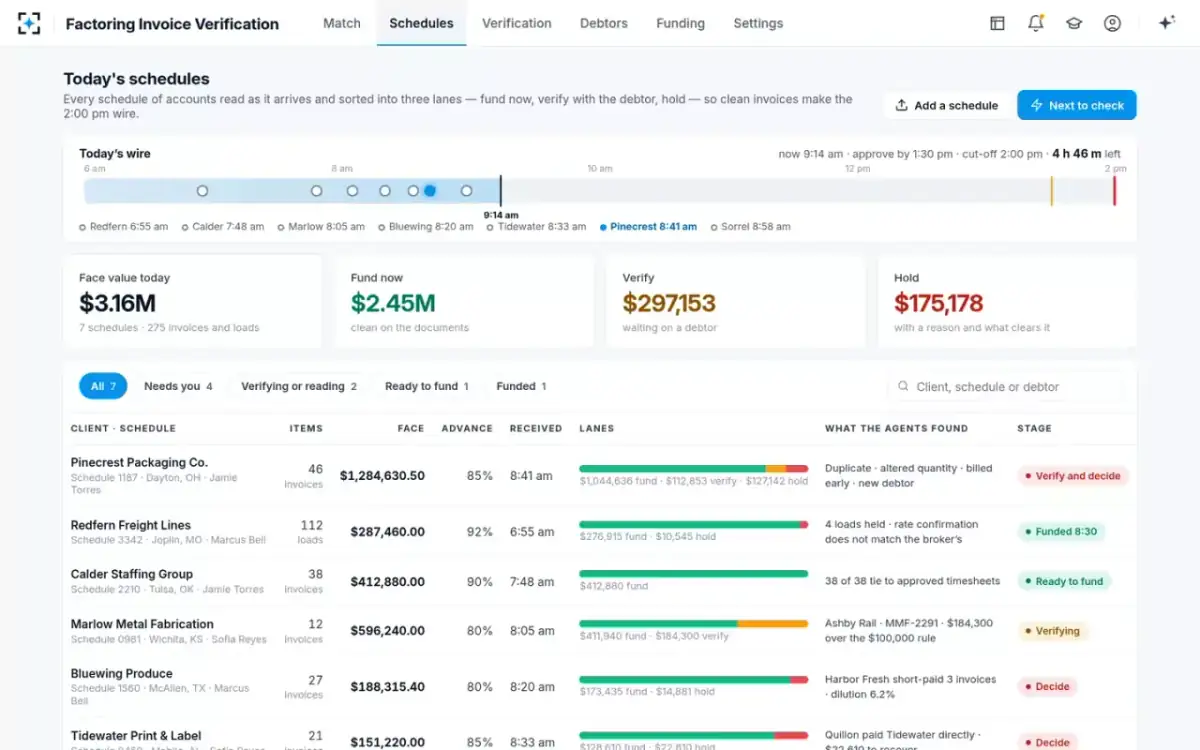
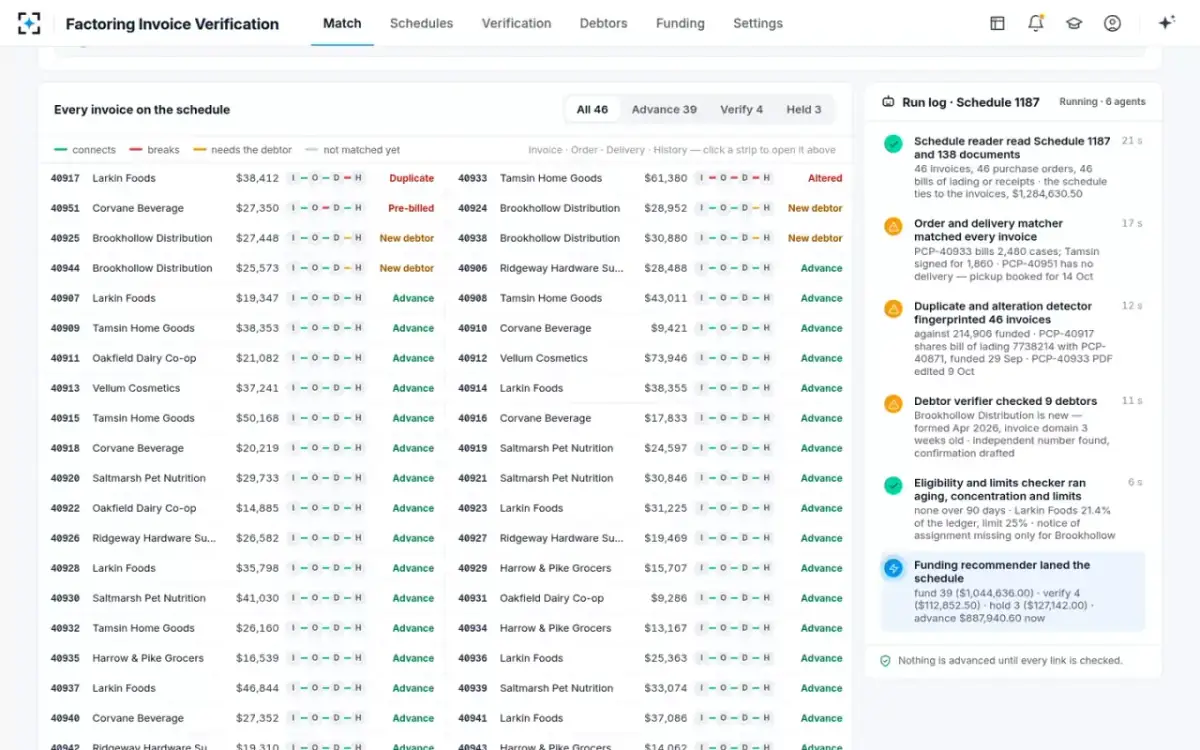
The run log, on a schedule that includes freight invoices
What to ask when a load has no verifiable phone number on file
A load with no phone number that resolves to the carrier's own SAFER listing is not automatically fraudulent, but it is a reason to pause before funding, not after. The questions worth asking are specific: does the number on the invoice match the one SAFER shows for that USDOT number; has this carrier's bill of lading number, or this exact shipment's case count and purchase order, appeared on any other schedule in the last year; and can the shipper or receiver named on the bill of lading be reached through a channel that was not supplied by whoever submitted the invoice. None of those three questions depends on trusting the document in front of you, which is the point.
A fourth question is worth asking alongside the first three, even though it is softer: how recently was this carrier or broker registered, and is this the client's first load with them. A new carrier relationship is not a red flag on its own — freight brokers add carriers constantly — but a brand-new registration paired with a load that is unusually large, or a rate that is unusually generous, is the combination FMCSA's own warning describes: a broker "quick to agree in paying you more" than the market rate is one of the signs the agency lists as a reason to stop a transaction before it completes, and the same caution applies from a factor's side of the same load.
Questions people ask
What is double brokering?
A broker re-assigning a load to a second carrier, sometimes without the shipper's knowledge and sometimes using a stolen or unregistered carrier identity to do it. It matters to a factor because the carrier named on a bill of lading, and the carrier that actually hauled the load, can end up being two different companies.
Is double brokering illegal?
FMCSA treats the underlying identity misuse as a criminal act: using another motor carrier's USDOT number without authorization, or acting as a broker without FMCSA registration, are both described by the agency as fraud and identity theft, not a grey-area business practice.
How to identify a fake bill of lading?
Check the carrier's identity independently through FMCSA's SAFER system rather than any number printed on the document, and compare the bill of lading number, case count and purchase order against everything already funded — a reused bill of lading from an earlier shipment is a common way a fake one is built.
Can a factor catch a fake freight invoice?
The same way it catches a fake invoice of any kind: a three-way match against the purchase order and delivery proof, a fingerprint against everything already funded for every client, and an independently sourced confirmation for a new or unusual debtor — none of which depends on trusting the invoice's own paperwork.
How does freight factoring verify loads without seeing the shipment?
By checking the paperwork against independent sources rather than the shipment itself: the carrier's registration and phone number through SAFER, the bill of lading against every other one already funded, and, where the debtor is new or unusual, a contact sourced independently of the invoice.