Invoice fraud statistics all point the same direction once an advance has already gone out: the cost stops being a percentage and starts being the whole amount wired. A verification specialist who catches a duplicate or an altered invoice before funding loses a few minutes re-reading a bill of lading. A factor that funds it loses the advance, and then spends weeks finding out the debtor never owed the money. Factoring Invoice Verification exists to keep that discovery on the first side of the wire, not the second, and the numbers below are why that distinction is worth pricing.
How common invoice fraud already is, before a single schedule is checked
76%
of US organisations hit by attempted or actual payments fraud in 2025
100K
median loss when an insider gets a false or inflated invoice paid, in the ACFE’s study of occupational fraud
17%
of organisations use AI against payments fraud at all
What invoice fraud costs, once the advance is already wired
Before an advance goes out, a doubtful invoice is a line in a verify-or-hold queue: a specialist reads the bill of lading again, calls a debtor, or asks a client to withdraw it. None of that costs the factor anything beyond the specialist's time. After the advance is wired, the same invoice is a hole in the factor's own cash, and the factor is now the one owed money by a debtor who may never have agreed to pay it, or by a client who sold the same receivable twice. The work does not disappear when the money moves; it gets harder, and a collections effort or a write-off replaces a two-minute check.
That asymmetry is the entire argument for verifying before funding rather than reconciling after. It does not require assuming fraud is more common than it is — the published rate is itself the point. The question a factor has to answer is not "how often does this happen," but "what does one miss cost, against what the check that would have caught it costs."
There is also a second cost that rarely makes it into a fraud statistic: the time a client's clean invoices lose while a doubtful one is sorted out by hand. When a schedule is treated as one unit rather than forty-six separate decisions, a single suspect invoice can hold up every other invoice on the same schedule until someone works through the whole thing in order. A client making payroll on Friday does not care that only one of its forty-six invoices was the problem; it experiences the whole wire as late. Splitting a schedule into fund-now, verify and hold lanes — so that clean invoices wire on schedule regardless of what else is still being checked — is itself a cost avoided, even on the schedules where nothing turns out to be fraudulent at all.
How often organisations are hit
Payments fraud is now closer to universal than rare. The 2026 AFP Payments Fraud and Control Survey found that "more than three-quarters of organizations (76%) in the United States experienced attempted or actual payments fraud in 2025," and that "about three in four organizations (74%) were affected by business email compromise (BEC)" in the same year. Attempted fraud is not the same as a loss: the survey also found financial losses reported by 48% of organisations with revenue under $1 billion, and 66% of those above it. Smaller firms report losses less often, but the survey adds that they "lack the recovery infrastructure of larger firms and are therefore much more likely to absorb the full financial loss", which is the position of most factors when an advance goes out against a bad invoice.
None of this is specific to factoring. A factor is exposed to the same payments fraud as any business that moves money against paper, plus one more: the paper itself, a client's invoice, purchase order and delivery proof, can be fabricated, duplicated or dated before the goods ever left a dock. Checking the invoice is a factor's version of checking the wire instruction.
What a billing scheme costs, by the numbers
The closest published measure of what a false invoice costs comes from fraud examiners' studies of billing schemes: an invoice that should not be paid, submitted as if it should. The ACFE's 2024 Report to the Nations, drawn from 1,921 cases investigated worldwide, puts billing schemes at 22% of occupational fraud cases, tied with theft of noncash assets as the most frequent way employees misappropriate assets, with a median loss of $100,000. The study covers insiders defrauding their own employers, not clients defrauding a factor, so read it as evidence of how far a false invoice gets before anyone notices, not as a factoring loss rate.
A billing scheme's loss, from the typical case to the bad one
| Percentile | Loss | What it means for a factor |
|---|---|---|
| 25th percentile | $25,000 | A small client, one bad invoice, caught within a schedule or two |
| Median (50th) | $100,000 | A client’s invoices, run for a few months before anyone notices |
| 75th percentile | $448,000 | A pattern across several schedules, usually several debtors |
A $100,000 median loss is not a statistic a factor can wait out. On the fictional 46-invoice sample schedule used throughout these guides, $100,000 is nearly 8% of the $1,284,630.50 face value. One undetected scheme at the median wipes out the margin on dozens of clean advances.
What two real factoring fraud cases cost, start to finish
Two recent Department of Justice prosecutions show what a billing scheme looks like once it is inside a factor's own book, not a hypothetical one. In Idaho, Douglas Worman, who owned a forestry management company, "entered into a factoring agreement with J.S. Richards Forestry Management to sell millions of dollars" of invoices for work his company claimed to have done. According to the U.S. Attorney's Office for the District of Idaho, between June and September 2018 alone "Worman submitted more than $2 million in false and fraudulent invoices for factoring," and in total "Worman fraudulently obtained at least $2.5 million from J.S. Richards Forestry Management." A federal jury convicted him of 17 counts of wire fraud after a six-day trial in August 2024, and he was sentenced on 15 January 2025 to 46 months in federal prison.
In October 2026, the U.S. Attorney's Office for the District of New Jersey announced that a California man had admitted to defrauding a New Jersey company of more than $4.6 million using fake invoices, and faces up to 20 years in prison. Both cases ran for months before they were caught — the Idaho scheme for over three years — which is the pattern a one-off spot check misses and a fingerprint across every invoice a factor has ever funded is built to catch.
Two real fraud cases, against one morning's schedule
When the loss comes after funding: collections that never arrive
Not every factoring loss starts with a bad invoice. A third federal case shows the cost that lands after a clean advance. In Minnesota, two executives of a medical services company entered factoring contracts with a Florida firm, MD Capital Solutions, between June and October 2018, selling receivables for more than $2.6 million. The invoices were real; the fraud came at collection. The executives "defrauded MD Capital Solutions by failing to pay over the receivables as they were collected and falsely represented to MD Capital Solutions that no funds had been received", and instead wired "more than $5 million overseas". Both pleaded guilty to wire fraud in December 2023 (U.S. Attorney's Office, District of Minnesota).
That is the cost of a factoring arrangement in which the client, not the factor, collects. A notice of assignment that redirects the debtor's payment to the factor, sent before the first advance, removes the client from the cash path; an independently sourced confirmation call tells the factor the debtor knows who to pay. Neither appears on a fraud-loss line until the money has gone, which is why both belong in the price of verification rather than the cost of recovery.
Why catching it before the wire changes the cost by orders of magnitude
The same bad invoice costs two completely different things depending on which side of the wire it is found.
The same duplicate invoice, caught before and after funding
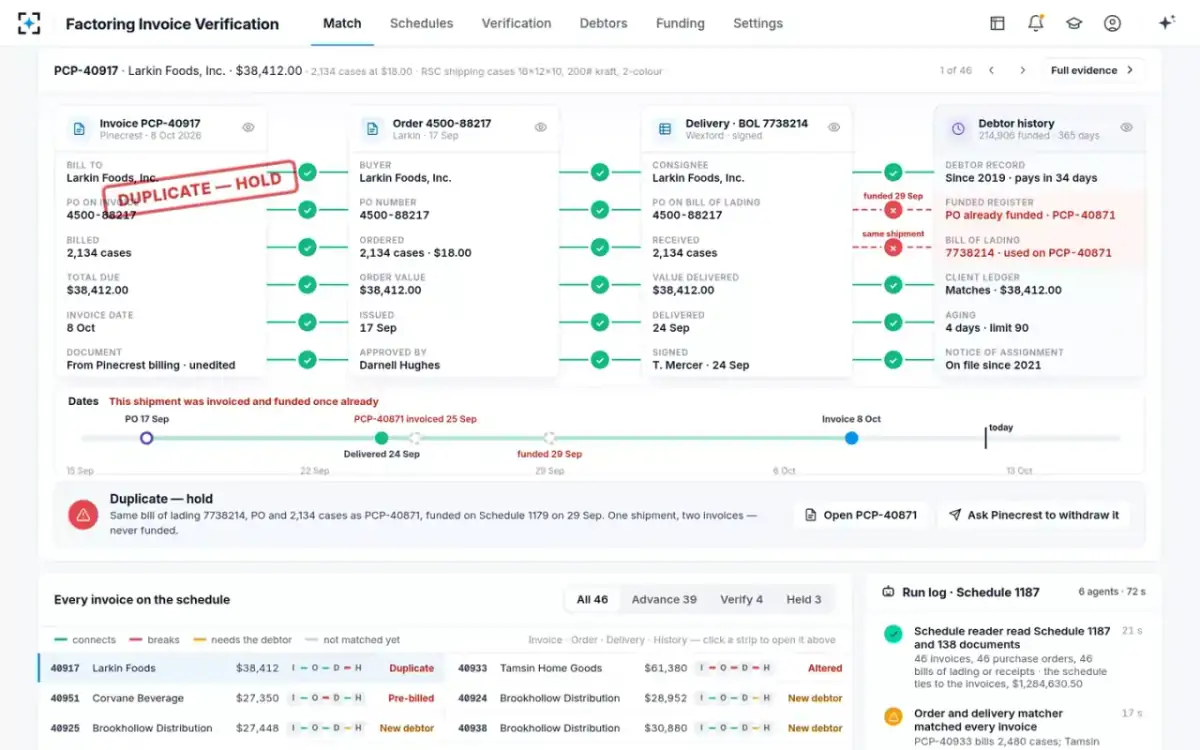
Caught before the wire: A specialist’s few minutes re-reading the bill of lading and the purchase order.
Caught after the wire: The advance already sent, 85% of face value on the sample schedule, now owed by a debtor who may not pay it.
Caught before the wire: The order and delivery matcher and the duplicate detector, before the lane is set.
Caught after the wire: The debtor, when a reconciliation or a collections call turns up an invoice it already paid.
Caught before the wire: The invoice is held; the client is asked to withdraw or correct it.
Caught after the wire: A write-off, a dispute with the client over recourse, or a collections and legal effort with its own cost.
Caught before the wire: Nothing — clean invoices on the same schedule still wire on time.
Caught after the wire: The client’s whole schedule is now suspect, and the next advance is slower while trust is rebuilt.
What a $1,000,000 schedule is worth if 1% of it is fraudulent
A factor does not need a precise fraud rate to price its exposure; it needs an order of magnitude. No published source gives a fraud rate for factored invoices, so take an assumed 1% as an illustration: a $1,000,000 schedule then carries $10,000 of risk. The question is only ever which side of the wire that $10,000 sits on.
The same $10,000, priced on each side of the wire
Caught before funding
a specialist’s review, minutes
The invoice is held or the client withdraws it. Nothing is paid out against it.
Caught after funding
$10,000 advance
The money is already with the client; recovering it depends on a debtor or a client who has no reason to help.
Collection and legal effort
hours to weeks
Chasing a debtor who never agreed to pay, or a client who may be insolvent, with no guarantee of recovery.
The relationship
the next advance, slower
Every other invoice on the same client’s schedule is now read twice.
Where AI adoption against payments fraud stands today
Most organisations are not yet using automation against this cost at all. The AFP survey found that just 17% of organisations use AI to combat payments fraud — but among the minority that do, the reported gains are specific rather than vague: "enhanced efficiency in fraud reporting (49%), improved detection of deepfake technology (45%) and real-time identification capabilities (43%)." That 17% figure is also the gap Factoring Invoice Verification is built into: fingerprinting against 365 days of funded invoices, across every client, is exactly the kind of check that does not scale by hand but does scale as a standing rule.
How to price your own exposure
A factor does not need to wait for its own fraud case to put a number on this. Three inputs, most of which already sit in a factor's own records, are enough for a first estimate: average schedule face value, number of schedules funded in a year, and an assumed fraud rate, taken from the factor's own loss history if it has one and stress-tested at a higher rate if it does not. Multiplying those three gives an annual exposure figure in the same units as the cost of a verification system — which is the comparison that actually decides whether to invest, rather than a vendor's accuracy claim on its own. Factoring Invoice Verification's own target is simple to state against that number: 100% of invoices matched to order, delivery and every invoice already funded, before the advance, not after.
The same exercise is worth repeating with a factor's own historical write-offs, not just an industry median, once a few quarters of data exist. A factor that has already lost money to a duplicate or an altered invoice has a better number for its own book than any survey; an assumed rate is a starting point for a factor with no history, not a substitute for one that has it. Tracking every held invoice's eventual outcome, not just the ones that were funded, is what turns next year's estimate into something sharper than this year's.
The duplicate, held before it ever reached a debtor
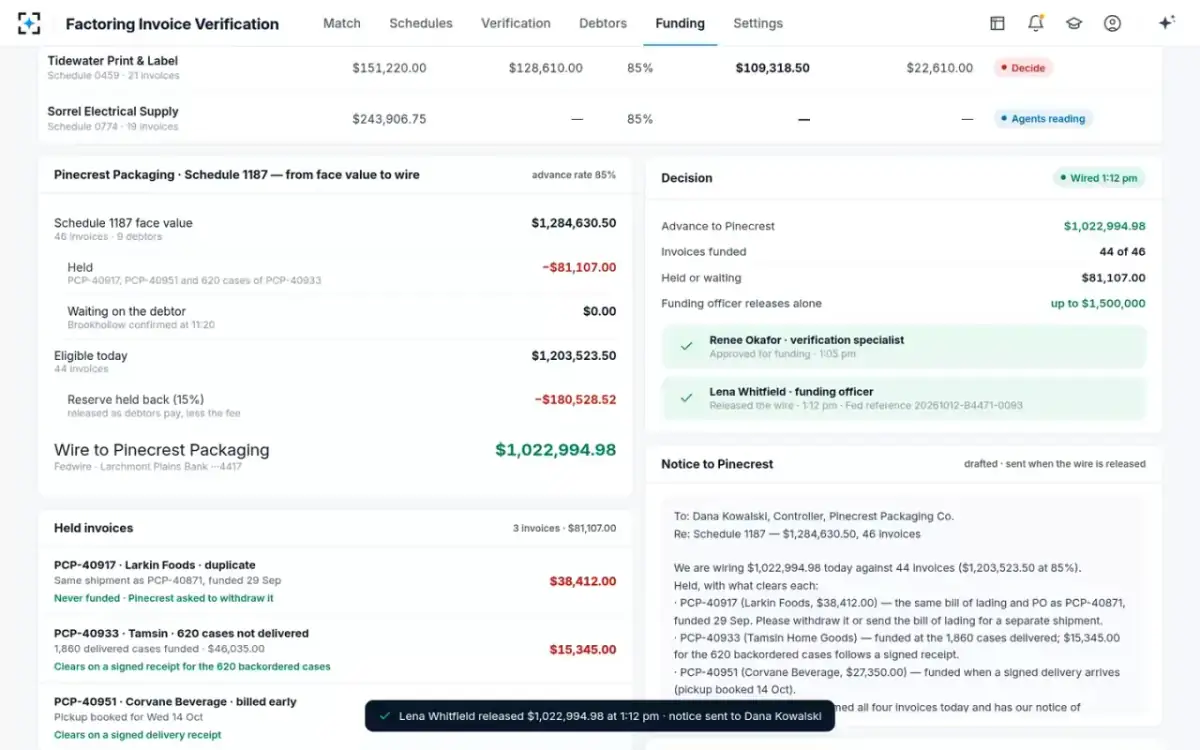
What did reach the wire: 44 of 46 invoices, $1,022,994.98, at 1:12 pm
Questions people ask
How much does invoice fraud cost, on average?
The ACFE's Report to the Nations puts the median billing-scheme loss at $100,000, ranging from $25,000 at the 25th percentile to $448,000 at the 75th. That is the cost of one undetected scheme, not a cost per invoice — a factor's actual exposure depends on how many schedules it funds and how long a scheme runs before it is caught.
How common is invoice fraud?
Very. The 2026 AFP survey found 76% of US organisations experienced attempted or actual payments fraud in 2025, and in the ACFE's study of occupational fraud, billing schemes, where a false or inflated invoice gets paid, were tied for the most frequent kind of asset theft, at 22% of cases.
What does a factoring fraud case actually cost, in a real prosecution?
In the two Department of Justice cases on this page, the amounts obtained were $2.5 million (Idaho, sentenced January 2025, after a scheme that ran from at least 2015 to 2018) and more than $4.6 million (New Jersey, announced October 2026). Both ran for a sustained period before discovery, not a single invoice.
Is AI used to catch payments fraud today?
Not widely yet — the AFP survey found only 17% of organisations use AI against payments fraud at all. Among those that do, the reported gains are in efficiency and real-time detection, not a single accuracy number; Factoring Invoice Verification's own design keeps a person clearing every fingerprint match rather than an agent deciding alone.
How do I calculate the ROI of invoice verification?
Multiply an assumed fraud rate by total schedule volume for a year to get an exposure figure, then compare it with the cost of a system that catches the fraud before funding rather than after. At even a conservative 1% rate, a factor funding $100 million a year is pricing roughly $1 million of exposure against a system that is meant to move that discovery to the specialist's desk instead of the collections desk.
Does catching fraud before funding really change the cost that much?
Yes, because the two outcomes are not the same event measured twice — they are different events. Caught before funding, nothing has moved and the invoice is simply held. Caught after, the advance has already left the factor's account, and recovering it depends on a debtor or client with no obligation to make that easy.