Commercial financing disclosure laws require something a factor's own compliance team has to watch separately from anything it checks on a client's invoices: a disclosure about the factor's own financing terms, given to the client before the transaction closes. California and New York require it for factoring by name, with a factoring-specific format; Florida requires it for any "accounts receivable purchase transaction" of $500,000 or less; Utah and Virginia have laws of their own. The laws are not uniform — the dollar threshold, the required line items and the effective dates all differ — so a factor operating in more than one state is tracking more than one rulebook at once.
Botminds' Factoring Invoice Verification does not draft these disclosures. What it does is keep the settings a disclosure depends on — advance rates, fees, cut-off times — versioned and on the audit trail, so a factor can show what its terms were on the date a disclosure went out, not just what they are today.
Why a factor has to disclose its own financing terms
A factoring advance looks, to the client receiving it, like a loan: money now, a discount instead of interest, a schedule for how the rest settles. Lawmakers in a handful of states decided a small business receiving that money deserves the same kind of cost-of-credit disclosure a consumer gets on a loan — even though factoring is legally a sale of receivables, not a loan, and the factor is not a lender. California's Commercial Financing Disclosure Law and New York's Commercial Finance Disclosure Law both apply this logic directly to factoring, requiring a standardized disclosure before the transaction is consummated.
California's Commercial Financing Disclosure Law
California was first. Senate Bill 1235, enacted in 2018, directed the state's financial regulator — then the Department of Business Oversight, now the Department of Financial Protection and Innovation — to write disclosure regulations covering non-loan commercial financing, including factoring. Those regulations were finalized in 2022, and they do not treat factoring as an afterthought: California's final text sets out a dedicated factoring disclosure format, distinct from the formats for loans, open-end credit, asset-based lending and leases, with its own rules for how the finance charge is calculated on a factoring transaction specifically — because, as the regulation states, the non-interest finance charge for factoring is measured differently from every other category, based on what the recipient must pay "if the recipient repurchases the account receivable before the account receivable is due for payment by the account debtor," rather than on prepaying a loan balance.
California's disclosure threshold is $500,000: under the regulation's thresholds section, a provider determines "whether the amount of a commercial financing offer is equal to or less than $500,000" with specific rules for each product, measuring a factoring facility against its approved advance limit rather than a single invoice's face amount.
New York's Commercial Finance Disclosure Law
New York's version, the Commercial Finance Disclosure Law in Financial Services Law sections 801 to 811, is implemented through the Department of Financial Services' regulation at 23 NYCRR Part 600, which took effect when its notice of adoption was published after proposals in October 2021 and September 2022. It sets a materially higher threshold: offers of $2,500,000 or less are covered, and the regulation measures a factoring agreement against the approved advance limit, with special rules for any amendment "increasing the approved credit limit for a consummated financing agreement to an amount exceeding $2,500,000". A factor doing business with larger clients in New York can find itself covered there on a deal that would fall outside California's $500,000 line entirely — the two states are not just different in process, they cover a different population of transactions.
California, New York and Florida, side by side
| California | New York | Florida | |
|---|---|---|---|
| In force | Regulations finalized 2022 | Part 600, adopted after the Sept 2022 proposal | Transactions on or after 1 Jan 2024 |
| Covered amount | $500,000 or below | $2,500,000 or below | $500,000 or below |
| Who enforces | Dept. of Financial Protection and Innovation | Dept. of Financial Services | Attorney General, exclusively |
| Factoring format | Its own table and finance-charge rule | Its own eight-row table | Six items for any commercial financing; no APR |
| Signature | Recipient signs before consummation | Recipient signs and dates | Disclosure at or before consummation |
What a factor must disclose under these two laws
California and New York converge on substantially the same six facts for a factoring transaction, even though they arrived by different rulemakings. New York's regulation spells out the format precisely: a table of eight rows and three columns, whose first six rows are labeled, in order, "Funding Provided," "Estimated Annual Percentage Rate (APR)," "Finance Charge," "Payment," "Estimated Term," and "Repurchase Costs."
What a factoring disclosure has to show
How much the factor pays the client for the invoice.
The estimated cost of the financing expressed as a yearly rate — explicitly not an interest rate where the fee isn't rate-based.
The total dollar cost of the financing, itemized.
Usually "not applicable" for factoring — the client isn't making payments, the debtor is.
How long until the invoice is expected to be paid, and the assumption behind that estimate.
What the client pays if it repurchases the receivable before the debtor pays it.
The APR line is the one that draws the most pushback from factors, because factoring's pricing — a flat fee or a per-diem rate on an advance — doesn't naturally translate into an annualized percentage rate the way loan interest does. California and New York require the estimate anyway (Florida does not ask for an APR), with required language making clear to the client that the APR is estimated and, where no part of the charge is interest-based, that it is "not an interest rate." New York's regulation also requires a short, plain-language explanation of the assumptions behind the estimate — for example, that the calculation assumes the debtor pays on the invoice's own due date — because a factor cannot know in advance exactly when a given invoice will actually be paid, and the APR figure is only ever as good as that assumption.
The "Payment" row is the one most specific to factoring as a product, and the one most likely to confuse a client reading a disclosure format built mainly for loans. On a term loan, this row states a monthly payment amount. On a factoring transaction, the client is not making payments at all — its debtor is — so New York's format requires the row to instead explain, in plain language, why no payment amount applies: typically that the client is selling an invoice, not borrowing against it, and only owes money back if the debtor doesn't pay and the client breached a warranty about the goods or services behind the invoice.
Does factoring count as "commercial financing"?
Yes, explicitly, in both California's and New York's regulations — neither state left this to interpretation. California's final regulation text repeatedly addresses "factoring transactions" as one of its named categories alongside closed-end loans, open-end credit, sales-based financing, asset-based lending and leases, with its own numbered disclosure sections. New York's regulation does the same, defining a factoring transaction disclosure under its own numbered section distinct from loans and sales-based financing. A factor cannot treat "commercial financing" as a category that describes term loans and lines of credit but not what it does.
Florida: the same idea, a different list
Florida's Commercial Financing Disclosure Law applies to commercial financing transactions "consummated on or after January 1, 2024" (Fla. Stat. §559.9612), and it names factoring in its own words: an "accounts receivable purchase transaction" is one in which a business sells its accounts "at a discount to the expected value", and the provider's characterization of it as a purchase "is conclusive" that it is not a loan (§559.9611). Transactions over $500,000 are exempt, as are banks and their subsidiaries, and providers that close no more than five commercial financing transactions in Florida in 12 months.
What Florida asks for is simpler than California or New York and has no APR at all: the total funds provided, the funds actually disbursed after deductions, the total to be paid to the provider, the total dollar cost, the manner and frequency of payments, and any prepayment costs or discounts (§559.9613). For a factoring facility it allows one disclosure for the whole facility, "based on an account receivable total face amount owed of $10,000", rather than one per purchase. The Attorney General enforces it, with fines of $500 per incident up to $20,000, rising to $1,000 per incident up to $50,000 after a written notice of a prior violation (§559.9615).
Which other states are moving the same way
Utah and Virginia also have commercial financing laws, which the CFPB named alongside California's and New York's in 2023. Virginia's shows how much the definitions matter. Its chapter applies to "providers or brokers offering, obtaining, or making sales-based financing over the internet to or for a recipient, whether or not the provider or broker maintains a physical presence in the Commonwealth", and it defines sales-based financing as a transaction "repaid by the recipient to the provider, over time, as a percentage of sales or revenue" (Va. Code §6.2-2228). That is the merchant-cash-advance model. A traditional factoring arrangement, where the account debtor pays the invoice, does not fit the definition on its face, but structures vary, and a factor with Virginia clients should get its own counsel's read rather than assume either way.
The pattern across every state so far is the same: regulators are extending consumer-style cost-of-credit disclosure to small-business financing that doesn't fit the traditional definition of a loan, and factoring keeps getting named explicitly or swept in by a broad definition of "sales-based" or "commercial" financing. A factor's compliance function has to track this as an open list, not a fixed one.
Does federal law override these state disclosure laws?
No, on the question that was asked. The federal Truth in Lending Act preempts a state disclosure law only if the state law is "inconsistent" with it, and in a determination issued on 31 March 2023 the Consumer Financial Protection Bureau concluded that "commercial financing disclosure laws in California, New York, Utah, and Virginia are not preempted by the Truth in Lending Act" (88 Fed. Reg. 19214). The bureau's reasoning was that the state laws cover commercial financing to businesses, which "do not receive TILA disclosures" at all, so a state rule filling that gap does not conflict with the federal one. For a factor, that settles the most common objection: the state disclosure is not optional on the theory that federal lending law occupies the field.
The practical lesson for a compliance program is the direction of travel: state by state, legislators have extended cost-of-credit disclosure to business financing that is not a loan, and each state has drawn the threshold, the covered products and the format differently. A disclosure program tuned once to one state and left alone is the wrong design for that landscape.
That is also the strongest argument for keeping every input to a disclosure — advance rate, fee schedule, which categories of financing are covered — as a dated, versioned setting rather than a document maintained by hand. A compliance team that can show exactly what applied on a given date, and when it changed, is prepared for a new threshold or a new covered category the next time a state legislature acts; one relying on the current version of a policy document, with no history behind it, has to reconstruct the past by memory.
What to version before your first disclosure goes out
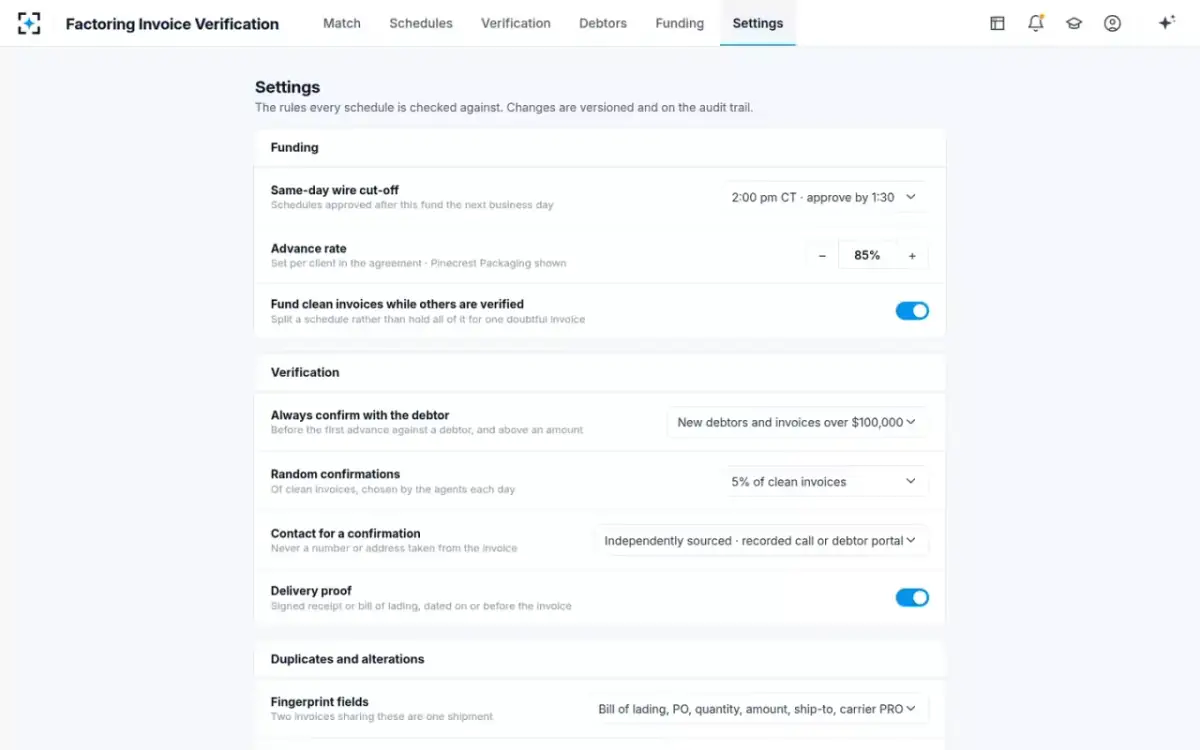
A disclosure is a snapshot of terms on a specific date, and the terms behind it change: advance rates get negotiated per client, fee schedules get updated, cut-off times move. If a factor cannot reproduce exactly what its advance rate and fee schedule were on the date a disclosure went out, it cannot defend that disclosure's accuracy later — to a client, a regulator, or a court. Botminds' Factoring Invoice Verification treats its verification and funding settings the same way a factor's compliance program should treat disclosure inputs: every rule — advance rate, cut-off time, confirmation thresholds, concentration limits, who approves a release — is versioned and on the audit trail, not just editable.
Settings as a version history, not a form
Four milestones, from one state's bill to a federal determination
- California SB 1235 enacted, directing disclosure regulations2018
- California's regulations finalized; New York's Part 600 re-proposed2022
- CFPB: California, New York, Utah and Virginia laws not preemptedMar 2023
- Florida's law applies to new transactionsJan 2024
Before a factoring disclosure goes out
- Confirm which state's law applies
Usually the client's state, but confirm against the specific statute's own trigger — some turn on where the offer is made, not just the client's address.
- Check the transaction against that state's dollar threshold
California and Florida: $500,000. New York: $2,500,000. For a factoring facility, California and New York measure the approved advance limit, not a single invoice's face value.
- Use the current advance rate and fee schedule, dated
Not a blended or historical average — the rate actually offered for this transaction, with the date it was set.
- Calculate the estimated APR under that state's own method
California's and New York's calculation methods are not identical; a figure correct under one regulation is not automatically correct under the other.
- Get the disclosure signed before consummation
California and New York require the recipient's signature on the disclosure; Florida requires the disclosure at or before consummation.
- Keep the version of the settings used, not just the disclosure
If the advance rate or fee changes next quarter, the record of what it was on this disclosure's date still has to be reproducible.
The advance rate a disclosure would have to reproduce
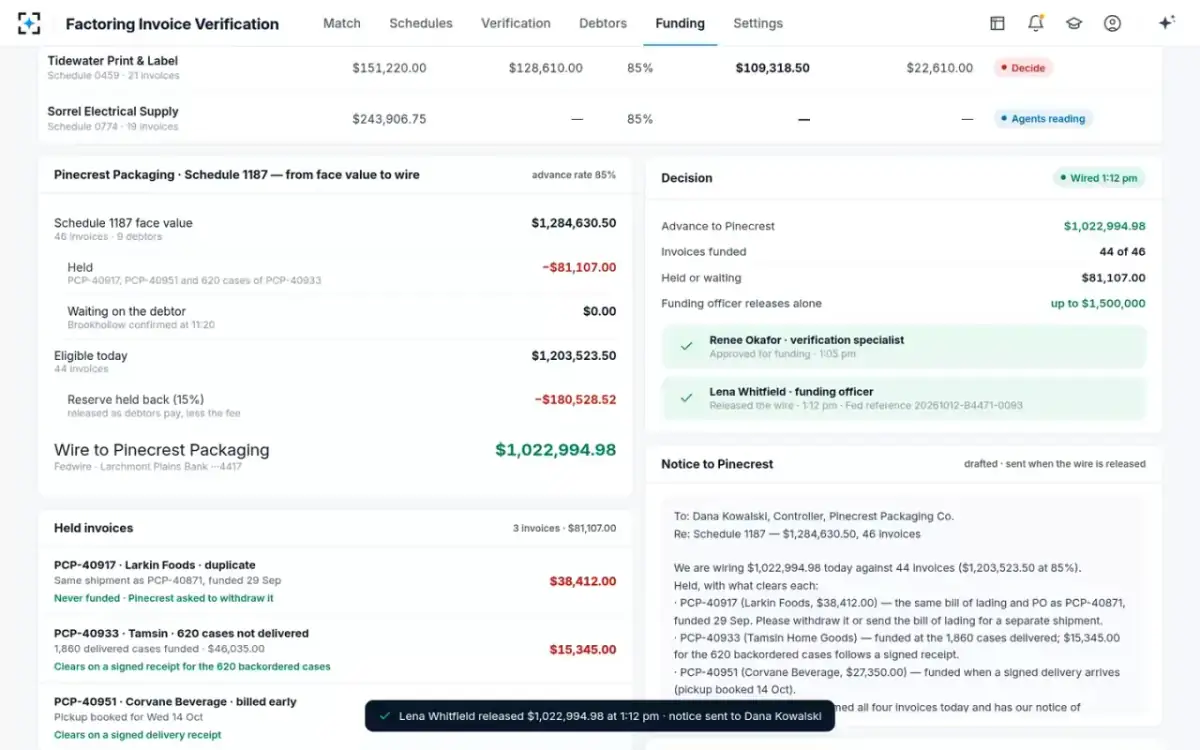
What a factor checks about its own client's invoices before funding — the three-way match, the duplicate check, the debtor confirmation — sits on the opposite side of this relationship from a disclosure law, which governs what the factor owes its client, not what the client owes the factor. The three-way match a factor runs before it pays an invoice covers that other half. To see the settings and the audit trail behind both, start from Factoring Invoice Verification.
Questions people ask
Which states require commercial financing disclosure?
California and New York have regulations requiring commercial financing disclosures with a factoring-specific format, and Florida's law covers accounts receivable purchases of $500,000 or less from 1 January 2024. Utah and Virginia also have commercial financing laws; Virginia's is written around sales-based financing repaid as a percentage of revenue, which traditional factoring does not fit on its face. Check each client state's own statute, because the list has grown since 2018.
What is California's Commercial Financing Disclosure Law?
A regulation, finalized in 2022 under Senate Bill 1235, requiring providers of non-loan commercial financing — including factoring, asset-based lending, sales-based financing and leases — to give recipients a standardized disclosure before a transaction of $500,000 or less is consummated.
Does New York's commercial finance disclosure law apply to factoring?
Yes. New York's regulation, 23 NYCRR Part 600, sets out a factoring-specific disclosure format in section 600.12 and applies to commercial financing offers of $2,500,000 or less — a materially higher threshold than California's.
What must a factor disclose to a client?
Under California's and New York's regulations: the funding provided, an estimated annual percentage rate, the finance charge, the payment structure, the estimated term, and the cost of repurchasing the receivable early, in a standardized table, signed by the client. Florida asks for a shorter list with no APR: funds provided and disbursed, total repayment, total dollar cost, the payment terms and any prepayment costs.
Does factoring count as "commercial financing" under these laws?
Yes, in both California and New York, where factoring is named as its own category with its own disclosure format and finance-charge calculation, distinct from loans and other financing types.
Are there exemptions to commercial financing disclosure laws?
Yes. Each state exempts transactions above its threshold: $500,000 in California and Florida, $2,500,000 in New York, measured for a factoring facility against the approved advance limit. Florida also exempts banks and their subsidiaries, leases, transactions secured by real property, and providers that close no more than five commercial financing transactions in the state in 12 months.