Shelf life and lifetime are two different claims about a medical device. Shelf life is how long the device may sit in storage and still be safe and perform as intended when it is taken out; lifetime is how long it goes on working safely once it is in use, which for an implant means years inside a patient and for a reusable instrument means a number of cycles. They need different evidence, they appear in different places, and the notified bodies have had to write down that they are not interchangeable. The harder problem is that a shelf life is never one number in one report: it is the same number in the stability report, the device specification, the sterile barrier label, the carton label, the instructions for use and the Annex I checklist — which is why extending one is a labelling project rather than a test. Botminds' EU MDR Technical Documentation Review reads a fact like this from every document that states it and shows the ones that disagree, side by side, with their pages.
The worked example is a fictional sample device: Calvera NC, a class III coronary dilatation catheter from the invented company Corvane Medical. Its document numbers, dates and people are sample data. The regulation and the notified bodies' guidance are quoted and linked where they appear.
What is the difference between shelf life and lifetime of a medical device?
The regulation handles the two in different places, and that is the clearest way to see the difference. Lifetime sits in Annex I section 6, among the general requirements: a device's characteristics and performance "shall not be adversely affected to such a degree that the health or safety of the patient or the user ... are compromised during the lifetime of the device, as indicated by the manufacturer", when it is subjected to the stresses of normal use and properly maintained. It is a claim about use.
Shelf life sits in Annex II section 6.1, in the list of verification and validation data a technical file must contain, as "stability, including shelf life". It is a claim about storage. And it reaches the label: Annex I section 23.2(i) requires the label to bear an unambiguous indication of "the time limit for using or implanting the device safely, expressed at least in terms of year and month, where this is relevant".
The notified bodies deal with the confusion directly in their best practice guidance for technical documentation: "In terms of the lifetime of the device there should be sufficient evidence to support the claims made; it should not be considered that product lifetime is equivalent to shelf life." It is the kind of sentence a guidance document carries when files arrive with one number doing both jobs.
Shelf life or lifetime? Two claims, two proofs
Shelf life: How long the device can be stored, in its packaging and under the stated conditions, and still be safe and perform as intended when used.
Lifetime: How long the device goes on performing safely once it is in use — years for an implant, cycles or procedures for a reusable device.
Shelf life: Annex II section 6.1(b), stability including shelf life, among the verification and validation data.
Lifetime: Annex I section 6, among the general requirements: performance must not be compromised during the lifetime indicated by the manufacturer.
Shelf life: An aging study: real-time aging, usually with accelerated aging alongside, on both the sterile barrier and the device function, with defined interim time points.
Lifetime: Fatigue, wear, reprocessing or simulated-use testing over the claimed duration, plus clinical data where the claim is clinical.
Shelf life: On the label and, for a sterile device, on the sterile packaging, as a use-by date in at least year and month.
Lifetime: Usually in the instructions for use, as a service life, a maximum number of uses or a replacement interval.
Shelf life: The number is extended in the design file and the artwork never catches up, so two documents in one file disagree.
Lifetime: Lifetime is set equal to shelf life, or claimed without evidence that covers the whole duration.
What the label is required to say, and in what units
The unit is the part most people get wrong when they first read it. Annex I does not require a day; it requires at least a year and a month. On the label, section 23.2(i) asks for the time limit for safe use or implantation in at least year and month, where this is relevant. On the sterile packaging, section 23.3(i) asks for "an unambiguous indication of the time limit for using or implanting the device safely expressed at least in terms of year and month" — with no "where relevant" attached, because a sterile barrier always has one.
Two neighbouring requirements decide how the date is read. Where there is no indication of a date until when the device may be used safely, section 23.2(j) requires the date of manufacture instead, which may sit inside the lot or serial number as long as it is clearly identifiable. And section 23.2(k) requires an indication of any special storage or handling condition that applies — which is what makes the shelf life meaningful, because a claim validated at 25 °C says nothing about a device stored at 40 °C.
That storage line is also the one place the instructions for use are pulled into the shelf-life argument. Section 23.4(a) carries point (k) into the instructions for use, so the storage conditions the aging study assumed have to appear there, in the languages of every Member State where the device is sold. The use-by date itself is not in that list — but the conditions that make it true are.
How do you justify the shelf life of a medical device?
With a study designed against the claim, not a study that happens to have passed. The notified bodies' list of what a file owes for packaging, stability and shelf life is short and specific: "Claimed shelf life and evidence, i.e. written evidence and justification with example of the label." The example of the label is the part worth noticing. The evidence is not considered complete until the file shows the claim as the user will see it.
The study itself has to cover both halves of the claim. The sterile barrier has to hold — seal strength and integrity after aging — and the device has to still work, which on a catheter means the bench tests that matter clinically, run on aged samples rather than fresh ones. Transport simulation belongs in the same family, because a device that has been aged and then shipped is the one the clinician opens.
What a shelf-life claim owes, before anyone reads the number
- A protocol written against the claim
The claim first, then the study designed to support it. A study that stops at the point it happened to reach supports that point, not the number on the label.
- Defined interim time points
Named in the protocol before the study starts, for real-time aging and, where used, accelerated aging.
- Real-time aging running alongside
Accelerated aging is a model. Real-time aging is the measurement the model is checked against, and it reports as it goes.
- Device function, not just packaging integrity
Seal strength and sterile barrier integrity after aging, and the performance tests that matter clinically, run on aged samples.
- The upper limit of the claimed storage range
The notified bodies list, as a pitfall, an accelerated aging calculation that does not cover the top of the storage temperature range the label claims.
- Labelling legibility after aging and transport
Their guidance notes that labelling integrity and readability after transport simulation and after aging is often not investigated — on a device whose date is printed on the pouch, that is the claim itself.
- An example of the label
Written evidence and justification, with an example of the label, is how the guidance phrases the deliverable.
Accelerated aging, real-time aging, and the interim result that decides everything
Accelerated aging holds a device at an elevated temperature for a shorter time, on the reasoning that chemical change runs faster when it is warmer, and converts that time back into months at ambient with an aging factor. On the fictional sample file the study was run at 55 °C under ASTM F1980, the accelerated-aging practice that file cites, with an aging factor built from a Q10 of 2 — which is a choice the manufacturer has to justify, not a constant.
The arithmetic behind one 36-month claim
The claim
36 months
The shelf life the study has to support, which is also the number that has to reach the label.
Set by the design file
Aging factor
Q₁₀ ^ ((T_chamber − T_ambient) ÷ 10)
With a Q₁₀ of 2, chamber at 55 °C and ambient at 25 °C: 2 ^ 3 = 8. The Q₁₀ chosen is a justification the file owes.
Design engineer
Time in the chamber
1,095 days ÷ 8 ≈ 137 days
About four and a half months at 55 °C to represent three years at 25 °C — which is why accelerated aging is used at all.
Test laboratory
Real-time aging
36 months, ending March 2028
Running alongside, reporting at its interim points. It is the measurement; the chamber result is the model.
Design engineer
The arithmetic is the easy part. What decides whether the claim survives is the interim results, and the notified bodies state the consequence of leaving them out more bluntly than guidance documents usually do.
Without a passing interim result, no shelf life can be supported (0 days), as it remains unclear at which point during storage the product may have failed.
Team-NB best practice guidance for technical documentation, April 2026
Read that against the common practice of testing only at the end point and it is clear what the objection is. A device that passes at 36 months and was never measured in between might have failed at 7 months and recovered, or might have been failing throughout; the end point alone cannot distinguish the two. The same guidance lists, among its pitfalls, the study where "the upper limit of the claimed storage temperature range is not covered by the calculation of the accelerated aging time" — a claim of storage up to 40 °C tested on an ambient of 25 °C has modelled a storage condition the label does not promise.
Every place one shelf life is written down
Here is the part that turns a test result into a project. One shelf life, on one device, appears in at least eight controlled documents, each owned by a different function and released on its own cycle. A change record that lists some of them and not others does not create a disagreement at the moment it is approved; it creates one at the moment the next revision is released.
One shelf life, every document it reaches
Aging protocol and the accelerated aging report
What it is forThe claim the study was designed to support, the temperature and the aging factor used, and the interim time points.
On this fileTR-2291 rev C: accelerated aging at 55 °C, supporting 36 months.
Real-time aging study, still running
What it is forThe same claim, measured rather than modelled, with each interim point reported as it passes.
On this fileDue to report its 36-month point in March 2028.
Device description and specification
What it is forThe shelf life as a specified characteristic of the device, which every other document inherits.
On this fileDS-114 rev C p. 12: 36 months from date of manufacture.
Manufacturing and packaging specification
What it is forHow the date is calculated and printed at the line, from the date of manufacture.
On this fileMP-220: updated by the change.
Sterile barrier label
What it is forAnnex I section 23.3(i): an unambiguous indication of the time limit, in year and month, on the packaging that maintains the sterile condition.
On this fileInherits the artwork family, so it inherits the error.
Carton and sales packaging label
What it is forAnnex I section 23.2(i): the time limit for using or implanting the device safely, in year and month, where relevant.
On this fileLA-0388 rev B panel 2: use-by at date of manufacture + 24 months.
Instructions for use
What it is forNot required to repeat the use-by date, but required by Annex I section 23.4(a) to carry the special storage and handling conditions of 23.2(k), which the aging study assumes.
On this fileIFU-0388 §11: still written around the older claim.
The Annex I checklist line
What it is forThe requirement, the method, the standard and the controlled document that proves the claim — one line, citing whichever document it was pointed at.
On this fileUpdated by the change, and now citing a specification that the label contradicts.
What happens if the label and the design file disagree?
A reviewer finds it, and treats it as doubt about the claim rather than as a clerical slip. A peer-reviewed account of conformity assessment written from inside a notified body, published in January 2026, reports that notified body reviews often find the intended purpose stated inconsistently between the application documents, the instructions for use and the clinical evidence (Stange and Julian, 2026). Shelf life behaves the same way, because it is duplicated across the same documents.
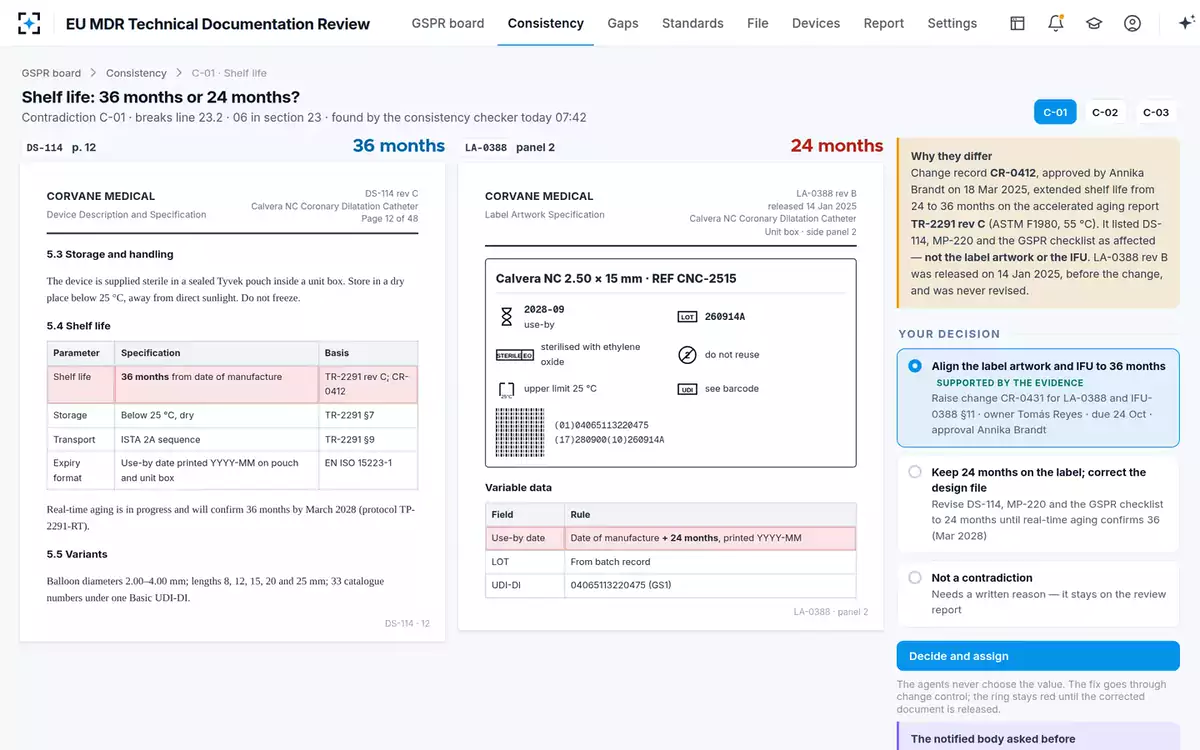
On the fictional sample file the disagreement is exact and dated. The device description and specification, DS-114 rev C, page 12, reads 36 months from the date of manufacture. The label artwork, LA-0388 rev B, panel 2, sets the use-by date at the date of manufacture plus 24 months. Both are released, controlled documents. Both are in the file that was about to be submitted.
Two released documents, two numbers, side by side
The change record that forgets the artwork
The cause on the sample file is a common one, and it is worth stating because it is preventable. Change record CR-0412, approved in March 2025, extended the shelf life to 36 months on the strength of the accelerated aging report. It listed the device specification, the manufacturing and packaging specification and the Annex I checklist as affected documents. It did not list the label artwork, and it did not list the instructions for use.
Nothing was wrong with the testing. The data supported the extension, the real-time study was running to confirm it, and the change went through change control with an approval. What failed was the impact assessment: the question "which documents state this number?" was answered from memory by the people in the room, and the people in the room were the ones who own the design file.
The fix at the level of the file is a second change record — on the sample device, CR-0431 for the artwork and the instructions for use, with an owner, a due date and an approver. The fix at the level of the company is to make the list of documents that state a fact something you read rather than something you recall, which is exactly what cross-reading a file produces as a by-product.
Does extending shelf life need notified body approval?
It depends on what the device is certified under, and the answer that most often applies to a legacy device is set out in the coordination group's guidance on significant changes under the transitional provisions. There, among changes related to sterilisation, an "extension of the shelf life validated by protocols approved by the notified body" is listed as a non-significant change. The same chart lists as significant an extension of the labelled shelf life that is not validated against protocols the notified body has approved.
The distinction is therefore not between big and small extensions; it is between an extension validated against protocols the notified body has already seen and one validated against protocols it has not. The guidance adds that its sterilisation examples hold only where there is no impact on the sterility assurance level or on sterilisation residuals.
For a device already certified under the MDR, the route is different: Annex IX section 4.10 requires changes to the approved device to be approved by the notified body that issued the technical documentation assessment certificate. Either way, the planning point is the same — the shelf-life extension is not finished when the study passes. It is finished when every document that states the number has been released, and the file re-read as a whole.
Cross-reading a fact instead of trusting a document
The reason this class of error survives six weeks of careful review is that a reviewer reads documents, and the error is not in any document. Each of DS-114 and LA-0388 is internally correct, approved by the right people, released under change control. The defect only exists in the relationship between them, and nothing in a document-by-document review forces that comparison.
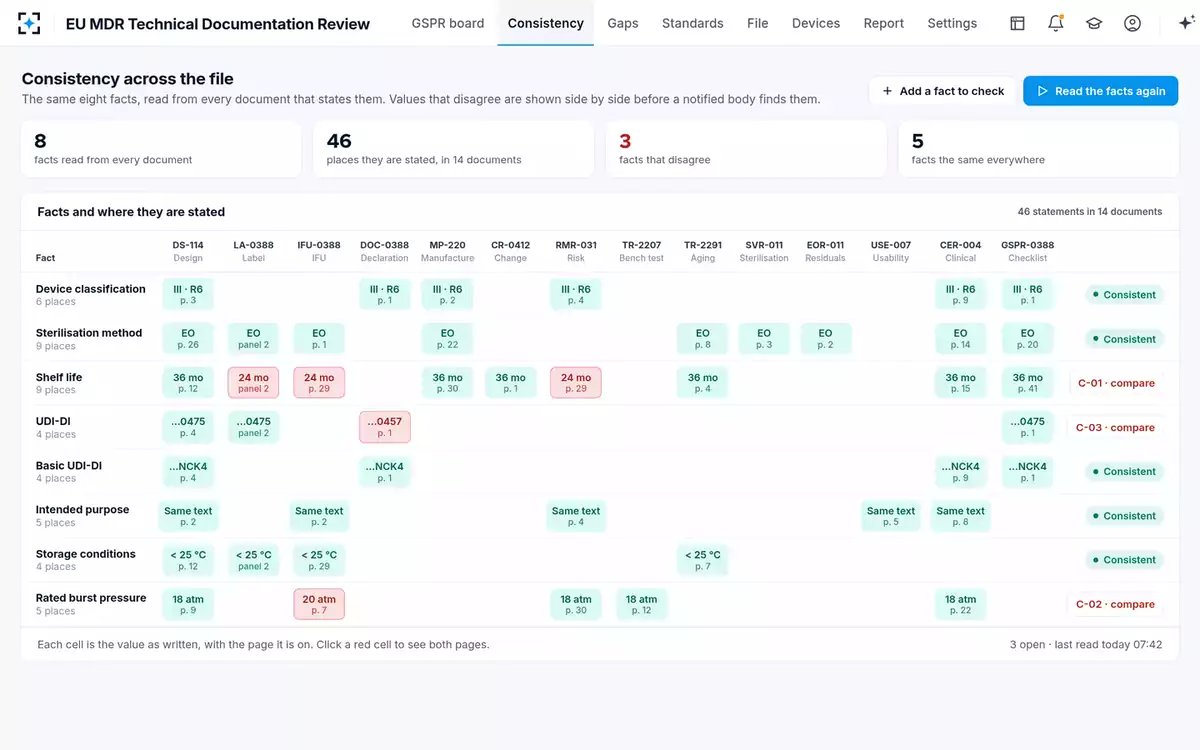
Cross-reading inverts the unit of work. Instead of reading a document and checking it, you take a fact — the shelf life — and read every document that states it, with the page each value came from. On the fictional sample file the solution does this for eight facts: classification, sterilisation method, shelf life, UDI-DI, Basic UDI-DI, intended purpose, storage conditions and rated burst pressure, read from 46 places in 14 documents. Five agree everywhere. Three do not.
Eight facts, 46 places, and the three that disagree
What happens to a fact that disagrees, and who decides it
Agent
Read the fact from every document that states itFind each statement of the shelf life across the released file and record the value with its document, revision and page.
Never: reads a draft or a superseded revision as evidence
Agent
Show the disagreement with what explains itPut the two pages side by side, with every other statement of the same fact and the change record or template history behind the difference.
Never: chooses which value is right
A person decides
The regulatory affairs lead decidesWeighs the options — align the label to the design file, hold the label and correct the design file until real-time aging confirms the claim, or record in writing that it is not a contradiction.
A person decides
A change is raised, with an owner and a dateThe decision becomes a change record against the documents that have to move, assigned to the person who owns them and due before the planned submission.
Agent
The requirement stays open until the document is releasedThe checklist line keeps its mark and the report keeps the open item until the corrected revision is released from document control.
Never: edits a controlled document, or writes anything back to the document control system
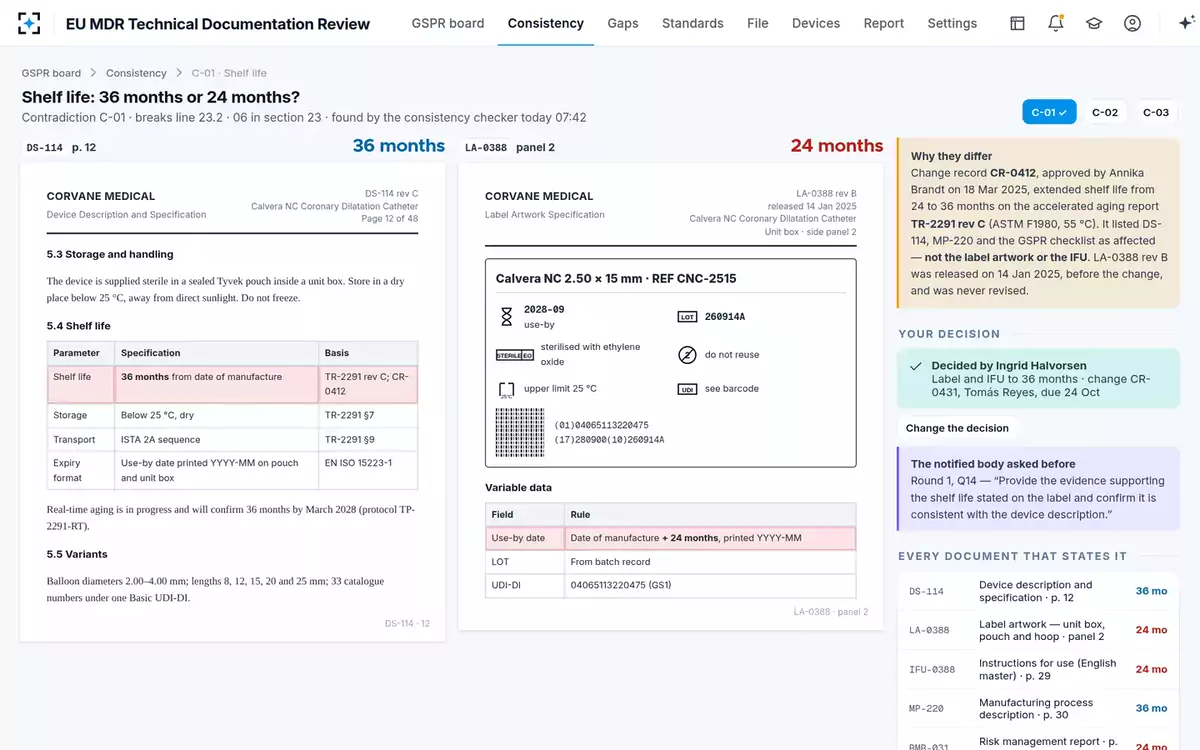
On the sample file the regulatory affairs lead chose the first option: align the artwork and the instructions for use to 36 months, because the accelerated aging report supports it and the real-time study is due to report its 36-month point in March 2028. The change was raised against the artwork and the instructions for use, with an owner, a due date and an approver — and the requirement stayed marked until the corrected artwork was released.
Decided, assigned, and still open until the document is released
The same cross-reading finds the other two disagreements on this file: a rated burst pressure of 18 atm in the specification and the bench report against 20 atm in a compliance chart rebuilt from a sister device's template, and a device identifier with two digits transposed in a draft declaration of conformity. All three have the same shape, and none of them is visible from inside a single document. To see the facts, the pages and the decisions together, start from EU MDR Technical Documentation Review, or read how the same discipline is applied to the Annex I checklist.
Questions people ask
Does the shelf life have to be on the label?
On the label, where it is relevant: Annex I section 23.2(i) requires an unambiguous indication of the time limit for using or implanting the device safely, expressed at least in terms of year and month. On the packaging that maintains a sterile condition, section 23.3(i) requires it without the qualifier. Where no such date is given, section 23.2(j) requires the date of manufacture instead, which may sit inside the lot or serial number provided it is clearly identifiable.
Can you extend a shelf life with accelerated aging alone?
Accelerated aging is a model, and on its own it supports a provisional claim at best. The notified bodies' guidance treats real-time aging as the measurement that the accelerated result is checked against, and is explicit that without a passing interim result no shelf life can be supported at all. The usual practice is to extend on accelerated data with real-time aging running alongside, and to report the real-time interim points as they arrive.
What is ASTM F1980 accelerated aging?
It is a published standard practice for accelerated aging of sterile barrier systems, and the one device files most often name: hold samples at an elevated temperature, convert that time to equivalent time at ambient using an aging factor derived from the temperature difference, and test seal integrity and product function at defined points. The arithmetic depends on assumptions — the ambient temperature, the elevated temperature and the factor used per ten degrees — and each of those is something the file has to justify rather than assume.
How many documents state the shelf life of a device?
More than most teams expect. On the fictional class III device used here it is at least eight: the aging protocol and report, the real-time study, the device specification, the manufacturing and packaging specification, the sterile barrier label, the carton label, the instructions for use through its storage conditions, and the Annex I checklist line. The number is worth counting for your own device, because it is the length of the list a change record has to carry.
What is a use-by date on a medical device?
It is the labelled time limit for using or implanting the device safely — the end of the shelf life, expressed in at least year and month. It is not a statement about how long the device will last in use, which is the lifetime, and it is only meaningful alongside the storage conditions on the label, since the aging study that supports it assumed a temperature range. Where a device carries no use-by date, the label carries the date of manufacture instead.
Who decides which number is right when two documents disagree?
A person, and on a class III file a second person checks the work. In this solution the regulatory affairs lead decides every contradiction and signs the pre-submission review with name, time and the meaning of the signature; the quality manager completes a second review first. Marking something as not a contradiction needs a written reason that stays on the report, and anything still open at signature is recorded as an open item rather than closed by the signature.