The harmonised standards MDR list is the Annex to Commission Implementing Decision (EU) 2021/1182, kept current by a stream of amending decisions and published by the European Commission on its harmonised standards page for medical devices. As at its last amendment, on 11 June 2026, the list runs to 70 entries — and that number is the first surprise for anyone who assumed the Union had harmonised everything a device file cites. The second surprise is that the list is not the only authority on which edition to use: a newer edition can be the state of the art from the day the standardisers publish it, long before its reference reaches the Official Journal. Botminds' EU MDR Technical Documentation Review reads every standard a file cites, compares the edition cited against the current edition and against the list, and shows the regulatory affairs lead which citations have aged.
The sample figures below come from a fictional device, Calvera NC, a class III coronary dilatation catheter from the invented company Corvane Medical, as it runs through the solution. The list, the decisions and the guidance are the published ones and are linked where they appear.
Where is the harmonised standards list for MDR?
On the European Commission's health directorate site, under harmonised standards for medical devices, which links the founding decision and every amendment in date order. Legally, what you are reading is the consolidated Annex to Implementing Decision (EU) 2021/1182 of 16 July 2021, whose Article 1 does one thing: it publishes the references of the listed harmonised standards in the Official Journal of the European Union.
Two things about that page catch regulatory teams out. It carries one list for Regulation (EU) 2017/745 and a separate one for the in vitro diagnostic regulation, with different amending decisions, so a company making both kinds of device is tracking two streams. And the entries carry no date column: the MDR list is a table of a number and a reference of the standard, and nothing else.
Once their references are published by the Commission in the Official Journal of the European Union, the voluntary use of those standards confer presumption of conformity with the requirements of the Regulations they aim to cover.
European Commission, harmonised standards under the medical devices regulations
Which edition of a standard should I cite in my technical file?
Cite the edition you actually tested to, say so precisely, and then show in writing how that edition stands against two references: the edition on the harmonised list, and the newest edition the standardisers have published. Those are different questions with different consequences, and a file that answers only the first has answered the easier one.
Where the edition you used is the one in the Official Journal, you have presumption of conformity for the requirements that standard covers, and the file should say which requirements those are. Where it is not — because the list carries an older edition, or carries none at all for that standard — the file owes a rationale. The notified bodies ask for exactly that: "Where appropriate, please provide a rationale and/or gap analysis to justify the use of a standard version that is not aligned with the SOTA."
Three editions of one standard, and which one the file is answering to
| Standard | The edition an older file often cites | The current edition from the standardisers | The reference in the Official Journal today |
|---|---|---|---|
| EN ISO 10993-1, biological evaluation within a risk management process | ISO 10993-1:2009, still cited in biological evaluation reports written years ago and never revisited. | EN ISO 10993-1:2025, the edition adopted by the European standardisers in 2025. | EN ISO 10993-1:2025, added as entry 54 by Implementing Decision (EU) 2026/1231 and listed since its publication on 17 June 2026. No earlier edition of this part has been on the MDR list. |
| EN ISO 15223-1, symbols supplied with the device | EN ISO 15223-1:2016, the edition many label artworks and symbol glossaries were built on. | EN ISO 15223-1:2021 as amended by EN ISO 15223-1:2021/A1:2025, which adds a defined term for the authorised representative and a modified symbol for it. | Both: entry 12 carries the 2021 edition on its own, and entry 12a carries the 2021 edition with its 2025 amendment. Entry 12 is deleted from 15 June 2031. |
The 10993-1 row is the one worth reading twice, because it shows how a file can be wrong in two directions at once. A report on the 2009 edition is a decade and a half behind the state of the art. And a file that claims the 2020 edition as the harmonised one is claiming something the Official Journal has never said: the recitals to the June 2026 decision describe EN ISO 10993-1:2020 as among the standards whose references are not published in the Official Journal in support of Regulation (EU) 2017/745, which is why the 2025 edition was added as a new entry rather than as a replacement.
Presumption of conformity: what the list actually gives you
Presumption of conformity is a shifting of the burden, not a certificate. The coordination group's guidance on standardisation puts it plainly: "the use of hENs cited in the OJEU confers presumption of conformity of the product with the legal requirements the standard aims to cover". Three limits follow from that sentence and are easy to miss.
The first is scope: the presumption covers what the standard aims to cover, not the whole of Annex I. A file that cites a harmonised standard against a requirement the standard does not address has cited it decoratively. The second is completeness: a presumption attaches to using the standard, which means using it fully — partial application is allowed, and the notified bodies' best practice guidance asks the file to say whether compliance is claimed in full or in part, because a partial claim carries a partial presumption. The third is that it is rebuttable: a notified body that has grounds can substantiate a different conclusion.
Do I have to use harmonised standards at all?
No. Their use is voluntary, and the guidance says so in a sentence worth keeping: "choosing to use a standard or not belongs to the manufacturer, within its overall and ultimate responsibility on compliance". Annex II section 4(c) asks for "the harmonised standards, CS or other solutions applied", and that third option is real: a documented method of your own, validated and verified, satisfies the Regulation if it demonstrates conformity.
What departing costs you is the shortcut. Without the presumption, the file has to argue from first principles that the method chosen demonstrates the requirement — which is more writing, more review and more scope for a question. Most teams therefore use harmonised standards where they exist and reserve their own methods for the places where nothing fits the device.
One requirement removes the choice. Annex I section 23.1(h) says that where the information supplied takes the form of internationally recognised symbols, "Any symbol or identification colour used shall conform to the harmonised standards or CS." On labels, the standard is not optional — which is why a symbol glossary built on a superseded edition is a finding rather than a preference.
The second clock: state of the art, regardless of the Official Journal
Annex I section 1 requires a device to be safe and effective, with risks acceptable against the benefit, "taking into account the generally acknowledged state of the art". The state of the art is not defined by the list, and the Commission has said so in terms the coordination group reproduced in its standardisation guidance: "The most recent editions of standards published by the standardisers should be considered as reflecting state-of-the-art, regardless of the OJ referencing".
Put the two sentences side by side and the structure of the problem appears. The list tells you which edition buys you a presumption. The state of the art tells you which edition a reviewer will measure the device against. They move at different speeds, because a standard is published by the standardisers first and referenced in the Official Journal later, if at all.
Harmonised, or state of the art? Two tests, one file
On the harmonised list: The European Commission, by implementing decision, after CEN and CENELEC deliver a standard against a standardisation request.
The state of the art: The standardisers, when they publish an edition — and, in a file, the manufacturer who has to take it into account.
On the harmonised list: Presumption of conformity with the requirements the standard aims to cover, for the edition in the Official Journal.
The state of the art: Nothing procedural. It is the benchmark the device is measured against under Annex I section 1.
On the harmonised list: An argument from first principles that the method used demonstrates the requirement, since the shortcut no longer applies.
The state of the art: A rationale or gap analysis showing why an edition that is not aligned with the state of the art still supports the claim.
On the harmonised list: Eleven implementing decisions in the list’s first five years, from July 2021 to June 2026.
The state of the art: Whenever a standardisation committee publishes, which is why a file can fall behind without anything changing in the Official Journal.
On the harmonised list: The standards column of the Annex I checklist, and the declaration of conformity.
The state of the art: The test reports, the biological evaluation and the clinical evaluation, which are read against the current method.
Dates of cessation, and the five-year label exception
The MDR list carries no date of cessation of presumption of conformity. That column belonged to the Official Journal lists under the old directives; here the equivalent is the date from which a deletion applies, set in the amending decision's own Article 2. The June 2026 decision is a clean example: it entered into force on the day of publication, but "Points (1), (3), (7) and (9) of the Annex shall apply from 15 December 2027." Those four points are the deletions of the superseded references for irritation testing, sample preparation, toxicological risk assessment and one part of the medical electrical equipment series. Until that date, both the old reference and the amended one are listed.
One standard was given far longer, and the reason is written into the recitals. For EN ISO 15223-1:2021, the Commission judged that "it is necessary to allow for a period of 5 years, as information provided by the sectorial interested parties in the Subgroup on Standards of the Medical Device Coordination Group shows the significant impact on economic operators in terms of costs and timing to implement labelling changes in manufacturing and distribution of devices". The deletion of the un-amended reference therefore applies from 15 June 2031.
That five-year grace is the most useful single fact on this page for anyone planning label work. It is also an admission of how expensive a symbol change is once artwork, printing and distribution are counted — which is the same arithmetic that makes a shelf-life change a labelling project.
Two standards, two clocks, on the same list
- Not yet on the list, Jul 2021 to Jan 2022
- The 2021 edition alone on the list5 Jan 2022 → 17 Jun 2026
- Both references listed: 2021, and 2021 with A1:202517 Jun 2026 → 15 Jun 2031
- No edition of this part on the MDR listno presumption available
- EN ISO 10993-1:2025 listed as entry 54from 17 Jun 2026
What happens if I cite a superseded standard?
Nothing automatic, and that is the trap. There is no mechanism that invalidates a report because its standard was revised. What happens is that a reviewer reads the report against the current method and asks what the difference means — and the notified bodies list the missing answer as a common pitfall in biocompatibility: "No gap and impact assessment provided to demonstrate validity of evaluation/test when performed according to outdated standard."
So the practical answer has three steps. Identify every place the superseded edition is cited, not just the report itself: the checklist line, the declaration of conformity, the clinical evaluation and often the risk file all repeat it. Write a gap and impact assessment that compares the two editions clause by clause and says what, if anything, the change means for the evidence. Then decide: accept the assessment, repeat the affected testing, or update the document to the current edition.
What you cannot do is leave the citation and say nothing, because a reviewer reading a 2009 edition in a 2026 file has to assume either that the manufacturer did not notice or that it decided not to say. Neither reading is good, and both cost a round of questions.
Eleven republications in the list's first five years
The list is not a document you read once. Between 16 July 2021 and 11 June 2026 the Commission adopted eleven implementing decisions for the MDR list: the founding one and ten amendments, each adding, replacing or deleting references. Nothing tells a manufacturer when one lands; the obligation to notice sits entirely on the company.
Eleven times the MDR harmonised list changed
| Decision | Date | What it covered |
|---|---|---|
| (EU) 2021/1182 | 16 July 2021 | The founding list of five standards: four on sterilisation of health care products and one on tests for irritation. |
| (EU) 2022/6 | 4 January 2022 | Biological evaluation, sterilisation of health care products, aseptic processing, quality management systems, symbols supplied by the manufacturer, processing of health care products and home light therapy equipment. |
| (EU) 2022/757 | 11 May 2022 | Quality management systems, sterilisation, and the application of risk management to medical devices. |
| (EU) 2023/1410 | 4 July 2023 | Sterilization of health care products and biological evaluation of medical devices. |
| (EU) 2024/815 | 6 March 2024 | Medical gloves for single use, biological evaluation, sterilization, packaging for terminally sterilized devices and processing of health care products. |
| (EU) 2024/2631 | 8 October 2024 | The harmonised standard for aseptic processing of health care products. |
| (EU) 2025/681 | 8 April 2025 | Medical gloves for single use, sterilization of medical devices, and patient handling equipment used in ambulances. |
| (EU) 2025/2078 | 17 October 2025 | Surgical clothing and drapes, medical face masks, and sterilizers for medical purposes. |
| (EU) 2026/193 | 28 January 2026 | Neurosurgical implants, biological evaluation, clinical investigation of devices for human subjects, non-active surgical implants, sterilization, biocompatibility of breathing gas pathways and small-bore connectors. |
| (EU) 2026/760 | 1 April 2026 | Small steam sterilizers, stainless steel steam boilers, and electroacoustics for hearing aids. |
| (EU) 2026/1231 | 11 June 2026 | Biological evaluation, symbols supplied by the manufacturer, medical electrical equipment, transfusion equipment, ophthalmic optics, non-active surgical implants, washer-disinfectors, prosthetics and sharps injury protection. |
The pattern in that table is worth naming. The changes are not spread evenly across the subject matter: biological evaluation appears in five of the ten amendments, sterilisation or sterilizers in eight, and symbols in two. A company whose devices are sterile and body-contacting is therefore tracking the two fastest-moving families in the list, and a company whose standards list is refreshed once a year will be out of date for most of it.
The two standards that most often turn up out of date
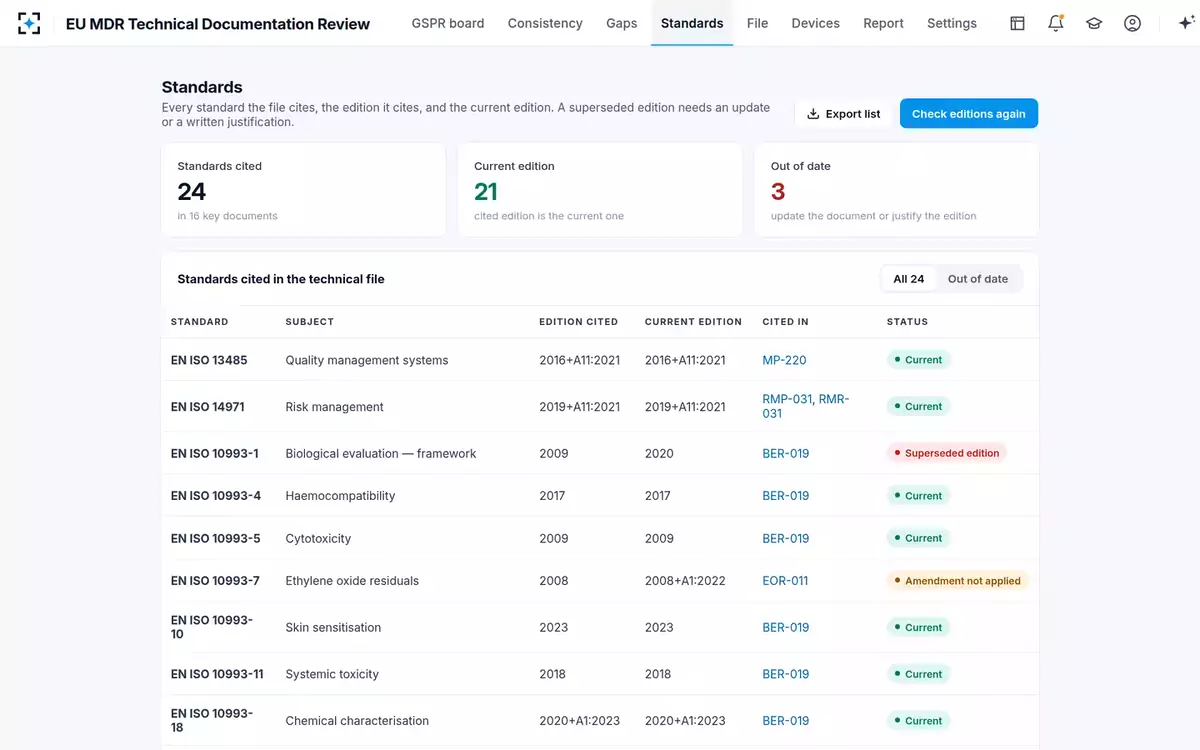
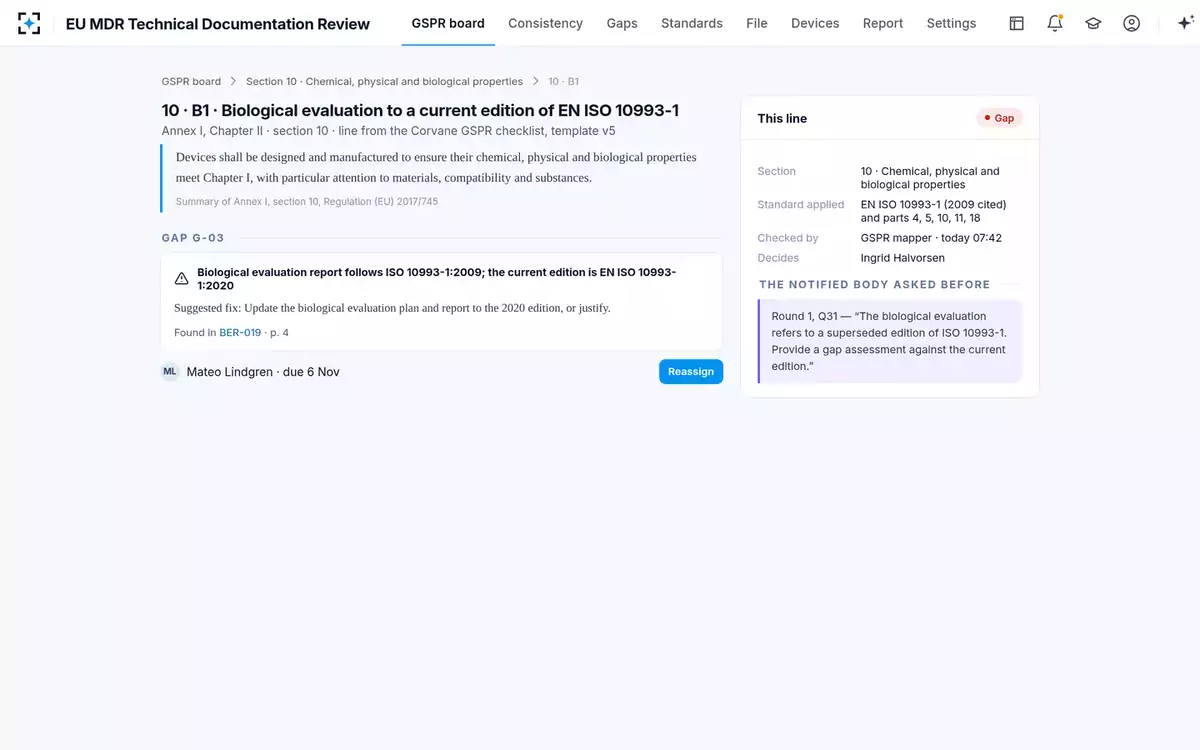
On the fictional sample file, the solution's standards checker compares 24 cited standards against their current and listed editions and finds three out of date. The first is the biological evaluation report, which follows the 2009 edition of part 1 of the biocompatibility series — a citation written before the 2025 edition existed and never revisited, which becomes a gap with a suggested fix and an owner rather than a quiet assumption.
The second is the symbols standard behind the label and the instructions for use, cited at the 2016 edition while the file was built under the 2021 edition and the Official Journal now also carries that edition as amended in 2025. The third is an amendment never applied: a residuals report citing a 2008 edition without the 2022 amendment that revised it. All three have the same shape — the document was right when it was written, and nothing in the company noticed that the reference moved.
Standards on one file, compared against the current edition and the list
24
standards cited across the released technical file
3
cited at an edition that is behind the current one, each raised as a gap with an owner
46
places in the file where those standards are cited, each with its page
Monthly
refresh of current editions and the harmonised standards list in the review settings
Every standard the file cites, against the edition that counts
Keeping a standards list current, without reading the Official Journal every week
Three habits cover most of the risk. Keep one list of every standard the company's files cite, with the edition and every document that cites it — not a list per file, which goes stale the moment a report is reissued. Re-read that list against the Commission's page and the standardisers' catalogues on a fixed cadence, monthly rather than annually, because the eleven decisions above cluster unpredictably. And treat any new edition as a change-control event with an impact assessment, even when the answer is that nothing needs to change, because the written answer is the thing a reviewer asks for.
The reason to automate the first two is arithmetic rather than ambition: 24 standards cited in 46 places on one file, across a portfolio of a dozen devices, is several hundred citations to re-read every time an edition moves. The judgement — whether a changed clause matters to this device — is not automatable and should not be. That is the same division of labour as the checklist itself: the agents cite and compare, and a person decides.
A gap raised against one requirement, with the standard that moved
To see the standards view, the checklist and the drafted review together, start from EU MDR Technical Documentation Review.
Questions people ask
Is EN ISO 10993-1:2025 harmonised?
Yes. Implementing Decision (EU) 2026/1231 of 11 June 2026 added EN ISO 10993-1:2025 to the MDR harmonised standards list as entry 54, and it has been listed since the decision was published on 17 June 2026. It is the only edition of that part on the list: the 2020 edition's reference was never published in the Official Journal in support of Regulation (EU) 2017/745, which is why the 2025 edition was added as a new entry rather than replacing an older one.
What is the date of cessation of presumption of conformity?
Under the MDR there is no such column. The harmonised list is a table of a number and a reference, and nothing else. The equivalent date is the one in an amending decision's Article 2, which says when a deletion from the Annex takes effect — for example 15 December 2027 for four of the deletions in the June 2026 decision, and 15 June 2031 for the un-amended symbols reference. Until that date arrives, the older reference is still on the list and still confers the presumption.
What is state of the art for a medical device standard?
The generally acknowledged state of the art is what Annex I section 1 requires a manufacturer to take into account, and for standards the Commission's position, recorded in the coordination group's standardisation guidance, is that the most recent editions published by the standardisers reflect it regardless of whether they are referenced in the Official Journal. In practice that means a newly published edition becomes the benchmark immediately, even though the presumption of conformity still attaches to whichever edition is on the list.
How often does the harmonised standards list change?
Eleven times in its first five years, counting the founding decision of 16 July 2021 and the ten amendments up to 11 June 2026 — roughly every five to six months, but irregularly: there were two decisions in 2022, one in 2023, two each in 2024 and 2025, and three in the first half of 2026. There is no notification to manufacturers, so a fixed review cadence is the only reliable way to notice.
What is the latest version of EN ISO 15223-1?
The 2021 edition as amended by EN ISO 15223-1:2021/A1:2025, which the June 2026 decision describes as adding a defined term for the authorised representative and a modified symbol for it that is not country or region specific. Both the plain 2021 reference and the amended one are currently on the harmonised list, as entries 12 and 12a; the plain reference is deleted from 15 June 2031, which is the window manufacturers were given to work the symbol change through artwork and distribution.
Does a notified body look at standards I have not claimed?
Yes. Annex VII section 4.5.1 requires that the notified body shall, where relevant, take into consideration available common specifications, guidance and best practice documents and harmonised standards, even if the manufacturer does not claim to be in compliance. Not claiming a standard therefore does not keep it out of the assessment; it only means the file has to explain what was done instead.