EU MDR certification cost is two numbers that get quoted as one. The first is the fee a notified body charges, which appears on a quotation and is the number most budgets contain. The second is what the certificate actually costs the manufacturer — technical documentation, clinical data, staff time and the fee together — which is several times larger and appears in no quotation at all. The European Commission surveyed both sides separately for its 2025 evaluation of the Regulation and published the two figures side by side, which makes this one of the few places in medical device regulation where a buyer can see the gap. Botminds' EU MDR Technical Documentation Review does not touch the fee. It addresses one specific slice of the second number: the weeks a round of notified body questions costs, and the reading that would have prevented them.
Every figure in this guide is linked to the document that published it, with the number of respondents behind it where the source gives one. No price for the solution appears on this page, because none has been published; the product examples are a fictional sample manufacturer preparing a class III catheter for submission.
How much does EU MDR certification cost?
For the product certificate that covers a technical documentation assessment — the one issued under Annex IX Chapter II, which the Commission's evaluation defines as a certificate issued following an assessment of the technical documentation for a device to verify their conformity with MDR/IVDR requirements
— manufacturers reported average issuance costs of 616 981 EUR (14 respondents) for first certificates and 385 617 EUR (33 respondents) for last certificates, with yearly maintenance costs averaging 48 503 EUR (31 respondents)
. Notified bodies, asked only about their fees, reported something much smaller: When considering only the fees charged, reported costs were 75 532 EUR for first and 68 309 EUR for last certificates, with yearly maintenance costs averaging 16 571 EUR.
Both from SWD(2025) 1051, the Commission's targeted evaluation, section 4.1.2.1.
What a product certificate costs, and what the fee for it is
On those reported averages, the fee is roughly an eighth of what a first product certificate costs a manufacturer, and roughly a sixth for the most recent one. The arithmetic is ours and the caveat matters: the two numbers come from different respondents answering different questions, and the evaluation is explicit that the larger figure is the full compliance burden rather than an invoice. But the direction is not in doubt, and it is the only thing a budget needs to get right. A transition budget built on quotations is a budget for between a sixth and an eighth of the work.
Fees and costs are two different numbers
The evaluation's own definition is the clearest statement of what separates them. The manufacturer survey was interpreted as covering the full compliance burden e.g. technical documentation, clinical data, staff resources etc, in addition to fees charged by notified bodies
, while the notified body survey was limited to fees charged
. So the difference between the two columns above is, by construction, your own people's time and the evidence they produce.
That is worth stating plainly to anyone building a transition case, because it changes which lever is worth pulling. A better fee is a negotiation with a supplier in a market where capacity, not price, is the constraint. A smaller second number is a change in how your own organisation produces and checks a technical file — and that is entirely within your control.
What the Commission's evaluation reports, item by item
| Item | Figure | Respondents behind it | Which survey |
|---|---|---|---|
| Product certificate, first — issuance cost | €616,981 | 14 | Manufacturers (full compliance burden) |
| Product certificate, most recent — issuance cost | €385,617 | 33 | Manufacturers (full compliance burden) |
| Product certificate — yearly maintenance cost | €48,503 | 31 | Manufacturers (full compliance burden) |
| Product certificate, first — fee charged | €75,532 | Notified bodies | Notified bodies (fees only) |
| Product certificate, most recent — fee charged | €68,309 | Notified bodies | Notified bodies (fees only) |
| Product certificate — yearly maintenance fee | €16,571 | Notified bodies | Notified bodies (fees only) |
| Clinical evaluation, per evaluation | €30,000–€250,000 | Manufacturers | Manufacturers (economic operator survey) |
What do notified bodies charge for a technical documentation assessment?
The €75,532 and €68,309 above are the published averages for exactly that certificate. The evaluation adds a split by risk that is worth reading because it runs against intuition in one direction: it reports higher first-certificate costs for high-risk devices (94 109 EUR) than for medium-risk devices (59 262 EUR), while for last certificates medium-risk devices were costlier (77 032 EUR) than high-risk (63 463 EUR)
. That sentence sits in the paragraph reporting fees charged. The first half is unsurprising — a class III file takes more assessment. The second half suggests that for a renewal the risk class matters less than how much changed and how clean the file is.
Which is the general lesson of this whole page. Beyond the first certificate, what you pay tracks the work your file creates rather than the class of your device.
Are notified body fees published?
Yes, as a legal requirement, and almost nobody uses it. Notified bodies shall establish lists of their standard fees for the conformity assessment activities that they carry out and shall make those lists publicly available
(Regulation (EU) 2017/745, Article 50). Annex VII section 4.2 adds that each body must have documented procedures and documented details about the fees charged for specific conformity assessment activities and any other financial conditions, and must publish a description of its application procedure.
Two practical uses follow. Before you sign a written agreement, read the standard fee list of the body you are approaching and ask which items on it your project will trigger — the assessment, the tests the body may require under Annex IX section 4.3, the supplements for changes under section 4.10, the annual surveillance. And after, treat the fee list as the map of what a change costs: a supplement to a certificate is a priced activity, and a change that could affect safety, performance or the conditions of use will need one.
What a clinical evaluation costs, by class
The clinical evidence is the other large term, and it varies more than anything else in the budget. Manufacturers reported costs of approximately €30 000–€250 000 per clinical evaluation, depending on device class and study complexity
, with class Ir devices at around €27,700 and class III devices reaching €250,000. The evaluation adds that no costs could be captured for clinical investigations and performance studies, which tend to exceed costs for clinical evaluations
— so for a device that needs its own investigation, the range above understates the clinical bill.
Industry respondents named clinical evidence as one of the main cost drivers under the Regulations, and the evaluation records that smaller manufacturers and makers of niche devices are disproportionately affected, with some organisations reporting that the need to generate new data has already led to product withdrawals. Nothing in a documentation review changes that number. What it changes is whether the clinical evidence you have paid for is cited precisely enough to be accepted — which is a smaller claim, and a true one.
What does a round of notified body questions cost?
No source publishes a figure, and anyone who quotes one is estimating. What can be stated is the structure of the bill, and every term in it is work your own organisation performs twice.
What a round of questions is made of
Reviewer days inside your team
questions in the round × hours to answer one ÷ a working day
Each answer means re-reading the file, finding the page, and writing a reply a stranger can check without ringing you.
Regulatory affairs lead
Engineering and authoring days
documents to correct × (rework + review + approval)
A superseded standard edition or a value two documents state differently is rarely one document's problem.
Design engineer, technical file author
Change control and release
corrected documents × your own approval cycle
An answer may only cite a released revision, so the change control cycle sits inside the reply, not after it.
Quality manager
The reviewer re-reads
the body's own queue + re-assessment of each affected part
Specialist review is off-site and batched, so your reply joins a queue rather than a conversation.
Notified body
Weeks of market access
calendar weeks added × what the device earns in a week
Usually the largest term, and the only one that never appears in a certification budget.
Commercial
The Commission's own survey of notified bodies shows how often the first term gets paid. Only 14 of the 52 bodies designated under the MDR say that more than half of the submissions they receive are complete on arrival, without a request for more information (DG SANTE notified body survey, February 2026 data). So the first round of questions is close to universal. The cost worth controlling is the second and the third.
And the queue those cycles join is what the market complains about most. In the Commission's call for evidence, 112 of 275 contributions — 40.7% — named notified body capacity limits and long delays as main obstacles under the Regulations. A round of questions is not only your days; it is your place in a queue, given back.
Do small manufacturers pay less?
Less in absolute terms, and the evaluation's own caveat is as important as its figure. It reports that costs varied by firm size in both surveys and, for one type of quality management system certificate, records large manufacturers paying 165% more than SMEs for the last certificate obtained
— and immediately adds that the data did not allow a comparable analysis of the proportion of cost between large manufacturers and SMEs, or of whether the difference was explained by device risk or by company size. Large firms also certify more complex devices, so the premium is not a size discount read backwards.
What is not in doubt is who bears the burden relative to their size. The Commission's own proposal to simplify the rules opens with the shape of the industry: There are more than 38 000 medical technology companies in Europe. Small and medium-sized enterprises (SMEs) make up around 90% of the industry, most of which are small and micro-sized companies which employ fewer than 50 people
(COM(2025) 1023). A fee of €68,309 and a full cost of €385,617 land very differently on a company of forty people than on a multinational, which is why the same proposal would amend Article 50 so that notified bodies shall apply at least a 50 % fee reduction for manufacturers that are micro enterprises
, at least 25% for small enterprises, and let micro and small manufacturers defer payment until the conformity assessment activity is finalised. The notified bodies' own association has objected, arguing that small manufacturers' files often take more assessment effort, not less.
The market these figures sit in
38,000+
medical technology companies in Europe, per the Commission's own proposal
~90%
of the industry are small and medium-sized enterprises, most employing fewer than 50 people
32,898
MDR applications recorded in the Commission's notified body survey to February 2026
18,010
MDR certificates issued, on the same survey
Proposals are not law, and a deferment is not a discount. But the direction of travel tells a small manufacturer something useful about sequencing: the cost of being early with an incomplete file is paid now, in rounds, while any relief is at best later and partial.
The yearly bill after the certificate
Certification is not a one-off purchase. On the Commission's figures, keeping a product certificate costs manufacturers an average of €48,503 a year in full costs, of which about €16,571 is fee — covering regular surveillance and recertification activities, including assessment of relevant updates to the devices covered and to the quality management system. For a portfolio of fourteen devices, that is a standing annual line item in six figures before anything changes.
What drives it up is change. Every modification that could affect safety, performance or the conditions of use needs the issuing body's approval, which is a priced activity and a wait. The cheapest version of that loop is one where your file is already consistent, so a change touches the documents it should and no others — and the expensive version is one where a change lists three affected documents and the label artwork is not among them.
Where the working days go on one technical file
The term in the formula that a pre-submission review actually moves is the first one, and it is worth looking at before as well as after a submission, because the same reading has to happen either way. The split below is the sample manufacturer's own estimate for one class III file.
The reading on one class III file, by hand and with the agents
By hand · about 30 working days, one reviewer
- Indexing the file, finding released revisions (4 d) · 13.3%
- Mapping each requirement to a document and page (12 d) · 40%
- Checking the edition of every standard (3 d) · 10%
- Cross-reading the same facts between documents (6 d) · 20%
- Writing reasons and the gap list (3 d) · 10%
- Drafting, second review and signing (2 d) · 6.7%
With the agents · about 5 working days
- Indexing (0.5 d) · 10%
- Mapping (1.5 d) · 30%
- Standard editions (0.25 d) · 5%
- Cross-reading (1 d) · 20%
- Reasons and gaps (0.75 d) · 15%
- Drafting, second review and signing (1 d) · 20%
The shape is the argument. Two bands dominate the manual review — mapping each requirement to a page, and cross-reading the same fact across documents — and they are exactly the two that scale with the size of the file rather than with the judgement required. The last band, drafting and signing, stays almost the same in absolute terms, because deciding and signing is not work anyone should want to shorten.
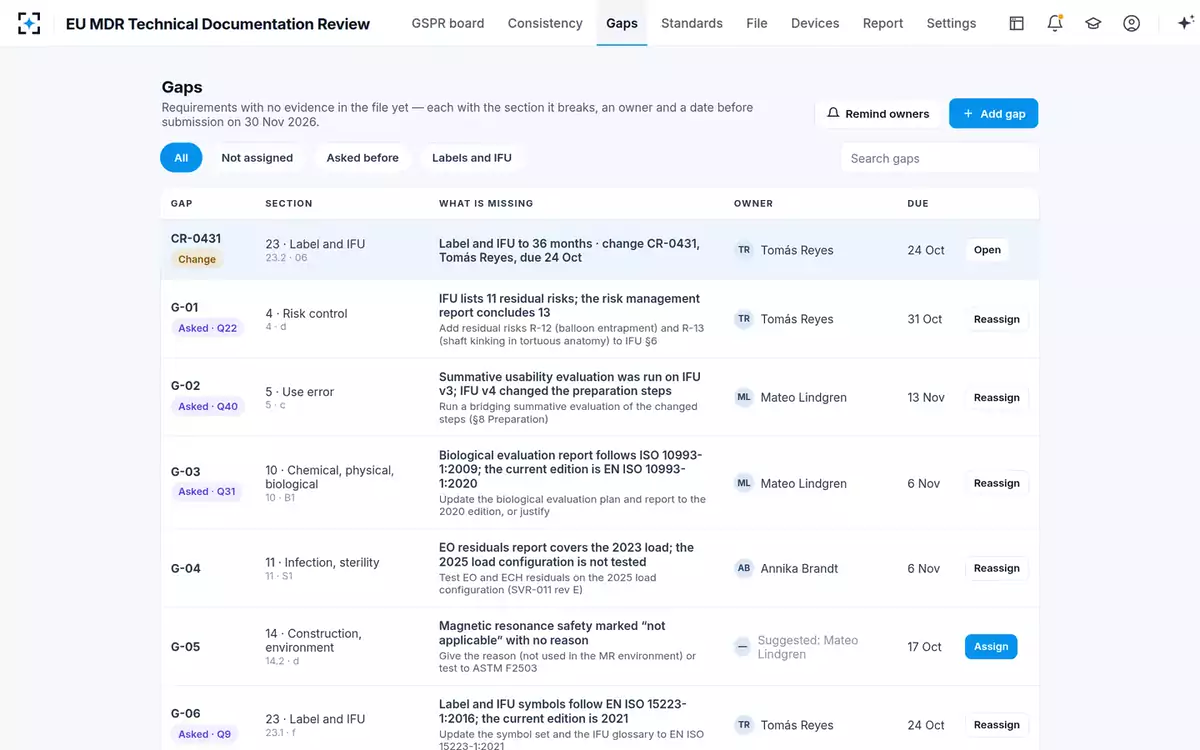
Every requirement without evidence, with a fix, an owner and a date
What is worth paying to avoid
Put the figures together and the ranking is unusual for a buying question, because the largest items are the least visible. The fee is known and quoted. The full cost is several times the fee and appears nowhere. The cost of a round of questions is unpublished, is made almost entirely of your own people's time, and carries weeks of market access with it. And the queue is shared, which means the weeks you lose are not weeks you can buy back.
112 out of 275 contributions to the Call for evidence (40.7%) explicitly highlighted notified body capacity limits and long delays as main obstacles under the Regulations
European Commission, SWD(2025) 1051, targeted evaluation of the MDR and IVDR, hassle costs
So the honest claim for a pre-submission review is narrow and worth making precisely. It does not reduce a fee. It does not reduce what a clinical evaluation costs. It moves one term: how many administrative findings — a superseded edition, a value two documents state differently, a requirement marked not applicable with no reason, a missing page citation — reach the reviewer instead of being caught at home. The sample manufacturer's design targets are fewer rounds of questions and five days per file instead of six weeks; both are goals to be measured in use, not results anyone has measured.
A portfolio with fourteen deadlines, and when each file is read
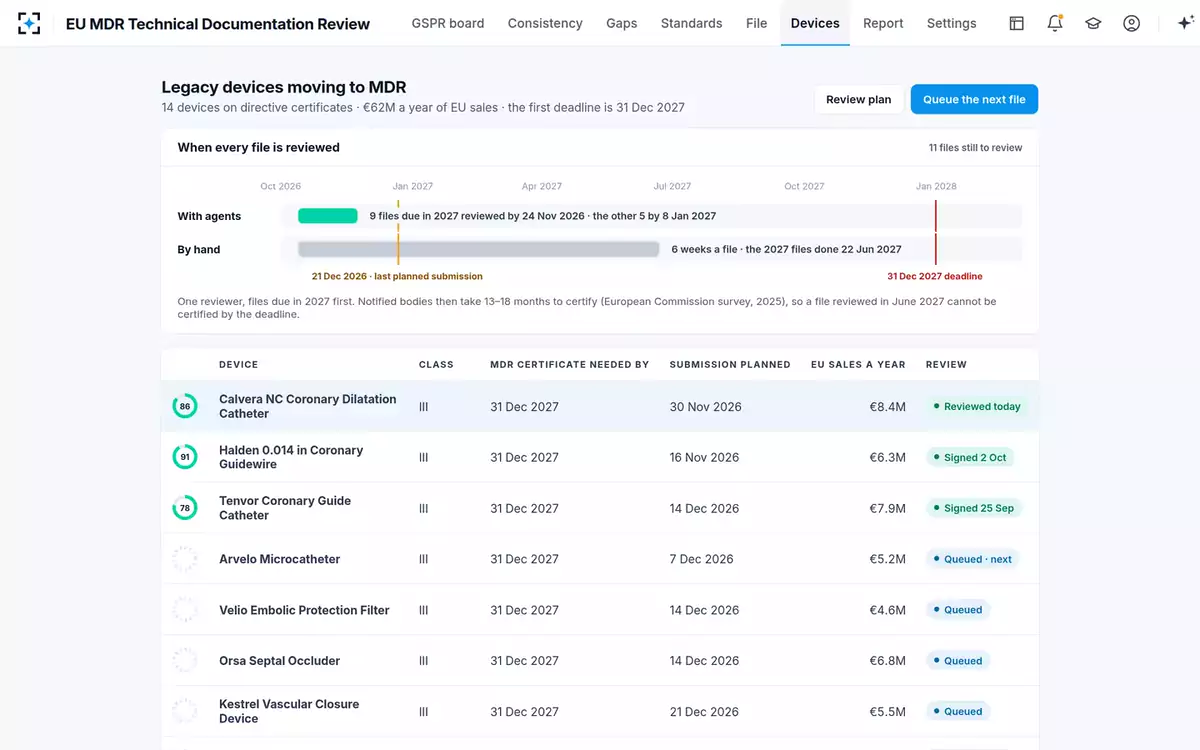
Which devices in a portfolio face 2027 and which 2028 is set out in the legacy device guide, and the sequence those months are spent in is in the review timeline. To see what a reading of one of your own files turns up, start from EU MDR Technical Documentation Review.
Questions people ask
Is MDR certification cheaper the second time?
On the Commission's reported averages for product certificates, yes in full cost — €385,617 for a most recent certificate against €616,981 for a first — but barely in fees, at €68,309 against €75,532. The reading is that the saving is in your own work rather than in the supplier's price: the second time, the evidence largely exists and the file structure is known.
Why can't I just get a quotation and budget from that?
Because the quotation is a fee, and the Commission's evaluation is explicit that the manufacturer figures cover the full compliance burden — technical documentation, clinical data and staff resources — in addition to the fees. On the reported averages the fee is roughly an eighth of a first product certificate's cost to the manufacturer. Budget the quotation and you have budgeted the smallest term.
What are the annual costs of keeping an MDR certificate?
An average of €48,503 a year in full costs reported by manufacturers, of which about €16,571 is fee, covering regular surveillance and recertification activity including assessment of updates to the devices and the quality management system. Changes to an approved device that could affect safety, performance or the conditions of use need the issuing body's approval on top of that.
Does a cheaper notified body save money?
It saves part of the smallest term, in a market where capacity rather than price is the constraint: more than two in five contributions to the Commission's call for evidence named capacity limits and delays as a main obstacle. A body that reviews slowly or asks more rounds costs far more in the other terms than any fee difference recovers, which is why the questions worth asking a body are about its reported review times and the composition of its review team.
Is there any relief for micro and small companies?
Not by law yet. The Commission's December 2025 proposal to amend the Regulation would require notified bodies to cut fees by at least 50% for micro enterprises and at least 25% for small ones, and to let them defer payment until the assessment is finalised; the notified bodies' association has objected to it. Treat it as a proposal and plan without it; small manufacturers in the meantime carry the same file-quality risk as everyone else with fewer people to absorb it.
How should I present this in a business case?
Three lines rather than one. The fee, from the body's published standard fee list. The full cost, benchmarked against the Commission's published averages with the respondent counts shown so nobody mistakes an average of fourteen for a market price. And the avoidable term — the rounds of questions — expressed in your own reviewer days, your own change control cycle and your own weeks of delayed market access, because those are the only numbers in this subject that your organisation actually controls.