The notified body review timeline for a medical device technical file runs from the moment a signed application arrives to the moment a certificate is issued, and almost none of it is one person reading cover to cover. Annexes VII and IX of Regulation (EU) 2017/745 lay out a sequence: an application review that tests whether the submission can even be assessed, specialist reviews allocated by subject, a review of the clinical evidence written up in its own report, a recommendation that must be signed off, a final review by people who did not do the assessment, and — for class III implantables and some class IIb active devices — a consultation at a European expert panel with its own statutory clocks. Botminds' EU MDR Technical Documentation Review exists for the weeks before all of that starts: it reads your whole file, maps each Annex I requirement to the document, revision and page that meets it, and shows where two of your own documents disagree, so the sequence below has less to come back to you about.
The people and figures in the product examples are a fictional sample manufacturer, Corvane Medical, preparing a class III coronary dilatation catheter for submission on 30 November 2026. The law and the published survey figures are linked where they appear.
How long does a notified body review take?
In the European Commission's twentieth notified body survey, with data to 28 February 2026, just over half of the notified bodies that had issued certificates covering both the quality management system and the product put the time at 13 to 18 months, and almost a third at 19 to 24. The indicator is defined precisely in the Commission's own note: This indicator shows the time to reach issuance of a new EC certificate (from written agreement signed to issuance) under MDR
(DG SANTE notified body survey, slide 30, data of 39 designated bodies).
What notified bodies report for a new certificate covering the system and the product
A peer-reviewed account written from inside a notified body agrees. Reviewing conformity assessment for the Journal of Market Access & Health Policy, Stange and Julian report that Data collected in summer 2024 show MDR product certifications take in 75% of all cases more than a year, unchanged from a year before
(Stange and Julian, 2026). The same Commission survey shows the scale the queue works at: 18,010 MDR certificates issued against 32,898 applications recorded by February 2026.
Those are durations for the whole engagement, not reading time. A great deal of what fills them is correspondence — the reviewer's questions and the manufacturer's answers — which is the part a manufacturer can shorten by submitting a file that generates fewer of them. What that queue costs, in fees and in everything the fees do not cover, is a separate question with published numbers behind it.
Who reviews the technical documentation at a notified body?
Not a generalist, and not one person. The Regulation requires the body to staff the assessment itself, from its own payroll, with people who know the technology and its clinical use.
The notified body shall examine the application by using staff, employed by it, with proven knowledge and experience regarding the technology concerned and its clinical application.
Regulation (EU) 2017/745, Annex IX, section 4.3
Annex VII then says how that staff is organised for a technical documentation assessment. The body must have documented procedures for the allocation of appropriately qualified and authorised personnel for the examination of individual aspects such as use of the device, biocompatibility, clinical evaluation, risk management, and sterilisation
(Annex VII, section 4.5.3). That list is effectively a map of who will read which part of your file: a biocompatibility specialist opens the biological evaluation, a sterilisation specialist opens the sterilisation validation and the aging study, a clinical reviewer opens the clinical evaluation report, and a usability or risk reviewer opens the risk management file and the instructions for use.
Two further provisions shape it. Annex VII section 4.4 requires the body to determine the resources for each application and to identify one individual responsible for making sure the assessment runs to procedure — your single point of contact exists because the Regulation asks for it. And Annex IX section 4.4 allows external clinical experts: the body must employ reviewers with sufficient clinical expertise and, if necessary, use external clinical experts with direct and current experience relating to the device in question or the clinical condition in which it is utilised
.
Step one: application review, before anyone reads a requirement
The first thing that happens to a submission is not an assessment of the device. It is a review of the application, and it can end in refusal. Annex VII section 4.3 requires documented procedures addressing five things: the completeness of the application against the conformity assessment procedure it is submitted under, the verification that the products qualify as devices and that their classification is right, whether the chosen conformity assessment route applies to that device at all, whether the notified body's own designation covers it, and whether the body has sufficient and appropriate resources.
The last line of that section is easy to miss: refusals and withdrawals of applications have to be notified to the electronic system referred to in Article 57, where other notified bodies can see them. A withdrawn application does not vanish quietly; it is visible to the body you approach next. That makes the decision to submit a file before it is finished more expensive than it looks on a project plan.
The specialist reviews, and why they happen off-site
The quality management system audit happens at your premises. The technical documentation assessment mostly does not. Expert reviews of technical documentation (TD) are performed off-site, often by several specialists like biocompatibility experts or clinicians
, Stange and Julian write of the process as it is actually run.
That single sentence explains most of what makes a weak file expensive. An auditor standing in your building can ask a question and get an answer in ten minutes. A biocompatibility specialist reading your biological evaluation at a desk two countries away cannot. When they find that the report follows a superseded edition of a standard, or that a stated value does not match the one in the device description, the only instrument available is a written question, which goes into a batch, comes back through your point of contact, and waits for your answer. The time cost of a defect is not the time to fix it. It is the time to post it twice. Which edition of each standard counts, and when a superseded one is still defensible, is its own subject.
The clinical evaluation assessment report
Alongside the technical review runs a clinical one, and it produces a document with a name worth knowing because you will be sent it. Annex IX sections 4.4 to 4.8 require the body to review the clinical evidence and the clinical evaluation behind it, to assess the suitability of any data drawn from devices claimed to be equivalent, to verify that the conclusions on conformity with the general safety and performance requirements hold, and to consider the adequacy of the benefit-risk determination, the risk management, the instructions for use, the user training and the post-market surveillance plan. Section 4.8 then requires that the body clearly document the outcome of its assessment in the clinical evaluation assessment report
.
Note what sits inside a clinical review: the instructions for use and the risk management file. A residual risk that the risk file carries but the instructions never communicate is a clinical finding, not a documentation one, and it is read by the person with the least patience for an administrative explanation.
What are the steps of an MDR conformity assessment?
Put end to end, the sequence for a class III device assessed under Annex IX is: the quality management system audit and its surveillance; an application lodged for assessment of the technical documentation; the application review; the specialist reviews, with physical or laboratory tests where the body requires them; the clinical evidence review and its report; the expert panel consultation where the device falls in scope; a project report with a recommendation signed off by the responsible member of personnel; a final review by different personnel; and the decision.
Where the months go between the written agreement and the certificate
- Application review1 month
- Specialist reviews, off-site4 months
- Questions, and your answers5 months
- Clinical evaluation assessment report2 months
- Expert panel21 + 60 days
- Final review and decision1 month
The expert panel, and the sixty days that are not yours
For class III implantable devices, and for class IIb active devices intended to administer or remove a medicinal product under Rule 12, Annex IX section 5.1 adds a step that happens outside the notified body entirely. The body prepares its clinical evaluation assessment report, transmits it with your clinical evaluation documentation to the Commission, and the Commission passes it to the relevant expert panel.
The panel then decides whether to give a scientific opinion, on three criteria: the novelty of the device or of the clinical procedure and its possible major clinical or health impact; a significantly adverse change in the benefit-risk profile of that category of devices; or a significantly increased rate of serious incidents reported for the category. It has 21 days to notify the Commission of its intention. If it declines, the notified body may proceed. If it accepts, That scientific opinion shall be provided within a period of 60 days, starting on the day of receipt of the documents from the Commission as referred to in point (a)
— and where no opinion is delivered inside those 60 days, the body may proceed anyway.
Three things follow for planning. The clock is real and bounded, which is unusual in this process. It is not yours: nothing you do shortens it, and the panel reads what the notified body sent, not what you would have added. And the panel's conclusions have teeth — where it finds the clinical evidence insufficient or the benefit-risk determination doubtful, the notified body may advise restricting the intended purpose to certain patient groups or indications, limit the certificate's validity, require specific post-market clinical follow-up studies, or require the instructions for use to be adapted. A restriction of intended purpose arriving at the end of a two-year assessment is the most expensive single outcome in this whole sequence.
The report you are entitled to, and the final review you never see
Two provisions at the end of the process are worth reading before the beginning of it. The first is your entitlement: The notified body shall provide the manufacturer with a report on the technical documentation assessment, including a clinical evaluation assessment report. If the device conforms to the relevant provisions of this Regulation, the notified body shall issue an EU technical documentation assessment certificate
(Annex IX, section 4.9). The report comes to you whichever way the decision goes, and Annex VII section 4.6 requires the project report to be based on a standard format with a minimum set of elements determined by the coordination group, and to make a recommendation for a final review and for a final decision to be taken by the notified body; this recommendation shall be signed off by the member of personnel responsible in the notified body
.
The second is the step you never see. Before the decision, Annex VII section 4.7 requires the body to ensure that the people doing the final review and making the decision are appropriately authorised and are different from the personnel who have conducted the assessments
, to verify that the reports and supporting documentation are complete and sufficient for the scope of the application, and to verify whether any unresolved non-conformities prevent issuance. That is the same separation a manufacturer applies to its own file when a quality manager, not the author, performs the second review before anybody signs — and a file that has already survived an independent internal read is a file less likely to arrive at this step with a loose end.
The pre-submission review report, before the file leaves the building
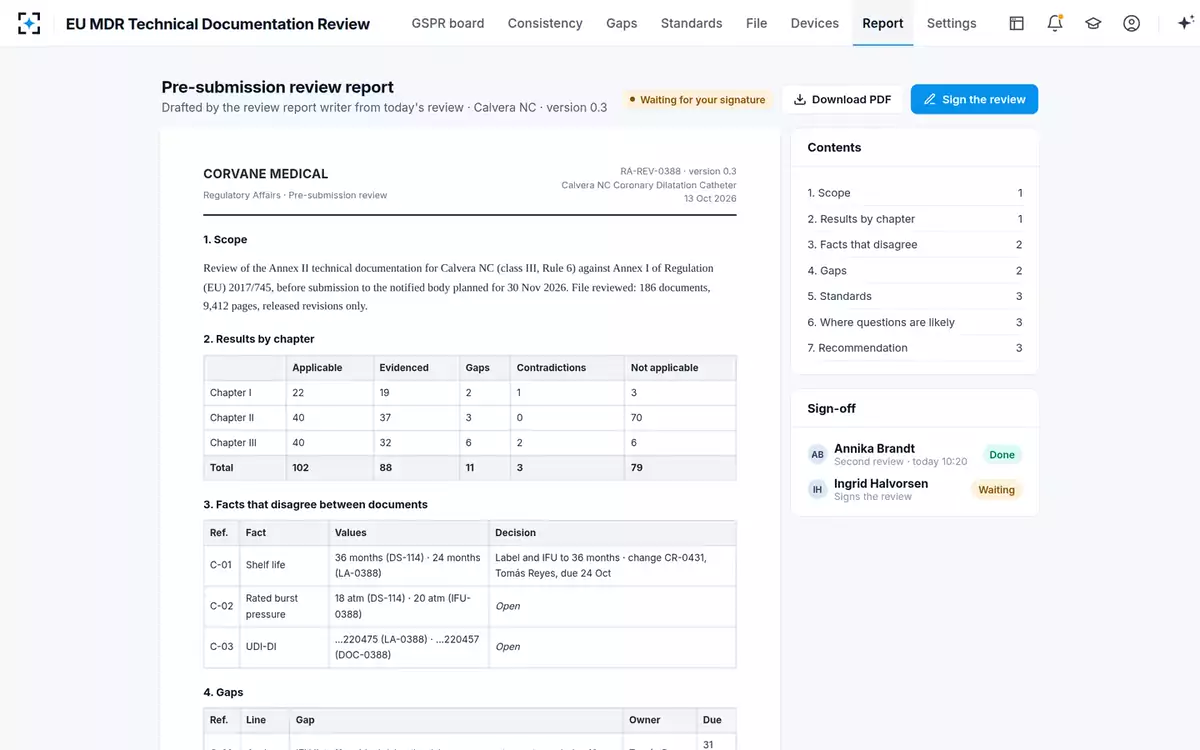
Four desks: where a question lands inside your own company
Every question the sequence above produces leaves the notified body as one paragraph and arrives inside your organisation as work for a specific person. On the sample file those are four desks, and the kind of question each one receives is predictable enough to prepare for.
Four desks, and the question that lands on each
| Desk | What they own in the file | The question that arrives from a reviewer |
|---|---|---|
| Regulatory affairs lead | The submission, the checklist and the signature on the pre-submission review. | Applicability and justification: why a requirement was treated as not applicable, why one evidence route was chosen over another, and whether the answers across a batch are consistent with each other. |
| Technical file author | The Annex II file, the label artwork and the instructions for use. | Information supplied with the device: symbols and the edition of the standard they come from, a residual risk that never reached the instructions, missing translations, a value printed on the label that the design file does not support. |
| R&D design engineer | Design verification, the bench reports and the aging study behind every performance claim. | Test evidence: the edition a report was run to, the sample size and statistical basis of a claim, and whether a bridging rationale covers a change made since the test. |
| Quality manager | Change control, document control and the second review on every class III file. | Control: which revision was released and when, whether a change was assessed before it was made, and whether the corrected document went through change control before it was cited in the answer. |
Those same four people are the ones whose weeks the pre-submission read actually changes.
The same four desks, before the file is read and after
Today
Walks the checklist line by line in a spreadsheet looking for the document and page that meets each requirement — about six weeks for one class III file — and still meets rounds of questions afterwards.
With agents
Opens a file already mapped requirement by requirement to document, revision and page, with every gap and every fact two documents state differently in front of her, decides each one and signs.
Still theirs: Decides every contradiction, and signs
Today
Assembles and updates the Annex II file, and learns that a label never caught up with a change when the questions arrive.
With agents
Gets each change with the requirement it breaks, the page that is wrong and what it should say, with an owner and a date before submission.
Still theirs: Drafts the corrected document
Today
Owns design verification, the bench reports and the aging study, and answers questions about them months after submission, from memory and from the archive.
With agents
Sees his reports cited page by page, and the gaps that are his — a superseded standard edition, a usability evaluation run on an earlier revision of the instructions — before anything is sent.
Still theirs: Owns the data behind the claim
Today
Runs change control and document control, and is the second reviewer on every class III file.
With agents
Approves the changes the decisions raise and completes the second review on a drafted report, before the regulatory lead signs.
Still theirs: Approves the change; completes the second review
The routing is the reason a pre-submission read pays for itself. Each finding it produces is the same shape as a notified body question — a requirement, what is missing, the fix, an owner and a date — except that it arrives months earlier and costs no correspondence.
The same questions, arriving before submission instead of after
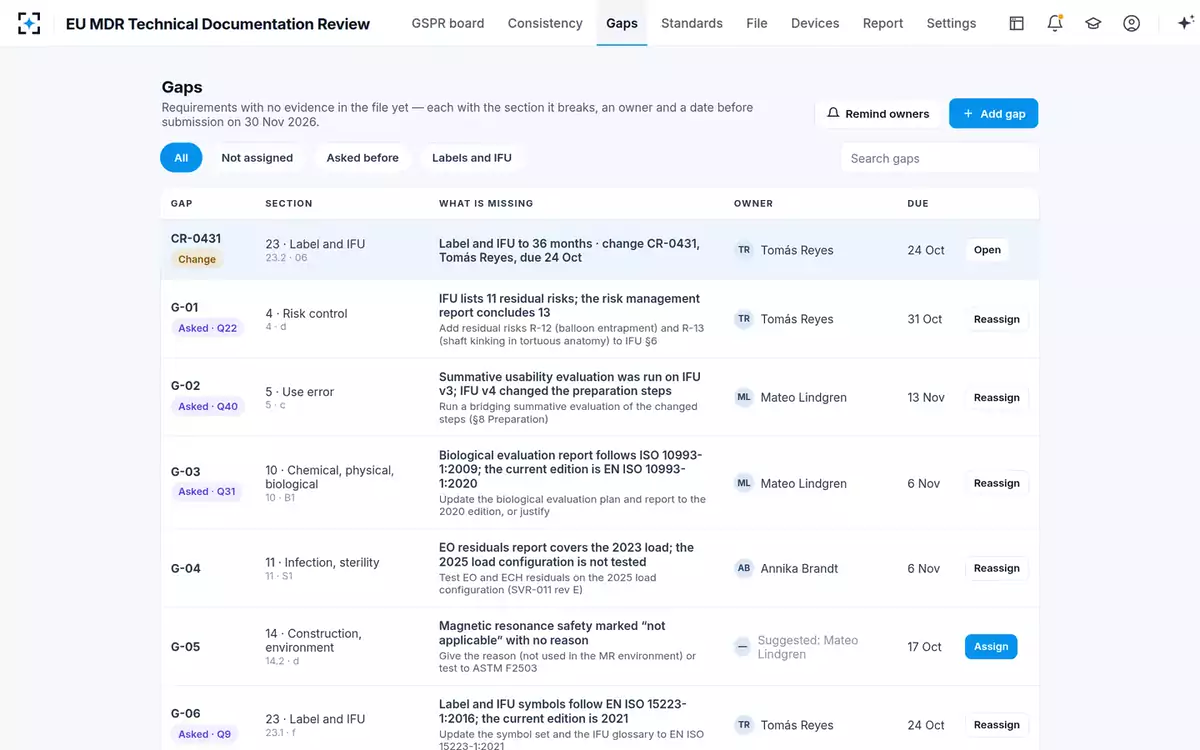
What a question does to the clock
A single question looks small on the page it arrives on. Followed through to the answer, it is a chain of steps in which every link is a person with a queue of their own.
One question, from the reviewer's desk and back
A person decides
Specialist reviewerFinds that a cited report follows a superseded edition of a standard, and writes the question into the batch for this review round.
A person decides
Project contact at the notified bodyConsolidates the batch and sends it to the manufacturer with a date for the reply.
A person decides
Regulatory affairs leadReads the batch, decides which of the four desks each question belongs to, and sets an internal date before the reply date.
A person decides
Design engineerRe-runs or re-evaluates the affected report against the current edition, or writes the justification for the edition used.
A person decides
Quality managerPuts the corrected document through change control and releases the new revision, because an answer may only cite a released document.
A person decides
Regulatory affairs leadWrites the consolidated reply with the new document, revision and page for every question in the batch, and sends it.
A person decides
Specialist reviewerRe-reads the affected part of the file, and either closes the question or asks the next one.
After the certificate: changes that need approval
The sequence does not end at issuance. Changes to the approved device shall require approval from the notified body which issued the EU technical documentation assessment certificate where such changes could affect the safety and performance of the device or the conditions prescribed for use of the device
(Annex IX, section 4.10). You inform the body; it decides whether the change needs a fresh conformity assessment under Article 52 or can be handled by a supplement to the certificate, and where it approves, it issues that supplement.
So a certified device inherits a smaller version of the same loop for the rest of its life, and the quality of the file determines how much of it you spend. The surveillance side keeps running too: Annex IX section 3.3 requires audits and assessments at least once every 12 months, and section 3.4 requires unannounced audits at least once every five years, to a plan the body does not disclose to you.
Two publication duties are useful before any of this starts. Annex VII section 4.2 requires each notified body to publish a description of its application procedure, including which languages it accepts for documentation and for correspondence — a detail that decides how much translation work sits in front of your submission. Article 50 requires each body to publish its standard fees as well, which is the subject of its own guide. Both are worth reading before the written agreement is signed rather than after.
Second review, then a signature with a meaning attached
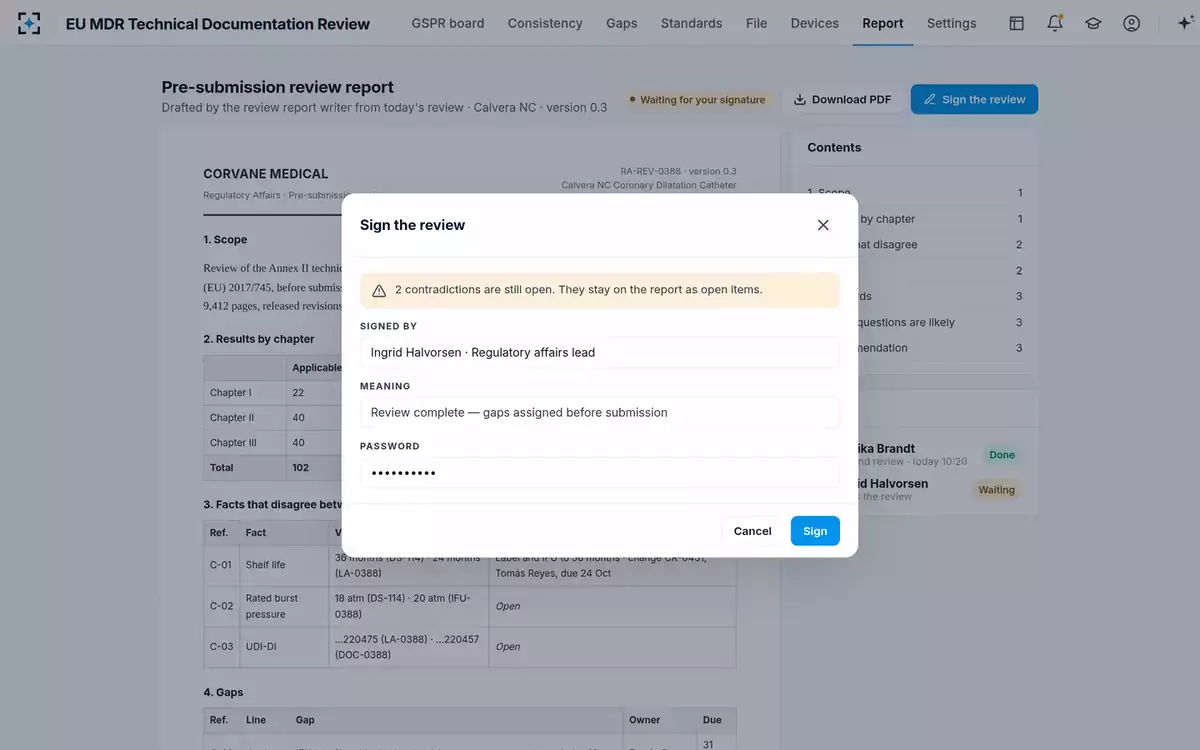
What the reviewers at the other end are looking for, requirement by requirement, is set out in the requirements guide, and the evidence columns that make a checklist line defensible are in the GSPR checklist guide. To see a file read before it goes in, start from EU MDR Technical Documentation Review.
Questions people ask
What is a technical documentation assessment certificate?
It is the certificate issued under Annex IX Chapter II when the technical documentation for a device is found to conform. Annex IX section 4.9 says it contains the conclusions of the assessment, the conditions of its validity, the data needed to identify the approved design and, where appropriate, a description of the intended purpose. It is distinct from the quality management system certificate, which covers your system rather than that device.
What happens after you submit a technical file?
The application is reviewed first for completeness, classification, the applicability of the chosen route, the body's designation and its resources — and the outcome of that review is documented. Only then do specialists read the documentation itself, in parallel with the clinical evidence review. Questions come back in batches; a recommendation is written and signed off; different personnel perform the final review and take the decision.
Can the notified body use external experts?
For clinical review, yes. Annex IX section 4.4 requires the body to employ reviewers with sufficient clinical expertise and permits it to use external clinical experts with direct and current experience of the device or of the clinical condition it treats. The examination of the application itself, under Annex IX section 4.3, must be done using staff employed by the body.
Does the notified body have to give you a report?
Yes. Annex IX section 4.9 requires the body to provide the manufacturer with a report on the technical documentation assessment, including the clinical evaluation assessment report. Annex VII section 4.6 adds that the project report follows a standard format with a minimum set of elements determined by the coordination group and is provided to the manufacturer.
Which devices go to an expert panel?
Class III implantable devices, and class IIb active devices intended to administer or remove a medicinal product under Rule 12 of Annex VIII. The panel is not consulted on every such device: it decides within 21 days whether to give an opinion at all, on novelty, a changed benefit-risk profile for the device category, or a rising rate of serious incidents in that category.
Can we speed the review up by submitting early and fixing later?
It works against you twice. Specialist review is off-site, so every defect becomes a written question and a wait rather than a conversation, and the questions-and-answers phase is where the months accumulate. And Annex VII section 4.3 requires refusals and withdrawals of applications to be notified to the electronic system under Article 57, where they are accessible to other notified bodies.