The EU MDR technical documentation requirements are set out in Annex II of Regulation (EU) 2017/745 as six numbered sections: the device description and specification, the information supplied with the device, design and manufacturing information, the general safety and performance requirements, benefit-risk analysis and risk management, and product verification and validation. The hard part is not the list. It is that a technical file is an act of assembly: the class III sample file on this page runs to 186 documents and 9,412 pages, and almost every one of them was written by someone other than the file's author, for a different purpose, at a different time — which is why files so often fail on cross-references rather than on content. Botminds' EU MDR Technical Documentation Review reads a released file, sorts every document into these six sections, maps each Annex I requirement to the document, revision and page that meets it, and hands a regulatory affairs lead the gaps and the contradictions to decide.
The worked examples on this page come from a fictional sample device as it runs through the solution: Calvera NC, a class III coronary dilatation catheter made by the invented company Corvane Medical, moving from a legacy directive certificate to an MDR certificate. The people, document numbers and counts are sample data. The regulation and the notified bodies' own guidance are quoted and linked where they appear.
The technical documentation and, if applicable, the summary thereof to be drawn up by the manufacturer shall be presented in a clear, organised, readily searchable and unambiguous manner.
Regulation (EU) 2017/745, Annex II, opening paragraph
That sentence opens Annex II, and it is the rule a reviewer feels first when it is broken. It does not ask for more evidence. It asks for evidence a stranger can find, which is a different thing and a different kind of work.
What are the EU MDR technical documentation requirements?
Annex II requires six sections, and Annex III requires a seventh body of documentation covering what happens after the device is on the market. Section 1 describes the device. Section 2 holds everything supplied with it. Section 3 explains how it is designed and made, and where. Section 4 demonstrates conformity with the applicable general safety and performance requirements of Annex I. Section 5 carries the benefit-risk analysis and risk management. Section 6 carries verification, validation and the clinical evaluation.
Two further obligations sit around the six. Article 10(8) requires a manufacturer to keep the technical documentation available for competent authorities for at least ten years after the last device was placed on the market, and at least fifteen years for implantable devices. And section 4(d) of Annex II requires, for every requirement claimed to be met, "the precise identity of the controlled documents offering evidence of conformity" together with a cross-reference to where that evidence sits in the file. One line of a regulation, and most of the work.
The notified bodies say the same thing in plainer words. Their best practice guidance, agreed across the European association of medical device notified bodies in April 2026, puts it as a warning: the documentation should show how the manufacturer ensures compliance with every applicable Annex I requirement, and "a simple collection of test/verification reports does not fulfil this requirement". A full shelf is not a demonstration.
The six sections of Annex II, in order
Read as a list, Annex II looks like a filing scheme. Read as a production plan, it is a map of six different departments, each of which produces evidence for its own reasons and hands it on. The file author owns none of the underlying work and all of the consequences of it.
Where each Annex II section gets its evidence
1
Device description and specification, including variants and accessories
Who produces itDesign and development, product management
What arrivesDevice description and specification, Basic UDI-DI, the classification rule and its justification, the configuration list, the materials in contact with the body, previous and similar generations
2
Information to be supplied by the manufacturer
Who produces itLabelling, regulatory affairs, translation
What arrivesEvery label on the device and on each level of packaging, and the instructions for use, in the languages of every Member State the device is sold in
3
Design and manufacturing information
Who produces itManufacturing, process validation, sterilisation, purchasing
What arrivesThe design stages, the manufacturing processes and their validation, continuous monitoring, final product testing, and every site including suppliers and sub-contractors
4
General safety and performance requirements
Who produces itRegulatory affairs, with every other function as a witness
What arrivesThe Annex I checklist: which lines apply, why the others do not, the method used, the standard applied, and the controlled document, revision and page that proves it
5
Benefit-risk analysis and risk management
Who produces itRisk management, clinical
What arrivesThe benefit-risk analysis required by Annex I sections 1 and 8, and the solutions adopted and results of risk management under Annex I section 3
6
Product verification and validation
Who produces itTest laboratories, design verification, clinical affairs
What arrivesBench and laboratory reports, biocompatibility, sterilisation and aging data, software verification, the clinical evaluation plan and report, and the follow-up plan after the device is on the market
The pattern to notice is that only section 4 is assembled rather than produced. Sections 1, 2, 3, 5 and 6 are collections of documents that exist in their own right: a specification, a label artwork, a process validation report, a risk management file, a bench report. Section 4 is a reading of all of them. That is why section 4 is where a file is usually weakest and where a notified body usually starts, and why it has a checklist of its own.
Annex II, section by section: what the regulation asks and what usually satisfies it
| Section | What the regulation asks for | What usually satisfies it |
|---|---|---|
| 1. Device description and specification | A general description and intended purpose, the Basic UDI-DI or another unambiguous reference, the patient population, indications and contra-indications, the principles of operation, the risk class with the justification of the classification rule applied, every variant and configuration, the key functional elements and the raw materials in contact with the body — plus an overview of previous and similar generations. | The device description and specification, the classification rationale, the configuration list, the bill of materials for contacting components, and a short note on the previous generation. |
| 2. Information to be supplied by the manufacturer | A complete set of the labels on the device and on single-unit, sales and transport packaging, and the instructions for use, in the languages accepted in each Member State where the device will be sold. | Released label artwork for every panel and packaging level, the instructions for use, and the translation set with its verification evidence. |
| 3. Design and manufacturing information | Information that allows the design stages to be understood; complete information and specifications on the manufacturing processes and their validation, the adjuvants, the continuous monitoring and the final product testing, with data fully included; and identification of all sites, including suppliers and sub-contractors. | Design and development plan and reviews, process validation reports, the sterilisation validation, in-process and final inspection specifications, and a site and supplier list. |
| 4. General safety and performance requirements | Which Annex I requirements apply and why the others do not, the methods used to demonstrate conformity with each applicable one, the harmonised standards or other solutions applied, and the precise identity of the controlled documents that prove it with a cross-reference to their location. | One checklist over the whole of Annex I, with a reason on every inapplicable line and a document, revision, section and page on every applicable one. |
| 5. Benefit-risk analysis and risk management | The benefit-risk analysis referred to in Annex I sections 1 and 8, and the solutions adopted and the results of the risk management referred to in Annex I section 3. | The risk management plan and report, the hazard analysis with residual risks, and the benefit-risk determination for each residual risk and in aggregate. |
| 6. Product verification and validation | The results and critical analyses of all verification and validation tests and studies: biocompatibility, physical, chemical and microbiological characterisation, electrical safety, software verification and validation, stability including shelf life, performance and safety, the clinical evaluation report and plan, and the follow-up plan after the device is on the market. | Design verification reports, biocompatibility and sterilisation files, aging and transport studies, software files, usability evaluation, and the clinical evaluation report with its plan. |
Section 1: the device description, and the facts it fixes for every other document
Section 1 looks like the easy one, and it sets the trap for the rest of the file. Every fact written down here — the intended purpose, the classification, the sterilisation method, the storage conditions, the rated performance, the Basic UDI-DI — reappears in the label, in the instructions for use, in the risk file, in the clinical evaluation and in the declaration of conformity. Each repetition is a chance for the file to disagree with itself.
The notified bodies warn about exactly that: ensure the information is correct "throughout all areas where this information is duplicated", and consider the risk of inconsistency when updating the Basic UDI-DI, the UDI-DI, the intended use, the indications, the contra-indications and the warnings. A device description is not a chapter. It is the authority for a dozen other documents, and a change to it is a change to all of them.
On the sample file the solution reads eight such facts — classification, sterilisation method, shelf life, UDI-DI, Basic UDI-DI, intended purpose, storage conditions and rated burst pressure — from 46 places in 14 documents, each value with its page. Five are the same everywhere. Three disagree, and one of them is a shelf life that a change in the design file never reached the label.
Section 2: the label, the IFU and everything else supplied with the device
Section 2 is short to read and long to satisfy. It asks for a complete set of the labels — on the device, on its single-unit packaging, on the sales packaging and, where specific management conditions apply, on the transport packaging — and the instructions for use, both in the languages accepted in every Member State where the device is to be sold. Annex I section 23 then says what each of those must bear, down to the time limit for using or implanting the device safely, expressed at least in year and month where this is relevant, and the requirement that any symbol used conform to the harmonised standards.
Two practical consequences follow. The first is arithmetic: a device sold across the Union carries one artwork family multiplied by the number of accepted languages, and each translation is a document that can lag behind a change. The second is that labelling draws questions out of proportion to its size. On the sample device's sister product, labels and instructions for use drew 22 of the 61 questions the notified body asked across three rounds — the kind of distribution that argues for reading section 2 against section 1 before anyone else does.
One class III file, as the solution reads it
186
documents in the released technical file, sorted into the six sections of Annex II
9,412pages
read, with 14 superseded revisions set aside and never cited
181lines
on the company's own checklist of Annex I, of which 102 apply to this device
24
standards cited across the file, each edition compared with the current one
Sections 3 and 5: how it is made, and what the risk file has to carry
Section 3 is easy to under-supply, because it asks for primary data rather than conclusions. It wants information that allows the design stages to be understood, complete information and specifications on the manufacturing processes and their validation — and then adds a sentence that settles many arguments: "Data shall be fully included in the technical documentation". A summary report with the underlying results held at the plant does not satisfy it. It also asks for the identification of all sites, including suppliers and sub-contractors, which is where a file assembled only from in-house documents tends to stop short.
Section 5 is two items long and carries a great deal of weight: the benefit-risk analysis of Annex I sections 1 and 8, and the solutions adopted and the results of the risk management of Annex I section 3. The join that reviewers look for is between the risk file and the test reports. The notified bodies ask that verification and validation protocols and reports "should be linked to the risk IDs indicated in the risk assessment; therefore, it will be clear which IDs are mitigated by the indicated documents". A risk file that names control measures, and a test file that proves tests, with nothing joining the two, leaves the reviewer to do the joining — and a reviewer doing your joining is a round of questions.
Section 4: the general safety and performance requirements, and the four things each line owes
Section 4 is the demonstration itself. It requires information showing conformity with the general safety and performance requirements of Annex I that apply to the device, including "a justification, validation and verification of the solutions adopted to meet those requirements". It then lists what the demonstration must include: which requirements apply and "an explanation as to why others do not apply"; the method or methods used for each applicable one; the harmonised standards, common specifications or other solutions applied; and the precise identity of the controlled documents that evidence each of them, with a cross-reference to where they sit.
Four things, then, on every applicable line, and one thing on every line that does not apply. There is no official form for recording them, which is why companies' checklists look so different from each other, and why several of the common pitfalls the notified bodies list for this section are about the columns rather than the evidence.
What every evidenced requirement owes
- The requirement, and whether it applies
The Annex I line as written, marked applicable or not applicable for this device and its intended purpose.
- The reason, when it does not apply
A written justification. A line marked not applicable with nothing beside it is on the notified bodies' own list of common pitfalls for this section.
- The method used to demonstrate conformity
Bench testing, biological evaluation, process validation, clinical data, a documented rationale — named, not implied.
- The standard or other solution applied
The harmonised standard, common specification or other solution, with the clause relied on where only part of it is used.
- The controlled document, with revision and page
Not a report title. The notified bodies ask for identification as document ID, document date, section, point, page, chapter or link.
- The cross-reference to where the evidence sits
Annex II section 4(d) requires the entry to incorporate a cross-reference to the location of that evidence within the full technical documentation.
The whole of Annex I as one board, before anyone reads a document
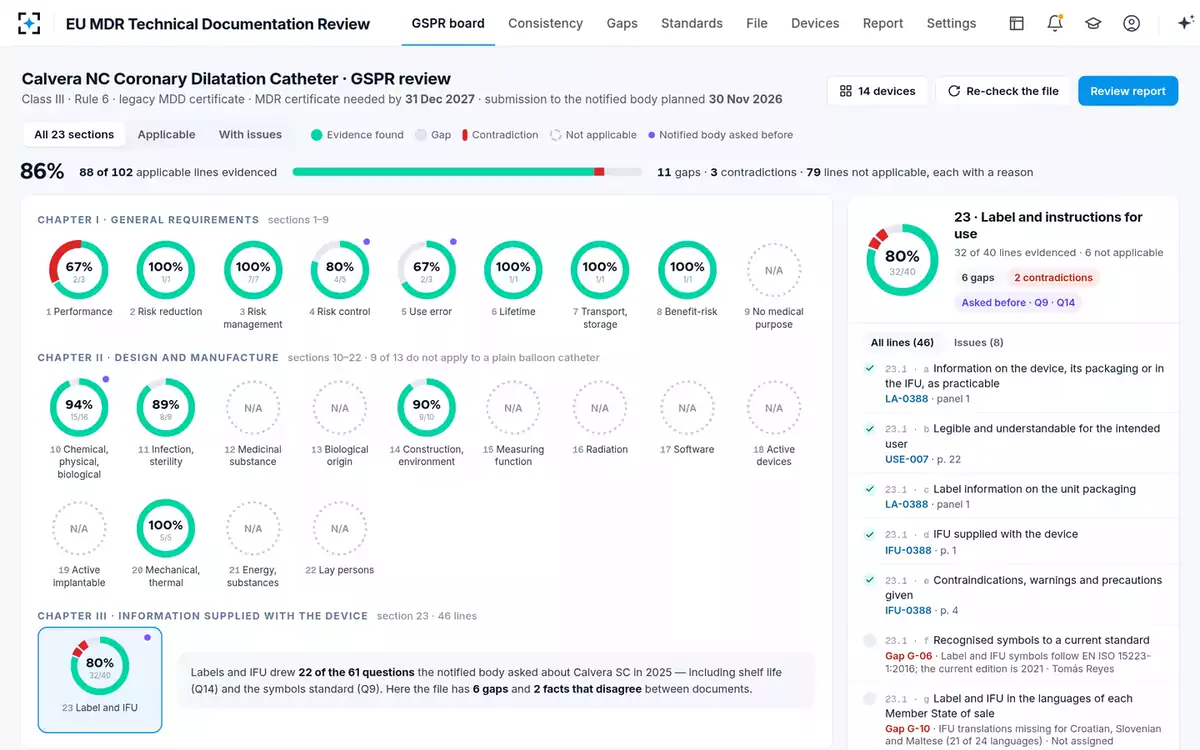
Section 6: verification, validation and the clinical evaluation
Section 6 is the largest section of most files and the most specific in what it asks. The documentation must contain "the results and critical analyses of all verifications and validation tests and/or studies undertaken to demonstrate conformity of the device with the requirements of this Regulation", and section 6.1 then names the families: biocompatibility with every material in direct or indirect contact identified, physical, chemical and microbiological characterisation, electrical safety and electromagnetic compatibility, software verification and validation, "stability, including shelf life", and performance and safety.
Two items in section 6 are often misread. The first is the sentence on absent testing: where no new testing has been undertaken, the documentation must carry a rationale for that decision — the regulation's own example being biocompatibility testing on identical materials in a previous version of the device already legally on the market. A gap with a written rationale is a position; a gap with nothing is a finding. The second is that section 6.1(d) names the plan and report for clinical follow-up after the device is on the market as part of the technical documentation. Post-market work is not entirely outside Annex II, and a file built on the assumption that it is will be short one plan.
What is the difference between Annex II and Annex III?
Annex II is the technical documentation on the device. Annex III is the technical documentation on post-market surveillance, drawn up in accordance with Articles 83 to 86, and it opens with the same sentence about clear, organised, readily searchable and unambiguous presentation. It contains two things: the post-market surveillance plan required by Article 84, with everything that plan must address and cover, and the periodic safety update report together with the post-market surveillance report.
The distinction that matters in practice is not that one is before market and the other after. It is that Annex II can demand a document whose content is post-market in nature — the follow-up plan of section 6.1(d) — while Annex III demands the surveillance machinery itself. For a device whose technical documentation is assessed under Annex IX Chapter II, such as a class III device, the application lodged with the notified body includes the technical documentation referred to in both annexes, so the practical question is not which annex owns a document but whether the index tells a reviewer where to find it.
Who writes each section, and who has to agree it
In most device companies the authorship runs roughly like this. Design and development owns section 1 and the verification half of section 6. Labelling and regulatory affairs own section 2, with translation as a supplier. Manufacturing, process validation and sterilisation own section 3. Risk management owns section 5 and feeds section 4. Clinical affairs owns the clinical evaluation in section 6. Regulatory affairs owns the Annex I checklist in section 4, which means regulatory affairs owns the only section that can fail because of someone else's revision number.
Agreement is a separate question from authorship. The notified bodies are explicit that only controlled, released documents belong in a submission: version or document control as per the manufacturer's own quality management system procedures, and "Draft documents should not be provided". That single rule decides a surprising number of arguments inside a company, because it converts "the data supports it" into "the released revision says it".
One click, five agents, and what each one found
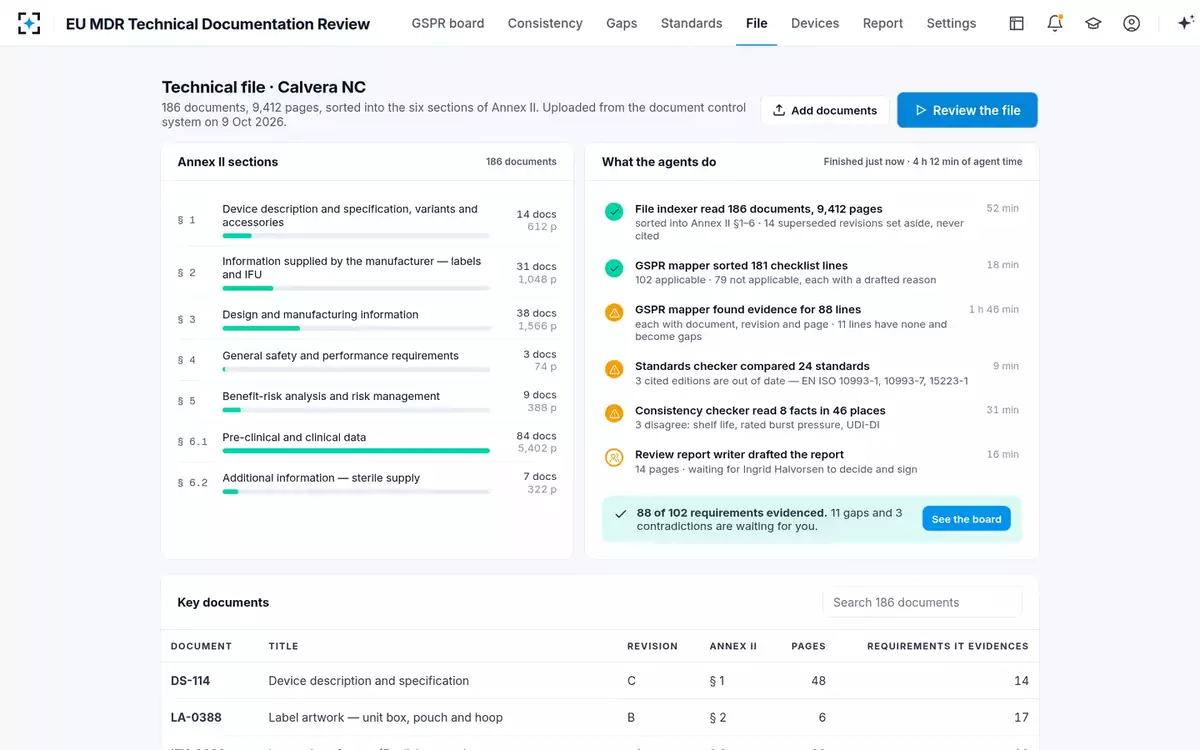
Why a page reference is the whole point
Everything above converges on one sentence of Annex II section 4(d): "The information referred to under this point shall incorporate a cross-reference to the location of such evidence within the full technical documentation". It is the difference between a file that contains the answer and a file that gives it.
The notified bodies spell out the consequence in both directions. Their guidance asks for precise references and explicitly warns against general or generic ones, and then offers the incentive: the more specific the references are to documents supporting compliance, "the faster the assessment can be conducted". On the other side, their list of common pitfalls includes documentation that does not include a clear and unambiguous reference to where the evidence can be found. The same rule, read from the reviewer's desk.
That is the rule the solution enforces rather than interprets. The requirement mapper will not mark a line evidenced without a document, revision and page; a line with a document name and no page stays a gap, and only released revisions count. The regulatory affairs lead accepts or rejects every reason given for a line that does not apply, decides every fact that disagrees between two documents, and signs the review. Before any of that, the file has to survive a check that happens before a reviewer reads a word of it — the completeness check. To see the board, the checklist and the report together, start from EU MDR Technical Documentation Review.
Questions people ask
What is in a medical device technical file?
Under the MDR, the six bodies of evidence Annex II names: the device description and specification with its variants and accessories; every label and the instructions for use in the required languages; design and manufacturing information including process validation and all sites and suppliers; the demonstration of conformity with the applicable Annex I requirements; the benefit-risk analysis and risk management; and verification, validation and clinical data. Annex III adds the post-market surveillance plan and the periodic safety update report as a separate body of documentation.
How many documents are in a technical file?
The regulation sets no number, because it asks for evidence rather than documents. In practice the count tracks the device's class and complexity: the fictional class III catheter used on this page has 186 released documents and 9,412 pages, while a simple class I device may run to a few dozen. What matters to a reviewer is not the count but whether an index leads to each one and whether the revision cited is the released revision.
Does the technical file have to be in English?
No. The labels and instructions for use must be in the languages accepted in each Member State where the device is sold, and Article 10(11) requires the information in Annex I section 23 to be in an official Union language determined by the Member State where the device is made available. For the rest of the file, Article 52(12) allows the Member State in which the notified body is established to require documents in a language it determines; where it does not, the documents must be in any official Union language acceptable to the notified body. Each notified body publishes which languages it accepts.
What is a summary technical documentation?
The MDR refers to it without defining it. Annex II's opening paragraph covers "the technical documentation and, if applicable, the summary thereof", section 4(d) asks for the cross-reference to appear in the summary where one applies, and Article 10(8) lets a competent authority ask for the technical documentation in its entirety or as a summary. The practical reading is that a summary is a navigable digest of the full file, not a substitute for it, and that the full data still has to be there: section 3(b) requires data to be fully included in the technical documentation.
How long must the technical documentation be kept?
At least ten years after the last device covered by the EU declaration of conformity was placed on the market, under Article 10(8), and at least fifteen years for implantable devices. The declaration of conformity and any certificates issued, with their amendments and supplements, are kept for the same period, and a manufacturer established outside the Union must make sure its authorised representative has the documentation permanently available.
How long does it take to assemble a technical file?
Nothing published measures it, and any figure offered should be read as an estimate rather than a benchmark. What the design targets of this solution assume is the review rather than the assembly: on the fictional sample file, a single reviewer walking the Annex I checklist by hand took about six weeks, against a design target of five days with the agents reading first. The honest answer to give a planning meeting is that assembly time depends almost entirely on how much of the evidence already exists under document control, because the file cannot cite a revision that has not been released.