AI in medical device regulatory affairs is useful for exactly one half of the work on a technical file, and dangerous when it is let near the other half. The half it is good at is finding: reading every document in an Annex II file, mapping each general safety and performance requirement to the passage that meets it, comparing the edition of every standard cited against the edition in force, and reading the same fact out of every document that states it so that disagreements surface. The half it must stay out of is deciding: which of two conflicting values is correct, whether a requirement genuinely does not apply, whether a change may be made, and whether the review is complete. Botminds' EU MDR Technical Documentation Review is built on that split — five agents that find, and named people who decide and sign.
The product examples come from a fictional sample manufacturer running a class III coronary dilatation catheter through the solution before submission. Nothing on this page is legal advice, and nothing here says the solution has been certified, approved or validated by any authority; the regulatory classification of any tool depends on what it is actually put to in your organisation.
Can AI be used in medical device regulatory affairs?
Yes, and the constraint is not a prohibition but an allocation of responsibility. The MDR never asks who or what read a document; it asks what the documentation proves and who is answerable for it. Article 10(4) sets the test for the file itself: The technical documentation shall be such as to allow the conformity of the device with the requirements of this Regulation to be assessed.
Article 15(3)(b) then puts one named person behind it — the person responsible for regulatory compliance must ensure that the technical documentation and the EU declaration of conformity are drawn up and kept up-to-date
(Regulation (EU) 2017/745).
Read together, those two provisions tell you how to evaluate any tool in this space. A tool helps if it makes the file more assessable — more completely mapped, more precisely cited, more internally consistent. It harms if it produces text that looks assessable and is not, because the person under Article 15 still carries it. No tool shifts that obligation, which is why the questions worth asking a vendor are all about what a reviewer can check.
Two different questions under one phrase
The phrase hides two subjects that have almost nothing to do with each other, and conversations go wrong when the two get mixed. The first is AI inside the device: a diagnostic algorithm, an image-analysis function, a dosing recommendation. That is a medical device in its own right or a component of one, it carries the whole weight of the MDR and, where the device needs a notified body's assessment, the AI Act's rules for high-risk systems, and the notified body's expectations for how it is documented are published. The second is AI used to do regulatory work: a tool that reads your own documents inside your own quality system and reports what it finds. The device never changes; only the work does.
Confusion between the two produces two opposite mistakes. One is paralysis, where a team refuses any tool because "AI in a medical device company is high-risk", which is a sentence about the first subject applied to the second. The other is complacency, where a team ships an AI function inside a device with the governance appropriate to an office tool. This guide is about the second subject; the documentation expectations for the first are a separate discipline with their own published guidance.
Is an AI tool that reviews my technical file a medical device?
On the ordinary reading of the MDR's own definition, no. A medical device is an instrument, apparatus, software or other article intended by its manufacturer to be used for a medical purpose — diagnosis, prevention, monitoring, prediction, prognosis, treatment or alleviation of disease, among the others listed in Article 2(1). A tool whose intended purpose is to read a manufacturer's controlled documents and report which requirements have evidence behind them has no medical purpose at all. It never touches a patient, never informs a clinical decision, and never acts on a physiological parameter.
It is worth being precise about the boundary rather than hand-waving past it, because software that supports a clinical decision in the smallest way can fall inside the definition. The test is the intended purpose the manufacturer of the software assigns it. A regulatory review tool's intended purpose is an administrative one performed inside the manufacturer's quality system, and the output is read by regulatory professionals, not clinicians. That is also why the tool must never present itself as having made a regulatory determination: the moment a tool's output is treated as a conclusion rather than a finding, the organisation has quietly moved a decision out of the place the Regulation put it.
Is a regulatory AI tool high-risk under the EU AI Act?
Not on the face of Article 6(1), and this is worth working through because the first condition genuinely does mention medical devices. An AI system is high-risk under that paragraph where both of two conditions hold: the AI system is intended to be used as a safety component of a product, or the AI system is itself a product, covered by the Union harmonisation legislation listed in Annex I
, and the product in question is required to undergo a third-party conformity assessment
under that legislation (Regulation (EU) 2024/1689). The MDR is item 11 of that Annex I list, which is why the paragraph looks alarming at first reading.
Both conditions have to be met together, and a document-review tool meets neither. It is not a safety component of a device; it is not itself a device placed on the market; and nothing about it undergoes third-party conformity assessment under the MDR. The other route into high-risk is Article 6(2), which points at the use cases listed in Annex III — biometrics, critical infrastructure, education, employment, essential services, law enforcement, migration, justice. Reviewing a manufacturer's own technical documentation is not among them. And even inside Annex III, Article 6(3) provides a derogation where the system does not pose a significant risk to health, safety or fundamental rights, including where the AI system is intended to perform a narrow procedural task
.
The two AI Act routes to high-risk, tested against a file-review tool
What the Regulation requires: The system is a safety component of, or is itself, a product covered by the Union harmonisation legislation in Annex I — which includes Regulation (EU) 2017/745 at item 11.
A tool that reads your own technical documentation: Not met. The tool is not part of the device and is not placed on the market as a device; the device is unchanged by it.
What the Regulation requires: That product is required to undergo a third-party conformity assessment under the same legislation.
A tool that reads your own technical documentation: Not met, and both conditions of Article 6(1) must hold together.
What the Regulation requires: The system falls in one of the listed areas: biometrics, critical infrastructure, education, employment, essential public and private services, law enforcement, migration and borders, justice and democratic processes.
A tool that reads your own technical documentation: Not listed. Reviewing a manufacturer's own controlled documents is not one of the Annex III use cases.
What the Regulation requires: Even within Annex III, a system is not high-risk where it does not pose a significant risk of harm — for example where it performs "a narrow procedural task", or improves the result of a previously completed human activity.
A tool that reads your own technical documentation: Relevant only if an Annex III use case applied. The derogation is a reminder that the AI Act grades by what a system decides, not by how clever it is.
One more point belongs here because regulatory teams will meet it from the other direction. When AI does sit inside a device, the notified bodies' own best-practice guidance names the failure they expect manufacturers to address: Lack of transparency is the AI model (manufacturer cannot explain why the system gives the output with a given input)
(Team-NB best practice guidance for technical documentation, version 4). That sentence is a good standard to hold a regulatory tool to as well, even though it is not legally required to meet it. If you cannot see why a tool said what it said, you cannot use its output as evidence of anything.
What AI can do on a technical file: finding, mapping, cross-reading
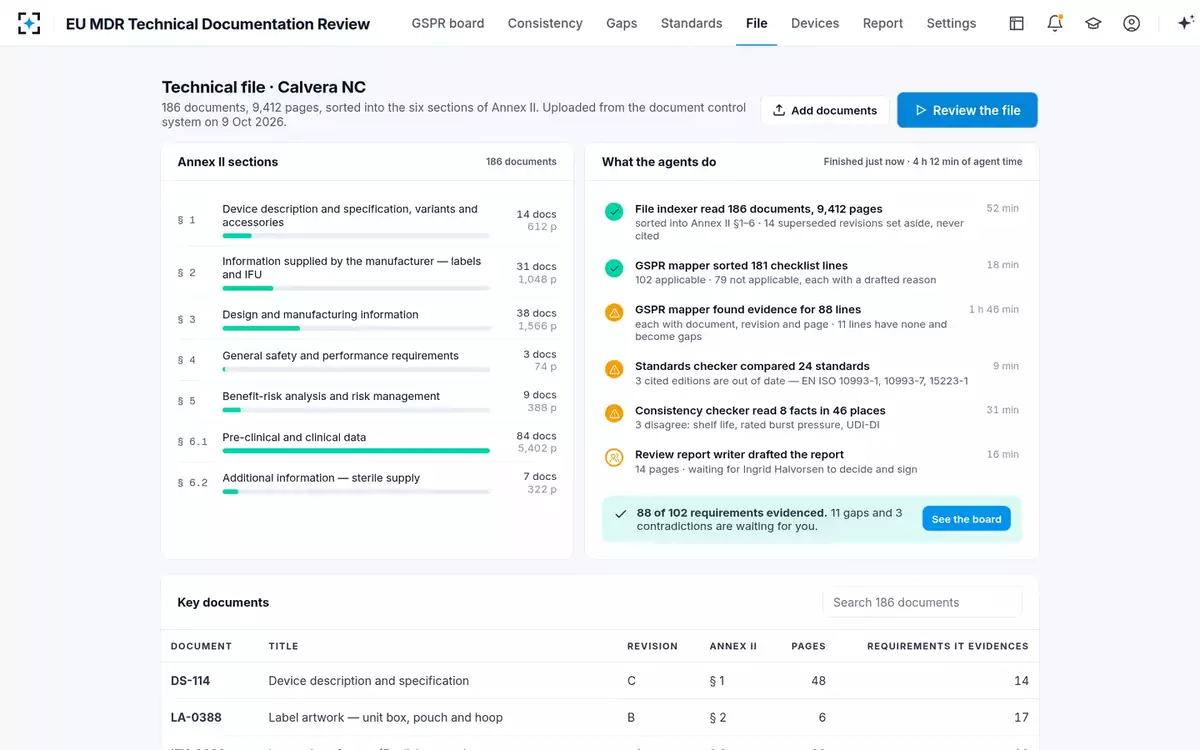
The work that genuinely suits a machine on a technical file is the work that is enormous, mechanical and checkable. The class III sample file below runs to 186 documents and 9,412 pages, and almost every finding worth having on it is a comparison between two places in it.
One class III file, as the agents read it
186docs
9,412 pages, sorted into the six sections of Annex II, with 14 superseded revisions set aside and never cited
102
checklist lines found applicable out of 181, with 79 not applicable — each with a drafted reason for a person to accept or reject
88
of the 102 evidenced with a document, revision and page; the other 14 opened as gaps
46places
where 8 facts are stated across 14 documents — three of which disagree, each shown as two pages side by side
Every one of those numbers is a finding, and every finding has the same property: a person can check it in under a minute by opening the page it cites. That is the whole test. The reason cross-reading is worth automating is that it is the defect reviewers actually hit. Notified body reviews often reveal inconsistencies of the intended purpose in application documents, the instructions for use of the medical device and the clinical evidence provided
, Stange and Julian write from inside a notified body (Journal of Market Access & Health Policy, 2026). An inconsistency between three documents is invisible to anyone reading one document at a time, which is how a human reviewer necessarily reads.
Five agents, one run, and what each one found
What should an AI tool never do on a technical file?
Four things, and they are the four the Regulation and your own quality system assign to a person by name.
Finding, or deciding
Finding — work a tool may do, because a reviewer can check it: Index every document, sort it into the sections of Annex II, identify the released revision of each, and set superseded revisions and drafts aside.
Deciding — work the Regulation and your quality system give to a named person: Decide that a document is fit to be cited as evidence at all, and release the corrected revision when one is needed.
Finding — work a tool may do, because a reviewer can check it: Propose, for each requirement, the passage that meets it with a document, revision and page, and the standard applied; open a gap where no passage exists.
Deciding — work the Regulation and your quality system give to a named person: Accept or reject each proposed mapping, and accept or reject every reason given for treating a requirement as not applicable.
Finding — work a tool may do, because a reviewer can check it: List every standard the file cites and compare the edition cited with the edition in force and with the harmonised list.
Deciding — work the Regulation and your quality system give to a named person: Decide whether a superseded edition is still defensible for this device, and whether a standard is needed at all.
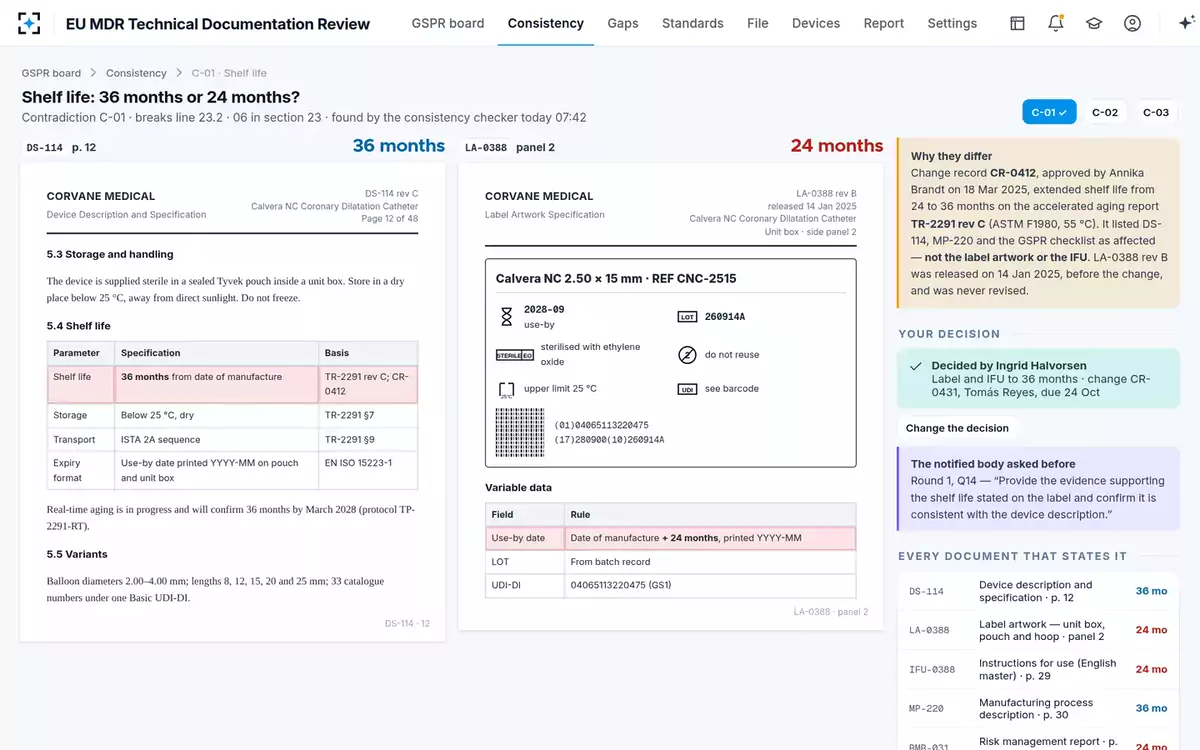
Finding — work a tool may do, because a reviewer can check it: Read the same fact from every document that states it, show both pages, and surface the change history that explains why they differ.
Deciding — work the Regulation and your quality system give to a named person: Decide which value is correct, raise the change that corrects the other document, and approve it.
Finding — work a tool may do, because a reviewer can check it: Draft the report: results by chapter, the conflicts, the gaps with owners and dates, the standards out of date.
Deciding — work the Regulation and your quality system give to a named person: Complete the second review, sign the report with a name, a time and a meaning, and decide what may be submitted.
The limit written beside each agent
| Agent | What it does | What it never does |
|---|---|---|
| File indexer | Reads every document and sorts it into the six sections of Annex II with number, title, revision, pages and release status. | Never edits or replaces a controlled document. Only released revisions count as evidence; drafts and superseded revisions are read and set aside. |
| Requirement mapper | Decides whether each checklist line applies, finds the passage that meets it, cites document, revision and page, names the standard applied, and drafts a reason for every line that does not apply. | No page citation, no evidence. "Not applicable" always needs a reason, and a person accepts every reason. |
| Standards checker | Lists every standard the file cites and compares the edition cited with the current and harmonised edition. | Never decides that a standard is not needed — that is the regulatory lead's call. |
| Consistency checker | Reads the same fact from every document that states it and shows any disagreement side by side with the change history that explains it. | Never chooses which value is right. Every value cites its page. |
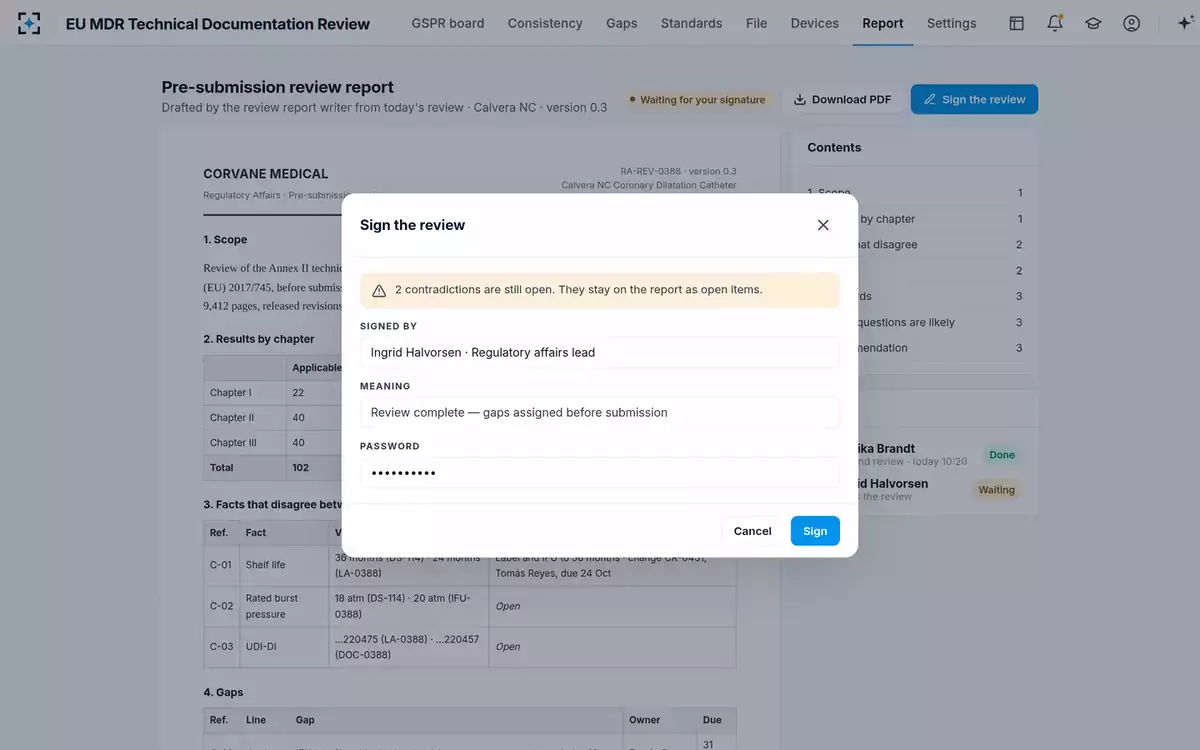
| Report writer | Drafts the pre-submission review report: chapter results, conflicts and their decisions, gaps with owners, standards out of date, and where questions are likely. | Never signs and never submits. Open items stay on the report. |
Why every claim has to carry a page reference
A page reference is not a nicety; it is the difference between evidence and assertion, and the notified bodies ask for it in those terms. Their best-practice guidance for technical documentation tells manufacturers to use precise references – avoid general or generic references
, and the MDR itself requires the general safety and performance requirement documentation to identify precisely the controlled documents that evidence conformity (Annex II, section 4(d)).
Valid justifications should always be provided or accompanied where there are deficiencies in the requested data.
Team-NB, Best Practice Guidance for the Submission of Technical Documentation under Annex II and III of MDR, version 4
Two practical rules fall out of that for anyone evaluating a tool. The first is that a claim without a page is a claim the tool should not have made: a mapping that says "covered in the risk management file" is not a mapping, and a tool that produces them is producing work for a reviewer rather than removing it. The second is that the citation must be checkable in one click, because the only defence against a confidently wrong answer is the habit of opening the page. A tool that makes checking cheap gets checked; a tool that makes checking expensive gets believed.
This also happens to be the gap the academic critique of the MDR points at from the other side. Analysing the Regulation against the product-development standards it imposes on manufacturers, Haimerl and colleagues find substantial deficiencies, and note that this applies to core principles like transparency, clarity, and traceability of requirements
(Frontiers in Medicine, 2026). Traceability of requirements is not supplied to you by the Regulation; you have to build it inside your own file. A tool that produces a citation per requirement is building precisely that artefact.
The person responsible, and what the regulation asks of them
Article 15 requires every manufacturer to have at least one person responsible for regulatory compliance available within the organisation, with defined qualifications — a relevant degree plus a year in regulatory affairs or quality management for devices, or four years' experience. Micro and small enterprises need not employ that person but must have them permanently and continuously at their disposal. Among their duties is the one quoted above: making sure the technical documentation and the declaration of conformity are drawn up and kept up to date.
Article 15(5) adds a protection that is easy to skim and important here: that person shall suffer no disadvantage within the manufacturer's organisation in relation to the proper fulfilment of his or her duties
. The Regulation anticipates that the regulatory decision and the commercial pressure can pull in opposite directions, and it protects the person, not the process. A tool that reports a file is 86% evidenced two weeks before a submission date does not relieve that pressure; what it does is make the remaining 14% specific, owned and dated, so the conversation is about eleven named gaps rather than about confidence.
A decision, and the change it raises
Questions to ask before you let a tool near a controlled document
Nine questions, each with the answer that should satisfy you. They are deliberately about mechanics rather than capability, because every vendor's capability demonstration uses a file prepared for the occasion.
Nine questions to ask before a tool reads a controlled document
- Does every claim cite document, revision and page?
Ask to see a requirement marked evidenced, then open the citation. A claim that cites a document but not a page is not checkable at the scale of a 9,000-page file.
- Are drafts and superseded revisions excluded from evidence?
Ask to see a superseded revision in the file and confirm it is read but never cited. The notified bodies' guidance is explicit that draft documents should not be provided.
- Is anything written back to the document control system?
The right answer is nothing. Released documents are read; corrections go through your change control, not through the tool.
- Who may accept a "not applicable" reason?
A named person, and the tool should refuse to close the line without one. Ask to see a reason rejected, not only accepted.
- Can we add our own facts to cross-check?
Your file has facts that matter which no vendor anticipated — a rated pressure, a storage condition, a sterilisation parameter. If the list is fixed, the tool only finds the conflicts someone else thought of.
- Where do the standards editions come from, and how often are they refreshed?
Ask for the source and the refresh interval, and ask what happens on the day an edition is superseded between your review and your submission.
- What happens to an open conflict at sign-off?
It should stay on the report as an open item, visible to whoever reads the report next. A tool that lets an unresolved conflict disappear at signature is worse than no tool.
- Who signs, and with what meaning?
An electronic signature with a name, a time and a stated meaning, and a second review by someone other than the author for your highest-risk class.
- What is recorded, and for how long?
Every step, decision, assignment and signature, with who and when, and every version of the review report kept — because the question "why was this line closed" arrives years later.
What good looks like after a year
The honest measure of a tool in this space is not how much reading it did. It is whether the questions that came back from the notified body changed in character. Before, a round of questions is a mixture: a few genuine scientific challenges, and a long tail of administrative findings — a superseded standard edition, a value that two documents state differently, a requirement marked not applicable with no reason, a missing page citation. The long tail is the part a pre-submission read removes, and it is the part that costs months, because each item is a letter and a wait rather than a conversation.
So the figures worth tracking over a year are: how many findings the internal review produced before submission and how many of those matched subjects the notified body had asked about on an earlier file; how many questions came back, split into scientific and administrative; and how many rounds there were. The sample manufacturer's design targets are fewer rounds of questions and five days per file instead of six weeks — targets to be measured in use, not results anyone has measured yet. What the solution does with the remaining human work, and who still signs, is the subject of the software comparison; what a round of questions actually costs is worked through with the Commission's own survey figures.
Signed by a person, with the open items still on it
Where each requirement's evidence has to come from in the first place is set out in the checklist guide. To see the split between finding and deciding on one of your own files, start from EU MDR Technical Documentation Review.
Questions people ask
Can AI fill in a GSPR checklist?
It can propose every line of one: whether the requirement applies, the passage that meets it with document, revision and page, the standard applied, and a drafted reason for each line treated as not applicable. It cannot close a line. Acceptance of each mapping and of every "not applicable" reason is a person's, and a line with no page citation should stay open as a gap rather than be filled with prose.
Can AI decide which value is correct in a technical file?
It should not, and a tool built for this work should refuse to. When the device specification says 36 months and the label says 24, the right output is both pages side by side plus the change history that explains how they diverged. Which one is correct depends on validated evidence and on what the manufacturer intends to claim — a decision with consequences under change control, and one that belongs to the regulatory lead.
Who is responsible when AI gets a regulatory answer wrong?
The manufacturer, through the person responsible for regulatory compliance under Article 15. Nothing in the MDR or the AI Act moves that responsibility to a software supplier. This is the practical reason to insist on page-level citations: responsibility you cannot delegate is responsibility you must be able to verify cheaply.
How do you stop an AI tool inventing a page reference?
By making every citation resolve to the page it names, so a wrong one is visible in one click rather than plausible in prose; by refusing to mark a requirement evidenced without a citation at all; and by restricting the readable set to released revisions, so a citation can never resolve to a draft. Then check a sample on every run — the discipline only works if someone opens the pages.
Does the notified body need to know we used AI?
What the notified body assesses is the technical documentation and your quality management system, not the office tools used to prepare them. The file is judged on whether it demonstrates conformity, with precise references to controlled documents. Where a tool becomes part of a process within the scope of your quality system, your own procedures for software used in that system apply — which is a question for your quality manager, and an argument for choosing a tool whose every output is traceable to a page.
What should we not expect it to do?
Four things. It does not talk to the notified body. It does not write or release your documents. It does not judge whether your clinical evidence is sufficient — that is the reviewer's assessment and, for some devices, an expert panel's. And it does not make a deadline move: what it changes is what arrives at the notified body on the date you already have.