Medical device regulatory compliance software is not one product category. Four distinct kinds of system are sold under the phrase — a quality management system, a document control system, a regulatory information management system, and a technical documentation review tool — and they answer four different questions. Three of them manage the containers your evidence lives in; only the fourth opens the documents and reads what is inside them. That is why a buyer comparing feature lists across all four ends up comparing nothing: the honest test is whether a line in your general safety and performance requirement checklist can be made to carry a document, a revision and a page, and whether a named person still decides every conflict and signs. Botminds' EU MDR Technical Documentation Review sits squarely in the fourth category, and this guide is as much about what the other three do better as about what it does.
The product examples come from a fictional sample manufacturer preparing a class III coronary dilatation catheter for submission; the configuration figures below are that sample setup, not a customer's. No price, contract length or implementation schedule appears on this page, because none has been published.
What is medical device regulatory compliance software?
Taken literally, it is any system a medical device manufacturer uses to meet an obligation the MDR imposes. The Regulation itself makes the quality management system the centre of that: for the assessment route most class III and implantable devices take, The manufacturer shall establish, document and implement a quality management system as described in Article 10(9) and maintain its effectiveness throughout the life cycle of the devices concerned
(Regulation (EU) 2017/745, Annex IX, section 1). Article 10(9) then lists what that system must address, from a strategy for regulatory compliance and the identification of applicable requirements through resource management, risk management, clinical evaluation, post-market surveillance and corrective action.
So the Regulation describes a system of processes, not a system of software, and it is indifferent to how many products you use to run it. What it is not indifferent to is the output: a technical file whose requirement documentation, under Annex II section 4(d), names the controlled document behind each requirement and cross-references where that evidence sits within the full technical documentation. That single requirement is the whole specification for the fourth category of tool, and it is the thing the first three were never built to produce.
The four categories, and what each one is for
Four categories under one phrase, and the question each one answers
| Category | What it holds | The question it answers | What it cannot tell you about your file |
|---|---|---|---|
| Quality management system | Procedures, training, suppliers, corrective and preventive actions, audits, change control, design history. | Are our processes defined, followed and improved, across everything Article 10(9) lists? | Whether the evidence produced by those processes actually meets each requirement for a given device. |
| Document control | Controlled documents with their revisions, release status, approvals and effective dates. | Which revision of this document is current, who approved it, and who may see it? | What any document says. Control is about the container, not the content. |
| Regulatory information management | Registrations, submissions, certificates, country requirements, correspondence, due dates. | What is registered where, which certificate expires when, what is due next? | Whether the submission behind a registration is internally consistent. |
| Technical documentation review | Nothing of its own: it reads released documents from the systems above. | Does every applicable requirement have a document, a revision and a page behind it — and do our own documents agree with each other? | Nothing about processes, registrations or approvals. It is a reading tool, not a system of record. |
The categories are complements, not competitors, and the order matters. A review tool with nothing to read is useless: it needs a document control system holding released revisions. A document control system with no review over it is exactly the situation that produces a file where the device specification says one thing and the label says another, each perfectly controlled, each approved, each current.
What is the difference between a QMS and a RIM system?
A quality management system is about how you work; a regulatory information management system is about what you have told authorities and what you owe them next. The first is a requirement of the MDR; the second is an administrative discipline that the Regulation never names but that a portfolio across several markets cannot run without.
A quality management system and a regulatory information management system, side by side
Quality management system: Processes: design control, change control, purchasing, corrective and preventive action, internal audit, management review, training.
Regulatory information management: Objects: products, registrations, certificates, submissions, markets, authorities, due dates.
Quality management system: Everyone who touches the product — engineering, manufacturing, quality, service.
Regulatory information management: Regulatory affairs, and whoever reports on market access.
Quality management system: Did we follow our own procedure, and can we prove it to an auditor?
Regulatory information management: Which certificate expires first, and what has to be filed where, by when?
Quality management system: Article 10(9) requires it and lists thirteen aspects it must address; Annex IX section 1 makes it a condition of the assessment route for class III devices.
Regulatory information management: Nothing directly. Registration duties under Articles 29 and 31 and the Eudamed obligations are what it serves.
Quality management system: It governs how a document was produced, not whether its content proves a requirement.
Regulatory information management: It tracks that a submission was made, not whether the file inside it hangs together.
Does a document control system check my technical file?
No, and the distinction is the most expensive misunderstanding in this market. A document control system enforces that the revision you are looking at is the released one, that it was approved by the right people, and that superseded revisions are withdrawn. It does not read. It cannot know that a shelf life of 36 months in a device specification and 24 months on the label artwork are the same fact stated twice.
The notified bodies' best-practice guidance assumes you have document control and then asks for something further: it expects Version control or document control, as per manufacturer quality management system procedures (Draft documents should not be provided)
, and in the same breath that Verification reports provided should be complete, i.e. not a report with subsequent amendments or revisions as the device was changed
(Team-NB best practice guidance, version 4). The second is a content judgement about a document that was perfectly well controlled.
The same guidance lists, among its common pitfalls for information supplied by the manufacturer, exactly the failure mode that control cannot catch: a Basic UDI-DI that differs between the application, the declaration of conformity, the technical documentation, the periodic safety update report and the vigilance reports. One identifier, five documents, every one of them under control, and the inconsistency invisible until somebody reads all five side by side.
Basic UDI-DI is not consistent across the application, Declaration of Conformity (in the application phase a draft DOC), Technical Documentation, PSUR and vigilance reports.
Team-NB, Best Practice Guidance for the Submission of Technical Documentation under Annex II and III of MDR, version 4, common pitfalls
That is the market's evidence, from the people who read the files. The Commission's own notified body survey gives the scale of it: only 14 of 52 designated bodies report that more than half of the submissions they receive are considered complete (DG SANTE notified body survey, February 2026 data, completeness of submissions under Annex VII section 4.3). Incomplete submissions are not a minority problem to be solved by better filing; they are the normal case, in an industry that already owns document control.
What should I look for in medical device compliance software?
One test, applied to whichever category you are buying: ask the vendor to show you the thing failing, not the thing working. Any product demonstrates well on a prepared file. The questions below are requests, in the order worth making them, each with the answer that should satisfy you.
Ten things to ask to see in a demonstration, and what should satisfy you
| Ask to see | What should satisfy you |
|---|---|
| A requirement with no evidence behind it. | An open gap with the requirement it breaks, what is missing, a suggested fix, an owner and a date — not a blank cell or a low score. |
| An evidenced requirement, then open its citation. | A document number, a revision and a page, and the page actually shows the passage claimed. |
| A superseded revision in the file being excluded. | It is read and set aside, visibly, and can never be cited as evidence. Drafts the same. |
| Two documents stating the same fact differently. | Both pages side by side, with the change history that explains the divergence, and no automatic choice between them. |
| A "not applicable" reason being rejected. | The line goes back to applicable and opens as a gap. If only acceptance is demonstrated, the control is decorative. |
| A standard cited at a superseded edition. | The edition cited, the edition in force, every place the standard is cited, and the gap it opens. |
| The signature, and what it means. | A name, a time and a stated meaning, with a second review by someone other than the author for your highest-risk class. |
| A conflict left open at sign-off. | It stays on the report as an open item. Nothing should let it disappear at signature. |
| The list of facts cross-checked, being changed. | You can add a fact that matters to your device — a rated pressure, a storage condition, a sterilisation parameter — without the vendor. |
| What was recorded about the run, a month later. | Every step, decision, assignment and signature with who and when, and every version of the report kept. |
What you have to bring: five inputs, and why each one matters
A review tool brings no knowledge of your device. Everything it tells you is derived from five things you already own, and a thin or missing one is visible in the output within a day.
The five things you bring
- Your own checklist template of Annex I
Not a generic one. Every manufacturer breaks the general safety and performance requirements into the lines its reviewers actually answer; the sample setup uses a 181-line template. The template decides what "complete" means for you, so it is the first thing to settle.
- Your review rules
Whether evidence must cite document, revision and page; whether every "not applicable" needs a reason; whether only released revisions may be cited. These are policy decisions, not settings, and they belong to your quality manager rather than to a configuration meeting.
- Your standards list
The editions your file cites, to compare against the editions in force and the harmonised list. Without it there is nothing to compare, and the edition check — one of the cheapest findings available — cannot run.
- One released technical file
Read from your document control system, read only. One real file tells you more in a day than any demonstration file, because your own file carries your own habits.
- Your history of notified body questions
Past rounds on this device or a sister device, which turn into a map of where questions are likely. The sample setup carries 61 questions over three rounds on a sister device — invented data on an invented company, but the shape is the point: most organisations are asked about the same things twice.
The scope line: what a review tool reads, and what it never touches
The scope worth stating plainly: a review tool reads the technical documentation under Annex II — device description and specification, information supplied with the device, design and manufacturing information, the general safety and performance requirements, benefit-risk and risk management, and verification and validation. It does not run your post-market surveillance, does not manage registrations, does not hold your procedures, and does not talk to your notified body.
Read-only: what comes in, and what never goes back
Agent
ReadReleased documents are read from the document control system, with their revisions and release status.
Never: Nothing is written back to the document control system.
Agent
Map and compareEach requirement is mapped to a document, revision and page; standard editions are compared; the same fact is read from every document that states it.
Never: No controlled document is edited or replaced.
A person decides
DecideThe regulatory affairs lead accepts or rejects each mapping and each "not applicable" reason, and decides every conflict between documents.
A person decides
ChangeThe corrected document goes through your own change control, is approved and released as a new revision.
Agent
Re-readThe new revision is read, and the requirement it serves is re-checked against it.
A person decides
Second review, and signThe quality manager completes the second review on the drafted report; the regulatory lead signs with name, time and meaning.
Two things sit just outside that loop and are worth asking any vendor about. The coordination group has encouraged notified bodies to reuse what has already been assessed — In order to avoid unnecessary duplication of work, the MDCG encourages notified bodies to develop a framework for leveraging evidence, or components thereof, from previous assessments conducted with regard to requirements under the Directives
(MDCG 2022-14, action 2) — which makes a clean trace from an old directive assessment to the MDR requirement it still serves genuinely valuable. And the same document invites them to publish what they keep finding: notified bodies are invited to work on common guidelines for manufacturers to assist them in the application phase, including information about typical non-conformities and preparation and content of technical documentation
(action 16) — the kind of guidance quoted throughout this page.
The review rules, set once
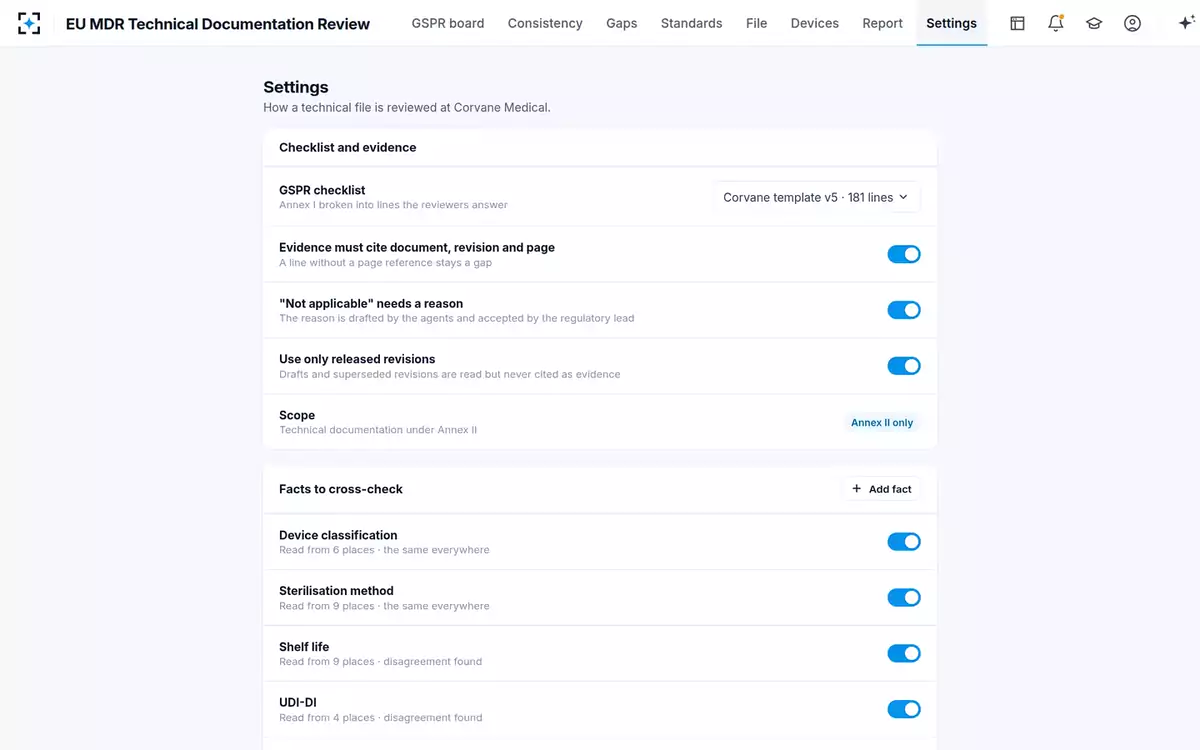
Validating the software, and what your auditor will ask
Software used in a process within your quality management system is your responsibility, not your supplier's. The MDR requires the system to address, among its listed aspects, resource management, including selection and control of suppliers and sub-contractors
(Article 10(9)(d)), and your own procedures will say how software used in the system is selected, validated for its intended use and kept under control. Many manufacturers run those procedures against EN ISO 13485, the quality management systems standard whose reference sits on the MDR harmonised list.
The practical consequence for a buyer is that two questions decide how heavy that validation is. What does the tool decide? And what does it change? A tool that decides nothing and changes nothing — one that proposes findings a person accepts, and writes nothing back to any controlled system — sits at the light end of anybody's risk-based approach, because every output is checked by a named person before it has an effect. A tool that closes requirements on its own authority or edits documents sits at the heavy end, and should.
Ask for the second question in writing. "Nothing is written back" is a sentence that should appear in a supplier's own documentation, not only in a demonstration.
The sample configuration, in numbers
181lines
in the manufacturer's own checklist template of Annex I — sample setup
8facts
cross-read from every document that states them, and you can add your own — sample setup
24
standards cited by the file, each compared with the edition in force — sample setup
13–18months
the most common reported time to a new MDR certificate covering system and product — published figure
How long does it take to go live on a technical file?
There is no published figure here, and a vendor who gives you one without seeing your inputs is quoting a hope. What actually determines it is whether the five things above exist in usable form. A manufacturer whose checklist template is settled, whose standards list is maintained and whose document control system can hand over a released file has a short setup; one that has to agree its checklist template across three sites first has a project, and the project is about the template rather than the software.
Two sequencing decisions are worth making before anything is configured. Settle the review rules first — the evidence rule, the "not applicable" rule, released revisions only — because they change what every subsequent output means, and changing them later invalidates the comparison between files. And start with one real file rather than a pilot checklist: the first run on a genuine class III file tells you more about your own documentation habits than any evaluation framework, and it is the only way to find out whether your file disagrees with itself.
That gap between what a manufacturer believes about a file and what the file says is also the market's loudest complaint about the Regulation. In the Commission's targeted evaluation of the MDR and the IVDR, 446 out of 575 respondents mentioned persistent ambiguity and inconsistent application
(SWD(2025) 1051, section 4.1.2.1). Ambiguity in the rules is not something software fixes. What software can do is make your own answer to an ambiguous requirement explicit, cited and consistent across every document that touches it — which is the only form of the answer a reviewer can accept or argue with.
One requirement, with the evidence, the gap and the standard applied
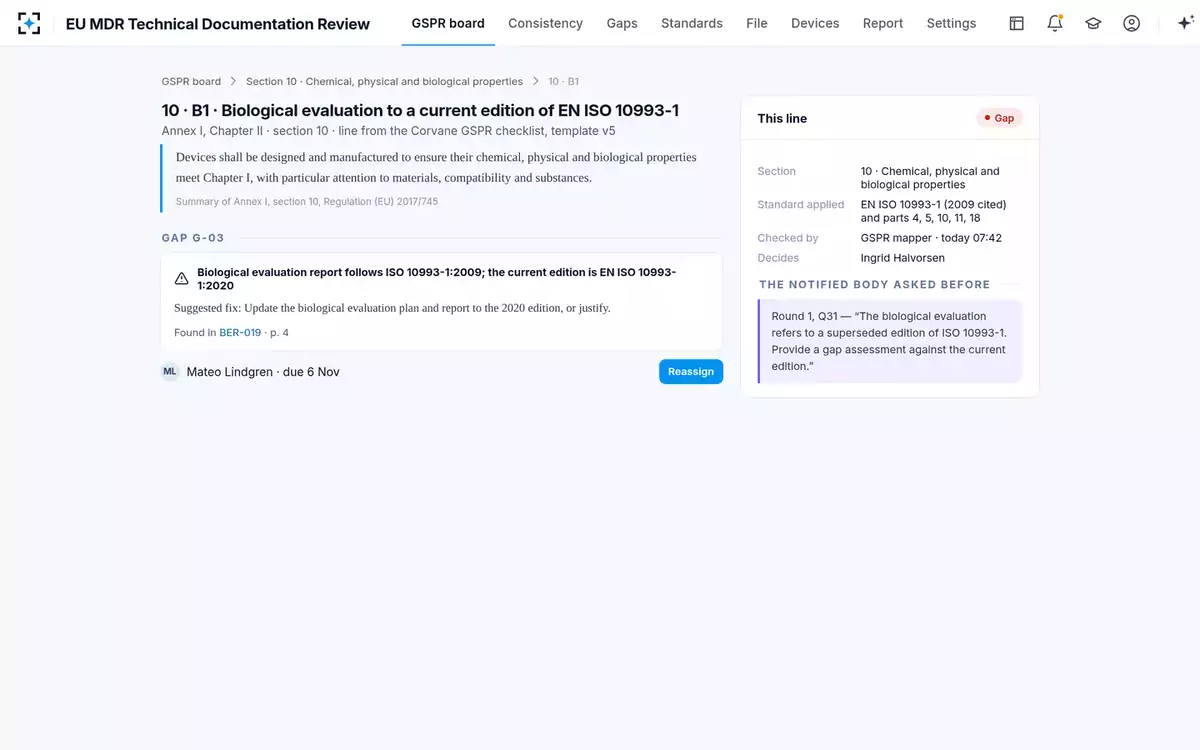
Which editions count, and when a superseded one can still be defended, is set out in the standards guide; the shape of the file the tool reads is in the technical file structure guide; and what a tool may and may not decide is drawn line by line here. To try the test on one of your own files, start from EU MDR Technical Documentation Review.
Questions people ask
Can software keep my checklist of general safety and performance requirements up to date?
It can keep the mapping up to date, which is the part that rots. When a document is re-released, the requirements citing it can be re-checked against the new revision and any that no longer hold reopened. What software cannot do is decide that a requirement now applies where it did not before — that follows a change of design or intended purpose, and it is a person's judgement.
Does the software need to be validated?
Software used in a process within your quality management system falls under your own procedures for selecting, validating and controlling it, and your auditor will ask to see that you followed them. The weight of that work scales with what the tool decides and what it changes: a tool that proposes findings for a person to accept and writes nothing back to a controlled system is at the light end of a risk-based approach.
What does it integrate with?
The technical file under Annex II, your checklist template, your standards list and their editions, your change control history to explain why two documents differ, your history of notified body questions, and your document control system — read only, with nothing written back. The integration that matters most is the dullest: being able to tell a released revision from a draft.
We already have a quality management system and document control. Do we need anything else?
You need them, and they do not answer the question a notified body asks. Control proves a document is the current approved one; it does not prove the document's content meets a requirement, and it cannot see that two controlled documents state one fact differently. That is the gap the fourth category exists to close.
Can one system do all four jobs?
Suites exist that span several categories, and there is a real benefit in one place to look. Test the claim the same way regardless of how many logos are involved: ask to see a requirement with no evidence, an evidenced requirement whose citation opens the page, a superseded revision excluded, and two documents disagreeing. A suite that does the first three categories well and the fourth not at all is still worth owning — just not for this job.
How do we compare vendors who use different words for the same thing?
Ignore the words and compare the artefacts. Ask each vendor for the same two outputs on the same file: the list of requirements with no evidence, each with what is missing, and the list of facts that two documents state differently, each with both pages. The products that cannot produce those two lists are not in this category, whatever the brochure says.