MDR technical file structure is the question of how to arrange, name and index the documents of a technical file so that a notified body can find anything in it, and the answer the notified bodies give is unambiguous: keep the folders few, follow the flow of Annex II, and lead with an index. What most manufacturers do not realise is that structure is tested before content. Annex VII section 4.3 obliges a notified body to have documented procedures to review applications for "the completeness of those applications with respect to the requirements of the relevant conformity assessment procedure" — a check that happens before anyone assesses whether the device is safe. Botminds' EU MDR Technical Documentation Review runs that reading first, on your side of the submission: it sorts every released document into the six sections of Annex II with its number, revision, pages and release status, sets superseded revisions aside, and shows what is missing while there is still time.
The file on this page is a fictional sample: Calvera NC, a class III coronary dilatation catheter from the invented company Corvane Medical. Its counts and durations are sample data. The survey and guidance figures are the published ones, linked where they appear.
How should an MDR technical file be structured?
Follow Annex II, and say so at the front. The notified bodies' best practice guidance for technical documentation submissions, agreed across their European association in April 2026, puts it in two sentences: the submission "should be accompanied by an index or table of contents with appropriate hyperlinks, as necessary, to aid navigation", and the number of folders should be kept to a minimum and, if possible, follow a logical flow per Annex II. It then adds the piece of advice that costs nothing and saves most: contact the notified body before submission and agree the folder structure.
Inside that shape, the useful discipline is one document per file, named so it can be identified without being opened, with the document number and the revision in the name. A folder tree that mirrors the company's own document control system rather than Annex II is a common structure, and one that forces a reviewer to learn a second filing scheme before starting work.
The six sections to build the tree from are the ones Annex II names: device description and specification, information supplied with the device, design and manufacturing information, the general safety and performance requirements, benefit-risk analysis and risk management, and verification and validation. Annex III, the post-market surveillance documentation, sits beside them as its own body.
What is the completeness check for a technical file?
It is the first of the five things a notified body's application-review procedure has to address under Annex VII section 4.3: completeness, then whether the product qualifies as a device and is correctly classified, whether the chosen conformity assessment procedure applies, whether the notified body's own designation covers it, and whether it has the resources. Only after that does assessment begin.
The check has teeth, because the outcome is recorded and visible. Annex VII section 4.3 ends: "Refusals or withdrawals of applications shall be notified to the electronic system referred to in Article 57 and shall be accessible to other notified bodies." An application refused for incompleteness is not a private embarrassment; it is a fact the next notified body can see.
The notified body shall have documented procedures to review applications, addressing: (a) the completeness of those applications with respect to the requirements of the relevant conformity assessment procedure, as referred to in the corresponding Annex, under which approval has been sought
Regulation (EU) 2017/745, Annex VII, section 4.3
What percentage of technical documentation submissions are complete?
Fewer than most manufacturers assume. The European Commission's twentieth notified body survey, with a data status of 28 February 2026, asks every notified body to estimate what share of submissions it considers complete — defined in the survey's own footnote as the "Estimated percentage of submissions which were deemed satisfactory in terms of documentation provided (before undertaking the review of its content) without requesting for any additional information". The distribution is the single most useful number in this subject.
How complete do notified bodies say submissions are?
Read the other way round, 38 of 52 notified bodies say that half or fewer of the submissions they receive are complete on arrival. A peer-reviewed account of conformity assessment written from inside a notified body, published in January 2026, reports the same picture: "the overall submission quality is still reported as being poor, 75% of notified bodies report that submissions are only 50% or less complete".
That is the fact that reframes file structure. If the base rate of a complete submission is under half, then arriving complete is not a hygiene factor — it is the first competitive decision a regulatory team makes about its own timeline.
The three reasons assessments are delayed, in the notified bodies' own words
The same best practice guidance opens with a list headed "The most common reasons for delays in Technical Documentation assessments by notified bodies", and all three are structural rather than scientific. The first is incomplete submissions — insufficient or missing information, including an incomplete or inconsistent description of the devices, variants, accessories and combined devices covered by the Basic UDI-DI under assessment.
The second is the one this page is about: "Lack of Cohesive Structure of Technical Documentation - The information is presented within the Technical Documentation but is difficult to locate." Not missing. Present, and unfindable. The third is inconsistent language within the file: information presented in several languages requiring further translation, and key information such as the intended purpose appearing in several places with different content.
Only the first of the three is about evidence. The other two are about how the evidence is laid out and whether it agrees with itself — which is why a manufacturer with a complete body of testing can still be the slow applicant.
What the notified bodies ask for before you submit
- An index or table of contents, with hyperlinks where they help
The one piece of navigation the guidance names first. It is also where a reviewer forms a view of how carefully the rest was assembled.
- Few folders, following the flow of Annex II
Keep the number of folders to a minimum and, if possible, follow a logical flow per Annex II. Agree the structure with the notified body before submission.
- PDF where possible, and no scanned documents
Files should preferably be in PDF; Microsoft Office formats can be acceptable; scanned documents are to be avoided, because they cannot be searched.
- No path and file name over 160 characters
Windows limits path length. Spaces are encoded as %20 and consume three characters each; the guidance suggests an underscore instead.
- No single PDF over 100 MB
Stated as a limit for the submission, not a preference. A 9,000-page file split sensibly also loads for the reviewer who opens one document at a time.
- Bookmarks, and an internal table of contents for anything over ten pages
Bookmark the PDF files for easier use; documents of ten pages or more should have their own internal table of contents.
- Good translations of the technical documentation
Poor ones cost questions and assessment time at a minimum, and the guidance names a negative recommendation for certification as the worst case.
Folders, file names and the 160-character problem
The file-naming rule looks like trivia and is not. Most notified body staff work in a Windows environment, which limits the length of a path plus file name; the guidance therefore asks manufacturers "do not use file names that combined with the path are longer than 160 characters", and warns that white spaces are encoded as "%20" and consume three characters each.
Work it through on a real naming convention and the limit arrives quickly. A folder path of four levels — the submission root, the annex, the section, the subsection — can easily take 90 characters on its own if each level is spelled out in words. That leaves 70 for a name like "Biological_Evaluation_Report_BER-019_revC_2026-03-14.pdf", which is 56 and fits, against "Biological Evaluation Report for Calvera NC per EN ISO 10993-1 (rev C, approved 14 March 2026).pdf", which is 98 before encoding and 128 once its fifteen spaces are counted at three characters each.
The deeper point is that the naming convention is a regulatory artefact. A reviewer who can tell from a file name which document, which revision and which section it belongs to will not ask for a list. One who cannot will ask, and the question goes into a round.
One index, with hyperlinks: what navigation is worth
An index is the cheapest thing in a submission and the one with the largest effect on how long the assessment takes. It should name every document with its number, title, revision and the Annex II section it belongs to, and link to it. Where the file also contains superseded revisions — which it should not, but often does — the index is where they are declared as superseded rather than left for the reviewer to discover.
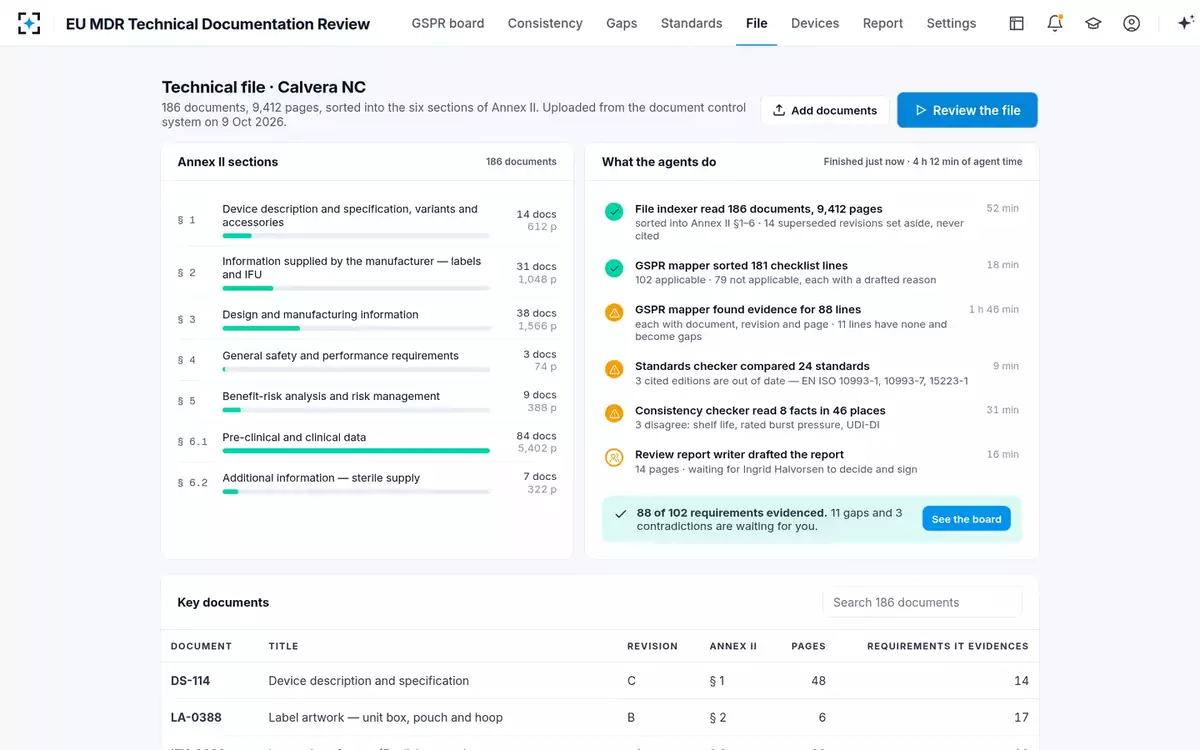
On the fictional sample file the solution produces exactly that list as a by-product of reading: 186 documents sorted into the six sections, each with document number, title, revision, pages and release status, and 14 superseded revisions read and set aside so that nothing cites them. The point is not the speed. It is that the index and the evidence come from the same reading, so the index cannot drift from the file.
One file, indexed and read before it leaves the building
186
documents taken from the document control system on 9 October 2026
9,412pages
read and sorted into the six sections of Annex II
14
superseded revisions read, set aside and never cited as evidence
4 h 12
of agent time across five steps, on this sample file
Two submissions of the same 186 documents
A folder tree nobody agreed: A root folder named after the project, with sub-folders mirroring the company’s own document control system.
Sorted into Annex II, with an index: An index naming every document with its number, revision, pages and the Annex II section it belongs to, each line linking to the file.
A folder tree nobody agreed: Search the tree. It may sit under design verification, under packaging or under sterilisation, depending on who filed it.
Sorted into Annex II, with an index: Section 6, pre-clinical and clinical data, under stability. One line in the index, one click.
A folder tree nobody agreed: Present, because the export took everything. The reviewer cannot tell which revision is the released one without asking.
Sorted into Annex II, with an index: Declared and set aside. Only released revisions are cited anywhere in the checklist.
A folder tree nobody agreed: Document names, sometimes with a revision. The reviewer searches for the passage.
Sorted into Annex II, with an index: Document, revision, section and page, with a cross-reference to where the evidence sits.
A folder tree nobody agreed: Questions about where things are, before any question about the device. Each one is a letter, an owner and a wait.
Sorted into Annex II, with an index: The questions that remain are about the evidence, which is the conversation worth having.
Why was my MDR application rejected?
The Commission's survey counts the reasons. In the February 2026 round, the two main reasons given for refusing an MDR application were that the device was outside the scope of the notified body's designation, at 30% of refusals, and that the "Applications not complete", at 25%. Wrong qualification or classification of the product, insufficient notified body resources and the wrong conformity assessment procedure make up most of the rest, alongside a group of other reasons that includes withdrawal by the customer and a client who stopped communicating.
Why MDR applications are refused, and how many have been
Reasons given for refusal, February 2026 round
- Outside the scope of the notified body's designation · 30%
- Application not complete · 25%
- Other, including withdrawal by the customer · 21%
- Wrong qualification or classification of the device · 16%
- Insufficient notified body resources, or the wrong conformity assessment procedure · 8%
Two readings are worth taking from that split. The first is that a quarter of refusals are a filing problem rather than a device problem, and a filing problem is the only kind a manufacturer can fix in the week before submission. The second is that refusals are rare in absolute terms — 989 cumulative against 32,898 applications filed. The common outcome of an incomplete file is not refusal. It is a request for more information, and a wait.
Translations, and the quiet cost of a bad one
Language is the third of the notified bodies' three delay reasons, and it works in two directions. One is the set of labels and instructions for use, which Annex II section 2 requires in the languages accepted in every Member State where the device will be sold. The other is the language of the submission itself: Article 52(12) lets the Member State in which the notified body is established require documents in a language it determines, and where it does not, the documents must be in an official Union language acceptable to the notified body. Each notified body publishes which languages it accepts, and the guidance asks manufacturers to clarify that before lodging anything.
On quality, the guidance does not hedge: good translations matter because "poor quality translations may, at a minimum, lead to additional questions and time spent on the assessment and, at worst, could lead to a negative recommendation for certification". A translation is also a place where a fact quietly changes: an intended purpose rendered slightly differently in one language is a disagreement between two documents in the file, and disagreements are read as doubt.
What a structured dialogue before submission is for
There is a sanctioned way to ask a notified body a question before you submit. The Medical Device Coordination Group's position paper on notified body capacity, endorsed in August 2022, says that "The MDCG encourages notified bodies and manufacturers to organise structured dialogues before and during the conformity assessment process" aimed at regulatory procedures, where this is useful to enhance the efficiency and predictability of the assessment, while respecting the independence and impartiality of the notified body. It adds the limit that keeps it legitimate: such dialogues should not be considered a consultancy service.
In practice the questions worth taking to one are structural. Which folder structure do you prefer? Which languages will you accept for the submission? How do you want the checklist's cross-references expressed? None of those are questions about whether the device conforms, and all of them decide how fast the first weeks go.
The file sorted, with what each step found and how long it took
Reading your own file as a stranger
The test that matters is not whether the file is complete. It is whether someone who has never seen it can be convinced that it is, in an afternoon. Three exercises get close to that. Hand the index to a colleague from another programme and ask them to find five named documents. Take ten lines of the checklist and ask them to produce the evidence. Open the longest document in the file and see whether it has a table of contents.
The structural failures all have the same shape: the information is there, and the reader cannot reach it. That is what the notified bodies describe as a lack of cohesive structure, and it is the one category of finding a manufacturer can close entirely before anyone else reads the file. What remains after that — the lines of the checklist with no evidence and the facts that disagree between documents — is real work, with owners and dates.
The pre-submission review, drafted from what the reading found
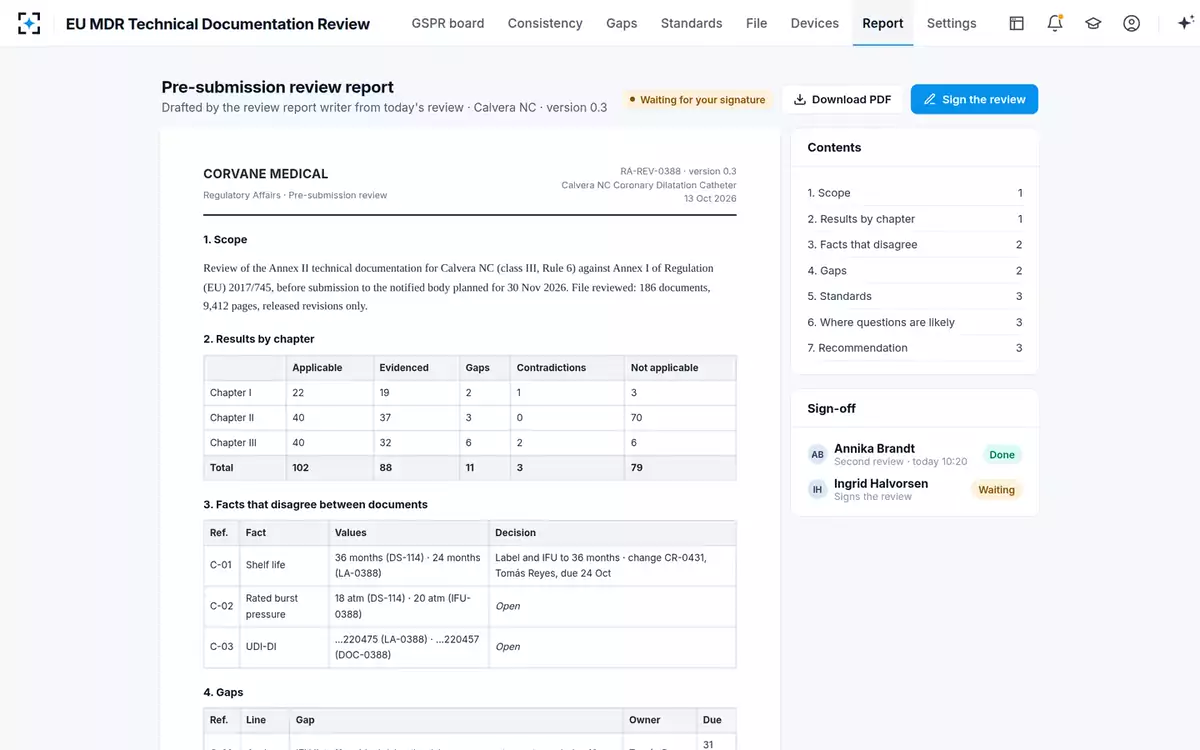
To see the index, the checklist and the report come out of one reading, start from EU MDR Technical Documentation Review.
Questions people ask
Does the notified body read the whole technical file?
For class III devices and the class IIb implantables that Article 52(4) singles out, yes: Annex IX Chapter II requires the manufacturer to lodge an application for assessment of the technical documentation, and the notified body assesses it using staff with proven knowledge of the technology. For class IIa and class IIb devices generally, the quality management system assessment is accompanied by assessment of the technical documentation of devices chosen on a representative basis, with the notified body documenting its rationale for the samples taken. So "the whole file" depends on the class — but every file passes the completeness check.
What format should a technical file be in?
Preferably PDF, with Microsoft Office formats acceptable and scanned documents to be avoided, according to the notified bodies' own guidance. Bookmark the PDFs, give anything over ten pages its own internal table of contents, keep no single PDF over 100 MB, and keep the path plus file name under 160 characters. The underlying reason for all of it is searchability: a scanned report is a picture of evidence, and a reviewer cannot search a picture.
How many MDR applications are refused?
989 cumulatively, as reported in the European Commission's February 2026 notified body survey, against 32,898 MDR applications filed and 18,010 certificates issued by the same date. Refusal is therefore uncommon; the usual consequence of an incomplete or hard-to-navigate file is a request for more information and a longer assessment, which does not appear in any published count.
How do you name files in a technical documentation submission?
So that the document, its revision and its place in Annex II can be read without opening it, and within the 160-character limit on path plus file name. Underscores rather than spaces, because a space is encoded as three characters. The document number first is usually best, because it matches the reference in the checklist, which is what a reviewer is holding when they go looking.
Can you submit a technical file as one large PDF?
Not sensibly. The guidance sets a 100 MB limit on any individual PDF in the submission, and a single combined file defeats the folder structure and the index it also asks for. The useful unit is one controlled document per file, named for that document, with the index carrying the structure.
Should you agree the structure with the notified body first?
Yes, and the guidance says so directly: contact the notified body before submission and agree the preferred folder structure, and clarify the language requirements at the same time. That conversation sits inside what the coordination group calls a structured dialogue, which is encouraged before and during conformity assessment and is explicitly not a consultancy service.