The MDR legacy device definition is narrower than most portfolio reviews assume. A legacy device is a device still covered by a certificate issued under one of the old directives, which Regulation (EU) 2017/745 nevertheless allows on the European market after 26 May 2021 — until 31 December 2027 or 31 December 2028 depending on its class, and only while five conditions in Article 120 continue to hold. Two of those conditions were deadlines that passed in 2024; one of them, no significant change in design or intended purpose, is a live constraint on every decision your engineers make between today and the day the certificate is issued. Botminds' EU MDR Technical Documentation Review is built for the file that has to clear that deadline: five agents read the whole technical file, map each Annex I requirement to the document, revision and page that meets it, compare the edition of every standard cited, and show the places where two of your own documents state the same fact differently.
The examples on this page come from a fictional sample manufacturer as it runs through the solution: Corvane Medical, moving Calvera NC, a class III coronary dilatation catheter, from a legacy directive certificate to an MDR certificate before 31 December 2027, with submission planned for 30 November 2026. The company, the device, the people and the sales figures are invented. The law and the published figures are linked where they appear.
What is a legacy device under MDR?
A legacy device is a device placed on the market after the MDR applied, on the strength of a directive certificate rather than an MDR one. The Medical Device Coordination Group — the group of Member State authorities that writes the MDR's interpretive guidance — puts it directly: ‘legacy devices’ should be understood as devices, which, in accordance with the MDR’s transitional provisions, are placed on the market after the MDR’s date of application (i.e. 26 May 2021) if certain conditions are fulfilled
(MDCG 2020-3 rev.1, section 1).
Three things follow from that sentence, and each one catches someone out. The status comes from the transitional provisions, not from the device: nothing about a catheter makes it legacy, only the certificate it travels on. It is conditional, so it can be lost. And it is temporary in a way the directives never were — the certificate itself may have expired already, because Article 120(2) keeps directive certificates valid for this purpose even past their printed expiry date, while the dates in Article 120(3a) are the ones that actually end the permission.
There is a second, smaller group of legacy devices that no notified body ever certified: devices that were self-declared class I under the old directive but are up-classified under the MDR, so they now need a notified body. Article 120(3b) gives those devices until 31 December 2028, provided their declaration of conformity was drawn up before 26 May 2021. A manufacturer in that position often does not think of itself as holding a legacy device at all, because it never held a certificate.
What is the MDR deadline for class III devices?
31 December 2027. The amending Regulation (EU) 2023/607 sets the date for 31 December 2027, for all class III devices, and for class IIb implantable devices except sutures, staples, dental fillings, dental braces, tooth crowns, screws, wedges, plates, wires, pins, clips and connectors
(Article 120(3a)(a)). Everything else that was in the transition gets one more year: 31 December 2028, for class IIb devices other than those covered by point (a) of this paragraph, for class IIa devices, and for class I devices placed on the market in sterile condition or having a measuring function
.
The exception list in point (a) is the part worth reading twice, because it moves a specific group of class IIb implantables — the well-understood, high-volume hardware of orthopaedics and dentistry — from 2027 to 2028. A screw is on the list; a coronary stent is not.
Which transition date applies to which device
| Device | Last day it may be placed on the market as a legacy device | Where it says so |
|---|---|---|
| Class III, all of it | 31 December 2027 | Article 120(3a)(a) |
| Class IIb implantable — except sutures, staples, dental fillings, dental braces, tooth crowns, screws, wedges, plates, wires, pins, clips and connectors | 31 December 2027 | Article 120(3a)(a) |
| Class IIb implantable on that exception list | 31 December 2028 | Article 120(3a)(b) |
| Class IIb, not implantable | 31 December 2028 | Article 120(3a)(b) |
| Class IIa | 31 December 2028 | Article 120(3a)(b) |
| Class I placed on the market sterile, or with a measuring function | 31 December 2028 | Article 120(3a)(b) |
| Class I under the directive, up-classified by the MDR, declaration of conformity drawn up before 26 May 2021 | 31 December 2028 | Article 120(3b) |
One nuance in that caption decides how much a missed date actually costs. The deadline governs placing a device on the market — the first supply of each individual unit in the Union. Units already placed on the market may continue to be made available and put into service afterwards, which means a distributor's stock is not stranded on 1 January 2028, but your factory stops shipping into Europe on that day. For a product earning its keep in a hospital's standing order, that is still the end of the line.
The five conditions the extended dates depend on
Article 120(3c) does not grant time; it grants permission subject to conditions, and the permission falls away if any of them fails. There are five, lettered (a) to (e), and the last carries two separate dates.
The five conditions behind the 2027 and 2028 dates
- The device still complies with the directive it was certified under
Article 120(3c)(a). The old directive keeps applying to this device for as long as it relies on the transition — Article 122, as amended, says the repealed directives "shall continue to apply to the extent necessary".
- There are no significant changes in the design and intended purpose
Article 120(3c)(b), quoted verbatim. The only condition that an engineering decision can break, and the only one with its own interpretive guidance.
- The device does not present an unacceptable risk to health or safety
Article 120(3c)(c). Read with the MDR post-market surveillance and vigilance duties that now apply to the device.
- A quality management system under Article 10(9) was in place no later than 26 May 2024
Article 120(3c)(d). A date already passed: either it was in place or the device left the transition in May 2024.
- A formal application was lodged by 26 May 2024, and a written agreement signed by 26 September 2024
Article 120(3c)(e): "no later than 26 May 2024, the manufacturer or the authorised representative has lodged a formal application with a notified body in accordance with Section 4.3, first subparagraph, of Annex VII for conformity assessment". The written agreement with that notified body had to be signed four months later.
Two of the five are now matters of historical fact. If no application was lodged by 26 May 2024, or no written agreement signed by 26 September 2024, the device has not been eligible for the extended dates since those days passed, whatever a project plan says. The practical reading for a portfolio review in 2026 is therefore short: confirm the 2024 paperwork exists for every device you are counting on, then put your attention on condition (b), which is the only one you can still break.
What counts as a significant change in design or intended purpose?
A significant change is one that alters what the device is for, who uses it, or how it works in the ways MDCG 2020-3 sets out — and making one takes the device out of the transition, so it may then only be placed on the market under an MDR certificate it does not yet hold. The guidance organises the question into a main chart and five supporting charts, A to E (intended purpose, design, software, substances or materials, and sterilisation), and it is worth walking with a specific change in hand rather than read in the abstract.
On intended purpose, the guidance treats extension as significant and restriction as not: additional or new indications or clinical conditions, a new target population, a new user group — a change from professional use to lay use is its own example — a new anatomical site, a new delivery pathway or deployment method. Restricting or deleting an indication, an application or part of the target population is non-significant. The asymmetry is the logic of the whole thing: the notified body assessed a given claim under the directive, and the transition rides on that assessment, so you may narrow what you claim but not widen it.
On design, a change is non-significant when it does not alter the built-in control mechanism, the device's operating principle, the source of energy or the alarm systems, and does not adversely affect safety, performance or usability or negatively affect the benefit-risk ratio. The examples are reassuringly mundane: a new catheter variant with length and diameter inside the certified range, a colour change, a connector modified to adhere to a revised standard, an existing instructions-for-use content reformatted into a newly created document.
Changes you can still make: the non-significant list
The shelf-life case is the one that comes up most on a file under remediation, and it falls on the comfortable side of the line — but only because of a condition in how the words are written.
Significant, or not: what the coordination group lists on each side
Significant change — the device leaves the transition: Additional or new indications or clinical conditions; an additional or new target population; a new user, such as a move from professional to lay use; a new anatomical site, delivery pathway or deployment method.
Not a significant change — the transition continues: Restriction or deletion of indications or applications; restricting the target population.
Significant change — the device leaves the transition: A change to the built-in control mechanism, the operating principle, the source of energy or the alarm systems; any change that adversely affects safety, performance or usability, or negatively affects the benefit-risk ratio.
Not a significant change — the transition continues: A new variant inside the certified range of lengths and diameters; a colour change; a connector modified to adhere to a new or revised standard; reformatting existing instructions-for-use content into a newly created document; editorial improvements to warnings and precautions that clarify critical information.
Significant change — the device leaves the transition: "Extension of the (labelled) shelf life which is not validated against protocols approved by the notified body"; a change of terminal sterilisation method; a packaging design change affecting sterility, stability or seal integrity.
Not a significant change — the transition continues: "Extension of the shelf life validated by protocols approved by the notified body"; a change of sterilisation cycle parameters; a new sterilisation vendor or chamber; single to double sterile packaging — each valid only where there is no impact on sterility assurance level or sterilisation residuals.
Read the shelf-life rows together and the condition is in the validation, not in the number. An extension validated by protocols approved by the notified body
is non-significant; the same extension which is not validated against protocols approved by the notified body
is significant. So on the sample file, where change control extended shelf life to 36 months on an accelerated aging report run to ASTM F1980 while the label artwork still printed 24, the question to answer before the label moves is not whether the number is bigger but whether the aging protocol behind it is one the notified body approved. Moving the printed date from 24 to 36 months is itself an extension of the labelled shelf life; if the protocol was approved, the guidance lists it as non-significant, and if it was not, the guidance lists it as significant. Either way the answer belongs in the change record, because leaving a label that contradicts the design file alone is the reading that produces another round of notified body questions. What shelf life means beside a device's lifetime, and which one belongs on the label, is worked through separately.
Which MDR rules already apply to a legacy device
A legacy device is not a device living under the old law. One paragraph moves a whole chapter of MDR duties onto it immediately: the requirements of this Regulation relating to post-market surveillance, market surveillance, vigilance, registration of economic operators and of devices shall apply to devices referred to in paragraphs 3a and 3b of this Article in place of the corresponding requirements in Directives 90/385/EEC and 93/42/EEC
(Article 120(3d)).
So a legacy device owes MDR post-market surveillance and vigilance now — the plan, the periodic safety update report for class IIa and above, the incident reporting timescales, registration of the device and of the economic operators behind it — while its conformity is still assessed against the directive. That split is where a transition portfolio most often leaks. The post-market data a legacy device generates under MDR rules is also the clinical and safety evidence the notified body will read in its technical documentation, so the two halves of the obligation meet in the file whether or not the organisation has joined them up.
How long does it take to get an MDR certificate?
Longer than the time most 2026 project plans have left. In the European Commission's twentieth notified body survey, with data to 28 February 2026, the most common answer for a new MDR certificate covering both the quality management system and the product was 51% of NBs: 13-18 months
, with 31% reporting 19 to 24 months and a further 10% more than 24 (DG SANTE notified body survey, slide 30, data of 39 notified bodies).
The clock those figures measure is the one that matters here, and it is not the one most people assume. The Commission's note under the chart is explicit that the indicator runs from the written agreement being signed to the certificate being issued. For a legacy device, that agreement was signed by 26 September 2024 at the latest, because condition (e) required it. So the survey band is not a reviewer's reading time: it is the whole engagement after the contract, and it includes however long the manufacturer takes to send the file and to answer the questions it raises. A plan that treats it as the time from submission to certificate, as the figure below does, is making a cautious assumption rather than reading a published number. The sequence inside that period, and which specialist reads which part of your file, is set out step by step.
Working backwards from the deadline to the day you submit
Draw the calendar to scale and the arithmetic of the transition stops being abstract. The figure below starts at 26 September 2024, the last of the conditional dates, and runs to the end of 2028.
From the written agreement to the deadline, in months
- To 31 December 2027 · class III, most class IIb implantables39 months
- Then to 31 December 2028 · other class IIb, class IIa, class I sterile or measuring12 months
- Preparing and reviewing the file before submission26 months
- Assessment at the fastest band13 months
- Preparing and reviewing the file before submission26 months
- Assessment at the top of the band18 months
Two readings come out of it. The first is that a submission date is a derived figure, not a choice: deadline minus the review band your notified body actually reports, minus the time your own organisation will need to answer its questions. The second is that every month spent answering a question that a pre-submission read of your own file would have caught is a month taken off the only buffer left. The coordination group said as much when it set out its capacity actions, reminding manufacturers of its earlier notice calling on manufacturers to ensure timely compliance with MDR requirements
(MDCG 2022-14, action 14).
What a pre-submission review has to prove, and when
For a portfolio, the question is not whether each file will eventually be complete but whether it will be complete before its own date, and which files have to be read first. The sample manufacturer's view of that is a list of devices on directive certificates with each deadline, each planned submission and when its file is reviewed.
Fourteen devices on directive certificates, each with its own deadline
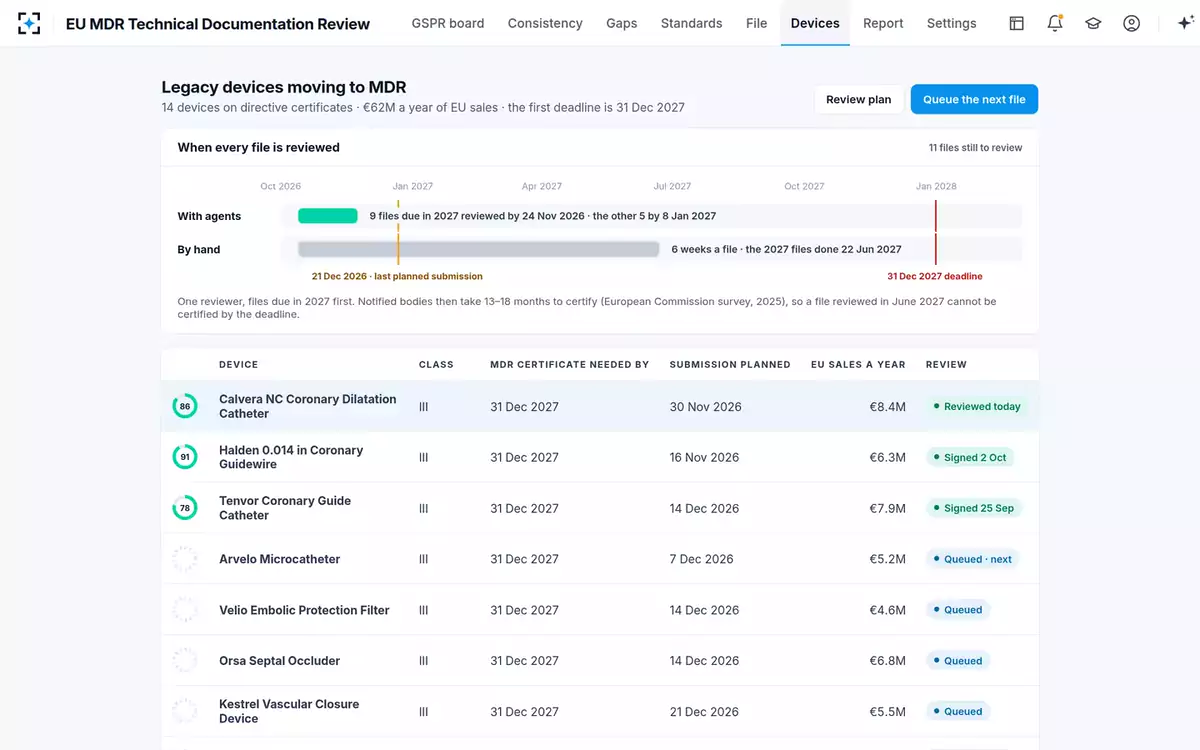
What a review of one file has to prove before submission is narrower than a readiness score and more useful: that every applicable Annex I requirement has a document, a revision and a page behind it; that no two documents in the file state the same fact differently; and that every standard cited is the edition in force. On the sample file the agents read 186 documents and 9,412 pages, sorted 181 checklist lines into 102 that apply and 79 that do not, found evidence for 88 of the 102, and read eight facts from 46 places in 14 documents — which is where the three disagreements came from, including the shelf life that the label never caught up with. Eleven requirements had no evidence at all, each one a question waiting to be asked.
None of that moves a deadline. It changes what arrives at the notified body on the planned date, which is the only lever a manufacturer still controls at this point in the transition — and the reason the dates moved at all was never about any individual file.
the overall capacity of notified bodies is still not sufficient to ensure the conformity assessment of the large number of devices covered by certificates issued in accordance with Directive 90/385/EEC or Directive 93/42/EEC before 26 May 2024
Regulation (EU) 2023/607, recital 4
That is the legislature saying plainly that the 2027 and 2028 dates are a capacity measure. A queue was too long, so the dates moved once; the conditions attached are what the legislature asked for in return. Reading the Regulation that way makes the governing question for a portfolio in 2026 obvious. Not "how much time do we have", but "which of our files can go in next, finished".
One file's Annex I requirements, section by section, before anyone submits
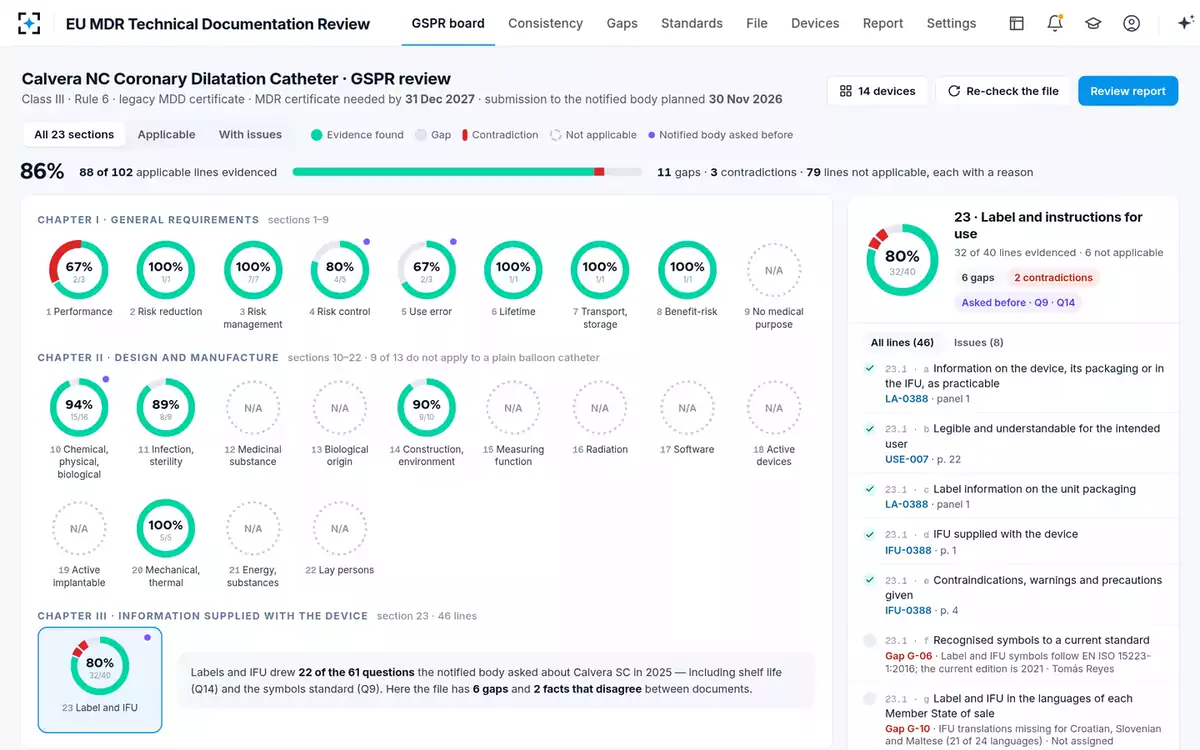
What goes into the file, section by section, is the subject of the requirements guide, and the structure a notified body expects to find it in is covered by the technical file structure guide. To see the agents read one of your own legacy device files, start from EU MDR Technical Documentation Review.
Questions people ask
Can a legacy device still be sold after its directive certificate expires?
Yes, if the conditions hold. Article 120(2) keeps a directive certificate issued from 25 May 2017, still valid on 26 May 2021 and not withdrawn since, valid after the date printed on it until the date Article 120(3a) sets for its class — 31 December 2027 or 2028. A certificate that had already expired before 20 March 2023 counts only if a written agreement with a notified body was signed before it expired, or a national authority granted a derogation or required the conformity assessment. Within those limits, the printed expiry is not what stops you; a failed condition or the calendar is.
What happens if my MDR certificate is not issued by the deadline?
The permission to place that device on the European market ends on the date in Article 120(3a), and the device may then only be placed on the market once it holds an MDR certificate. Units already placed on the market may still be made available and put into service under Article 120(4), so distributor stock and installed devices are unaffected — but new supply into the Union stops until the certificate is issued.
Does post-market surveillance follow the MDR for legacy devices?
Yes. Article 120(3d) applies the MDR's requirements on post-market surveillance, market surveillance, vigilance and registration of economic operators and devices to legacy devices in place of the corresponding directive requirements. Conformity is still assessed against the directive, which is why a legacy device lives under two regimes at once.
Can I change notified body during the transition?
The written agreement required by 26 September 2024 fixed which notified body is responsible for surveillance of the device from that date. Article 120(3e) does contemplate transfer: the arrangements must be clearly defined in an agreement between the manufacturer and the receiving notified body designated under Article 42 and, where practicable, the body that issued the certificate, and the receiving body is not responsible for the other's earlier conformity assessment work. In a market where capacity is the binding constraint, the time a transfer costs is the thing to weigh.
Is a software update a significant change?
It is assessed on its own chart. MDCG 2020-3 routes software changes primarily through chart C, while noting that a major software change may amount to a change in the built-in control mechanism or the device's operating principle and then be judged under the design chart instead. The chart's non-significant examples include a bug fix that brings the device back to its original specification, a security update and an update of a standard third-party operating system.
Does correcting a document that disagrees with another one risk the transition?
Not in itself. MDCG 2020-3 lists editorial work on printed information — reformatting instructions-for-use content, clarifying warnings — as non-significant, and an extension of shelf life as non-significant when it is validated by protocols the notified body approved. A correction that moves a claim, such as a longer use-by date, has to pass that second test as well. Judge each change against the charts and keep the reasoning with the change, because the opposite course, leaving two of your own documents in conflict, is what produces a question from the reviewer.