A GSPR checklist is the table that demonstrates conformity with the general safety and performance requirements of Annex I of the EU Medical Device Regulation: one row for each requirement, saying whether it applies to this device, why it does not where it does not, how conformity was shown, which standard was used, and which controlled document — with revision, section and page — proves it. Writing one is harder than it looks, because the regulation names the content of the demonstration and leaves the form entirely to the manufacturer, so every company's checklist is its own invention and every reviewer reads it cold. Botminds' EU MDR Technical Documentation Review works through a company's own checklist template line by line, finds the passage that meets each requirement and cites it to the page, opens a gap where there is none, and leaves the judgement to the regulatory affairs lead.
The sample figures on this page come from a fictional device, Calvera NC, a class III coronary dilatation catheter from the invented company Corvane Medical, as it runs through the solution. Everything quoted from the regulation and from the notified bodies' own guidance is linked where it appears.
What is a GSPR checklist?
Annex II of the Regulation, section 4, asks the manufacturer for information demonstrating conformity with the Annex I requirements that apply to the device, "taking into account its intended purpose", and says the demonstration must include a justification, validation and verification of the solutions adopted. It then lists four things: which requirements apply and an explanation as to why the others do not; the method or methods used for each applicable one; the harmonised standards, common specifications or other solutions applied; and the precise identity of the controlled documents that evidence them.
Nothing in that text says "checklist". A table is simply the most practical way to answer four questions about each of a hundred-odd requirements without writing a book, and over the years it has become the usual form. What matters is that the table is the demonstration, not an index to one. A reviewer who cannot follow a row from the requirement to the page has not been shown conformity, however good the underlying testing.
Annex I itself is three chapters and 23 numbered sections: general requirements in Chapter I (sections 1 to 9), requirements on design and manufacture in Chapter II (sections 10 to 22), and the requirements on the information supplied with the device in Chapter III (section 23, with its sub-sections on the label, the sterile packaging and the instructions for use). How many checklist lines those 23 sections become is the manufacturer's decision — which is the first thing to understand about templates.
What columns should a GSPR checklist have?
Five, at minimum, and the fifth is the one that fails. The requirement; whether it applies and why not if it does not; the method used to demonstrate conformity; the standard or other solution applied; and the controlled document with its revision, section and page. The notified bodies' best practice guidance for technical documentation submissions, agreed across the European association of medical device notified bodies in April 2026, describes that last column as a place for the "precise identity of the controlled documents" offering evidence of conformity, and says the identification should be given as "Document ID, document date, section, point, page, chapter, link etc."
Two optional columns earn their place. The first records whether full or partial compliance with a standard is claimed — the same guidance asks you to "Indicate if full or partial compliance is being claimed", which matters whenever only certain clauses of a standard were used. The second carries the risk identifiers the line relates to, so the checklist, the risk file and the test reports can be read as one argument rather than three.
One GSPR line, five columns, filled the way a reviewer wants to read it
| Column | What goes in it | Worked, on one requirement |
|---|---|---|
| The requirement | The Annex I line as written, with its number. Splitting a long requirement into several lines is allowed and usually helps, as long as nothing is dropped. | Annex I, 23.2(i): an unambiguous indication of the time limit for using or implanting the device safely, expressed at least in terms of year and month, where this is relevant. |
| Applicable, and why not | Applicable or not applicable for this device and this intended purpose. Every not applicable line carries a written reason. | Applicable. The device is supplied sterile with a limited shelf life, so a use-by date is relevant. |
| The method used | How conformity was shown: bench or laboratory testing, biological evaluation, process validation, clinical data, a documented rationale, or a design control. | Accelerated and real-time aging of the sterile barrier and the device, with the resulting claim carried onto the label artwork and verified at artwork release. |
| The standard or other solution | The harmonised standard, common specification or other solution applied, with the clause where only part of it is used, and whether full or partial compliance is claimed. | EN ISO 15223-1 for the use-by symbol; the aging protocol for the claim itself; full compliance claimed for the symbol. |
| The controlled document, to the page | Document number, revision, section and page, plus a cross-reference to where that evidence sits in the full file. | LA-0388 rev B, panel 2 (artwork); TR-2291 rev C section 7.4 p. 31 (aging); DS-114 rev C p. 12 (specification). |
Is there an official GSPR checklist template?
No. Neither the Regulation nor the Medical Device Coordination Group publishes a GSPR checklist form, and the notified bodies' guidance describes what a column should contain rather than issuing a template to fill in. That is deliberate: Annex I has to cover a tongue depressor and an implantable defibrillator, so how many lines a requirement becomes depends on the device.
The practical consequence is that a template is a company asset, built once and reused. The fictional manufacturer on this page keeps a 181-line template of Annex I — its own split of Annex I's 23 sections into the questions its reviewers answer. That number is a drafting choice, not a count of requirements in the Regulation; a different company's template of the same Annex I might have 120 lines or 260.
Two cautions about borrowed templates. A template written for a class IIa device usually under-covers Chapter II, and one written before a standard was revised carries the old edition in its standards column, which quietly ages every file built on it. Where a file cites an edition that has been superseded, the checklist is often where the error was first copied.
The sample file's checklist, after the agents have been through it
181lines
on the manufacturer's own template of Annex I
102
lines that apply to this device, with 79 marked not applicable, each with a drafted reason
88
applicable lines evidenced to a document, revision and page
11gaps
applicable lines with no evidence yet, each with an owner and a date
Column by column: the requirement, why it applies, the method, the standard, the document
The first column is the only one most people get right, and even there the common failure is paraphrase. A row that restates a requirement in the author's own words invites an argument about whether the paraphrase is faithful. Quote the line, number it, and split it if it contains several distinct obligations.
The applicability column is a judgement, and it has to be made against the intended purpose rather than against the device in the abstract. Annex I section 1 requires a device to be safe and effective and to carry acceptable risks judged against the generally acknowledged state of the art (Annex I, section 1) — so a requirement can become applicable over time, as the state of the art moves, without the device changing at all.
The method column should name an activity, not a document. "Biological evaluation in accordance with a risk-based plan" is a method; "BER-019" is a document, and belongs two columns to the right. The standards column should say which standard, which edition, and — where a standard was applied in part — which clauses and whether full or partial compliance is claimed. The document column is the subject of the next section, because it is where most deficiencies are written.
The page reference: the difference between a document name and evidence
The regulation's requirement is unusually specific. Annex II section 4(d) asks for the precise identity of the controlled documents offering evidence of conformity with each standard or method applied, and then requires that information to carry a cross-reference to where that evidence sits within the full technical documentation (Annex II, section 4(d)). A document number alone satisfies the first half of that sentence and not the second.
The notified bodies report the failure in both directions. On their list of common pitfalls in this section is documentation that "does not include a clear and unambiguous reference to where the evidence used to demonstrate compliance (for applicable GSPRs) can be found inside the Technical Documentation provided". And in a note on the same section they ask for a cross-reference to the location of the document, telling manufacturers to use precise references and avoid general or generic ones.
The more specific the references are to documents supporting compliance, the faster the assessment can be conducted.
Team-NB best practice guidance for technical documentation, April 2026
That sentence is worth reading as a commercial fact rather than an editorial preference. A reviewer paid by the hour who has to search a 9,000-page file for the paragraph that proves a requirement will either find it slowly or ask a question about it, and a question is a round. Precision in the fifth column is the cheapest thing a manufacturer can buy.
How do you mark a GSPR as not applicable?
With a reason, in writing, on the line itself. The regulation asks for the requirements that apply "and an explanation as to why others do not apply", and the notified bodies' single most quotable pitfall in this section is the row that skips it: "The GSPR requirement no. XX is identified as “not applicable”; however, no justification/rationale is provided."
A good reason refers to a property of the device, not to the absence of a document. "Not applicable: the device contains no substances that are absorbed by or locally dispersed in the human body" is a reason. "Not applicable: no testing performed" is a gap wearing a reason's clothes. Where a requirement is excluded because of the intended purpose, say which part of the intended purpose excludes it, so that the row survives a change of indication.
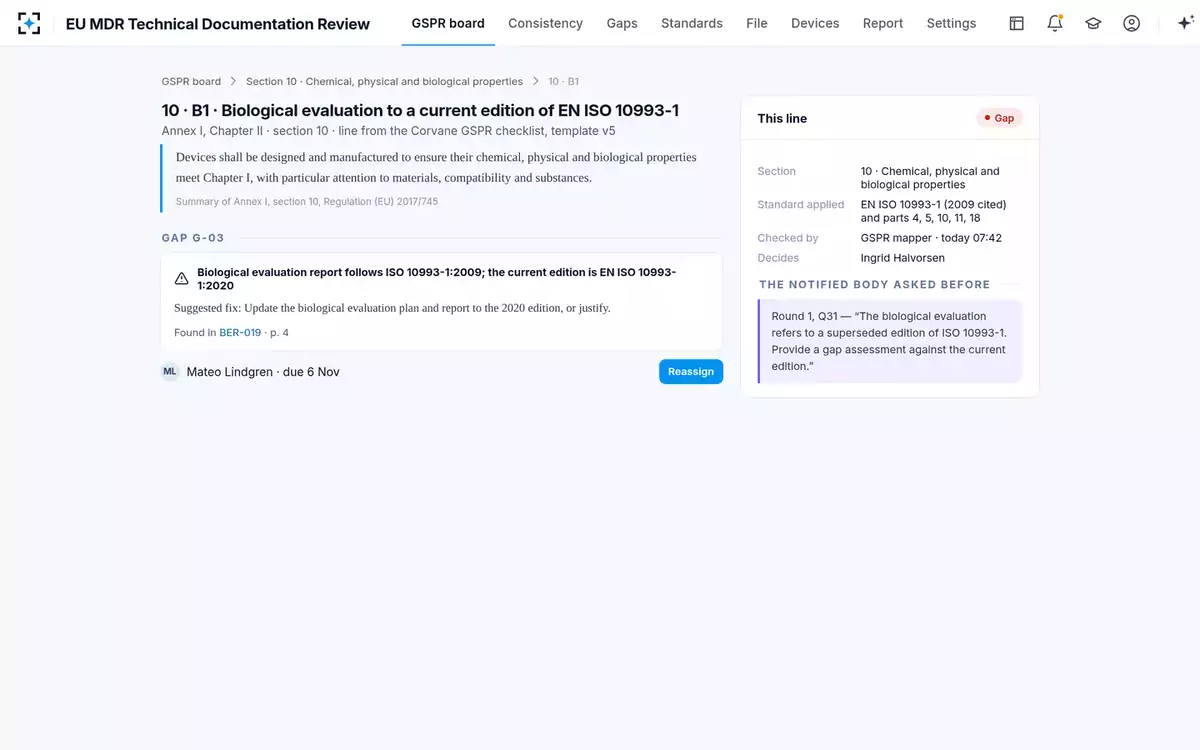
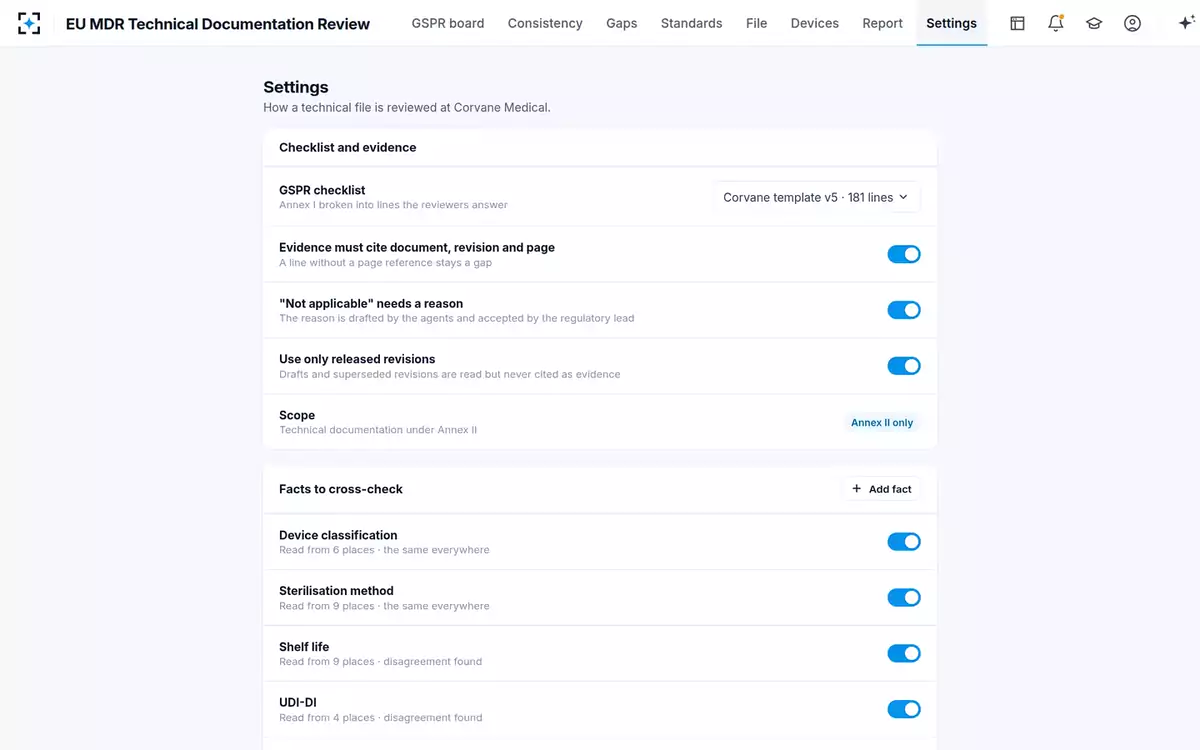
Two requirements deserve special care. Requirements about information supplied with the device are almost never inapplicable, because every device carries some information. And a requirement excluded on the basis that the device is not, for example, magnetic-resonance conditional still needs a reason that says so, rather than a blank. On the fictional sample file, a line about magnetic resonance safety marked not applicable with nothing beside it became gap G-05, with a suggested owner and a date, because the rule in the review settings is that every inapplicable line needs a reason and a person accepts it.
What happens to one checklist line, and where a person takes over
Agent
Does this line apply to this device?Read against the intended purpose, the classification and the device description, and set applicable or not applicable.
Never: decides a requirement does not apply without writing the reason that would have to be accepted
Agent
Find the passage that meets itSearch the released documents for the text that demonstrates the requirement, and cite document, revision, section and page.
Never: marks a line evidenced without a page citation
Agent
Name the standard or other solution appliedRecord the standard and edition relied on, or the documented rationale where no standard was used.
Never: decides a standard is not needed — that is the regulatory lead’s call
Agent
Open a gap where there is nothingCreate the gap with what is missing, a suggested fix, a suggested owner and a date before the planned submission.
A person decides
The regulatory affairs lead accepts or rejects each reasonReads every drafted reason for a line that does not apply, accepts it or marks the line applicable, and decides every fact that disagrees between two documents.
A person decides
The quality manager completes the second review, and the lead signsFor a class III file a second reviewer goes through the drafted report; the regulatory lead then signs it with name, time and meaning, and open items stay on it.
One requirement, with the evidence, the standard and the gap on the same screen
One document, several lines — and what happens when that document changes
One document routinely evidences many requirements. A sterilisation validation report can serve half a dozen lines in Chapter II; a risk management report touches nearly every line in Chapter I. That is normal and efficient, and it creates the maintenance problem that makes a checklist go stale.
When the document is revised, every line that cites it has to be re-read. Not re-cited — re-read, because the page the evidence sat on may have moved and the conclusion may have changed. A checklist whose references point at revision B of a report now at revision D is not merely out of date; it cites something that no longer exists under document control, and the notified bodies are explicit that only controlled, released documents belong in a submission: version or document control as per the manufacturer's own quality management system procedures, with no draft documents in the submission.
This is the arithmetic that makes the work expensive by hand. On the fictional sample file 88 evidenced lines point into a file of 186 documents, and a single revision to a widely cited report moves several of them at once. It is also the part a machine does well: re-reading every citation after a change is mechanical, and the judgement — whether the new revision still supports the claim — stays with the person.
Where the checklist meets the risk file
The checklist and the risk management file are two views of the same argument, and reviewers read them together. The notified bodies ask for verification and validation protocols and reports to be tied to the risk identifiers in the risk assessment, so that a reader can see which risks each document mitigates (Team-NB best practice guidance). Where the checklist carries a risk identifier column, that link is made once and holds.
The join matters most on the lines about residual risk and about the information supplied with the device. Annex I section 23.1(g) requires residual risks that must be communicated to the user to appear in the information supplied with the device, as limitations, contra-indications, precautions or warnings. So a residual risk accepted in the risk file creates an obligation in the instructions for use, and a checklist that evidences the risk line without evidencing the labelling line has left the argument half-finished. On the sample file two residual risks accepted in the risk management report were missing from the instructions for use — a gap found by reading the two documents against each other, not by reading either one.
Five ways a line that looks finished still fails
- No page reference
A document number with no section or page. The entry identifies a document; the regulation asks where in it the evidence sits.
- A generic reference to a whole report
Citing a 300-page validation report against a specific requirement. The notified bodies ask for precise references and warn against general or generic ones.
- A standard cited without saying which clause
Where only part of a standard was applied, the line should say which part, and whether full or partial compliance is claimed.
- Not applicable with no reason
On the notified bodies' own list of common pitfalls for this section of the file. A reason tied to the device and its intended purpose, written on the line, closes it.
- A draft or superseded revision cited
Only released revisions are evidence. A citation to a revision that document control has superseded points at a document the reviewer cannot obtain.
Reading your own checklist the way a reviewer will
A useful exercise before submission: take ten lines at random, hand them to someone who did not write the file, and ask them to produce the evidence. Not to judge it — to find it. Anything that takes more than a minute is a question waiting to be asked, and anything that cannot be found at all is a gap that the author believed was closed.
What a reviewer is doing, line by line, is checking three joins: that the requirement is correctly marked applicable or not; that the method named would, if performed, demonstrate the requirement; and that the document cited actually says what the line claims. The third join is where files break, and it breaks quietly, because the person who wrote the line knew what the report said and did not need the page.
That is the division of labour the solution is built on. Reading 9,412 pages to find which passage meets a requirement is mechanical and can be done in hours instead of weeks; deciding whether a reason is good enough, or which of two disagreeing documents is right, is judgement and stays with the regulatory affairs lead and, on a class III file, with the quality manager who completes the second review. Before any of it, the file has to arrive in a shape a reviewer can navigate at all — the subject of the completeness check.
The review rules, set once: evidence, reasons and released revisions
To see a filled checklist, the gaps it opens and the report it drafts, start from EU MDR Technical Documentation Review.
Questions people ask
How many GSPRs are there in MDR Annex I?
Annex I has three chapters and 23 numbered sections: sections 1 to 9 are the general requirements, 10 to 22 cover design and manufacture, and section 23 covers the label and the instructions for use. Those 23 sections contain many more individual obligations, which is why checklists run to a hundred or more lines. There is no official count of "requirements", and a company that says its checklist has 181 lines is describing its own template, not the Regulation.
What evidence do you cite for a GSPR?
A controlled, released document, identified to the point: document number, date or revision, section and page, with a cross-reference to where it sits in the full file. Test and validation reports, the risk management report, design verification records, the clinical evaluation report and released label artwork are the usual sources. Drafts and superseded revisions do not count, and a documented rationale is acceptable as evidence where no testing was done, provided the rationale itself is a released document.
Who signs off the GSPR checklist?
The Regulation does not name a signatory for the checklist itself; it is part of the technical documentation, which Article 15 makes the responsibility of the person responsible for regulatory compliance to keep drawn up and up to date, and it is approved under the manufacturer's own quality management system. In practice the regulatory affairs lead owns it, the functions that produced the evidence confirm their own lines, and a second reviewer goes through the whole of it before a class III file is submitted.
What is the difference between a GSPR checklist and a gap analysis?
The checklist is a permanent part of the technical documentation and states the position as it stands; a gap analysis is a working document that lists what is missing and who will close it. They are usually built from the same table: every applicable line with no evidence is a gap, with what is missing, the fix, an owner and a date. Once the gap closes, the checklist line carries the new citation and the gap disappears from the working list.
Does a GSPR checklist go to the notified body as a separate document?
It is submitted as part of the technical documentation under Annex II section 4, usually as its own file within the submission because of its size. What matters more than where it sits is that it is navigable: the notified bodies ask for an index with hyperlinks where helpful, and a checklist whose references link to the cited documents is the single most useful piece of navigation in a submission.
Is the IVDR checklist the same?
No. In vitro diagnostic medical devices are covered by Regulation (EU) 2017/746, which has its own Annex I general safety and performance requirements and its own Annex II technical documentation requirements. The method is the same — applicability, reason, method, standard, document and page — but the requirements differ, so an IVDR checklist cannot be produced by editing an MDR one.