Regulatory affairs roles and responsibilities on a dossier are usually described one level too high: own the submission strategy, manage agency correspondence, keep the application compliant. On Module 2 the question that actually has to be answered before anyone starts writing is narrower and harder — which desk owns which numbered section, and whose name goes on it. The answer is that ownership follows the module a section summarises, because only the person who knows the source data can tell whether the summary of it is true. That puts five functions inside one document, each drafting from a different module, all against one submission date. Botminds' CTD Module 2 Authoring is built around that division: each section has a named owner, agents draft and check but never approve, a correction to somebody else's section is sent to its owner rather than applied, and the signature at the end carries its own stated meaning.
The dossier on the screens below is fictional — a biologic, its studies, its five named people and every figure attached to them are sample data. The occupational tasks, the writing conventions and the signature rules are quoted from the sources that set them.
Six owners, one document, one date
6owners
named across the seven ICH sections of the sample application
6of 14
nodes of the sample binder signed at the point shown
214statements
in one section alone, 2.7.3 Summary of Clinical Efficacy
29facts
checked across 2.5, 2.7 and Module 5 when 2.7.4 changed
What are the roles and responsibilities of regulatory affairs on Module 2?
Regulatory affairs owns the application as an object the agency will receive: its content, its format, its date and everything said to the agency about it. The U.S. Department of Labor's occupational description of a regulatory affairs specialist lists the duties in that order: coordinating, preparing or reviewing regulatory submissions for domestic and international projects; coordinating and documenting internal regulatory processes such as audits, inspections, licence renewals and registrations; and compiling and preparing the materials that go to regulatory agencies (O*NET OnLine, 13-1041.07). Prepare, review, compile: the verbs describe the work on Module 2 exactly.
What the description does not settle is who writes the prose, and in most companies the answer is a regulatory or medical writer working to a scientific owner. An overview of the CTD in Medical Writing, the European Medical Writers Association's journal, makes the point about the clinical sections, and adds the reason consistency is a writer's problem rather than a reviewer's: "the Clinical Summary and Clinical Overview provide the supporting information for the Summary of Product Characteristics (SmPC) or the product label (included in Module 1 of the CTD), so it is important these documents are consistent" (Jordan, Medical Writing, 2014). Module 2 is where the label's evidence base is assembled, which is why its authorship is spread across the people who generated that evidence.
Why the owner of a section follows the module it summarises
A Module 2 section is a derived document. Every factual sentence in it is a value read off a page in Module 3, 4 or 5, so the only person who can approve the sentence is someone who can judge whether the right value was read, from the right population, in the right version of the report. That is a property of the source module, not of the job title, and it is why the mapping below is stable across companies even when the titles are not.
Each section, the module it reads, and the desk that owns it
2.3 Quality Overall Summary
SourceModule 3 — quality and manufacturing
OwnerCMC regulatory lead
2.4 Nonclinical Overview
SourceModule 4, read through 2.6
OwnerNonclinical lead
2.5 Clinical Overview
SourceModule 5, read through 2.7
OwnerClinical lead
2.6 Nonclinical Written and Tabulated Summaries
SourceModule 4 study reports
OwnerNonclinical lead with a writer
2.7.1 and 2.7.2 Biopharmaceutics, clinical pharmacology
SourceModule 5 pharmacology reports
OwnerClinical lead
2.7.3 and 2.7.6 Efficacy, study synopses
SourceModule 5 efficacy reports
OwnerClinical efficacy lead
2.7.4 Summary of Clinical Safety
SourceModule 5 and the integrated safety analysis
OwnerClinical scientist
2.1, 2.2 and the build
SourceEverything above
OwnerSubmission lead
Two consequences follow, and both are organisational rather than scientific. The first is that no single function can plan the module: the quality lead's draft depends on when the process validation report goes final, the clinical sections depend on the last data cut, and these clocks are not the same clock. The second is that the people who have to agree with each other most — the owners of 2.5 and 2.7, who state the same clinical facts at two levels of detail — usually sit in different teams and review on different cycles.
2.3: the CMC regulatory lead, and the registered limit
The Quality Overall Summary goes to a CMC regulatory writer or quality lead, because the judgement it needs is a quality judgement. ICH asks that the summary "include sufficient information from each section to provide the Quality reviewer with an overview of Module 3" and that it emphasise the product's critical key parameters (ICH M4Q(R1)) — which means deciding what is critical, a decision a general writer cannot make.
The specific trap this owner carries is the difference between a development value and a registered one. On the sample dossier, 2.3.P.5 quotes a protein concentration of 100 plus or minus 10 mg/mL, which is the limit the formulation was developed against; the registered release limit in 3.2.P.5.1, at specification v2.1, is 95 to 105 mg/mL. Both numbers are real, one is narrower than the other, and only the registered one belongs in the summary. Writing 2.3 from Module 3 works through that section and the values it has to quote exactly.
2.4 and 2.6: the nonclinical lead and the study reports behind them
The nonclinical sections go to a toxicologist or pharmacologist with a writer, and they split by register in the same way the clinical ones do: 2.4 is the integrated assessment, 2.6 is the evidence in seven numbered parts, three of them written summaries and three of them tabulated. ICH asks for the written summaries to stay inside roughly 100 to 150 pages together while the tabulated summaries sit outside that budget (ICH M4S(R2)), so the two halves are often done by different hands: a scientist writes the interpretation and a writer builds the tables.
The discipline here is quotation. Doses, exposures and no-observed-adverse-effect levels are carried up exactly as printed in the study report, including the units and the species, because a nonclinical margin recalculated in the summary is a new analysis — and a new analysis is exactly what a Module 2 summary is not meant to contain.
2.5 and 2.7: the clinical lead, the clinical scientist and the writer
The clinical half is where the ownership question gets its sharpest answer, because ICH itself distinguishes the two documents by the kind of thinking each requires. The comparisons in the Clinical Summary "should focus on factual observations. In contrast, the CTD Clinical Overview document should provide critical analysis of the clinical study program and its results, including discussion and interpretation of the clinical findings and discussion of the place of the test drug in the armamentarium" (ICH M4E(R2)). Factual summarisation and critical analysis are different jobs, and companies staff them differently.
On the sample dossier that comes out as three people. The clinical lead owns 2.5 and the first two parts of 2.7 — biopharmaceutics and clinical pharmacology — and is the person who has to defend the benefit-risk argument. The clinical efficacy lead owns 2.7.3 and 2.7.6, the efficacy summary and the study synopses. The clinical scientist owns 2.7.4, the safety summary, which moves every time a data cut moves. A regulatory medical writer drafts for all three and owns none of them.
Five of the six owners on one Module 2, and what each one's month turns on
Today
Reviews drafts, answers reviewers and signs her sections — after someone has re-read every number against its study report page.
With agents
Sees which number disagrees, where each one came from and the proposed correction; applies it and signs in the same sitting.
Still theirs: the signature on 2.7.3 and 2.7.6
Today
Keeps the overview's story consistent with the summaries: if 2.5 says it, 2.7 had better say the same.
With agents
Receives a tracked change for 2.5.5 with both source pages linked, and decides whether to apply it.
Still theirs: the benefit-risk argument in 2.5
Today
Drafts the safety summary from the integrated analysis, and exposure numbers move at every data cut.
With agents
Updates 2.7.4 and the consistency agent re-checks it against 2.5, 2.7 and Module 5 immediately.
Still theirs: what 2.7.4 claims about safety
Today
Writes the quality summary from Module 3, and has to quote the registered limit rather than the development one.
With agents
Gets a conflict the moment 2.3.P.5 and 3.2.P.5.1 state the limit differently, with both pages open.
Still theirs: what is critical in 2.3
Today
Fourteen parts, one date, and a draft-by-draft idea of where the dossier stands.
With agents
Sees weeks to first draft by section, conflicts per week, citation status and what is due, and assigns section owners.
Still theirs: the date and the electronic build
The submission lead: one date, every section
The submission lead owns nothing scientific and everything else: the schedule, the assignment of section owners, the electronic build and the date the application is handed to the agency. It is the only role on the dossier whose unit of work is the whole of Module 2, which is why it is also the role most often flying blind — a section's true state is a drafting fact, and drafting facts live in other people's files.
What this desk needs is not a status meeting but a readable position: how far from first draft each section is, how many disagreements across modules are open and with whom, how much of each section is cited to a source page, and what falls due next. On the sample dossier that is one screen, and the conflicts on it are attributed by owner, so the lead chases the person who can close one rather than the person who found it.
A correction routed to the owner of the section it changes
Who signs a Module 2 section, and what the signature means
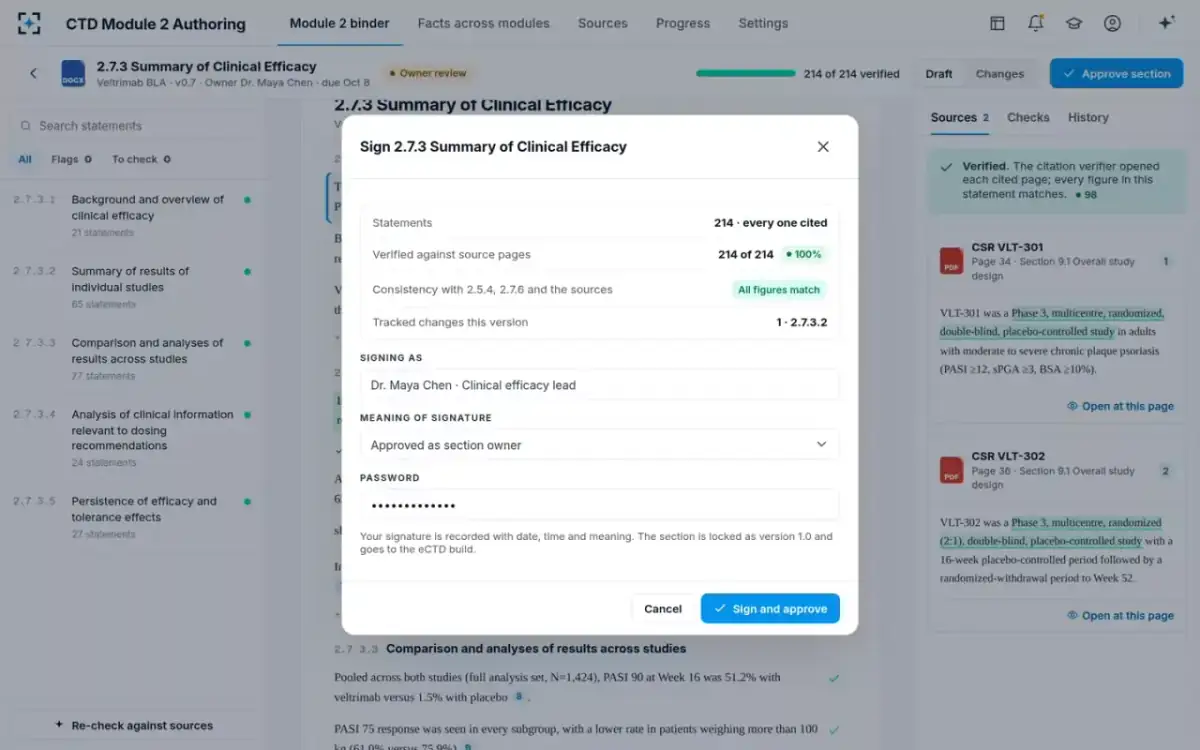
A signature on a Module 2 section is not a formality, and in an electronic system it is regulated. Under 21 CFR Part 11, a signed electronic record has to display the signer's printed name, the date and time, and the meaning of the signature — whether it records review, approval, responsibility or authorship (21 CFR 11.50). The meaning is the part teams most often leave implicit, and it is the part that decides what the signature is evidence of: authorship is not approval, and review is not responsibility.
The second rule is about attachment. Each electronic signature has to be bound to its own record, so that it cannot be lifted out, copied or moved onto another record to falsify it by ordinary means (21 CFR 11.70). In practice that is why a signed section is locked as a version and a later edit opens a new one with a stated reason, rather than being saved over the approved text.
The signature panel, with the meaning the signer selects
What a section owner is actually attesting to
- The section follows the ICH structure for its module
M4Q headings for 2.3, M4S for 2.4 and 2.6, M4E for 2.5 and 2.7, plus the company template.
- Every factual sentence names the page it came from
And the citation points at the version of the report that is current, not the draft it was written from.
- Each cited page says what the sentence says
Same value, same population, same direction of claim — checked against the page, not against the previous draft.
- No statement disagrees with another section
Sample sizes, exposure, doses and limits match wherever else they are stated.
- Every change since the last version is listed
Including the ones proposed by an agent and applied by a person, with who applied each.
- Nothing in it is new
No data, analysis or justification that is not already in the module beneath it.
- The meaning of the signature is stated
Approved as section owner, reviewed, or authored — the three are different attestations.
- The version goes forward, not sideways
The signed text is locked and handed to the electronic build; a later correction opens a new version with its reason.
Where the handoffs break: one author, one report version
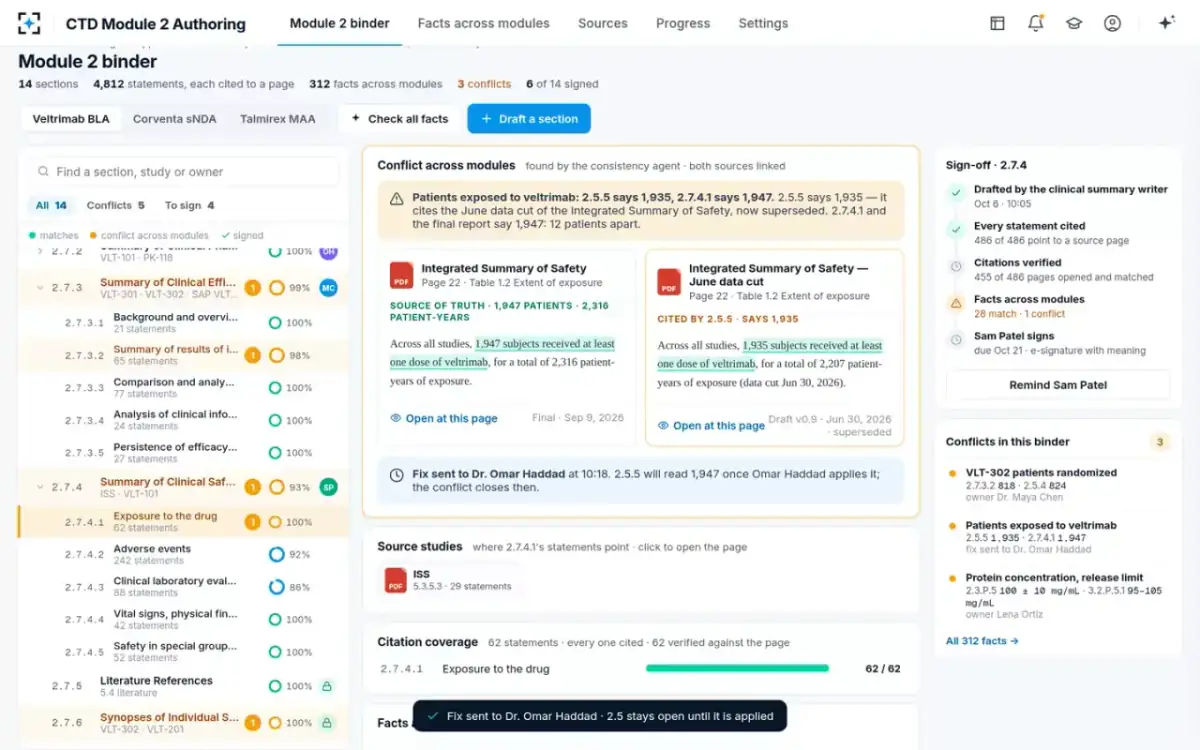
The failure that costs the most time is not a disagreement about science. It is two people who were both right. The clinical scientist updates 2.7.4.1 from the final integrated safety analysis and states 1,947 patients exposed. The clinical lead's 2.5.5, written weeks earlier, says 1,935 from the June data cut it cites, which has since been superseded. Twelve patients apart, two sections, two authors, two versions of one report — and no event anywhere in the dossier that marks the moment the first sentence became stale.
Hand-offs break in this shape because authorship is distributed but the facts are shared. Every mitigation that works is a form of the same move: make the shared facts visible as shared, attach each to the version it was read from, and re-check the other statements whenever one of them changes. The exposure numbers in 2.7.4 are the clearest example, because exposure moves at every data cut while efficacy usually does not.
What changes when agents draft and the owner decides
Agents change the drafting, not the accountability. On the sample dossier six of them do the mechanical half: one reads the study reports page by page and notes each key fact with its page, table or figure; three draft the clinical, nonclinical and quality sections in their ICH order with a citation on every factual sentence; one opens every cited page and checks the value, the population and the wording of the claim; one tracks each shared fact across Modules 2 to 5 and raises a disagreement when two places differ.
One correction, from the page it contradicts to the signature
Agent
Source readerReads the study reports, integrated analyses and quality documents and notes every key fact with its page, table or figure.
Never: infers a number that is not printed
Agent
Section writerDrafts the section in ICH order and the company template, with a citation on every statement that states a fact.
Never: approves its own draft
Agent
Citation verifierOpens each cited page and marks the statement verified, to check, or disagreeing with its source.
Never: edits the text
Agent
Consistency agentCompares each shared fact across Modules 2 to 5 and opens a disagreement with both values, both pages and a proposed wording.
Never: closes a conflict it opened
A person decides
The section ownerApplies, edits or rejects the proposal; a correction to another section is sent to the person who owns that one.
Never: signs while a statement disagrees with its source
A person decides
The section owner, againSigns with name, role and the meaning of the signature; the section locks as a version and goes to the electronic build.
The division holds because it matches the one in the regulations. An agent can establish what a page says; it cannot be responsible for a claim made to an agency. So the proposals stop at the owner, a section with a statement that disagrees with its source cannot be signed at all, and every step — drafted, verified, flagged, applied, signed — stays on the section's history with its time and its actor. The seven sections and how long each may run gives the shape of the module those owners are dividing, and CTD Module 2 Authoring shows the division running on a dossier.
Questions people ask
Who writes the clinical overview?
The Clinical Overview in 2.5 is normally owned by a clinical lead or clinical development physician and drafted by a regulatory medical writer working to them. It is the dossier's argument rather than its evidence — ICH asks it for critical analysis and interpretation, in about thirty pages — so the owner has to be someone who can defend the benefit-risk conclusion in front of an agency, not only someone who can summarise.
Who should own section 2.3, the quality overall summary?
A CMC regulatory lead or quality writer, because 2.3 requires deciding which parameters of the product are critical and quoting registered specifications exactly. Companies that hand 2.3 to a general medical writer usually discover the gap at the first specification: the development limit and the registered limit are both printed in Module 3, and only one of them may be carried up.
Is medical writing part of regulatory affairs?
Sometimes. In many companies regulatory medical writing sits inside regulatory affairs; in others it sits in clinical development or is outsourced, and regulatory affairs reviews what comes back. The reporting line matters less than the split of duties on the dossier: the writer drafts and harmonises, the section owner approves, and the submission lead holds the date and the agency relationship.
What does a regulatory writer do on a dossier?
Drafts the summaries to the ICH structure and the house style, pulls each number from its source document with the page it came from, keeps the same fact reading the same way in every section that states it, and manages the review cycles. The writer owns the text's quality and consistency; the scientific owner of the section owns its claims.
What does a submission lead do?
Assigns section owners, runs the schedule back from the filing date, tracks how far each section is from first draft, keeps the open disagreements attributed to the people who can close them, and compiles the signed sections into the electronic submission. It is the only role whose unit of work is the whole module rather than one section of it.
How many people work on a Module 2?
For a full application, expect five functions and usually six or more named owners: a CMC regulatory lead, a nonclinical lead, one or two clinical leads for the overview and the efficacy summary, a clinical scientist for safety and a submission lead, plus one or more medical writers, a statistician answering questions on the analyses, and quality review. The sample dossier here splits seven ICH sections into fourteen separately managed parts across six owners.