The Summary of Clinical Safety, section 2.7.4 of the Common Technical Document, is where an application states what happened to the people who took the drug. ICH builds it in three levels — the extent of exposure, then the common adverse events and laboratory changes, then the serious ones — and then divides it into seven numbered subsections, from 2.7.4.1 Exposure to the Drug through to the tables in 2.7.4.7. Writing it is less a matter of prose than of population arithmetic: nearly every sentence attaches a number to a group of patients at a point in time, and the group and the point in time have to be the ones the source report used. Botminds' CTD Module 2 Authoring drafts 2.7.4 from the study reports and integrated analyses with a citation on every statement, and re-checks every shared figure against the other sections that state it the moment the section changes.
The structure and the instructions below are ICH M4E(R2)'s. The worked example, the screens and every counted figure attached to them come from a fictional sample dossier — an invented biologic, invented studies and invented people.
ICH's three levels of safety display, and where each one lives in 2.7.4
Level one
How much exposure was there, and does it support a safety conclusion at all?
Doses, durations, numbers of patients and types of patient, so a reader can judge what the database can and cannot show.
2.7.4.1 Exposure to the Drug
Level two
What happened often?
The more common adverse events and changes in laboratory tests, identified, classified and summarised by rate.
2.7.4.2 and 2.7.4.3
Level three
What happened that was serious?
Serious and other significant adverse events, examined for frequency over time — particularly for a drug meant to be taken for years.
2.7.4.2.1 and the narratives
What is in the Summary of Clinical Safety, section 2.7.4?
ICH's own one-line answer is that the section "should be a summary of data relevant to safety in the intended patient population, integrating the results of individual clinical study reports as well as other relevant reports, e.g., the integrated analyses of safety that are routinely submitted in some regions" (ICH M4E(R2)). Three things are packed into that sentence. The population is the intended one, not everybody who was ever dosed. The content is integrated across studies rather than reported study by study. And the integrated analyses that some regions require are an input to 2.7.4, not the same document as 2.7.4.
The register is factual. The safety profile "should be outlined in a detailed, clear, and objective manner, with use of tables and figures" — detailed and objective, with the interpretation of what it means for the benefit-risk balance belonging one level up in the Clinical Overview. A 2.7.4 that argues is a 2.7.4 that will be contradicted by 2.5.
One Summary of Clinical Safety, as the sample dossier counts it
29facts
in 2.7.4 re-checked against 2.5, 2.7 and Module 5 when the section changed
1,947patients
exposed, from the final integrated safety analysis cited by 2.7.4.1
12patients
of difference between what 2.5.5 states and what 2.7.4.1 states
7subsections
from 2.7.4.1 Exposure to the Drug to the 2.7.4.7 tables
ICH's three levels: exposure, common events, serious events
The three levels are worth treating as a drafting order rather than a classification. ICH asks first that "the extent of exposure (dose, duration, number of patients, type of patients) should be examined to determine the degree to which safety can be assessed from the database" — a sentence about the limits of the evidence, placed before any result. Then that "the more common adverse events and changes in laboratory tests should be identified and classified, and their occurrence should be summarised". Then that serious adverse events and other significant events "should be identified and their occurrence should be summarised", examined "for frequency over time, particularly for drugs that may be used chronically".
Writing in that order protects against the most common structural fault in a safety summary, which is a long and careful account of rare events sitting on an exposure base nobody has characterised. If 180 patients took the drug for more than a year, no amount of event tabulation makes the section say anything about year-two risk, and the honest sentence about that belongs at the top.
What goes in 2.7.4.1 Exposure to the Drug
Section 2.7.4.1 has three parts, and they are usually written by different means. The first, 2.7.4.1.1, describes the overall safety evaluation plan and the sources of the safety data, with a tabular listing of every study that contributed safety data — including studies for indications not being sought and ongoing studies, where they add to the analysis. The second, 2.7.4.1.2, is the extent of exposure. The third, 2.7.4.1.3, is the demographic and other characteristics of the exposed population.
One rule in the first part saves a great deal of duplication and is routinely missed: "narrative descriptions of these studies should be provided here, except that narrative descriptions for studies that contributed both efficacy and safety data should be included in Section 2.7.3.2 and cross-referenced here." In a programme where most trials measured both, that means the narratives live in the efficacy summary and 2.7.4.1 points at them. Two sets of narratives for the same trials is not thoroughness; it is two things that can drift apart.
2.7.4.1 to 2.7.4.7, what ICH asks of each, and where the content usually comes from
| Subsection | What it has to carry | Usual source |
|---|---|---|
| 2.7.4.1 Exposure to the Drug | The safety evaluation plan and study listing, the overall extent of exposure, and the demographics of the exposed population. | The integrated safety analysis; the study reports for the listing |
| 2.7.4.2 Adverse Events | Frequency of adverse events in text and tables — every event that began or worsened after treatment started — then the serious and significant ones, with narratives. | Pooled analyses across studies; individual study reports where pooling is not appropriate |
| 2.7.4.3 Clinical Laboratory Evaluations | Changes in patterns of laboratory tests, described at three levels: central tendency, the range and number of abnormal values, and individual clinically important abnormalities. | The integrated safety analysis and study report laboratory sections |
| 2.7.4.4 Vital Signs, Physical Findings and Other Observations | The same treatment for vital signs, physical examination findings and other safety observations. | As above |
| 2.7.4.5 Safety in Special Groups and Situations | Intrinsic factors (age, sex, weight, organ dysfunction, genetic polymorphism), extrinsic factors, interactions, pregnancy and lactation, overdose, abuse, withdrawal and rebound, driving. | Subgroup analyses, clinical pharmacology, and the safety database |
| 2.7.4.6 Post-marketing Data | For an already marketed drug, the post-marketing experience, the estimated number of subjects exposed and how that estimate was made, and a tabulation of serious events reported after marketing. | Periodic safety update reports and the sponsor’s safety database |
| 2.7.4.7 Appendix | The tables summarising the important results from all studies pertinent to safety: exposure by dose and duration, demographic profile, adverse event incidence, withdrawals and deaths. | Built for the drug, its class and its indications |
The exposure table: doses, routes, durations, patients
The exposure table is the single most consequential object in the section, because every rate elsewhere in 2.7.4 has one of its cells as a denominator. ICH asks that it "indicate the numbers of subjects exposed in studies of different types and at various doses, routes, and durations", with durations grouped in a way that suits the drug — the guideline's own example bands being one day or less, two days to a week, a week to a month, a month to six months, six months to a year, and more than a year.
Three decisions have to be made explicit, because each changes the numbers. Which dose is counted for a patient whose dose changed: the maximum received, the one taken longest, or the mean daily dose. Whether the counts are of patients or of patient-years, which are different claims about the same programme. And which population the table uses — ICH's default is broad: "it is assumed that all subjects who were enrolled and received at least one dose of the treatment are included in the safety analysis; if that is not so, an explanation should be provided."
That last sentence is the one worth printing out. A safety table built on a per-protocol or completer population is not wrong, but it is a departure from the assumption the reviewer will make, and the departure has to be said out loud rather than discovered from a footnote in the study report.
Demographics, and the characteristics that change a rate
Section 2.7.4.1.3 asks for an overview of the demographic characteristics of the population that was exposed, and then for a second kind of table: the relevant characteristics of the study population and the numbers of subjects with special characteristics. ICH's list is concrete — severity of disease, hospitalisation, impaired renal function, concomitant illnesses, concomitant use of particular medications, geographical location — and the reason for it is that each of these changes a rate without changing a drug.
Two practical rules follow. Where the mix in the controlled trials differs from the mix in the whole database, present both groupings, because a pooled rate drawn from a different population than the controlled comparison is not comparable to it. And where subjects were excluded from studies — for concomitant illness, severity, or concomitant medication — say so, since the exclusion is the boundary of what the section can claim. ICH also asks for separate demographic tables for every indication, with closely related indications allowed to share one.
Adverse events, laboratory findings, vital signs: 2.7.4.2 to 2.7.4.4
Section 2.7.4.2 is the largest part of most safety summaries, and its definition of what to count is wider than teams expect: "all adverse events occurring or worsening after treatment has begun ('treatment emergent signs and symptoms', those adverse events not seen at baseline and those that worsened even if present at baseline) should be summarised in tables listing each event, the number of subjects in whom the event occurred and the frequency of occurrence". Worsened even if present at baseline — in a chronic disease population, that clause carries a lot of events.
Whether to pool is the other decision. ICH advises presenting by study where the relevant safety data come from one or two studies, or where very different populations were enrolled, and pooling where exposure is spread across many trials; but it warns that "pooling of safety data across studies should be approached with caution because in some cases interpretation can be difficult, and it can obscure real differences", and that where differences are apparent it is more appropriate to present by study. The laboratory section, 2.7.4.3, then asks for each parameter at each time point at three levels — central tendency, the range and the number of subjects with abnormal values, and the individual clinically important abnormalities — with normal ranges given and values in standard international units. Section 2.7.4.4 treats vital signs and physical findings the same way.
Safety in special groups, and post-marketing data
Section 2.7.4.5 is eight short subsections that together answer the question a prescriber will ask: who is this riskier for? Intrinsic factors are the patient's own — age, sex, height, weight, lean body mass, genetic polymorphism, body composition, other illness and organ dysfunction — and ICH asks for paediatric safety to be analysed routinely where the proposed indication occurs in children. Extrinsic factors are the environment around the patient: other drugs, tobacco, alcohol, food habits, the medical setting. Then drug interactions, pregnancy and lactation, overdose, abuse potential, withdrawal and rebound, and effects on the ability to drive or operate machinery.
Section 2.7.4.6 applies only to a drug already marketed somewhere, and asks for more than a narrative: all relevant post-marketing data available to the applicant; the estimated number of subjects exposed, split by indication, dosage, route, duration and geography; a description of how that estimate was made; and a tabulation of serious events reported after marketing. The estimation method is the part most often skipped, and it matters because an exposure denominator derived from kilograms shipped is a different kind of number from one derived from prescriptions.
Why exposure is the number that moves
Efficacy results settle when the database locks. Exposure does not: it grows with every patient who takes another dose in an ongoing extension study, so each data cut produces a new and equally correct count. A safety summary written against the June cut and a clinical overview written against the September one will disagree, and neither author will have done anything wrong.
One sentence, two sections, two data cuts
2.5.5, from the June data cut: 1,935 subjects received at least one dose.
2.7.4.1, from the final analysis: 1,947 patients received at least one dose.
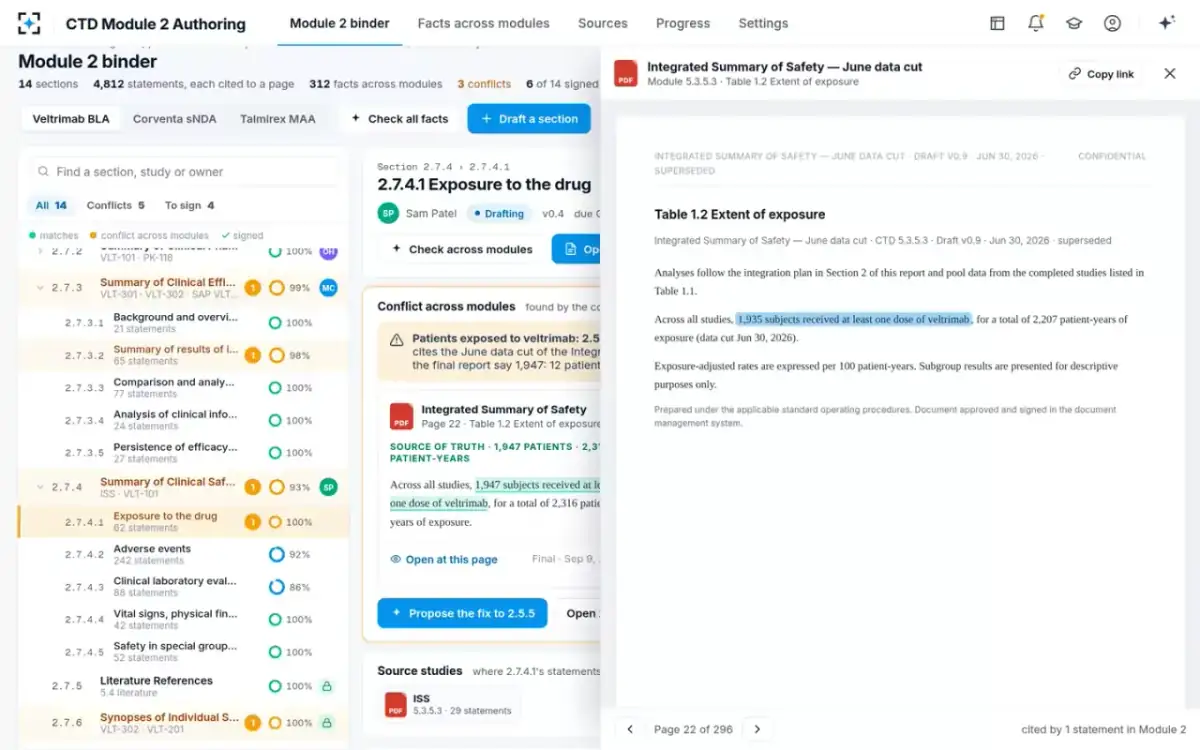
2.5.5, from the June data cut: The integrated safety analysis, draft version 0.9, page 22 — a document now marked superseded.
2.7.4.1, from the final analysis: The final integrated safety analysis, page 22, table 1.2.
2.5.5, from the June data cut: It was right when written, against the report version available at the time.
2.7.4.1, from the final analysis: It is right now, against the report the application will be filed with.
2.5.5, from the June data cut: The owner of 2.5 applies a correction cited to the final report; nobody else may edit the section.
2.7.4.1, from the final analysis: Nothing. The disagreement stays open on the node until 2.5.5 is updated.
The disagreement, with both source pages open
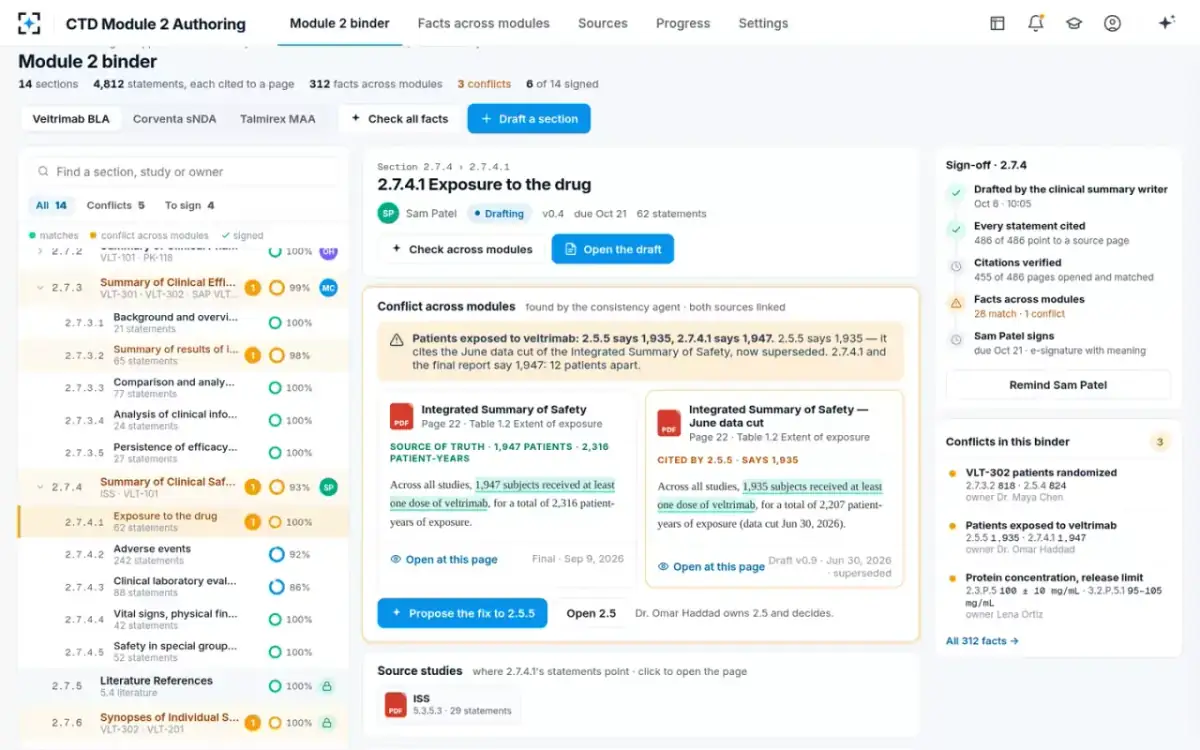
What catches this is not cleverness about safety but bookkeeping about versions. Each shared fact is tracked across Modules 2 to 5 with the document and version it was read from, so when a report is superseded every statement that still cites it is visible.
The superseded page, opened at the passage a statement still cites
Checking 2.7.4 against 2.5.5 before anyone signs
The Clinical Overview's safety section, 2.5.5, is a condensation of 2.7.4, so every number in it is a number in 2.7.4 as well. That makes the pair the easiest consistency check in the whole module and the one most worth running on a schedule: exposure totals, the population each is drawn from, the data cut date behind each count, and the headline event rates.
ICH E3 adds a rule that applies to every derived figure carried into a summary: wherever a table, figure or listing uses estimated or derived values, they should be marked so that nobody can miss them (ICH E3). Patient-years, exposure-adjusted rates and pooled percentages are all derived, and a derived figure that is not marked as derived invites a reviewer to look for it in a source table that does not contain it. CDER's own policy manual counts summaries that do not say where the underlying studies and records can be found among the deficiencies that can make a section unreviewable (CDER MAPP 6025.4, Rev. 1); what else is on that list is worth reading before a filing date.
Before 2.7.4 leaves your desk
- The exposure table names its population
All enrolled subjects who received at least one dose, or a stated and explained departure from that.
- Every count carries its data cut date
Two counts from different cuts are both right and will still contradict each other in print.
- Patients and patient-years are not used interchangeably
And every derived figure — patient-years, exposure-adjusted rates, pooled percentages — is identified as derived.
- The dose basis is stated
Maximum dose received, longest-duration dose or mean daily dose: the table means something different under each.
- Narratives are in one place only
Studies contributing both efficacy and safety data have their narratives in 2.7.3.2, cross-referenced from here.
- Pooling is justified where it is used
And the data are presented by study where the populations or designs differ enough for pooling to hide a real difference.
- The same figures appear in 2.5.5
Exposure, the main rates and the population names, all from the same version of the same report.
- Laboratory values carry their normal ranges
In standard international units, with the pooling method described where centres had different ranges.
A safety draft with the verifier's verdict on each statement
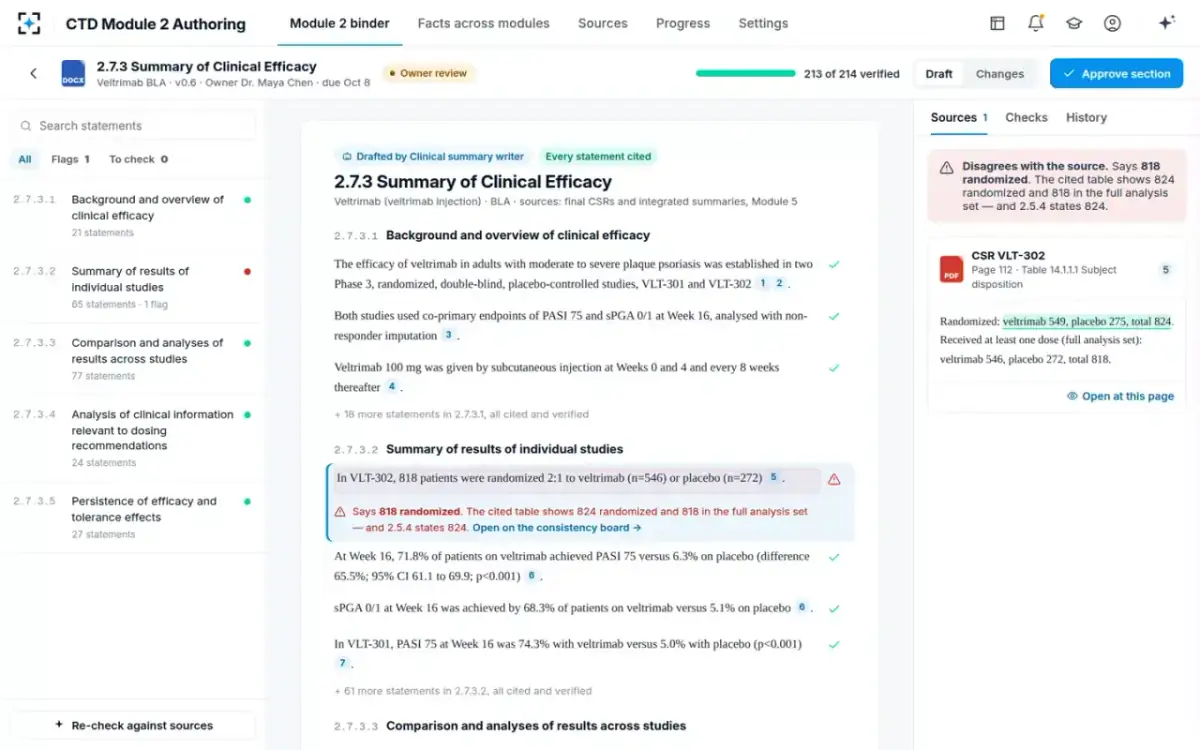
Running the check before the owner reads the section is what makes it cheap: a disagreement found at review costs a review cycle, and the same one found at the filing date costs the date. Who owns 2.7.4, and who owns the section it has to agree with, decides who can act on either. To see the checks on a dossier of your own, start from CTD Module 2 Authoring.
Questions people ask
What is the difference between 2.7.4 and the integrated summary of safety?
They are different documents with different homes. The integrated summary of safety is a United States regulatory requirement for a new drug application and is a detailed integrated analysis, not a summary; the FDA expects it in Module 5. Section 2.7.4 is the ICH summary of safety in Module 2, and it draws on that analysis. Submitting 2.7.4 and assuming it discharges the integrated summary requirement is a known cause of an incomplete application.
Does 2.7.4 need patient narratives?
Yes, but not necessarily inside 2.7.4. ICH asks for narrative descriptions of the safety studies in 2.7.4.1.1, except that narratives for studies which contributed both efficacy and safety data belong in 2.7.3.2 and are cross-referenced from the safety section. Individual patient narratives for deaths, serious adverse events and discontinuations sit in the study reports in Module 5, with the summary pointing at them.
How do you report post-marketing data in 2.7.4?
In 2.7.4.6, and only if the drug is already marketed. ICH asks for all relevant post-marketing data available to the applicant, published and unpublished; an estimate of the number of subjects exposed, split by indication, dosage, route, duration and geography; a description of how that estimate was produced; a tabulation of serious events reported after marketing, including potentially serious interactions; and any findings in subgroups.
How long should the Summary of Clinical Safety be?
ICH gives no figure for 2.7.4 on its own. It anticipates the whole Clinical Summary, 2.7.1 to 2.7.6, running 50 to 400 pages excluding attached tables, and safety is usually its largest part on a chronic-use product. The useful constraint is not length but placement: lengthy tables go to the 2.7.4.7 appendix, and tables embedded in the text are there because they make that passage readable.
Which population is used for the safety analysis?
Unless you say otherwise, every subject who was enrolled and received at least one dose. ICH states that as an assumption and asks for an explanation where it does not hold, which means a safety summary built on completers, or on a per-protocol set, has to declare it in the section rather than leave it to the study report. The same discipline applies to each subgroup table: name the population, then give the number.
What is the difference between 2.7.4 and 2.5.5?
Length and register. Section 2.5.5 is the safety part of the Clinical Overview: a few pages that characterise the safety profile and feed the benefit-risk conclusion. Section 2.7.4 is the factual summary behind it. Every number in 2.5.5 should be traceable to 2.7.4 and from there to a page in Module 5, which is why the two are checked against each other before either is signed.