Regulatory document automation is a heading over three different products. The first automates the container: a template with the ICH M4 headings, numbering, styles and a review workflow. The second automates reuse: content broken into components that can be assembled into several documents and several regions' dossiers. The third automates the sentence: each statement of fact drafted from a source document and carried with the page it rests on. The three fix different problems, and only the third touches the one that actually costs a Module 2 its timeline — a sentence that no longer agrees with the page it cites, found late by a quality reviewer or by the agency. Botminds' CTD Module 2 Authoring is the third kind: six agents draft 2.3 to 2.7 from Modules 3 to 5, open every cited page, and check each fact against the same fact everywhere else in the dossier, for the section owner to apply and sign.
What follows compares the three honestly, including where the first two are the better answer. The guidance is quoted from ICH, the figures come from a fictional sample dossier the solution runs on — the Veltrimab BLA — and the time split is the solution's own estimate, labelled as one.
Three ways to automate Module 2, against the six things a submission team needs
| Template and style guide | Component authoring with reuse | Drafting with a citation on every statement | |
|---|---|---|---|
| First draft of a section | A structured empty document. The writing is still manual. | Assembled from approved components where they exist; new analysis still written by hand. | A complete draft from the source documents, every statement of fact carrying its page. |
| House style and numbering | Solved. This is what templates are for. | Solved, and enforced at component level. | Solved as settings — headings, decimal places, how small p-values are written. |
| Reuse across regions and documents | None beyond copy and paste. | The point of the approach, and nothing else does it as well. | Partial: the facts are reused, the sentences are re-drafted for each document. |
| Agreement with the source page | Not addressed. The template does not know what the number should be. | Not addressed. A component is consistent with itself, not with a study report. | The whole design: every statement is verified against the page it cites. |
| What happens on a new data cut | Someone remembers, or does not. | Every document carrying the component changes together — including the ones that should not. | Affected statements are re-checked and proposed as tracked changes to their owners. |
| What the record shows | Document versions and approvals. | Component versions and where each is used. | Each statement with its source page, each agent step, each person’s action, each signature. |
What is regulatory document automation, and what does it automate?
Regulatory document automation is software that removes manual work from producing submission documents. The useful question is which manual work, because the phrase covers everything from a Word template with locked headings to a system that reads a study report and drafts a cited summary from it.
Sort the work in a Module 2 section into four kinds and the category stops being vague. There is structure: the headings, the order, the numbering, the house style. There is assembly: putting approved content into several documents without retyping it. There is derivation: getting a number out of a 2,140-page study report with its population and its page. And there is agreement: making sure the sentence that states it still matches the page, and matches the three other places the dossier says the same thing.
Templates automate structure. Component authoring automates assembly. Neither touches derivation or agreement, which is where most of the time and all of the risk sit. That is not a criticism of either — it is a statement of what each was built for.
Where the time and the risk actually sit in a Module 2
22weeks
to a first Module 2 draft by hand on the sample sponsor’s last submission, against a five-week design target
2,140pages
in one pivotal study report that the summaries have to cite, page by page
312
facts stated in more than one place across Module 2 and its sources
41
disagreements across modules resolved on one application since August
Three approaches, and what each one is for
A template and a style guide are the cheapest thing that works, and for a small sponsor filing one application they may be all that is justified. They produce a correctly shaped document and they make a reviewer's job easier. What they cannot do is tell a writer that the exposure figure in 2.5.5 came from a data cut that has since been superseded, because the template has no relationship with the study reports at all.
Component authoring breaks content into reusable pieces with their own versions and approvals. Where the same text genuinely has to serve several documents and several regions, nothing else comes close: write once, approve once, assemble many times. It is the right answer for product information, for repeated boilerplate, and for the parts of a dossier that are the same in every market.
Drafting with a citation on every statement is a different proposition. The unit is not a document or a component but a statement of fact and the page it rests on. The system reads the sources, writes down each key fact with its population and its exact page, drafts each section from those facts, then opens every cited page again to confirm that the number, the population and the direction of the claim match. It solves a smaller problem than the other two and solves it completely.
What is structured content authoring in pharma?
Structured content authoring means writing into defined components with defined metadata rather than into a document, so the same content can be assembled, reused, tracked and exchanged. In a dossier it typically shows up as a library of approved components, each versioned, each knowing which documents use it.
The CTD itself is the oldest structured-content idea in the industry, and ICH is explicit about why it exists: "To avoid the need to generate and compile different registration dossiers, this guideline describes a format for the Common Technical Document that will be acceptable in all three regions" (ICH M4(R4)). The structure is deliberately split so reuse is possible at all. "Module 1 is region specific. Modules 2, 3, 4, and 5 are intended to be common for all regions."
That one sentence is the whole case for component authoring and also its boundary. Everything in Modules 2 to 5 is reusable by design; Module 1 is not. Where a market asks for a different presentation of the same evidence, the component library earns its cost. Where the question is whether the evidence is stated correctly, it is silent.
ICH M11 shows where structured content is going, and where it stops
The clearest signal of where regulatory content is heading is ICH M11, the clinical electronic structured harmonised protocol, adopted in November 2025. Its explainer describes the problem in words any Module 2 author will recognise: "Prior to this guideline, there was no globally harmonised standard for protocol format and content, leading to significant variability across sponsors and regions."
M11 answers it with three artefacts: the guideline itself, a protocol template that fixes the structure, and a technical specification that "lists and describes the data elements and technical attributes — such as definitions, conformance requirements and cardinality — that will enable the electronic exchange of protocol contents." The documents cover interventional trials of medicinal products in every phase and therapeutic area, including pharmaceuticals, biologics, vaccines, drug-device combinations and cell or gene therapies.
Two things follow for Module 2. The direction of travel is real: regulators are standardising document content into exchangeable data elements, and a sponsor investing in structured authoring is investing with the current rather than against it. And the limit is equally real: M11 standardises the protocol, not the summaries, and a standard for structure does not make a statement true. ICH says as much about the CTD itself — the guideline "is not intended to indicate what studies are required. It merely indicates an appropriate format for the data that have been acquired."
Reuse is not consistency
The most expensive misunderstanding in this category is treating reuse as if it delivered consistency. It delivers identity, which is a different thing. Two documents containing the same component are identical in that passage. They are consistent only if the component is still right.
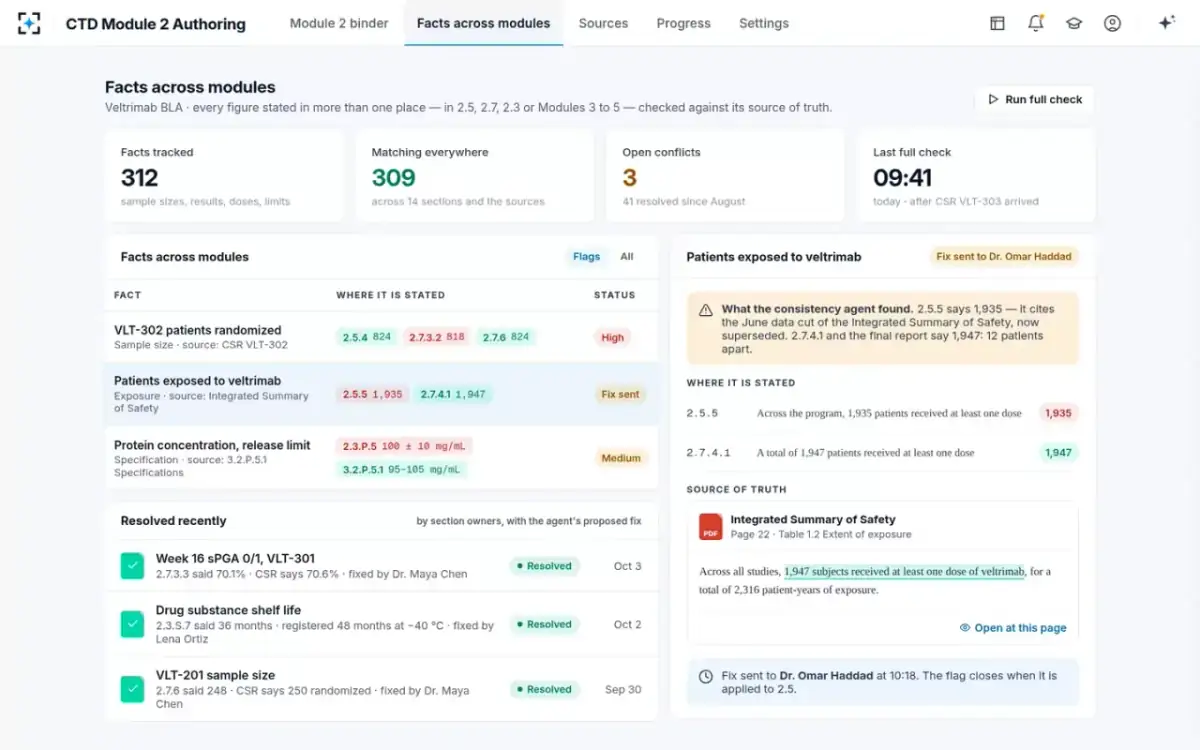
Module 2 is full of facts that are stated in several places on purpose and must agree without being identical. Patients randomized belongs in 2.5.4, 2.7.3.2 and 2.7.6, phrased differently each time because the surrounding argument differs. ICH M4E assumes exactly this and asks for cross-referencing rather than repetition: "The same data and summarisations should generally not be repeated in more than one subsection of Section 2.7.4.2.1. Instead, a summary presentation may be placed in one subsection and cross-referenced as needed in the other."
So the dossier needs the number to agree in several places while the sentences differ. A component library cannot express that, because its unit is text. What can express it is a register of facts: one entry per fact, with its value, its population and its page, and every sentence stating that fact pointing at the entry rather than at another sentence.
What reuses safely across documents and regions, and what has to be re-derived every time
Reuses safely as a component: Design, randomisation, blinding, endpoints as defined in the protocol — stable once the study is final.
Has to be re-derived, and re-checked, every time: Nothing, as long as the protocol version cited is the one the study ran under.
Reuses safely as a component: Nothing. A result belongs to a data cut.
Has to be re-derived, and re-checked, every time: Every sample size, exposure figure, incidence and estimate, each with its population and the page it is printed on.
Reuses safely as a component: The structure of the discussion, and standing language about how events were coded and grouped.
Has to be re-derived, and re-checked, every time: Every number in it, and any claim about consistency across subgroups, which a new cut can overturn.
Reuses safely as a component: The description of the method and the control strategy.
Has to be re-derived, and re-checked, every time: The limit itself, quoted as registered, with its Module 3 page and specification version.
Reuses safely as a component: The whole list. ICH asks that acronyms and abbreviations be defined the first time they are used in each module, which is reuse working as intended.
Has to be re-derived, and re-checked, every time: Nothing.
Reuses safely as a component: Modules 2 to 5 are common to all regions by design, so the body text reuses across markets.
Has to be re-derived, and re-checked, every time: Any figure a region asks to be presented differently, and anything derived from a market-specific population.
What the difference between structured content authoring and AI drafting really is
Stated as a slogan, structured content authoring is about where text lives and AI drafting is about where text comes from. Stated usefully, the difference is in what each one treats as the smallest unit worth governing: a component in the first, a statement and its source page in the second.
That choice decides everything downstream. If the unit is a component, versioning tracks text and the question "where else is this used?" has a precise answer. If the unit is a statement with a citation, versioning tracks facts and the question that has a precise answer is "where else do we say this, and does it still match the page?"
Put another way, a result is data before it is prose. A sample size or an exposure count is a value with a population, a data cut and a page, and the sentence that states it is one presentation of that value among several. A Module 2 that keeps one register of facts treats the sentences as views of the entry: the result is written down once, and every section that states it points back to the same place.
The two approaches also carry different obligations. EMA's reflection paper, which permits AI drafting of regulatory documents under close human supervision, asks for quality review before submission precisely because generative text can be plausible and wrong. A component library needs no such clause — and gets no such check. What each regulator allows, and who may sign, sets out the rule in full.
House style as settings: owners, citation rules, p-values and decimal places
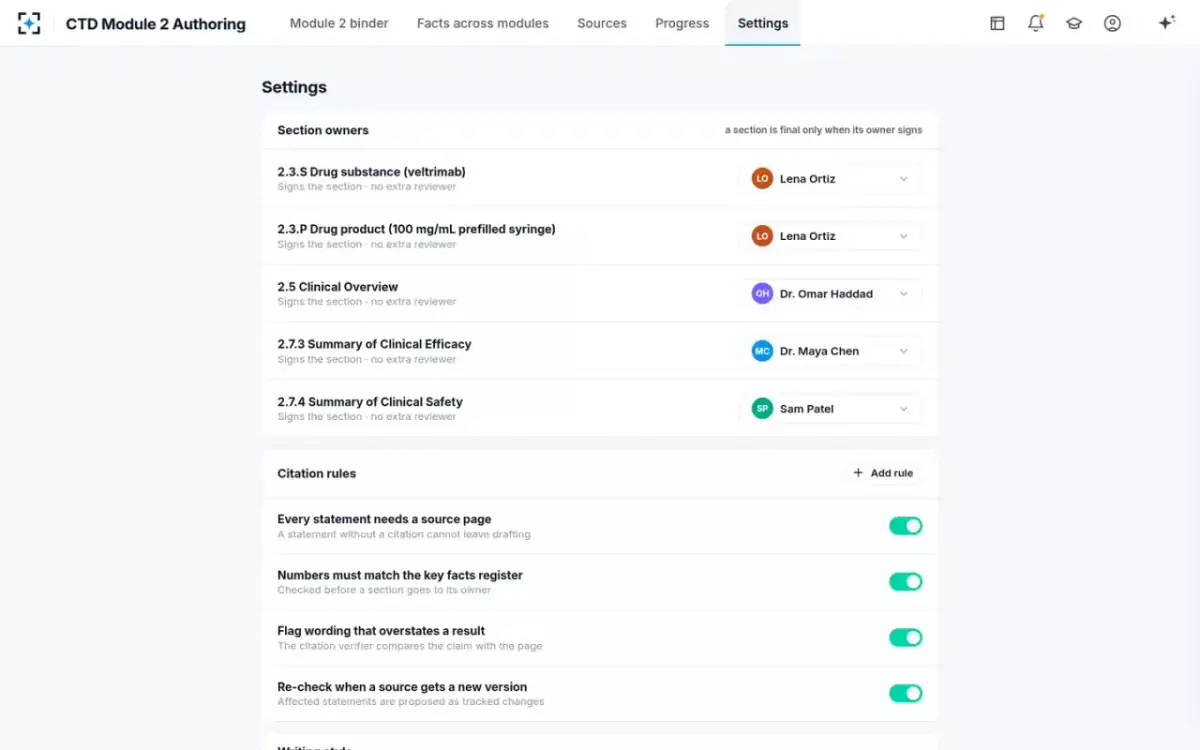
House style belongs in settings, not in a style guide nobody opens
Every regulatory writing group has a style guide, and most of it is a list of decisions: how small p-values are written, how many decimal places results carry, which headings the Module 2 template uses, whether an acronym is redefined in each module. These are not matters of judgement. They are settings that should be applied rather than remembered.
ICH supplies some of them. M4(R4) asks that "acronyms and abbreviations should be defined the first time they are used in each module" — a rule that is trivial to apply mechanically and tedious to apply by hand across fourteen sections written by five people. The company supplies the rest: in the sample dossier, p-values are written as p<0.001, results text carries one decimal place, and the headings follow ICH M4 plus the company style guide.
This is the part of the problem a template genuinely solves, and a good drafting tool should not pretend otherwise. What it adds is that the same settings panel also carries the rules a template cannot enforce: that a statement without a citation cannot leave drafting, that numbers must match the key facts, that wording which overstates a result is flagged, and that a new version of a source triggers a re-check. Style and substance in one place, applied by the same mechanism.
The question to put to every approach: who re-checks the number?
Here is the test that separates the three. A pivotal study report gets a new version in week nine of drafting. Eleven sentences across four sections cite figures that may have changed. Who finds them?
With a template: a person, from memory, at the end. With component authoring: a person, from the component usage list — which tells you where the text went but not whether the number in it is still right, and says nothing at all about the eight sentences that stated the same fact in their own words. With statement-level drafting: the new version is read and indexed page by page, the old one is marked superseded, and the statements that cite affected facts are proposed as tracked changes to the owner of each section.
In the sample dossier that last path produced a concrete, small result: when the interim report for the long-term extension study arrived, 14 statements in 2.7.3.5 and 2.5.4 were flagged for their owners. Not corrected — flagged, with both pages open, for the person who owns the section to decide.
Every fact stated in more than one place, with its source of truth and its status
Where the working days actually go, and what each approach changes
The split below is the solution's own estimate of a first Module 2 draft, in working days. It is worth reading twice, because almost half the work by hand is not writing at all: it is reading the source documents, re-reading each number against them, and reconciling the same figure across sections.
A first Module 2 draft, band by band: where the working days go
By hand, with a template and a style guide — about 110 working days
- Reading Modules 3 to 5 and pulling each fact with its page · 23%
- Drafting 2.5 and 2.7 from the study reports and integrated summaries · 32%
- Drafting 2.3, 2.4 and 2.6 from Modules 3 and 4 · 18%
- Quality control: re-reading every number against its source page · 18%
- Reconciling the same figures across 2.5, 2.7 and 2.3 · 9%
With drafting, verification and cross-checking — about 25 working days
- Reading Modules 3 to 5 and pulling each fact with its page · 12%
- Drafting 2.5 and 2.7 from the study reports and integrated summaries · 32%
- Drafting 2.3, 2.4 and 2.6 from Modules 3 and 4 · 20%
- Quality control: re-reading every number against its source page · 16%
- Reconciling the same figures across 2.5, 2.7 and 2.3 · 20%
Three of the five bands — pulling facts with their pages, re-reading every number against its source, and reconciling the same figure across sections — are half the working days by hand, and none of them is a writing task. A template does not shorten them, because the template has no relationship with the study reports. A component library shortens the third only where the text is literally identical, which in Module 2 it usually is not. Only reading the sources and holding each fact with its page reaches all three, which is why the first band's share falls furthest in the second bar.
What it costs to change approach in the middle of a programme
Changing authoring approach mid-programme is mostly a cost in attention rather than in software. Three things have to be true before it is worth doing.
The source documents have to be final, or their versions have to be known. A statement-level approach is only as good as its knowledge of which report is the source of truth, and a programme where the final study report is still moving will produce flags that are correct and unhelpful. The section owners have to be named, because a system that proposes changes needs somewhere to send them. And the style decisions have to be written down once, which is usually a half-day exercise that no one has done because the style guide is assumed to contain them.
What does not need to change is the template or the component library. In practice the third approach sits alongside them: the template still defines the document, the library still serves the content that genuinely repeats, and the drafting layer owns the statements and their sources. What a document system and a regulatory information management system each do sets out how the pieces divide the work, and the honest answer to a build-or-buy question starts there.
Eight questions that separate a reuse problem from an agreement problem
- When a figure is wrong, is the same text wrong in several places, or different text?
Same text means a reuse problem. Different sentences stating the same fact means an agreement problem, and reuse will not help.
- How did you find the last cross-module disagreement?
If the answer is "a quality reviewer at the end" or "the agency", the problem is agreement.
- Does the same content have to serve several regions?
If yes, component authoring is earning its cost whatever else you do.
- How many of your Module 2 statements could you trace to a page in ten seconds?
This is the measure that predicts how long quality control takes, and no template changes it.
- What happens today when a study report gets a new version?
If nothing systematic happens, that is the gap, and it is not a template gap.
- Is your style guide a document or a set of applied rules?
A document people consult is a reuse-adjacent problem. Rules the system applies are cheap and worth doing first.
- Who owns each section, and can they sign it alone?
Any automation that proposes changes needs a named owner per section. If you cannot list them, start there.
- How much of your drafting time is reading rather than writing?
If more than a third, the derivation band is your cost, and only a source-reading approach touches it.
To see what statement-level drafting looks like on a dossier — the citations, the verdicts and the disagreements across modules — start from CTD Module 2 Authoring.
Questions people ask
Can you automate regulatory writing?
Parts of it, and the parts worth automating are not the ones people expect. Structure and house style automate completely. Reading a 2,140-page study report and writing down each key fact with its population and its page automates well, because it is mechanical and checkable. Drafting prose automates adequately and must be verified. Judgement — what the evidence means, what to claim, what to concede — does not automate, and in a signed dossier it belongs to the named owner of the section.
Can you reuse content between regulatory documents?
Descriptive content, yes: study design, methods, the control strategy, abbreviation lists, and anything common to Modules 2 to 5, which ICH intends to be common across all regions. Derived content, no: every result belongs to a data cut and a population, so a figure reused as text becomes stale silently. The safe rule is that descriptions reuse and derivations are re-derived with their page.
What happens to reused text when the source data changes?
In a component library, every document carrying the component changes together, which is right when the text should be identical everywhere and wrong when one of those documents was describing a different population. In a statement-level approach the sources are re-read, the old version is marked superseded, and the affected statements are proposed as tracked changes to the owner of each section rather than applied. The difference matters most when the change is small enough to be plausible.
How do you keep house style consistent across a dossier?
By making the decisions settings rather than guidance. Headings and order, how small p-values are written, decimal places in results text, and who signs each section are all decided once and applied by the system. A style guide still has a job — the matters of judgement it describes are real — but it should not be the mechanism by which a decimal place is applied across fourteen sections written by five people.
Should you build or buy regulatory document automation?
Templates are always a build, and a small one. Component libraries are usually bought, because the versioning and usage-tracking are the product. Statement-level drafting is a buy for almost everyone, because the expensive part is not the drafting but reading source documents page by page, holding the citations, and re-checking when a version changes — and that is a system, not a script. What you should always keep in-house is the fault list you test it against.
Does automating Module 2 mean fewer medical writers?
In the sample dossier the writers' work changes shape rather than disappearing: the reading and reconciling bands shrink, and the work that remains is the argument, the concessions and the signature. The approach deliberately cannot approve its own drafts, so every section still needs an owner who reads it, applies the changes they accept, and signs with the meaning their signature carries.