An Integrated Summary of Safety is the pooled safety analysis of every relevant study in a marketing application: all exposure, all adverse events, all laboratory findings, analysed together rather than study by study. Despite its name it is not a summary. FDA's guidance on where it belongs says so in one line — the ISE and ISS "are not summaries but rather detailed integrated analyses of all relevant data from the clinical study reports that belong in Module 5" (FDA, April 2009). Section 2.7.4, Summary of Clinical Safety, is the Module 2 document that summarises and cites it. The hard part is not knowing the difference; it is that one exposure figure travels through six hands between a site visit and a sentence in 2.7.4.1, and nothing in a word processor remembers which page it came from. Botminds' CTD Module 2 Authoring drafts the Module 2 summaries with a citation on every statement, opens each cited page to check the number, and tracks the same fact wherever else the dossier states it.
The screens and figures below come from a fictional sample dossier the solution runs on: the Veltrimab BLA, an anti-IL-23p19 antibody for plaque psoriasis, with 14 Module 2 sections and 4,812 cited statements. The regulatory material is quoted from FDA, ICH and the Code of Federal Regulations, linked where it appears.
From a collected observation to one sentence in 2.7.4.1: the six links a number travels
- The collected observation
A dose given, an adverse event recorded on a case report form at a site.
source data
- The tabulation dataset
The observation as submitted data, one row per record, in the study data standard.
Module 5 datasets
- The analysis dataset
The derived, analysis-ready version: populations flagged, exposure days computed, treatment arms assigned.
Module 5 datasets
- The table in the study report
Extent of exposure, by arm, for one study — the first place a reader sees a count.
CSR, section 14
- The integrated analysis
The ISS pools that study with every other, re-derives exposure across the programme and prints one number.
Module 5, 5.3.5.3
- The sentence in Module 2
A writer states the pooled figure in 2.7.4.1, and the same figure has to appear in 2.5.5.
Module 2
What is an Integrated Summary of Safety?
An Integrated Summary of Safety is the integrated safety analysis a US marketing application has to contain. The requirement is in the NDA content regulation, not in ICH: an applicant "must submit an integrated summary of all available information about the safety of the drug product, including pertinent animal data, demonstrated or potential adverse effects of the drug, clinically significant drug/drug interactions, and other safety considerations, such as data from epidemiological studies of related drugs" (21 CFR 314.50(d)(5)(vi)(a)). The same paragraph adds that the safety data must be presented by gender, age and racial subgroups.
Three things follow from the wording. It is about all available information, so it pools studies rather than reporting them one at a time. It is a technical section document, filed under 314.50(d), not part of the application summary under 314.50(c). And it is a US requirement: the ISS and the ISE are not ICH constructs, which is why ICH M4E, the guideline that defines the Module 2 clinical overview and summary, says nothing about where the full reports of either should sit.
In the sample dossier the ISS is a 318-page final report dated 9 September 2026, pooling all studies for 2,316 patient-years of exposure. Eight hundred and twelve Module 2 statements cite it. That ratio is the point: the ISS is the evidence, and Module 2 is what a reviewer reads about it first.
Where does the Integrated Summary of Safety go in the CTD?
The Integrated Summary of Safety goes in Module 5, section 5.3.5.3, Reports of Analyses of Data from More than One Study. FDA's 2009 guidance exists because applicants kept putting it somewhere else. Module 5 "has no space limitation" and is designed for analyses that carry large appendices of tables, figures and datasets; Module 2 is not. "These clinical summary sections are subject to space limitations in the eCTD of about 400 pages," the guidance notes, "whereas a typical ISS alone often can be substantially larger."
There is one narrow exception, and it is worth knowing precisely because it is narrow. Where an application is small — a single study, or a few small ones — sections 2.7.3 and 2.7.4 can be detailed enough to serve as the narrative portion of the ISE or ISS while staying inside Module 2's size expectations. In that case the document is split: the narrative sits in 2.7.3 or 2.7.4, the appendices and datasets in 5.3.5.3, and each location must carry a clear explanation of where the other part is. In the eCTD the narrative is submitted once and referenced from both places as leaf elements.
What each document is, which regulation asks for it, and where CTD Module 2 Authoring expects to find it
| Document | CTD location | US regulation | Size, as FDA describes it |
|---|---|---|---|
| Clinical Overview — 2.5.4 Overview of Efficacy, 2.5.5 Overview of Safety | Module 2 | None; recommended by ICH M4E | About 30 pages, mostly text |
| Clinical Summary — 2.7.3 Summary of Clinical Efficacy, 2.7.4 Summary of Clinical Safety | Module 2 | 21 CFR 314.50(c)(2)(viii) | About 50 to 400 pages |
| Integrated Summary of Effectiveness (ISE) | Module 5, 5.3.5.3 | 21 CFR 314.50(d)(5)(v) | No limit; text plus appendices and datasets |
| Integrated Summary of Safety (ISS) | Module 5, 5.3.5.3 | 21 CFR 314.50(d)(5)(vi) | No limit; "often can be substantially larger" than 400 pages |
The ISS and the ISE: two documents, two regulations
The ISE is the effectiveness twin: "an integrated summary of the data demonstrating substantial evidence of effectiveness for the claimed indications", required by 21 CFR 314.50(d)(5)(v), with effectiveness data presented by gender, age and racial subgroups and any dose modification those subgroups need. The ISS, under 314.50(d)(5)(vi)(a), does the same work for safety. They are separate documents under separate paragraphs of the same regulation, and they sit side by side in 5.3.5.3.
Their Module 2 counterparts are separate too: 2.7.3 Summary of Clinical Efficacy summarises the efficacy evidence, 2.7.4 Summary of Clinical Safety the safety evidence, and the two overviews in 2.5.4 and 2.5.5 argue above both. Neither pair is interchangeable. The clinical summary sections "should contain summarized information derived from the full ISE and ISS", FDA writes — derived from, and therefore citing, rather than being.
For a BLA the arithmetic changes slightly. There is no regulation requiring an ISE or an ISS for a biologics licence application; FDA simply encourages applicants to provide the analyses. Many sponsors file them anyway, because the review needs the pooled analysis whatever the regulation says, and because the same filing problems arise without one.
The assumption that causes a refusal to file
The mistake FDA names is a simple one: applicants assume that because 2.7.3 and 2.7.4 summarise the integrated analyses, filing them satisfies the regulation that asks for the analyses themselves. It does not, and the agency is explicit that the assumption can lead it to determine that an application is incomplete.
The guidance's own worked examples show both ends of it. An applicant files a new molecular entity whose ISS runs to 1,000 pages of text, 3,000 pages of appendices and four gigabytes of datasets, and places all of it in section 2.7.4 with nothing in 5.3.5.3. FDA's verdict on that submission: "This submission is unacceptable. Although the application contains an ISS, it is inappropriately placed in Module 2 and exceeds the suggested size limitation for section 2.7.4." The application fails twice — the analysis is in the wrong module, and because the whole analysis has been pasted into 2.7.4, the application no longer contains a true clinical summary either.
The guidance's acceptable counterpart, a BLA with an ISS of the same size, keeps the full ISS in 5.3.5.3 and summarises its text into a 100-page 2.7.4. The guidance's second example is gentler: an orphan-drug NDA whose ISS text runs to 100 pages can have that text repeated in 2.7.4, because at that size the text can honestly do both jobs.
Size is the signal worth watching during authoring. A 2.7.4 that has grown past a few hundred pages has usually stopped summarising and started reproducing, and the filing checklist Module 2 has to satisfy covers what else a reviewer looks for before the application is accepted.
From an observation to a sentence: the chain a number travels
Take one number from the sample dossier: patients exposed to veltrimab. At a site, a dose is given and recorded. The record becomes a row in a tabulation dataset, then a flagged subject in an analysis dataset with exposure days derived. The study report prints an extent-of-exposure table for that study. The ISS pools that study with the rest and prints a programme-wide count. A writer states the pooled count in 2.7.4.1, and the clinical overview states it again in 2.5.5.
Six links, and the number is re-derived at three of them. ICH M4E tells the writer what to leave behind at the last link: "References or electronic links to the full report of each study should be included in the narratives." That is the minimum. It identifies the document; it does not identify the page, the table, the population or the data cut, which is where disagreements actually live.
In the sample dossier the disagreement was twelve patients. Section 2.7.4.1 said 1,947 patients exposed, citing the final ISS at page 22, Table 1.2. Section 2.5.5 said 1,935, citing the June data cut of the same report — a draft marked superseded. Twelve patients had been enrolled in the long-term extension study after the June cut. Neither sentence was careless; one was simply written against an older page.
Every source the summaries cite, with its version and what still points at it
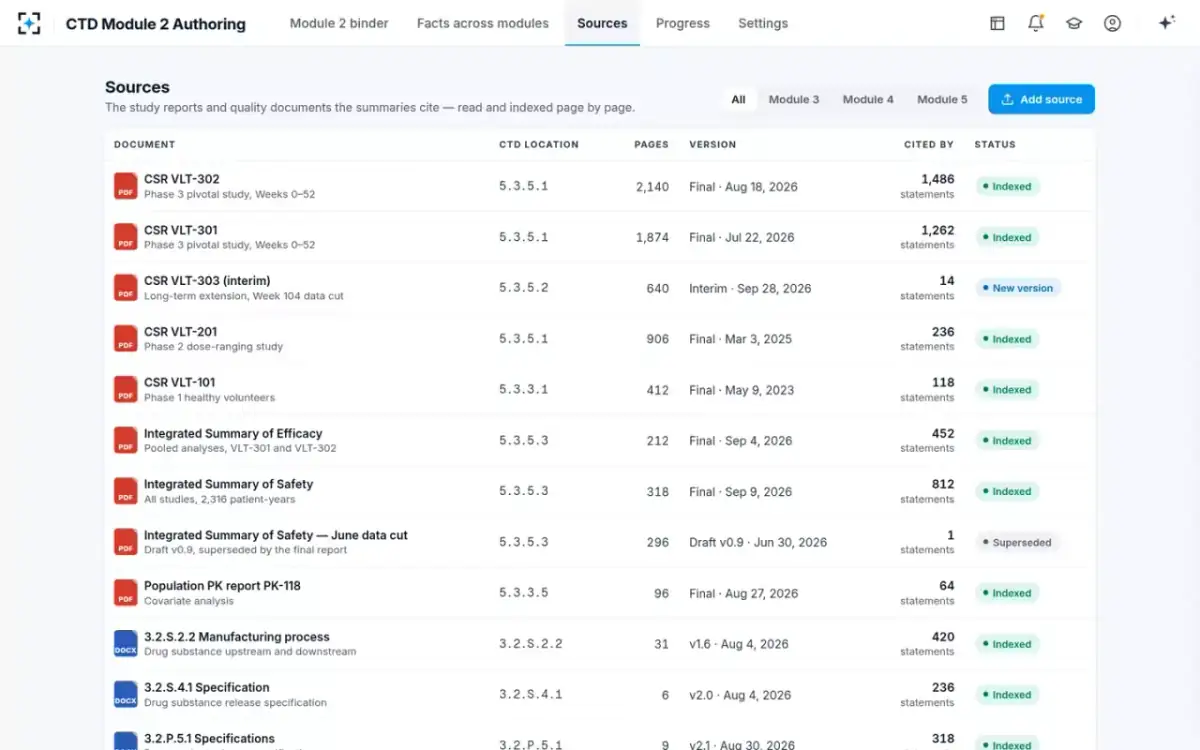
Traceability, as FDA defines it for study data
FDA's Study Data Technical Conformance Guide gives the chain a name and a definition. It opens the section plainly: "An important component of a regulatory review is an understanding of the provenance of the data (e.g., traceability of the sponsor's results back to the CRF data)." Then it defines what traceability buys.
In the guide's terms, traceability is what lets a reviewer see how the analysis results — the tables, listings and figures in a study report — relate to the analysis datasets, the tabulation datasets and the source data underneath them.
The guide lists what a reviewer should be able to do with it, and one item on that list is the one Module 2 authors live with: "Relate counts from tables, listings, and figures in a study report to the underlying data." It also says what happens when the chain breaks: a reviewer who cannot follow the data from collection at the subject level through to the analysis of the whole study may not be able to complete a sound review of the submission. The guide adds, from reviewers' experience, that establishing traceability is one of the most problematic issues associated with any data conversion.
The guide is written about datasets, and its subject is Module 5, not Module 2. But a Module 2 sentence is the last link of the same chain, and the agency's expectation does not stop at the module boundary. A reviewer who cannot get from a count in 2.7.4.1 to a table in the ISS is in exactly the position the guide describes.
Derived and estimated values have to say so
Most of the numbers in a safety summary are derived rather than counted: exposure-adjusted rates, patient-years, incidences with a denominator chosen by the analysis plan. ICH E3, the clinical study report guideline, asks that estimated and derived values in any table, figure or listing be marked conspicuously, and then asks for more than the marking: a detailed explanation of how each value was estimated or derived, and of the assumptions behind it. A summary that carries the value forward without the explanation has carried half the obligation.
Written into a summary, the rule becomes a habit about denominators. "1,947 patients received at least one dose" is a count. "2,316 patient-years of exposure" is a derivation, and the sentence is only checkable if the reader can get to the table that derived it. A statement that gives a rate per 100 patient-years without naming the population it was computed over cannot be verified by opening a page, because there is nothing on the page to compare it with.
This is why the solution's source reader records only printed values and never infers one. A number that is not on a page does not enter the key facts the writers draw from, so it cannot arrive in a draft with a citation that does not support it.
One Module 2, counted: what CTD Module 2 Authoring is holding together
4,812
statements in Module 2, each cited to a page in Modules 3 to 5
312
facts stated in more than one place across the dossier
29
facts in 2.7.4 re-checked against 2.5, 2.7 and Module 5 when the section changed
14
statements flagged for their owners when one interim report arrived
One number, one source of truth, many places
The same fact appears in several Module 2 sections by design. Patients randomized belongs in 2.5.4, in 2.7.3.2 and in 2.7.6. Patients exposed belongs in 2.5.5 and in 2.7.4.1. A specification limit belongs in 2.3.P.5 and in 3.2.P.5.1. Repetition is not the fault; disagreement is.
The discipline that prevents it is to name one source of truth per fact — the final, signed report — and to make every other statement cite it rather than cite each other. In the solution that rule is explicit: facts are checked against the final signed report, never against a topline memo or a superseded draft, and a superseded version stays visible with the statements that still point at it.
Keeping one register of facts, each with its value, its population and its page, is what makes that rule workable at the scale of a dossier: the number is written down once, and every sentence that states it points at that entry rather than at another sentence.
A citation opens the page it rests on, superseded or not
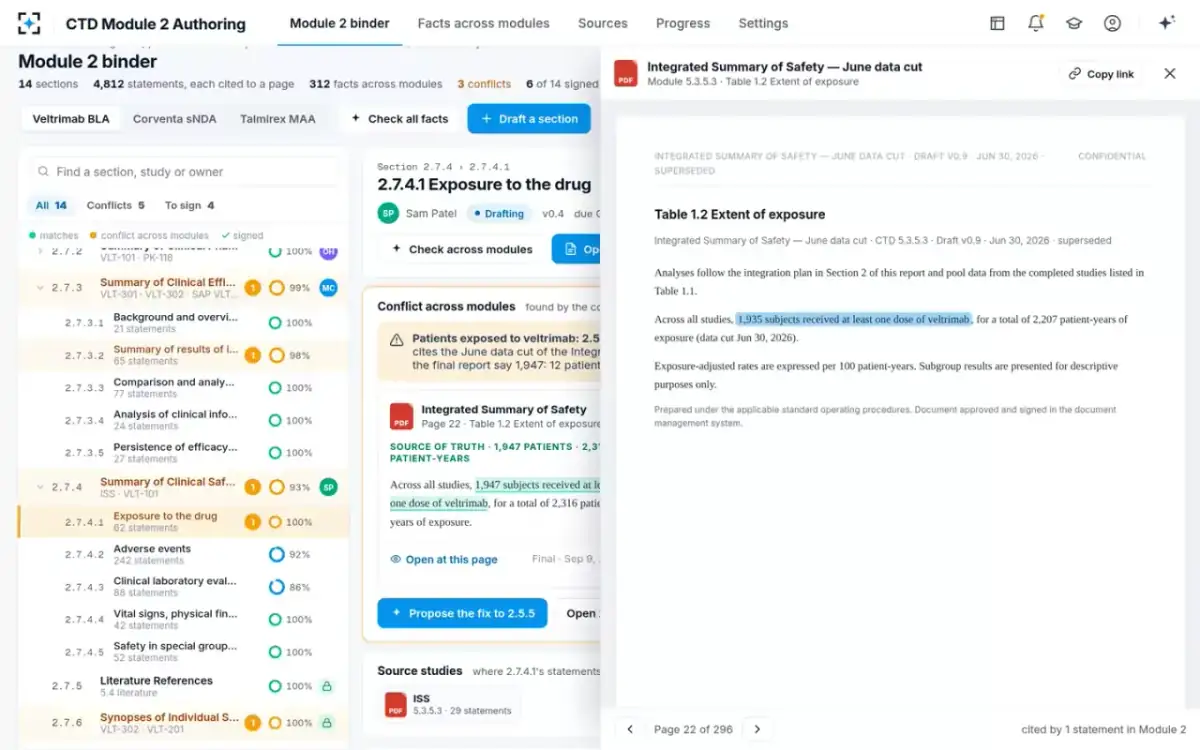
What a new data cut does to the sentences that cite it
A data cut moves, a report gets a new version, and every sentence written against the old one becomes a question. The honest answer is that most of them are still right: a new cut does not change the efficacy result or the dose. The work is finding the few that are not, before a reviewer does.
Done by hand, that means someone re-reads the summaries against the new report at the end of the timeline, which is why, on the sample sponsor's last submission, re-reading every number against its source took close to a fifth of the effort on a first Module 2 draft. Done by the solution, the new version is read and indexed page by page, the old one is marked superseded, and the statements that cite affected facts are proposed as tracked changes for the owner of each section. When the interim report for the long-term extension study arrived in the sample dossier, 14 statements in 2.7.3.5 and 2.5.4 were flagged for their owners that way.
The flag is a proposal, not an edit. A fix to a section someone else owns goes to that owner, and the disagreement stays open on the node until they apply it — the authority line that FDA's and EMA's positions on AI in regulatory submissions both point to.
What has to be recorded for one fact, if a sentence is going to be checkable
- The printed value, exactly as the page prints it
1,947 — not a rounded version, and not a figure recomputed from two others.
- The population it describes
All-treated, safety, full analysis set, randomized. Most cross-module disagreements are a population name, not an arithmetic error.
- The document and its version
Final, interim, or a draft that has since been superseded. The source of truth is the final signed report.
- The page, the table or the figure
Page 22, Table 1.2. A citation to a 318-page document is a reference, not a check.
- The data-cut date
A June cut and a September cut of the same analysis are two different numbers, both correct on their own page.
- Whether the value is counted or derived
Patient-years and exposure-adjusted rates are derived, and ICH E3 asks that derived values be identified conspicuously.
- Everywhere else the dossier states it
A fact stated in 2.5.5 and 2.7.4.1 needs one entry and two pointers, not two independent sentences.
What this looks like in a draft of 2.7.3 or 2.7.4
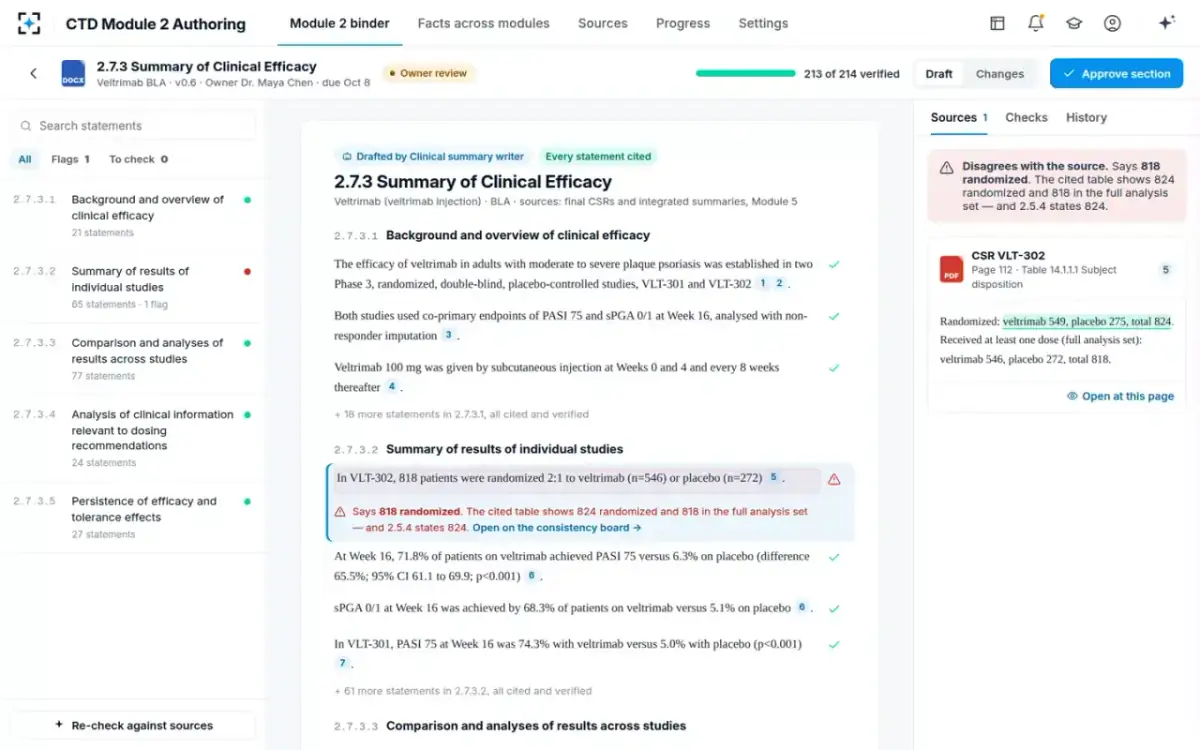
On the sample dossier's 2.7.3, 213 of 214 statements matched the pages they cite. The one that did not read: "In VLT-302, 818 patients were randomized 2:1 to veltrimab (n=546) or placebo (n=272)." The verifier opened CSR VLT-302 at page 112, Table 14.1.1.1, Subject disposition, and found 824 randomized with 818 receiving at least one dose and forming the full analysis set. Section 2.5.4 already said 824.
That is the characteristic shape of a cross-module safety or efficacy disagreement: not a typing error, a population name. The number 818 was real and printed; it was the wrong row. Catching it needs the cited page open next to the sentence, which is also why a section cannot be signed in the solution while any statement disagrees with its source.
2.7.3 in draft: a citation chip on every statement, and the one that disagrees
Where the summaries meet the rest of the dossier — what 2.7.4 owes each of its subsections, and what a reviewer looks for there — is set out in what each subsection of 2.7.4 needs. To see the sources, the citations and the conflicts on one dossier, start from CTD Module 2 Authoring.
Questions people ask
Is the Integrated Summary of Safety the same as 2.7.4?
No. The ISS is a detailed pooled analysis that belongs in Module 5, section 5.3.5.3, and has no page limit. Section 2.7.4, Summary of Clinical Safety, is a Module 2 document that summarises the ISS and cites it, within the eCTD's expectation of about 400 pages for the whole of section 2.7. FDA's 2009 guidance was written because treating the two as one can lead to a refuse-to-file action.
Is an ISS required for a BLA?
Not by regulation. The requirements in 21 CFR 314.50(d)(5)(v) and (vi) apply to new drug applications; there are no corresponding regulations for biologics licence applications, and FDA's guidance says applicants are encouraged to provide the analyses. Many sponsors do, because the integrated analysis is what the clinical review needs and because the same placement and summarisation questions arise either way.
Who writes the Integrated Summary of Safety?
Often the clinical scientist and the biostatistician who own the integrated analyses, with programming support, rather than the medical writer who owns 2.7.4. That split is why the hand-off matters: the ISS authors produce the tables, and the Module 2 author has to state their results without restating the analysis. In the sample dossier the clinical scientist owns 2.7.4 and the clinical lead owns 2.5, so an exposure figure that disagrees between them belongs to two different people.
How do you trace a number in 2.7.4 back to the data?
Through the links FDA names in its Study Data Technical Conformance Guide: analysis results in the study report, to analysis datasets, to tabulation datasets, to source data. For a Module 2 author the practical version is shorter — the sentence cites a page in the ISS or a study report, that page prints the number, and the analysis behind it is reachable from there. A citation to a document rather than a page breaks the chain at its last link.
What happens when a data cut changes?
Every statement written against the old cut becomes a candidate for revision, and most of them are still correct. The work is identifying the few that are not. Marking the old version superseded rather than deleting it is what makes that possible, because the statements that still point at it can be listed; in the sample dossier that list was one statement, in 2.5.5, twelve patients out of date.
Does 2.7.4 have a page limit?
Not a regulatory one. FDA describes section 2.7 as running about 50 to 400 pages and 2.5 as about 30, and treats those as the expectation the eCTD is built around rather than a rule. The number to watch is not the page count but what the pages contain: a 2.7.4 that has grown large has usually started reproducing the ISS instead of summarising it, which is the failure the guidance was written to prevent.