Regulatory document management software stores controlled documents, keeps their versions, routes them for review and records who approved what. It is the system of record for the document as an object. What it does not do — and what a regulatory information management system and an eCTD publishing tool do not do either — is open page 112 of a 2,140-page study report, read the subject disposition table, and write a sentence in 2.7.3.2 that cites it. Four jobs get sold under one heading: store, plan, author, assemble. Most submission teams already own three of them and have never bought the third, because for thirty years authoring has meant a person with a word processor. Botminds' CTD Module 2 Authoring is that third job, and it is built to sit beside the other three rather than replace any of them: it joins at the section, its citations and its signature.
The technical requirements below are quoted from FDA's eCTD Technical Conformance Guide and from ICH M4(R4), linked where they appear. The screens come from a fictional sample dossier, the Veltrimab BLA, as the solution runs on it.
Four jobs under one heading, and the one artefact each hands to the next
Holds every controlled document, its versions, its approvals and its access rules. The system of record for what a document is and who may change it.
Hands on: an approved, versioned document.
Tracks products, registrations, submissions, commitments and deadlines across markets. Knows what is due where, and what has been filed.
Hands on: the submission plan, and the record that it was filed.
Reads the source documents, drafts each section, carries a citation on every statement of fact, and checks each fact against the same fact elsewhere.
Hands on: a signed, locked section whose statements point at pages.
Builds the eCTD sequence, places each document at its heading, applies lifecycle operations, and runs the technical validation before it goes.
Hands on: a valid sequence, ready to send.
What is regulatory document management software?
Regulatory document management software is a controlled repository for the documents a regulated company produces: protocols, study reports, quality documents, submission components, standard operating procedures. Its job is custody. It holds each document, knows its version history, enforces who may read and edit it, routes it through review and approval, and keeps the record of both.
That is a real and necessary job, and it is the reason the category exists. An inspector asking which version of a specification was in force in August gets an answer from this system and from no other. A submission team asking whether the final study report has been approved asks the same place.
What the system holds is a document. What it does not hold is the relationship between a sentence in 2.5.5 and the table on page 22 of the integrated analysis that sentence summarises. That relationship is not a property of either document; it belongs between them, and no repository is designed to carry it.
Four jobs, and the systems that do them: store, plan, author, assemble
The confusion in this category comes from the fact that all four jobs touch the same documents, so all four can reasonably claim to be "regulatory software". They differ in what they are the system of record for.
A document system is the record of the document. A regulatory information management system is the record of the registration: what products exist, in which markets, under which applications, with which commitments and deadlines. A publishing tool is the record of the sequence: what was actually sent to which agency, in which order, with which lifecycle operations. An authoring layer is the record of the statement: what each sentence of fact claims, which page it rests on, and whether it still agrees with that page and with the rest of the dossier.
Buying the fourth does not displace the other three. It fills the gap between a shelf of approved source documents and a set of summaries that have to be true about them.
Four systems against seven things a submission team needs done
| What the team needs | Document system | RIM system | eCTD publishing | Authoring layer |
|---|---|---|---|---|
| Hold the approved version of every source document | Yes — this is the job | No | No | No: it reads what the document system holds |
| Know what is due, where, and what was committed | No | Yes — this is the job | Partly: it knows what was sent | No |
| Draft a Module 2 section from the study reports | No | No | No | Yes — this is the job |
| Confirm a stated figure against the page it cites | No | No | No | Yes: every citation is opened and compared |
| Find the same fact stated differently in another section | No | No | No | Yes: facts are tracked across Modules 2 to 5 |
| Place each document at its eCTD heading and validate | No | No | Yes — this is the job | No: it hands over signed, locked sections |
| Show who approved what, and when | Yes, per document | Yes, per submission | Yes, per sequence | Yes, per statement and per signature |
What a regulatory information management system adds
A regulatory information management system is the planning and registration record. It knows that a product has an application in one market, a variation pending in another and a commitment due in a third; it tracks the submission plan, the health-authority correspondence, and the status of each filing.
For a Module 2 team the value is upstream and downstream of the writing: what is due, which markets need which variant, and what was promised at the end of the last review cycle. It is not an authoring system and does not claim to be. Where it touches the writing is in the plan — which sections exist, who is accountable, what the dates are.
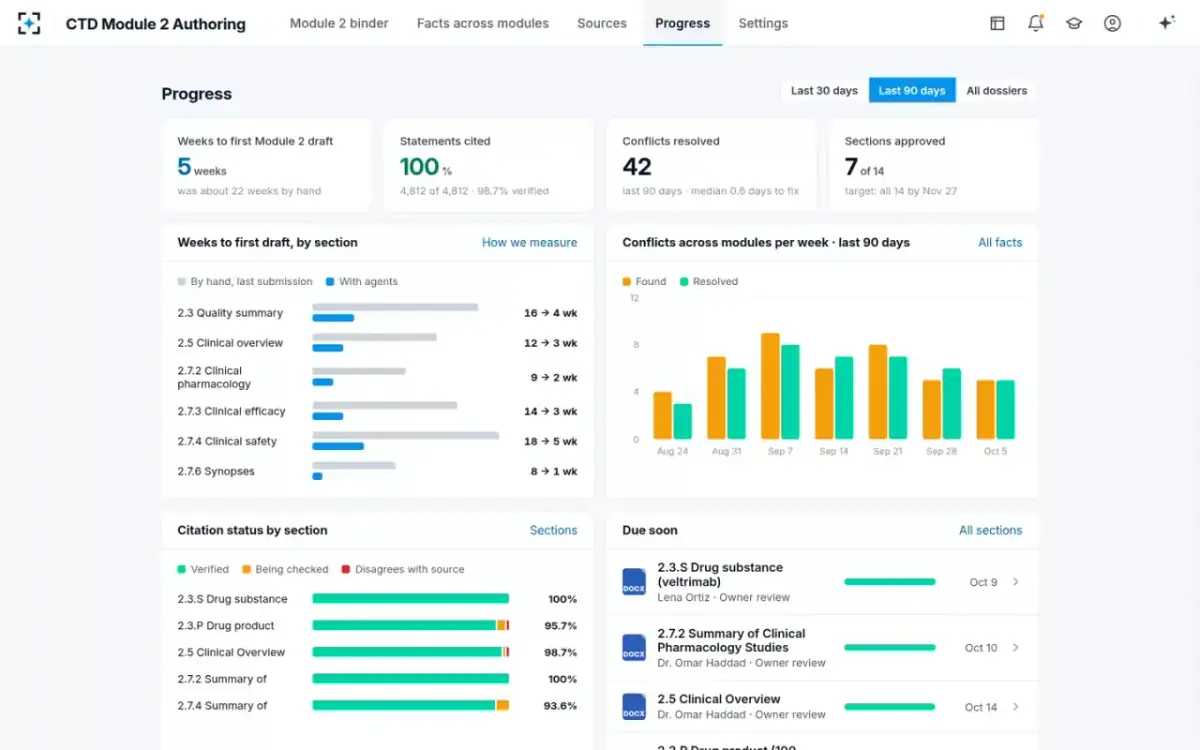
That overlap is also where the join has to be deliberate. A submission plan that says 2.7.4 is due on 21 October and an authoring layer that says 2.7.4 has 62 statements, every one cited, 93.6% verified and one open disagreement are talking about the same section from two directions. Neither should be the other's source of truth; they should agree on the section's identity and nothing else.
What a submission lead sees that a plan alone cannot tell them
What eCTD assembly adds, and what it checks
An eCTD publishing tool takes finished documents and builds the submission: it places each file at its heading in the CTD structure, writes the backbone, applies lifecycle operations across sequences, and runs technical validation before the sequence is sent.
The checks it runs are real and almost entirely structural. FDA's eCTD Technical Conformance Guide is a good measure of their flavour: folder and file paths must not exceed 150 characters and leaf titles are capped at 512; a reviewer's guide belongs in Module 1 section 1.2 and "should provide a high-level overview (with reference links) of the submission's content and should list the location of information in the eCTD"; for the tabular listing of clinical studies, "for ease of review, hyperlinks to the referenced studies in m5 should be provided" (FDA, September 2024).
Every one of those is a statement about where a thing is, not about whether it is true. A sequence can validate cleanly while 2.5.5 states an exposure figure from a superseded data cut. That is not a failing of the publishing tool — it is the boundary of what assembly can check, and it is why an authoring layer has to do its work before the sequence is built rather than during it.
Can a document management system author Module 2?
It can hold the Module 2 documents, version them, route them and record their approvals. It cannot author them, and the reason is structural rather than a matter of features.
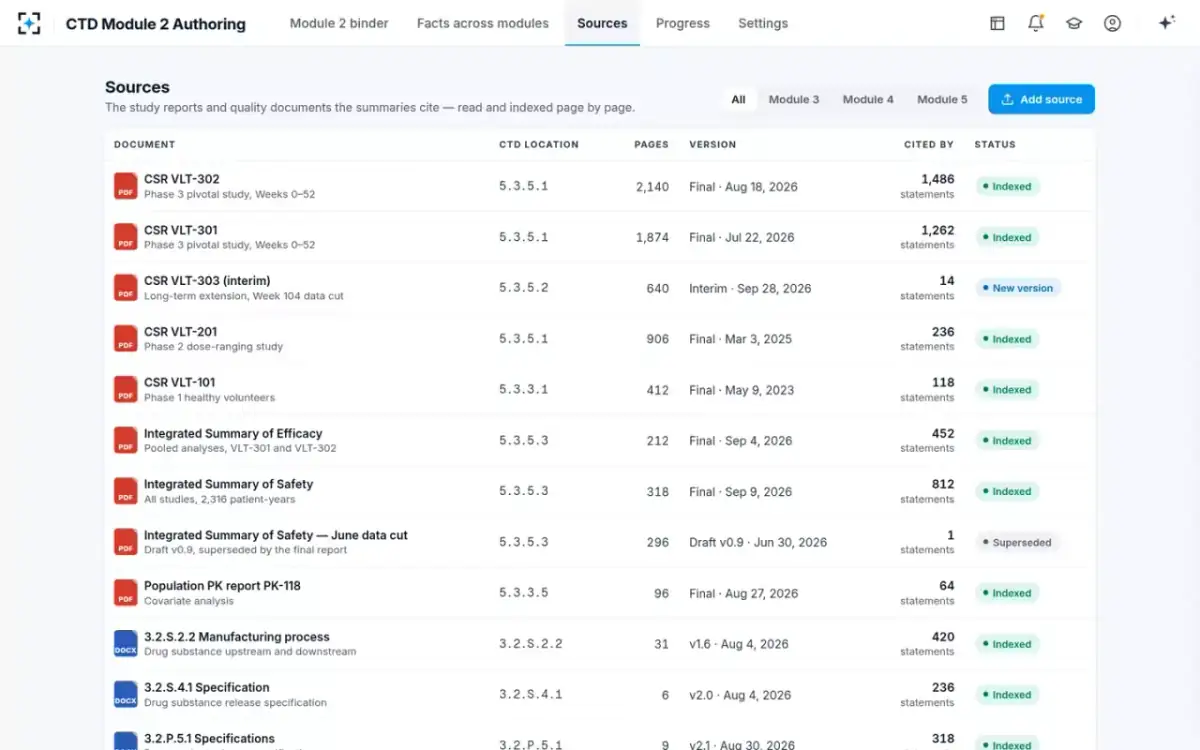
Authoring Module 2 means reading Modules 3 to 5 and writing down what they say. The sample dossier's sources are a 2,140-page pivotal study report, a 1,874-page companion, a 318-page integrated safety analysis, a population pharmacokinetics report and a shelf of quality documents. A document system holds all of them as files. Nothing in it reads page 22 of one, extracts "1,947 subjects received at least one dose", records that it describes the all-treated population at the September data cut, and attaches that to the sentence in 2.7.4.1 that states it.
ICH asks for the result of that work without naming the system that does it. M4(R4) sets the expectation plainly: "Throughout the Common Technical Document, the display of information should be unambiguous and transparent, in order to facilitate the review of the basic data and to help a reviewer become quickly oriented to the application contents." Unambiguous is a property of the content, and it is produced while the content is written.
The sources a Module 2 authoring layer has to read, and what each one is cited by
Where an authoring layer joins: the section, its citations, its signature
A fourth system is only worth owning if its boundaries are clean. This one has three joins and no others.
It joins the document system at the source: it reads approved documents and records their versions, and when a new version is approved the old one is marked superseded rather than deleted, so the statements still citing it can be listed. It joins the planning system at the section: the same fourteen sections, the same owners, the same dates, with the authoring layer supplying the status that a plan cannot compute. And it joins the publishing tool at the signed section: a section that has been approved and locked as a version goes to the eCTD build as a finished document.
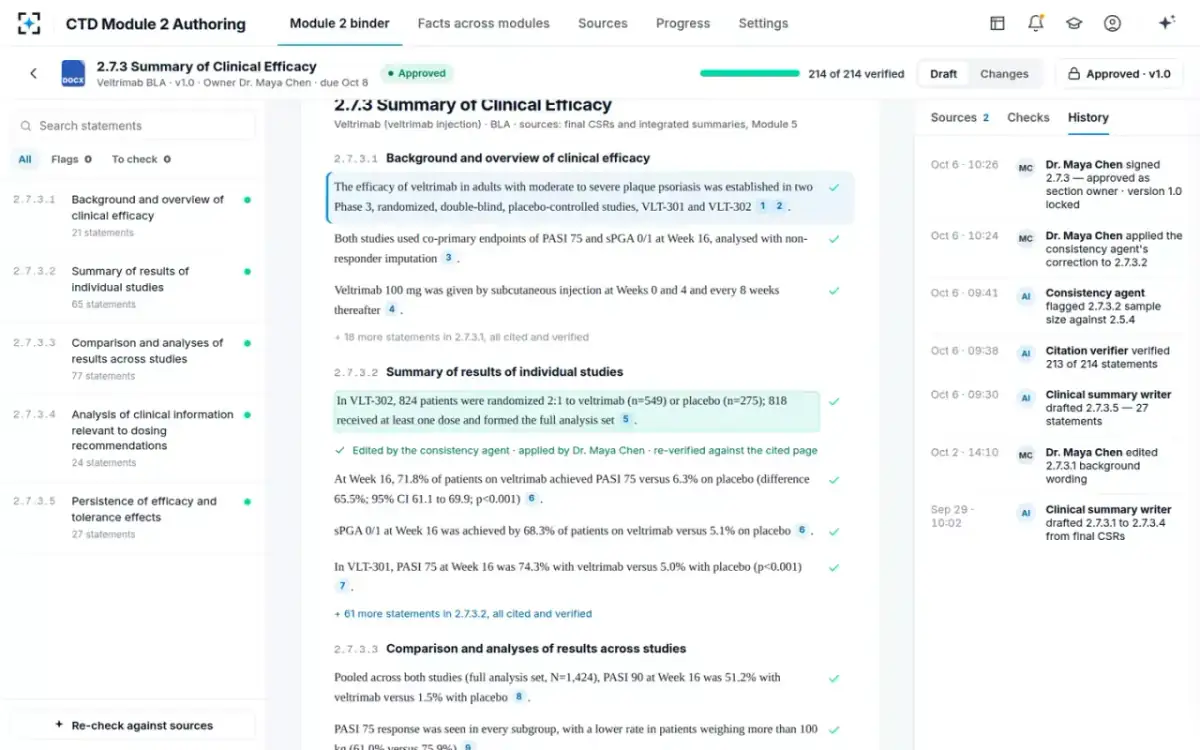
The signature is the cleanest of the three because the regulation already defines what travels with it. Electronic signatures must be linked to their records so that they cannot be excised, copied or otherwise transferred (21 CFR 11.70), which means the handover to a publishing tool is a document plus a signature that belongs to it, not a file that someone says was approved.
The join, in numbers, on one dossier
14
sections in the Module 2 binder, each with a named owner and a date the plan also knows
4,812
statements cited to a page in Modules 3 to 5 — the relationship no other system holds
312
facts stated in more than one place, checked against one source of truth each
1
locked version per signed section, which is what goes to the eCTD build
What you have to bring to start
The list is short, and the exercise of assembling it is worth doing even if no software follows. Three of the five items are usually already written down somewhere; two of them usually are not.
What a Module 2 authoring layer needs from you before it is useful
- The Module 2 template
ICH M4 headings plus whatever your style guide adds. This is the part you almost certainly have.
- The house style decisions, written out
How small p-values are written, decimal places in results text, heading order. Usually scattered across a style guide, a template and three people’s habits.
- A sample of past study reports and summaries
Final versions, with their superseded predecessors where they exist. The superseded ones are not clutter: they are how you test whether a tool can tell the difference.
- The section owners, by name
One person per section who applies changes and signs. If two people own a section, decide which one signs before you start.
- The citation rules you want enforced
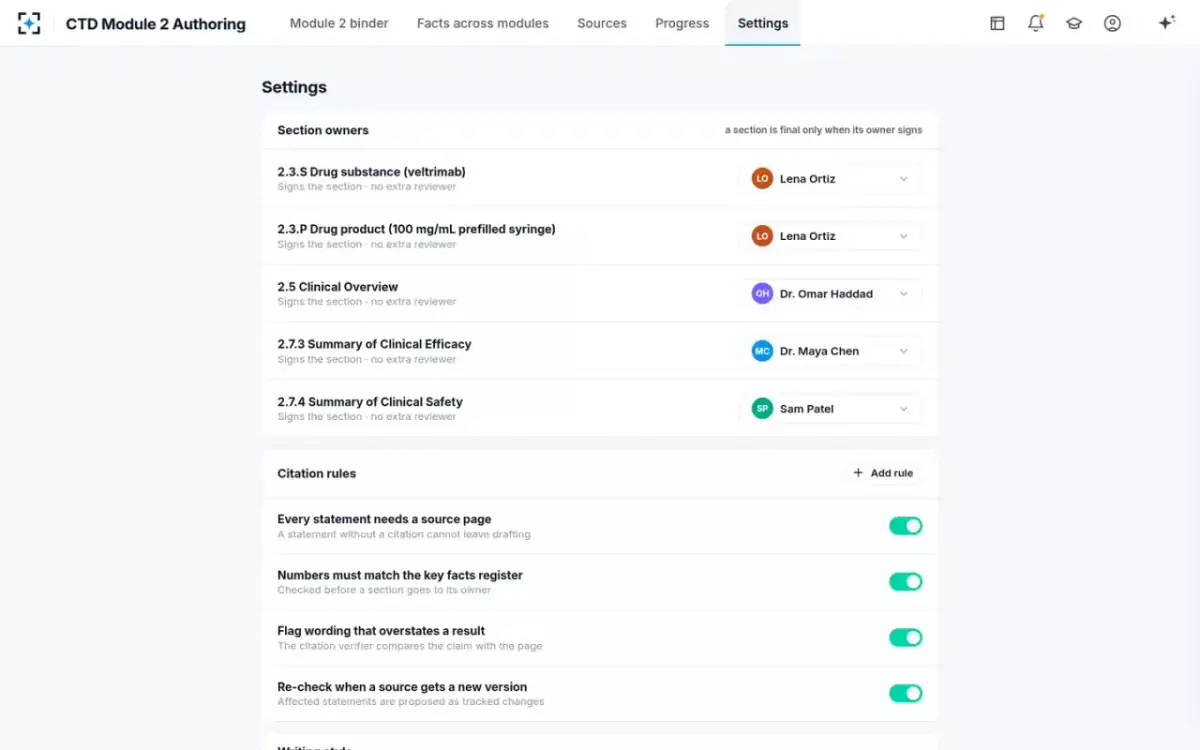
Whether an uncited statement may leave drafting, whether wording that overstates a result is flagged, whether a new source version triggers a re-check.
The same list, once it is configuration rather than a document
Going live on one section, then one dossier
The sensible way in is one section of one application, chosen because it is awkward rather than because it is easy. A section with numbers stated elsewhere in the dossier, sources that were revised during the programme, and an owner who will actually read the output.
What one section proves, and what only a whole dossier can
One section, first: Whether the sources were read correctly: does each statement carry a page, and does the page say what the statement says?
One dossier, after: Whether facts hold across sections written by different people from different source versions.
One section, first: A statement-level list with a verdict against each, and the cited page beside the ones that disagree.
One dossier, after: The list of facts stated in more than one place, and which of them currently match.
One section, first: The section owner, for a day. Nobody else needs to change how they work.
One dossier, after: Every section owner, because a proposed correction goes to whoever owns the section it touches.
One section, first: Anything about cross-module agreement: one section cannot disagree with itself.
One dossier, after: Anything about a live data cut moving, unless one actually moves during the trial.
One section, first: A good result here means the reading is sound. It says nothing about the rest of the dossier.
One dossier, after: A good result here means the dossier agrees with itself today. The real test is the next new report version.
One thing cannot be proved in either stage, and it is worth saying so before a steering group asks. The behaviour that matters most — what happens when a pivotal report is reissued three weeks before filing — only shows itself when a source version actually moves. Until then the evidence is indirect: load a superseded version alongside its final replacement and see whether the tool can tell which statements still point at the wrong one. How to design that kind of test properly is set out in how to test an AI writing tool on your own dossier.
Keeping the systems in step across a lifecycle
An application is not filed once. It is filed, supplemented, varied and renewed, and every sequence has to be consistent with the ones before it. The eCTD's own mechanism for this is the lifecycle operation: a later sequence replaces, appends to or deletes a leaf from an earlier one. FDA's guidance is specific about which to prefer — "the use of 'append' is not common", and sponsors should "consider consolidating the information and using the 'replace' life cycle attribute to update the original file."
That preference has a consequence for the layers below. If the eCTD replaces a document, something upstream has to know which statements inside it changed and which other sections stated the same fact. Otherwise the replacement is clean at the sequence level and wrong at the sentence level, which is precisely the failure the structural checks cannot see.
Three simple rules keep the four systems in step over a lifecycle. The document system owns version identity, and every other system refers to its versions rather than keeping its own. The authoring layer never deletes a superseded source, so the statements that cite it can always be listed. And the publishing tool receives signed, locked sections only — never a draft that someone intends to finalise later. ICH's own formatting requirement, that "every page should be numbered, according to the granularity document" (ICH M4(R4)), is a small instance of the same principle: a citation to a page is only durable if the page numbering is.
FDA's expectation of traceability for study data runs along the same line, from the analysis results in a study report back through the datasets to the collected observations (FDA, Study Data Technical Conformance Guide). The Module 2 sentence is the last link in that chain, and the journey one number makes before it gets there is worth following once.
What the publishing tool should receive: a signed, locked section with its history
To see the sources, the sections and the signatures on one dossier, and how they would join the systems you already run, start from CTD Module 2 Authoring.
Questions people ask
Is a RIM system the same as a document management system?
No, though many suppliers sell both and some products contain both. A document management system is the record of a document: its versions, approvals and access. A regulatory information management system is the record of a registration: products, markets, applications, variations, commitments and dates. One answers "which version of this was approved in August"; the other answers "what do we owe which agency, and by when".
Do you need a document management system to submit an eCTD?
Not technically. An eCTD sequence is built from files, and a publishing tool can assemble one from a well-organised folder. You need a document system for a different reason: to be able to show, later, which version of each source document was approved and in force. That question is asked in inspections rather than at submission, which is why small sponsors sometimes discover the need after the filing rather than before it.
Can a document management system author Module 2?
No. It can hold the Module 2 documents and control their versions, which is a different job. Authoring Module 2 means reading thousands of pages of study, integrated and quality reports and writing summaries whose every statement of fact can be traced to a page in them. No repository reads its own contents, and the relationship between a sentence and the page it rests on is not a property of either document.
What is eCTD publishing software?
Software that assembles finished documents into a valid eCTD sequence: placing each file at its CTD heading, writing the backbone, applying lifecycle operations such as replace across sequences, and running technical validation before the sequence is sent. Its checks are structural — paths, leaf titles, headings, links — and a sequence can validate perfectly while a summary states a figure from a superseded report.
What do you need to start automating Module 2 authoring?
A Module 2 template, your house style decisions written out, a sample of past study reports and summaries including the versions that were later superseded, a named owner for each section, and the citation rules you want applied. The fourth is the item that most often holds a start up, and it is an organisational decision rather than a technical one.
How do you keep an authoring tool and a document system in step?
By giving each one a single job. The document system owns version identity and every other system refers to its versions rather than keeping copies with their own numbering. The authoring layer keeps superseded sources visible rather than removing them, so the statements still citing one can be listed when a replacement arrives. And only signed, locked sections pass to the eCTD build, so a sequence never contains a document someone intended to finish later.