An FDA refuse to file decision says that an application cannot be reviewed as submitted. It is a completeness judgement taken in the first 60 days, before the scientific review begins, and the regulation behind it is short: the agency may refuse to file when an application "is incomplete because it does not on its face contain information required under section 505(b) or section 505(j) of the Federal Food, Drug, and Cosmetic Act and § 314.50 or § 314.94" (21 CFR 314.101(d)(3)). There is no single published checklist with that name, but CDER's own policy manual publishes the deficiency lists its reviewers work from — and four entries on them are not about the science at all, but about whether a reviewer can find the data. That is the part of the risk Module 2 controls, and it is why Botminds' CTD Module 2 Authoring treats a citation to a source page as a condition of a statement existing rather than as a finishing touch.
Every fee, clock and deficiency below is quoted from the FDA's own documents and linked where it appears. The dossier on the screens is fictional sample data, and the before-and-after effort figures attached to it are an estimate and a design target, not a measured customer result.
The four numbers behind a refusal
60days
from receipt to the filing decision
74days
from receipt to the letter that names filing review issues
75%
of the paid application fee refunded when an application is refused for filing
$4.60m
the FY2027 fee for a full application requiring clinical data
What is an FDA refuse to file, and when does it happen?
Filing is a threshold decision, and it comes early. "The FDA will file an NDA within 60 days of receipt or inform the applicant of the refusal to file," says CDER's draft guidance on the subject, adding that it generally makes the same determination for biologics licence applications in the same period (FDA, Refuse to File: NDA and BLA Submissions to CDER, draft guidance, December 2017). Filing means the agency has decided the application is complete enough for a substantive review to begin; refusing to file means it has decided the opposite.
The threshold is wider than missing data. The same guidance explains that an application "may be considered incomplete for purposes of § 314.101(d)(3) based on deficiencies that on their face render an application incomplete, including applications that are unreviewable or inconsistent with statutory or regulatory requirements." Unreviewable is the operative word, and CDER's policy manual makes the reading explicit: "CDER has interpreted § 314.101(d)(3) to permit it to refuse to file an application when required content is presented in a form that makes it inaccessible" (CDER MAPP 6025.4, Rev. 1, effective 23 October 2025).
Content that is present but inaccessible is a presentation problem, and presentation is what Module 2 is.
Is there an FDA refuse to file checklist?
Not under that name, and not as a form an applicant fills in. What exists is better: the deficiency lists in CDER's policy manual, which its reviewers use and which the 2025 revision expanded specifically to include the checklists the agency uses internally to decide whether a submitted application is complete and reviewable. They come in two appendices, and the difference between them is the difference between a phone call and a letter.
Appendix A lists potentially easily correctable deficiencies — a missing financial disclosure form, an incorrectly worded debarment certification, small amounts of information collected but not submitted. Appendix B lists the complex and significant deficiencies that may support a refusal, either alone or, more commonly, in combination with each other or with items from Appendix A. Appendix B has two halves: required sections that are missing altogether, and sections that are present but "incomplete or unable to be reviewed".
The four general deficiencies that are about Module 2, not the science
Under the second half of Appendix B, before any discipline-specific list, sits a short set of general deficiencies. Four entries, and every one of them describes a dossier rather than a drug: the application is unreasonably disorganized; data tabulations or graphical displays are not interpretable, are inadequately labelled, or do not indicate the sources of the data; there is "inadequate annotation in final reports or summaries of where individual studies/clinical investigations or individual data and records can be found"; and there are "problems with hypertext links".
Application is unreasonably disorganized
CDER MAPP 6025.4, Rev. 1, general deficiencies that may support a refuse-to-file action
Read those four together and they describe a single failure: the agency cannot get from a claim to the evidence behind it. A summary that states a number without saying which table it came from, a link that resolves to the wrong document, a pooled figure whose source is not indicated — each of them turns a reviewable dossier into one that has to be excavated. None of them requires a flaw in the trial, the process or the molecule.
There is also a warning for teams who plan to explain the gap rather than close it. The appendix notes that where an applicant offers reasons why a section is not needed, the merits should be considered as part of the filing review, but "the mere presence of an explanation is not adequate to support accepting an incomplete application."
CDER's general deficiencies, as questions to ask of your own Module 2
- Would a reviewer call this application unreasonably disorganized?
Not whether your team can navigate it, but whether someone who has never seen it can find a named section in one move.
- Does every summary say where its data can be found?
The deficiency is inadequate annotation in final reports or summaries of where individual studies or data records can be found — section, page, table.
- Do all the hypertext links resolve, to the right place?
Problems with hypertext links is its own line on the list. Test them after the last sequence is assembled, not before.
- Are tabulations and graphical displays interpretable and labelled?
Including the sources of the data behind them: an unlabelled figure is an unverifiable claim.
- Is every required section actually present?
Appendix B lists them by regulation, from the index and table of contents to the integrated summaries and the statistical evaluation. Omission of an entire section renders the application incomplete.
- Do two sections state the same number differently?
Not on CDER’s list by name, but it is how a reviewer discovers that a summary cannot be relied on — and it is the cheapest thing on this list to check.
- Are you relying on an explanation instead of content?
The merits of an explanation are considered, but its mere presence does not make an incomplete section acceptable.
The first 60 days, and what the filing review reads
The filing review is not a short version of the scientific review. It asks whether the required content is there and whether it can be read, and the documents it reaches for first are the ones that claim to summarise everything else — the table of contents, the summaries, the reviewer's guide, the links. A filing reviewer who can follow a claim from 2.7.4 to a table in a study report in two clicks forms one impression of the application; one who cannot forms another, and forms it in week one.
This is the asymmetry worth planning around. Module 2 is a small fraction of the pages in an application and a large fraction of what gets read in the first 60 days. The same effort spent making a summary traceable buys far more here than it does anywhere else in the dossier.
The Day 74 letter: a review issue is not a refusal
Within the same window there is a second, less alarming communication. Under the PDUFA VII commitments, the FDA identifies and communicates filing review issues in what everyone calls the Day 74 letter: "for applications subject to the Program, the timeline for this communication will be within 74 calendar days from the date of FDA receipt of the original submission" (PDUFA Reauthorization Performance Goals and Procedures, FY2023–2027). The letter also carries the planned review timeline, including the date of the internal mid-cycle review meeting, and preliminary plans on whether to hold an advisory committee meeting.
A Day 74 letter is therefore evidence that the application was filed. It can still contain uncomfortable reading — issues identified during the filing review that the agency expects to pursue — but the clock it sets out is a review clock, not a restart.
What a refuse to file costs: a quarter of the fee, then the whole fee again
The fee consequence is arithmetic rather than judgement. "If an application is refused for filing by the FDA or withdrawn by the applicant without a waiver before filing, FDA will refund 75 percent of the paid application fee" (FDA, Assessing User Fees Under the Prescription Drug User Fee Amendments of 2022). And the resubmission is not free: an application "that was withdrawn before filing or refused for filing, shall be subject to the full application fee when resubmitted or filed over protest".
What a refusal costs in fees, at the fiscal year 2027 rate
Fee paid with the original application
$4,600,753
The FY2027 rate for a full application requiring clinical data.
Federal Register, 91 FR 48160
Refunded on the refusal
75% × $4,600,753 = $3,450,565
The statutory refund where an application is refused for filing.
FDA user fee guidance
Kept by the agency
$4,600,753 − $3,450,565 = $1,150,188
A quarter of the fee, spent on an application that was never reviewed.
The arithmetic of the two lines above
Full fee again on resubmission
$4,600,753
A refused application is subject to the full application fee when resubmitted. The rate is the one in force in that fiscal year.
FDA user fee guidance
A smaller application pays proportionally the same price: the FY2027 notice sets the fee at $2,300,376 for an application not requiring clinical data, and the 75 per cent refund applies the same way.
The clock: 60 days, then ten months
The time cost is larger than the fee cost and harder to recover. For applications filed under the programme, "the PDUFA review clock will begin at the conclusion of the 60-day filing review period that begins on the date of FDA receipt of the original submission", and the FDA's goal is to review and act on 90 per cent of standard new molecular entity applications within ten months of that 60-day filing date. A refusal resets both: the corrected application is a new original submission, with its own 60 days and its own ten months after them.
One application, filed at the first attempt and after a refusal
- Filing review60 days
- Review to the goal date10 months
- First filing review60 days
- Correcting and resubmittingvaries
- Filing review again60 days
- Review to the goal date10 months
The one assumption that causes an avoidable refusal
Appendix B's first half lists the sections that are required by regulation, and notes that omission of an entire section renders the application incomplete. Two of the entries on that list are easy to believe you have already satisfied: the integrated summary of effectiveness, required by 21 CFR 314.50(d)(5)(v), and the integrated summary of safety, required by 21 CFR 314.50(d)(5)(vi).
Both have close namesakes in Module 2 — the Summary of Clinical Efficacy in 2.7.3 and the Summary of Clinical Safety in 2.7.4 — and the two pairs are not the same documents. The Module 2 sections are summaries, written to ICH length expectations; the integrated summaries required by the regulation are detailed analyses across the whole programme, and the FDA expects them with the clinical study reports in Module 5. A team that files 2.7.3 and 2.7.4 and treats the regulatory requirement as met has omitted a required section without noticing. What 2.7.4 actually contains is the easiest way to see the difference in scope.
A pre-submission pass over Module 2's numbers
The defence against all of this is dull and cheap: read every number in Module 2 against the page it cites, and read every fact stated in two places against the other place. The reason it does not happen reliably is that it lands at the end of the timeline, when the date is closest and the people are most committed elsewhere.
Where a first Module 2 draft's working days go
By hand — about 22 weeks on the sample sponsor’s last submission
- Reading Modules 3 to 5 and pulling each fact with its page · 23%
- Drafting 2.5 and 2.7 · 32%
- Drafting 2.3, 2.4 and 2.6 · 18%
- Re-reading every number against its source page · 18%
- Reconciling figures across 2.5, 2.7 and 2.3 · 9%
With the solution — the 5-week design target
- Reading Modules 3 to 5 and pulling each fact with its page · 12%
- Drafting 2.5 and 2.7 · 32%
- Drafting 2.3, 2.4 and 2.6 · 20%
- Re-reading every number against its source page · 16%
- Reconciling figures across 2.5, 2.7 and 2.3 · 20%
The shape of the second lane is the point. Checking does not disappear; it becomes a larger share of a much smaller number of days, because the reading and the page-finding that used to surround it are done as the draft is written. On the fictional dossier that has a visible output: 41 disagreements across modules resolved on one application since August, and three still open with the people who own the sections they affect.
What is due, and where the disagreements still are
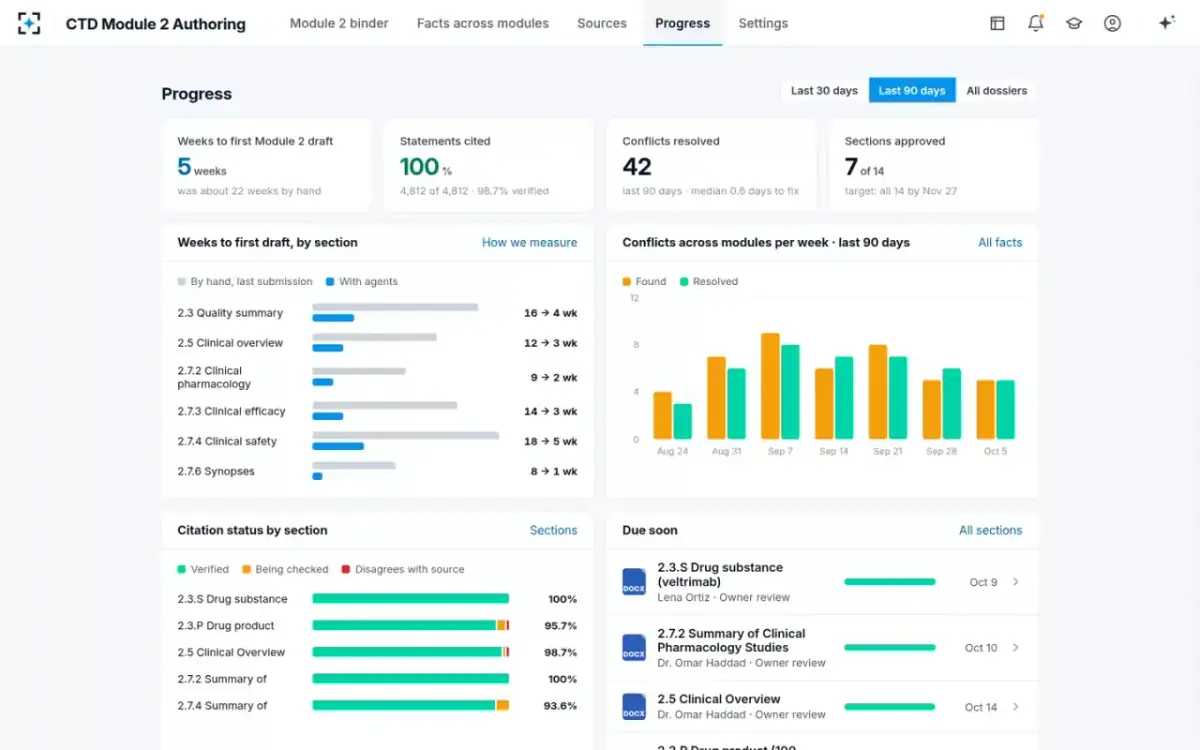
Running the pass twice — once when the sections are drafted and once after the last source document goes final — catches two different classes of error: the value that was never right, and the value that stopped being right. The second class is the one that survives a careful first review, because nothing about the sentence changed.
The sign-off state of every section, in CTD Module 2 Authoring
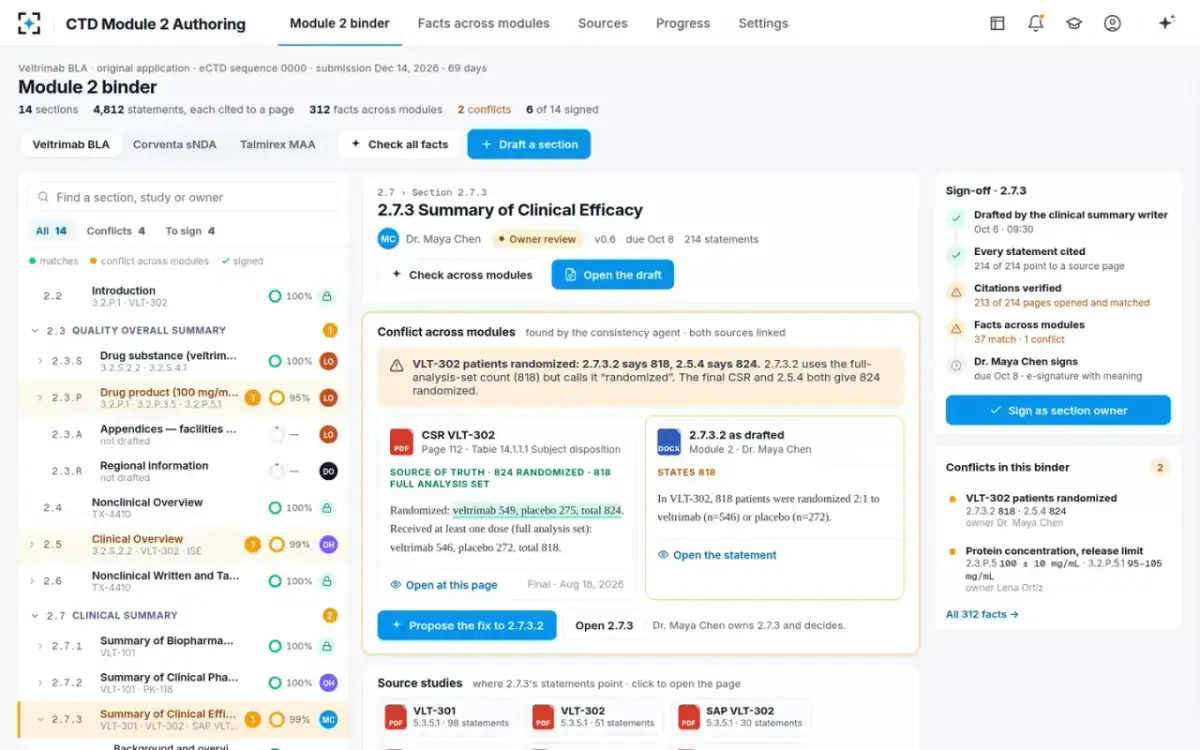
None of this makes an application good. It removes a category of reasons for an application not to be read, which is a smaller claim and a more useful one: the science is argued over for months, while a refusal is decided in sixty days on whether a reviewer could find things. The seven sections and what each has to carry sets out the structure the filing review reads first, and CTD Module 2 Authoring shows the citations and the disagreements on a dossier.
Questions people ask
What is a refuse to file letter from the FDA?
The notice an applicant receives, within 60 days of the agency receiving an application, saying that it will not be filed because it is incomplete on its face. It is not a scientific rejection and it is not a complete response letter, which comes at the end of a review cycle. The application can be corrected and resubmitted, or filed over protest.
Do you get the user fee back if the FDA refuses to file?
Three quarters of it. The FDA refunds 75 per cent of the paid application fee where an application is refused for filing, or withdrawn without a waiver before filing. The remaining quarter is not refunded, and the resubmitted application is subject to the full application fee again, at the rate in force in the fiscal year it is resubmitted.
What is a Day 74 letter?
A communication sent within 74 calendar days of the FDA receiving an application, identifying filing review issues and setting out the planned review timeline, including the planned date for the internal mid-cycle review meeting and preliminary plans on an advisory committee meeting. Receiving one means the application was filed; the issues it names are review issues, not a refusal.
Can inconsistent data cause a refuse to file?
Inconsistency is not a listed deficiency on its own, but what it produces is. CDER's general deficiency list covers an application that is unreasonably disorganized, tabulations that do not indicate the sources of the data, summaries that do not say where the underlying studies and records can be found, and broken hypertext links. Two sections stating a different patient count is how a reviewer discovers that the summaries cannot be relied on.
What is the difference between a refuse to file and a review issue?
Timing and consequence. A refusal happens in the first 60 days and means the review never starts; the clock restarts when a corrected application is resubmitted. A review issue arises during the review and is handled inside the cycle, through information requests, the mid-cycle communication and the late-cycle meeting, ending in an action at the goal date. An application filed over protest after a refusal loses access to several of those features.
How long does the FDA have to decide to file?
Sixty days from receipt of the original submission. For a new molecular entity application filed under the programme, the review clock then begins at the end of that 60-day period, and the FDA's goal is to act on 90 per cent of standard applications within ten months of the 60-day filing date, or six months for priority applications.