CTD Module 2 is the summary layer of a Common Technical Document: seven sections, numbered 2.1 to 2.7, that condense the quality, nonclinical and clinical modules into something a reviewer can read before opening a study report. ICH M4(R4) is blunt about the count — "Module 2 should contain 7 sections in the following order" (ICH M4(R4)) — and each of those seven summarises a different body of data, under its own length guidance, usually with a different owner. That is why Module 2 is hard: nothing in it is new work, every sentence in it belongs to a page somewhere in Modules 3 to 5, and five desks have to agree on the same numbers by one date. Botminds' CTD Module 2 Authoring is built for exactly that shape — agents draft each section from the source documents with a citation on every statement, open every cited page to check it, and flag each fact that two sections state differently, leaving the decision and the signature with the named section owner.
The sample dossier used for the screens and the counted figures on this page is fictional: a biologic called veltrimab, its studies, its people and its numbers are invented characters and sample data. The rules, page limits and quoted sentences come from the ICH guidelines themselves, linked where they appear.
Module 2, section by section: what it summarises, how long ICH says it may run, who owns it
| Section | What it summarises | ICH length guidance | Who usually owns it |
|---|---|---|---|
| 2.1 CTD Table of Contents | The entries of Modules 2 to 5 | No page guidance. "The TOC is only called for in the paper version of the CTD; there is no entry needed for the eCTD." | Submission lead |
| 2.2 CTD Introduction | The pharmaceutical: class, mode of action, proposed use | "In general, the Introduction should not exceed one page." | Submission lead |
| 2.3 Quality Overall Summary | Module 3, heading for heading | Normally no more than 40 pages of text, with tables and figures not counted; up to about 80 for biotech products and more complex processes. | CMC regulatory lead |
| 2.4 Nonclinical Overview | Module 4, as an integrated assessment | "In general, the Nonclinical Overview should not exceed about 30 pages." | Nonclinical lead |
| 2.5 Clinical Overview | Module 5 and 2.7, as a critical analysis | "should generally be a relatively short document (about 30 pages)" | Clinical lead |
| 2.6 Nonclinical Written and Tabulated Summaries | The Module 4 study reports in seven parts | The three written summaries together "in general not exceed 100-150 pages"; the tabulated summaries sit outside that. | Nonclinical lead and writer |
| 2.7 Clinical Summary | Module 5 study reports and the integrated analyses | "excluding attached tables … usually be in the range of 50 to 400 pages" | Clinical lead, clinical scientist, writer |
What is CTD Module 2, and what is it for?
Module 2 exists because the modules beneath it are unreadable at speed. A biologics application can run to tens of thousands of pages, and no assessor starts there. Module 2 gives the assessor an orientation: what the product is, what the quality data show, what the animals showed, what the trials showed, and where in the dossier to go next. ICH M4(R4) puts Module 2 second of five, after the region-specific Module 1, and makes it common to all ICH regions, so the same seven sections go to the FDA, the EMA, Health Canada, the PMDA and every other authority that accepts the CTD.
The functional point is that Module 2 carries no data of its own. ICH tells authors that the Quality Overall Summary should not include anything that is not already in Module 3 or elsewhere in the dossier (ICH M4Q(R1)), and describes the Clinical Summary as "intended to provide a detailed, factual summarisation of all of the clinical information in the Common Technical Document" (ICH M4E(R2)). Every number in Module 2 is therefore a copy of a number printed somewhere else, which is both what makes it quick to draft and what makes it fragile: a copy has no way of knowing that its original has moved.
One Module 2 on the sample dossier, counted
4,812statements
in Module 2, each citing a page in Module 3, 4 or 5
312
facts stated in more than one place across the modules
14nodes
in the binder, because several sections are managed as separate parts
2,140pages
in one pivotal study report that the summaries cite
The seven sections of Module 2, in order
ICH lists them as the CTD Table of Contents, the CTD Introduction, the Quality Overall Summary, the Nonclinical Overview, the Clinical Overview, the Nonclinical Written and Tabulated Summaries, and the Clinical Summary. Read in that order the list looks odd, because the two overviews come before the two detailed summaries they rest on. That is deliberate: the overviews are what an assessor reads first, and the summaries are what the assessor reads when the overview makes a claim worth checking.
Two sections are administrative. 2.1 is the table of contents for Modules 2 to 5, and in an electronic submission the software builds it from the submission's own structure rather than from a document you write. 2.2 is one page introducing the product, and ICH means one page: "In general, the Introduction should not exceed one page."
The other five are the writing. They divide neatly by discipline — quality in 2.3, nonclinical in 2.4 and 2.6, clinical in 2.5 and 2.7 — and within each discipline by register: an overview that argues, and a summary that reports.
Where each Module 2 section gets its facts
2.1 CTD Table of Contents
Modules 2 to 5The entries of everything that follows.
2.2 CTD Introduction
The product itselfPharmacologic class, mode of action, proposed clinical use.
2.3 Quality Overall Summary
Module 3 — 3.2.S, 3.2.P, 3.2.A, 3.2.RHeading for heading, in Module 3’s own order.
2.4 Nonclinical Overview
Module 4, and 2.6The integrated nonclinical assessment.
2.5 Clinical Overview
Module 5, and 2.7The critical analysis, not a second summary.
2.6 Nonclinical Written and Tabulated Summaries
Module 4 study reportsPharmacology, pharmacokinetics, toxicology.
2.7 Clinical Summary
Module 5 study reports and integrated analysesFactual, study by study and across studies.
2.3 Quality Overall Summary: Module 3 in forty pages
The Quality Overall Summary "follows the scope and the outline of the Body of Data in Module 3", which means its headings are Module 3's headings with a 2.3 in front: 2.3.S.1 to 2.3.S.7 for the drug substance, 2.3.P.1 to 2.3.P.8 for the drug product, then 2.3.A for appendices and 2.3.R for regional information. Under each heading ICH says what to carry up — the specification from 3.2.P.5.1, a tabulated summary of the batch analyses from 3.2.P.5.4, a flow diagram as provided in 3.2.S.2.2 — so the work is selection and exact quotation rather than composition.
The length discipline is the hard part. Forty pages of text, excluding tables and figures, to summarise a module that routinely runs past a thousand pages; eighty for a biotech product or a complex process. A writer who has not done it before tends to write a short Module 3 instead of a summary, then cut by deleting the cross-references, which is the one thing that must survive. The 2.3 structure, its page limits and the values you have to quote exactly go through that section heading by heading.
2.4 and 2.6: the nonclinical overview and the written summaries
The nonclinical pair divides the same way as the clinical pair, one level apart. 2.4, the Nonclinical Overview, is the integrated argument: what the pharmacology, pharmacokinetics and toxicology together say about the drug's safety for the proposed clinical use, in "not exceed about 30 pages" (ICH M4S(R2)). 2.6 is the evidence under it, in seven numbered parts — an introduction, then a written and a tabulated summary each for pharmacology, pharmacokinetics and toxicology.
The 100-150 page recommendation applies to the three written summaries together, not to each, and the tabulated summaries sit outside it. That matters when a programme has a long toxicology package: the tables can run as long as the data demand, while the prose that interprets them stays inside a budget a reviewer can read in a sitting. In practice 2.6's written summaries are where doses and no-observed-adverse-effect levels are first carried out of the study reports, which is why they are quoted exactly as printed and never re-derived.
2.5 and 2.7: the critical assessment and the factual summary
The clinical pair is the one most readers mean when they say Module 2, and the distinction between them is the single most useful thing to learn about the module. 2.5, the Clinical Overview, argues: it evaluates benefits and risks, explains how the findings support the proposed dose and indication, addresses the issues encountered in development and explains the unusual parts of the prescribing information. It is short on purpose, about thirty pages, and ICH asks that material presented fully elsewhere not be repeated in it, encouraging a cross-reference to the Clinical Summary or Module 5 instead.
2.7, the Clinical Summary, reports. It runs 2.7.1 biopharmaceutics, 2.7.2 clinical pharmacology, 2.7.3 efficacy, 2.7.4 safety, 2.7.5 literature references and 2.7.6 synopses of individual studies, and ICH expects it to land anywhere from 50 to 400 pages excluding attached tables. ICH wants the comparisons in it to stay with factual observations; the judgement belongs upstairs in 2.5. Get that wrong and the two sections start to compete: an overview that re-summarises and a summary that interprets, each with its own version of the same table. What each subsection of 2.7.4 needs is the clearest case, because safety is where the two sections most often disagree.
A note on who does this work: an overview of the CTD in Medical Writing, the European Medical Writers Association's journal, says of 2.5 and 2.7 that "these modules are usually the documents a medical writer is most likely to be asked to write" (Jordan, Medical Writing, 2014). The division of labour is set out in the five desks behind 2.3 to 2.7, and who signs.
How long should CTD Module 2 be?
Added up, ICH's guidance puts a complete Module 2 somewhere between about 250 and 700 pages of text, and most of that range comes from the clinical summary, the one section that scales with the size of the programme. One page of introduction, about 30 for the nonclinical overview and about 30 for the clinical overview are close to fixed whatever the product; the quality summary adds 40, or up to 80 for a biotech product or a complex process; the nonclinical written summaries add 100 to 150; and the clinical summary adds anywhere from 50 pages for a small programme to 400 for a large one.
Three cautions about treating any of those as a limit. None of them is a rule — ICH writes "in general", "normally" and "it is anticipated", and no regulation turns them into a ceiling. All of them exclude tables and figures, which is where an experienced writer puts the detail that would otherwise burst the budget. And a section that is short because it left out its cross-references is worse than a section that is long: the reviewer then has to find the data, and CDER's own deficiency list names summaries that do not say where the data can be found.
One section, one document, or many: granularity and the eCTD
Module 2's seven sections are not seven files. ICH's granularity annex defines a document as "a set of pages, numbered sequentially and divided from other documents by a tab", equates a document to a file in an electronic submission, and then says, for each level of the hierarchy, whether one document or several may sit there. For Module 2 the annex allows the Quality Overall Summary to be managed either as one document or split down to its 2.3.S and 2.3.P parts, because products differ in complexity and the annex leaves the applicant to choose the level at which the summary is managed.
Two of its notes catch people out. One document should be submitted for each drug substance, so a combination product's 2.3 splits whether you wanted it to or not. And for 2.7.3, one document should be submitted for each indication, "although closely related indications can be within a single document" — which is how a dossier that ICH describes as seven sections becomes a binder of a dozen or more separately managed parts.
Whichever split you choose, ICH closes the option behind you: the granularity you pick is meant to stay in place for the life of the application. The reason is replacement. A lifecycle change replaces a file, so a dossier that re-splits its 2.3 at sequence 0005 leaves the agency holding two overlapping versions of the same summary.
Module 2 as a binder: CTD Module 2 Authoring on one sample dossier
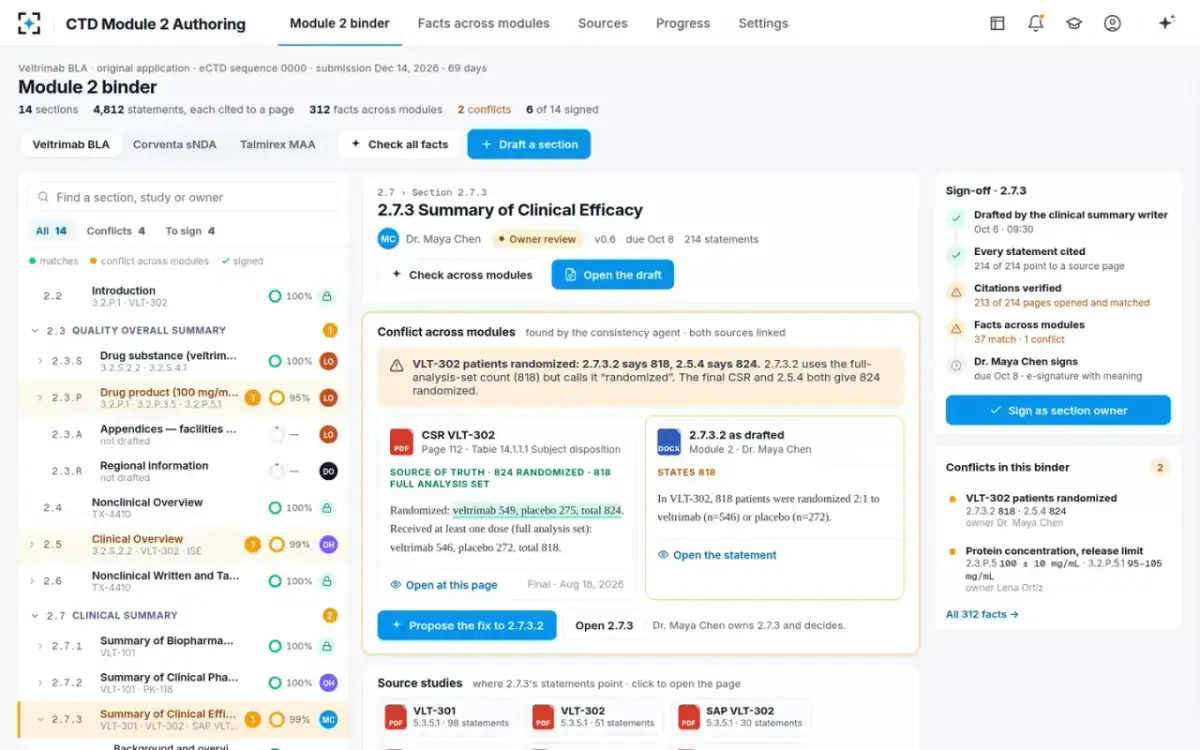
Why every statement in Module 2 points at a page in another module
A citation in Module 2 is not a courtesy. M4Q(R1), written in 2002, already asked the Quality Overall Summary to point its key issues at the volume and page in other modules where the data sat — volume and page, because the dossier was paper. M4E(R2) encourages the same for the Clinical Overview, and sends the narrative descriptions of studies that contributed both efficacy and safety data to 2.7.3.2 with a cross-reference from 2.7.4.1 rather than a second copy of the text.
The reason is the assessor's day. A summary sentence is a claim about a table in a report; if the sentence names the table, checking it takes a minute, and if it does not, checking it takes an afternoon or does not happen. That is also why the rule the sample dossier runs on is absolute rather than aspirational: a statement with no source page cannot leave drafting, and the writers take their numbers only from a list of facts that were read off a page, never from memory of a previous draft.
What every Module 2 section has to carry before it can be signed
- The ICH heading structure for that section
M4Q for 2.3, M4S for 2.4 and 2.6, M4E for 2.5 and 2.7 — and Health Canada asks that default headings be retained or addressed even where they look irrelevant.
- A length a reviewer can read
Inside ICH’s guidance for that section, with the detail moved to tables rather than cut from the text.
- A source page behind every factual sentence
The volume, page, table or figure the value was read from, in the module that owns the data.
- The same value as every other section that states it
Sample sizes, exposure, doses, limits and shelf life are stated in several places; one of them is the source of truth.
- A named owner, and a signature with its meaning
One person approves the section as its owner; the signature records who, when and in what capacity.
What happens to Module 2 when one number moves
Here is the failure mode the whole module is exposed to. The same fact appears in several sections by design: patients randomized in 2.5.4, 2.7.3.2 and 2.7.6; patients exposed in 2.5.5 and 2.7.4.1; a specification limit in 2.3.P.5 and 3.2.P.5.1. Each of those sentences was written by a different person, at a different time, from the report version in front of them. When a data cut is superseded or a study report goes final, one copy updates and the others do not, and nothing in the dossier announces it.
On the sample dossier that shows up as a twelve-patient gap: 2.7.4.1 states 1,947 patients exposed from the final integrated safety analysis, while 2.5.5 still says 1,935 from the June data cut it cites. Neither sentence is careless. Both were right when written. The difference is only visible to something that reads both sections and both source pages at once — which is the job the consistency agent does on every change, opening a disagreement with both values, both pages and a proposed correction for the section's owner, who decides.
The sources behind the summaries, in CTD Module 2 Authoring
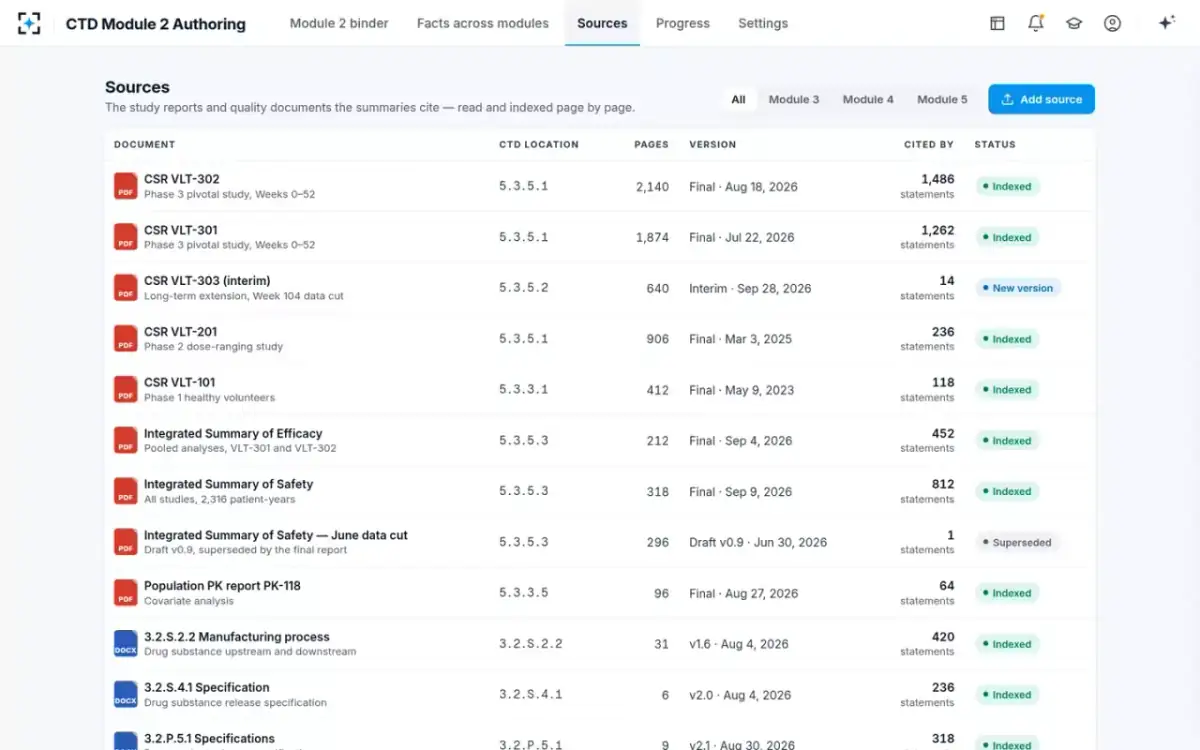
That is the whole argument for treating Module 2 as one connected object rather than fourteen documents in a folder. The sections have different owners, different source modules and different length budgets, but they share their facts, and a dossier is only as consistent as its least recently updated copy. To see the binder, the citations and the conflicts on a dossier of your own, start from CTD Module 2 Authoring.
Questions people ask
What is the difference between Module 2 and Module 5?
Module 5 holds the clinical study reports themselves — the full ICH E3 report for each trial, with its tables, listings and appendices. Module 2 holds the summaries of those reports: 2.7 states what they found, factually and across studies, and 2.5 argues what it means. Nothing may appear in Module 2 that is not already in the modules beneath it, and every factual sentence in 2.7 should point back to the page in Module 5 it came from.
Is Module 2 the same for the FDA and the EMA?
The seven sections and their numbering are common to all ICH regions; only Module 1 is region-specific. The differences are regional additions rather than a different structure: for a new drug application the FDA requires an integrated summary of effectiveness and an integrated summary of safety under 21 CFR 314.50(d)(5), which are detailed analyses that belong in Module 5 rather than in 2.7, and Health Canada publishes its own quality summary template and asks for 40 to 100 pages where ICH says 40.
Does Module 2 need a table of contents?
Section 2.1 is the table of contents for Modules 2 to 5, but ICH's granularity annex notes that "the TOC is only called for in the paper version of the CTD; there is no entry needed for the eCTD". In an electronic submission the structure and the hyperlinks do the work, which is also why broken links inside a dossier are treated as a presentation defect rather than a formatting nicety.
How many documents are in Module 2?
Between seven and about fifteen, depending on how you split it. ICH allows the Quality Overall Summary to be managed as one document or divided into its drug substance and drug product parts, requires one document per drug substance, and asks for one 2.7.3 document per indication unless the indications are closely related. Whichever split you pick, ICH asks you to keep it for the life of the application.
What is in CTD module 2.7?
Six numbered parts: 2.7.1 biopharmaceutic studies and the analytical methods behind them, 2.7.2 clinical pharmacology, 2.7.3 efficacy, 2.7.4 safety, 2.7.5 literature references and 2.7.6 synopses of the individual studies. ICH anticipates 50 to 400 pages excluding attached tables, and asks that the comparisons across studies in it stay factual, leaving interpretation to the Clinical Overview in 2.5.
Who writes CTD Module 2?
Not one person. The quality summary goes to a CMC regulatory writer, the nonclinical sections to a nonclinical lead, the clinical overview to a clinical lead and the clinical summary to a clinical scientist or a regulatory medical writer, with a submission lead holding the date. Ownership follows the module each section summarises rather than the organisation chart, which is why five desks end up inside one document.