AI is allowed in regulatory submissions, and the two agencies that say so say it in different ways. FDA's draft guidance on artificial intelligence sets out a credibility framework for AI models that produce information supporting regulatory decisions, then expressly excludes drafting from its scope. EMA's reflection paper goes the other way and addresses drafting head-on, permitting it under close human supervision with quality review before anything is submitted. Neither allows an AI to approve or sign anything, because approval is a signature and a signature under 21 CFR Part 11 carries a printed human name and a stated meaning. So the question worth asking a vendor is narrower than "is this allowed": it is which decisions the software is permitted to make, and what the record shows when it is wrong. Botminds' CTD Module 2 Authoring draws that line in one place — six agents draft, cite and verify, and the named owner of each section applies every change and signs it.
The rules below are quoted from FDA, EMA and the Code of Federal Regulations, with each source linked where it appears. The screens come from a fictional sample dossier, the Veltrimab BLA, as the solution runs on it.
Two regulators on AI and the dossier: what each one is actually about
FDA, draft guidance on AI (January 2025): AI models whose job is to produce information or data that supports a regulatory decision on a drug's safety, effectiveness or quality.
EMA, reflection paper on AI (September 2024): AI across the whole medicinal product lifecycle, including the documents that go to the regulator.
FDA, draft guidance on AI (January 2025): No. It sets aside AI used for operational efficiencies — internal workflows, resource allocation, drafting or writing a regulatory submission — so long as that use leaves patient safety, drug quality and the reliability of results untouched.
EMA, reflection paper on AI (September 2024): Yes, by name: AI that drafts, compiles, edits, translates, tailors or reviews product information documents.
FDA, draft guidance on AI (January 2025): A risk-based credibility assessment for a model in a stated context of use — credibility meaning trust in the model's performance for that use, earned by collecting evidence.
EMA, reflection paper on AI (September 2024): Close human supervision, plus quality review that makes sure every piece of model-generated text is factually and syntactically correct before it is submitted.
FDA, draft guidance on AI (January 2025): The sponsor, who is encouraged to engage with FDA early if it is uncertain whether a use is in scope.
EMA, reflection paper on AI (September 2024): The sponsor, applicant, holder or manufacturer, who has to make sure every algorithm, model, dataset and data pipeline it uses is fit for purpose.
FDA, draft guidance on AI (January 2025): A drafting tool is outside the guidance only while it does not touch the reliability of results. The moment its output is the basis of a regulatory conclusion, the framework is the right place to look.
EMA, reflection paper on AI (September 2024): Drafting is permitted and supervised. The obligation is on the applicant to prove the text is correct, not on the tool to claim it.
Does the FDA allow AI to write a regulatory submission?
Yes, in the sense that nothing prohibits it, and the clearest evidence is in a scope paragraph rather than a permission. FDA's draft guidance tells sponsors what it is not about:
Its scope section sets aside two kinds of use: AI in drug discovery, and AI used for operational efficiencies — the guidance's own examples are internal workflows, resource allocation and drafting or writing a regulatory submission — where the use does not affect patient safety, drug quality or the reliability of nonclinical or clinical results (FDA draft guidance, section II).
Read it carefully, because the exclusion has a condition attached. Drafting is out of scope only where it does not affect patient safety, drug quality, or the reliability of results. A tool that assembles sentences from study reports and carries their numbers forward sits very close to that condition: if the tool's output is where a reviewer reads a result, the reliability of what the reviewer reads is no longer an internal matter. The guidance also asks sponsors to engage with FDA early if they are uncertain whether a particular use falls inside its scope, which is the sentence to point at when the question comes up internally.
The practical reading is this. A drafting tool stays on the safe side of the line by never being the source of a fact — by taking every number from a page in Modules 3 to 5 and keeping the page with it. A tool that generates a plausible figure, or restates one from its own earlier output, has quietly become a source, and the exclusion no longer obviously covers it.
What the FDA's AI guidance covers, and what it leaves out
What the guidance is about is models whose output supports a regulatory decision: a model predicting a quality attribute, a model used in a clinical endpoint, a model substituting for an analysis. For those, it describes a seven-step, risk-based credibility assessment: define the question of interest, define the model's context of use, assess the risk that the model's answer is wrong and what that would cost, plan the credibility evidence, execute, document, and decide whether the model is adequate for that use.
What it leaves out is everything an operations team buys software for — workflow, allocation, and drafting. That omission is not an endorsement. It is a boundary, and boundaries move when the facts do. The useful habit for a buyer is to write down which of the two sides each piece of the tool sits on, and to insist that anything near the boundary carries evidence of the kind the framework asks for.
The three numbers that decide the argument about AI drafting
50–82%
of outputs, model by model, that elaborated on a planted false clinical detail under default settings, across six models
44%
mean hallucination rate once a mitigation prompt was used, down from 66% — cut by a third, not removed
3
items a signed electronic record must carry under 21 CFR 11.50: the printed name, the date and time, and the meaning
What the EMA says about AI drafting regulatory documents
EMA's reflection paper is the document to read if your question is specifically about drafting, because it names the activity: AI that drafts, compiles, edits, translates, tailors or reviews product information documents is to be used under close human supervision. The sentence that follows explains why, and it is the most honest description of the failure mode a regulator has published.
Generative language models, the paper says, tend to produce output that is plausible but wrong or incomplete, so quality review has to be in place to confirm that every piece of model-generated text is factually and syntactically correct before it goes to a regulator (EMA reflection paper, section 2.3.5).
Two words carry the weight. Plausible is the reason a human reader is a poor detector: a fabricated exposure figure in a safety summary looks exactly like a real one, and it is wrong by twelve patients rather than by an order of magnitude. Incomplete is the quieter failure: a sentence that reports a subgroup result and omits the subgroup where the effect was smaller is syntactically perfect and substantively misleading.
EMA also settles the question of responsibility before anyone asks it. The sponsor, applicant, holder or manufacturer is responsible for making sure that every algorithm, model, dataset and data pipeline it uses is fit for purpose, in line with legal, ethical, technical, scientific and regulatory standards. No contract with a software supplier moves that.
Credibility and context of use, in plain words
Two terms from the FDA framework are worth taking even where the framework does not formally apply, because they turn a vague question into a testable one.
A context of use is a written description of exactly what the model does and how far its answer reaches. FDA's definition comes down to one idea: the context of use fixes the specific role and scope of the model in answering a question of interest. For a drafting tool, a good context of use is narrow and boring. Proposes a first draft of section 2.7.4 from the integrated analyses already filed, with a citation on every statement of fact, for the section owner to edit, approve or reject. That sentence can be tested. Writes Module 2 cannot.
Credibility is then the evidence that the model performs in that context — in FDA's framing, trust in the model's performance for one particular use, built up by collecting evidence. Evidence, not assurance. The practical form it takes for a drafting tool is a measured test on documents whose answers are already known, which is the subject of how to test an AI writing tool on your own dossier.
The pairing is what makes the framework useful outside its own scope. Risk is assessed against the context of use, not against the technology, so a model that drafts a sentence a human must verify and may reject carries a different risk from one whose output goes to an agency unread. A buyer who writes the context of use narrowly has already done most of the work of deciding what evidence to ask for.
Can AI sign a regulatory document?
No. A signature under 21 CFR Part 11 is a record about a person. Section 11.50 requires that signed electronic records carry information associated with the signing that clearly indicates the printed name of the signer, the date and time of execution, and what the signature means — review, approval, responsibility or authorship, for example. Section 11.70 then requires each signature to be bound to its record so tightly that it cannot be cut out, copied or moved to falsify another record by ordinary means.
A model has no printed name, cannot hold responsibility, and cannot be the subject of the certification an organisation gives the agency about its electronic signatures. So approval remains a human act, and any tool that can mark a section approved without a person doing it has not been configured carefully — it has been built wrong.
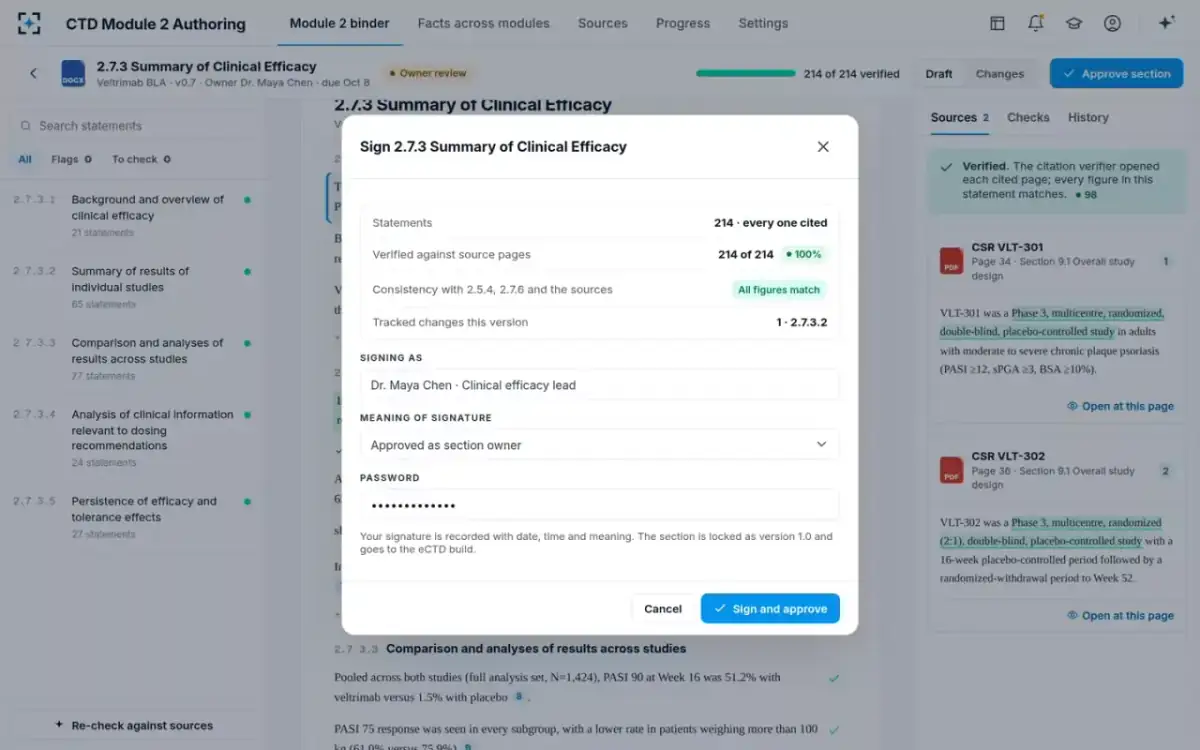
What the signature step can honestly do is make the meaning explicit. In the sample dossier the owner of 2.7.3 signs as herself, in her role, with the meaning Approved as section owner, against a summary of what she is approving: 214 statements, every one cited, 214 of 214 verified against their source pages, all figures matching 2.5.4 and 2.7.6, and one tracked change in this version.
Signing a section: the name, the role, the meaning, and what is being approved
Why "propose, never apply" is the only authority line that holds
Every other line a vendor might draw bends under pressure. "A human reviews everything" is true of any workflow and survives exactly as long as the deadline does. "The AI only makes small changes" fails because the twelve-patient difference between 1,935 and 1,947 is a small change. "The AI is accurate" is a claim about the past, not a constraint on the next sentence.
A line between proposing and applying is different because it is structural. The software can produce a draft, a verdict and a tracked change; it cannot be the actor that puts the change into a document, because that action requires an identity the software does not have. That makes the line visible on every screen and checkable in the history afterwards.
It has a second effect that buyers underrate. If the tool cannot apply, the person has to read, and reading is where a wrong population name is caught. A tool that silently corrects would have fixed 1,935 to 1,947 and nobody would have learned that the overview was citing a superseded data cut.
What each agent in CTD Module 2 Authoring may do, and what none of them may do
Source reader
MayReads study, integrated and quality reports page by page and writes down each key fact with its population and its exact page, table or figure.
May neverNever infers a number that is not printed on the page, and never drops the page anchor.
Clinical summary writer
MayDrafts 2.5 and 2.7 in ICH M4E order and the company template, with a citation on every statement of fact.
May neverNever writes a statement without a citation, never takes a number from anywhere but the key facts, and never approves its own draft.
Nonclinical summary writer
MayDrafts 2.4 and the 2.6 written and tabulated summaries from the Module 4 study reports.
May neverNever paraphrases a dose or a no-observed-adverse-effect level; both are quoted exactly as printed.
Quality summary writer
MayDrafts the 2.3 Quality Overall Summary from the matching 3.2.S and 3.2.P sections.
May neverNever restates a limit from memory or from a development document — only as registered, with its Module 3 page.
Citation verifier
MayOpens every cited page and confirms the number, the population and the direction of the claim; marks each statement verified, to check, or disagrees.
May neverCannot change a word of the text. It proposes, and it keeps the page it read against its verdict.
Consistency agent
MayTracks each fact across Modules 2 to 5 and opens a disagreement with both values, both pages and a proposed tracked change.
May neverNever applies its own correction, and never closes a disagreement it opened.
The named section owner
MayApplies, edits or rejects every proposal, and signs the section with their name, role, the meaning of the signature and a password.
May neverThe only actor on this list who decides anything.
What the record has to show afterwards
The regulation that governs the record is 21 CFR 11.10(e), and it is specific about two things: the audit trail has to be secure, generated by the computer and time-stamped, recording when operators create, modify or delete electronic records; and a change to a record must never hide what was recorded before. The second half is the one that bites a drafting tool. A system that rewrites a paragraph and keeps only the result has obscured what was there.
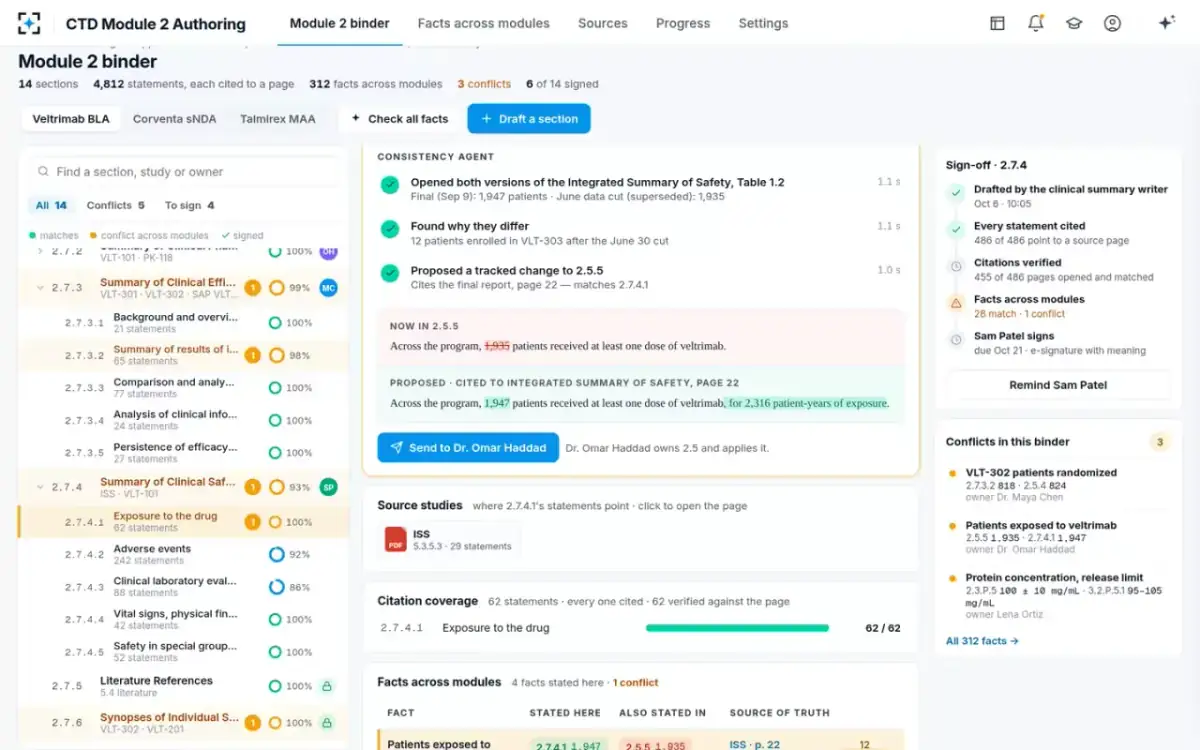
For an AI-assisted draft that means the history has to distinguish four different things that all look like "a change" in a word processor: what an agent drafted, what it proposed, what a person applied, and what a person wrote themselves. In the sample dossier the corrected statement in 2.7.3.2 carries all four — edited by the consistency agent, applied by the section owner, re-verified against the cited page — and the section's history lists every agent step and every human action with its time.
The same section opens with a requirement to validate the system itself, so that it performs as specified and can tell an invalid or altered record from a sound one. That is the question a quality function will ask about any drafting tool, and it is a reasonable one with a measurable answer — though validating the system is a different exercise from measuring whether the sentences it produces agree with their sources.
A proposal, with the agent's working shown and the owner it has to go to
Six drafting agents, and the things none of them may do
The limits in the figure above are worth reading as a set, because what they have in common is more useful than any single rule. None of the agents may originate a fact. The source reader records only printed values. The writers take numbers only from the key facts the reader wrote down. The verifier cannot change text. The consistency agent cannot apply or close anything. The chain has no step at which a number appears without a page behind it.
Two further rules sit on top, as settings rather than as agent behaviour: a statement without a citation cannot leave drafting, and a section cannot be signed while any statement disagrees with its source. Both are the kind of constraint EMA's quality review clause implies — a check that happens before submission rather than a promise that the text was good.
What this does not do is make the output correct. It makes the output checkable, which is a weaker and much more defensible claim. The published evidence on how often models elaborate on a false premise is the reason the weaker claim is the right one to buy: across six models and 5,400 generated outputs, between half and four-fifths of each model's responses under default settings built on a single planted fabricated detail, and a mitigation prompt cut the average rate by about a third without removing it.
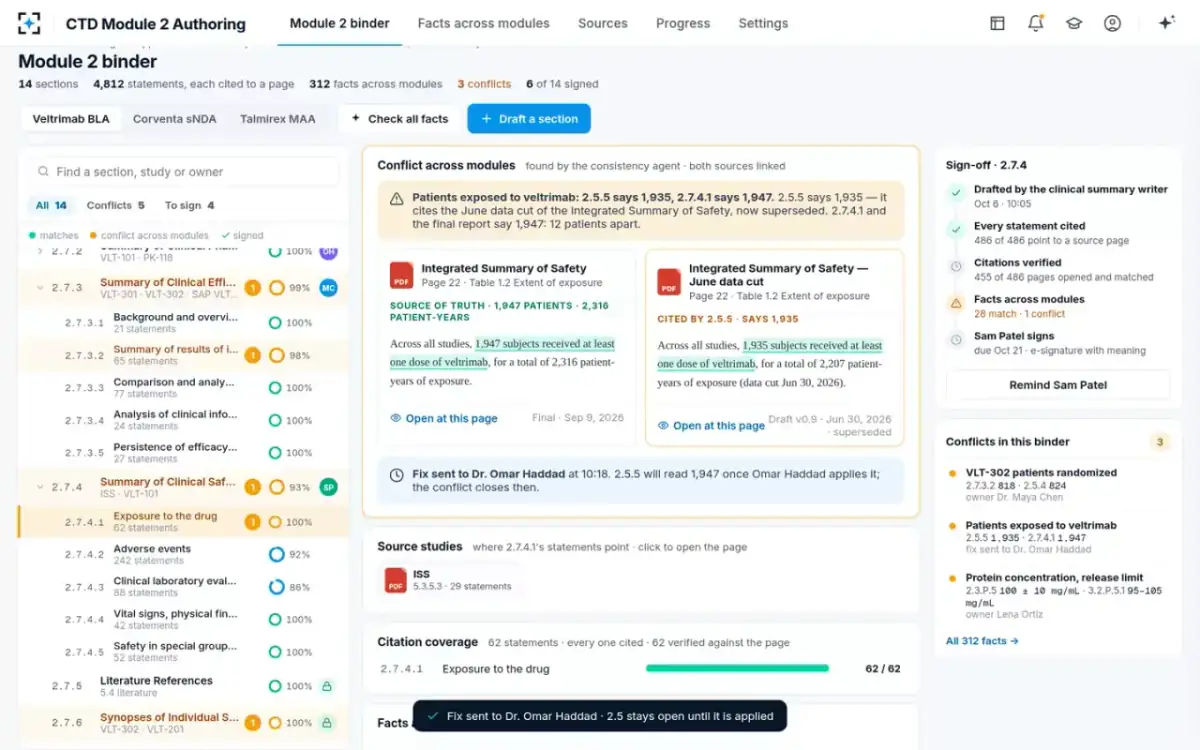
A fix that belongs to someone else goes to them, and the disagreement stays open
What to ask before AI touches your dossier
The questions below are the ones whose answers change a decision. Each has an answer that should stop the conversation, and most can be answered in a demonstration rather than a questionnaire.
Nine questions for a regulatory drafting tool, and the answer that should worry you
- Where did this number come from?
Point at any figure in a generated draft. The worrying answer is a document name without a page, or a confident explanation with nothing to open.
- Can the tool write a sentence that has no citation?
If yes, ask what stops one reaching a reviewer. The useful answer is a rule that holds an uncited statement in drafting.
- Can it apply its own correction?
The worrying answer is "yes, for small changes". A twelve-patient exposure difference is a small change.
- What is its stated context of use, in one sentence?
If the supplier cannot write the sentence, neither the FDA framework nor your own quality function has anything to assess.
- What does it do when two sections disagree?
Worrying: it picks one. Useful: it shows both values, both pages, and names the owner who decides.
- What happens when a report gets a new version?
Ask to see the superseded document afterwards. If it has disappeared, the statements that cite it cannot be listed.
- Who can mark a section approved?
The only acceptable answer names a person, a role and the meaning of the signature. Part 11 requires all three.
- Show me the history of one corrected sentence.
It should distinguish what an agent proposed from what a person applied, and it must not have overwritten the earlier text.
- How was the tool measured, and on what?
Worrying: a time saving from a demonstration. Useful: a test on documents whose answers were known in advance.
One question is deliberately absent: whether the tool is "compliant". Software is not compliant on its own; an organisation's use of it is, and the evidence for that is the context of use, the validation and the record. The rest of the decision is a matter of what the tool refuses to do, and the three ways to automate Module 2 sets out the alternatives honestly. To see the authority line on one dossier, start from CTD Module 2 Authoring.
Questions people ask
Do you have to tell the FDA that AI drafted a document?
There is no disclosure requirement in the draft guidance for the uses it excludes, which include drafting a regulatory submission where that does not affect patient safety, drug quality or the reliability of results. The guidance does encourage sponsors to engage with FDA early if they are uncertain whether a use falls inside its scope, and that is the sensible course where a tool's output is where a reviewer reads a result.
What does a context of use look like for a drafting tool?
FDA defines it as the specific role and scope of the model used to address a question of interest. In practice it is one written sentence saying what the model does, what it does not do, and whose decision follows its output. It matters because risk is assessed against it: the same technology drafting a section a person must verify is a different proposition from the same technology producing a number nobody checks.
Does 21 CFR Part 11 apply to AI-drafted documents?
Part 11 applies to the electronic records and signatures, not to how the text was produced. If a section is approved with an electronic signature, 11.50 requires the printed name, the date and time and the meaning; 11.10(e) requires a secure, time-stamped audit trail whose changes do not obscure what was recorded before. An AI-drafted paragraph is subject to all of that exactly as a hand-written one is.
Who is responsible if an AI-drafted sentence is wrong?
The applicant. EMA states it plainly: it is the responsibility of the sponsor, applicant, holder or manufacturer to ensure the algorithms, models, datasets and pipelines used are fit for purpose. In a signed dossier the responsibility is more specific still — it belongs to the named person who signed the section, with the meaning their signature carries.
What should an AI never do in a regulatory submission?
Four things. Originate a number that is not printed on a source page. Change a document without a person applying the change. Mark its own work approved. And discard the earlier version of a sentence it rewrote. The first three are authority limits; the fourth is the audit-trail rule in 21 CFR 11.10(e).
Is AI allowed in regulatory submissions in the EU?
Yes, with conditions that are stated more directly than in the US. EMA's reflection paper permits AI for drafting, compiling, editing, translating, tailoring and reviewing product information documents under close human supervision, and requires quality review mechanisms to establish that model-generated text is factually and syntactically correct before it is submitted. The paper is guidance rather than legislation, and it places the obligation on the applicant.