Searching for a Quality Overall Summary template is a reasonable first move and a slightly misleading one. There is no single form to download: ICH wrote the outline of 2.3 into the M4Q guideline itself, heading by heading, with an instruction under each saying what to carry up from Module 3, and Health Canada publishes an optional template over the top of that outline for chemical entities. The work the template cannot do for you is the work that takes the time — choosing what is critical, quoting registered values exactly as registered, and naming the Module 3 page behind every number, in a document that may contain nothing new. Botminds' CTD Module 2 Authoring drafts 2.3 against the matching Module 3 sections, carries the source page with every value, and raises a conflict the moment a quoted limit stops matching the specification it was taken from.
The structure, instructions and page guidance below are quoted from ICH M4Q(R1) and Health Canada's quality guidance. The worked example and the screens come from a fictional sample dossier: the product, its specification and the people around it are invented sample data.
M4Q(R1) is still the quality guideline in force. ICH is revising it: the draft M4Q(R2), which reorganises both the quality summary and Module 3, went out for public consultation in May 2025, and ICH's February 2026 work plan expects final adoption in June 2027 (ICH M4Q(R2) work plan). A 2.3 written for a filing before then follows R1, which is what this guide describes.
The Quality Overall Summary, by the numbers
40pages
of text normally, excluding tables and figures (ICH M4Q)
80pages
where the product is biotech or the process is complex
40–100
pages recommended by Health Canada for the same document
0new facts
may appear in 2.3 that are not already in Module 3 or elsewhere in the dossier
What is a Quality Overall Summary, and what may it contain?
Section 2.3 is the summary of the quality module: the drug substance, the drug product, the appendices and the regional information, condensed for a quality assessor who will read Module 3 afterwards. Its defining constraint is negative. ICH M4Q(R1) rules out any information, data or justification in the summary that is not already in Module 3 or elsewhere in the dossier (ICH M4Q(R1)). Nothing may be introduced here — not a fresh calculation, not a justification you meant to add to 3.2.P.2, not a limit rounded for readability.
What it must do is positive and harder to measure: carry enough from each section to give the assessor an overview, bring out the product's critical key parameters, and justify, for instance, any place where a guideline was not followed. That word critical is where the author's judgement lives. A 2.3 that reproduces every heading evenly is a Module 3 in miniature, which helps nobody; a 2.3 that says which attributes control the product, why the limits are where they are, and where the process was changed during development is doing the job.
Is there a Quality Overall Summary template?
Two things exist, and neither is a blank document you fill in. The first is M4Q's own section 2.3, which is the outline: every heading from 2.3.S.1 to 2.3.R in order, each followed by an instruction — "Information from 3.2.S.1 should be included", "A flow diagram, as provided in 3.2.S.2.2", "Specification(s) from 3.2.P.5.1 should be provided". The guideline even marks which items may be lifted straight across: "the italicised text below indicates where tables, figures, or other items can be imported directly from Module 3." Copied into a document with the headings in place, that is a working template, and it is the one most companies actually use.
The second is Health Canada's Quality Overall Summary — Chemical Entities form for new and abbreviated new drug submissions, the QOS-CE. Health Canada is explicit about its status: "use of Health Canada's QOS-CE (NDS/ANDS) template is optional, although its use may facilitate the preparation of the Quality Overall Summary and may contribute to review efficiencies" (Health Canada). It is a Canadian form for chemical entities, not a global one, and the guidance it sits in says what should be submitted regardless of which template is used.
So the honest answer to the search is: take the outline from M4Q, add your company's house style, and expect the template to be the easy part. What follows is that outline, with the Module 3 section each heading draws on.
Each 2.3 heading, the Module 3 section it summarises, and what ICH asks you to carry up
| 2.3 heading | Reads from | What the guideline asks for |
|---|---|---|
| Introduction | — | Proprietary name, non-proprietary name, company, dosage forms, strengths, route of administration and proposed indications. |
| 2.3.S.1 General Information | 3.2.S.1 | Information from 3.2.S.1. |
| 2.3.S.2 Manufacture | 3.2.S.2 | The manufacturer, a description of the process and its controls, the flow diagram from 3.2.S.2.2, the starting materials, the critical steps and acceptance criteria, process validation, and the major manufacturing changes made during development — cross-referred to the nonclinical and clinical studies that used the affected batches. |
| 2.3.S.3 Characterisation | 3.2.S.3 | Structure and isomerism for a chemical entity, or the desired product and its characterisation data for a biotech one; then the impurities, their acceptance criteria, their levels in the batches used in studies, and how the limits are qualified. |
| 2.3.S.4 Control of Drug Substance | 3.2.S.4.1, 3.2.S.4.4 | The justification of the specification, the analytical procedures and validation; the specification itself from 3.2.S.4.1; a tabulated summary of the batch analyses from 3.2.S.4.4. |
| 2.3.S.5 Reference Standards or Materials | 3.2.S.5 | Information from 3.2.S.5, tabulated where appropriate. |
| 2.3.S.6 Container Closure System | 3.2.S.6 | A description and discussion of the information in 3.2.S.6. |
| 2.3.S.7 Stability | 3.2.S.7 | The studies undertaken and their conclusions, the proposed storage conditions and retest date, the post-approval protocol from 3.2.S.7.2, and a tabulated summary of the results from 3.2.S.7.3. |
| 2.3.P.1 Description and Composition | 3.2.P.1 | The description and the composition. |
| 2.3.P.2 Pharmaceutical Development | 3.2.P.2 | A discussion of the development data, a tabulated summary of the formulations used in clinical trials, and dissolution profiles where relevant. |
| 2.3.P.3 Manufacture | 3.2.P.3 | The manufacturer, the process and its controls, the flow diagram from 3.2.P.3.3, and the process validation from 3.2.P.3.5. |
| 2.3.P.4 Control of Excipients | 3.2.P.4 | A summary of the quality of the excipients. |
| 2.3.P.5 Control of Drug Product | 3.2.P.5.1, 3.2.P.5.4 | The justification of the specification, the analytical procedures and validation, the characterisation of impurities; the specification from 3.2.P.5.1; the batch analyses from 3.2.P.5.4. |
| 2.3.P.6 Reference Standards or Materials | 3.2.P.6 | Information from 3.2.P.6, tabulated where appropriate. |
| 2.3.P.7 Container Closure System | 3.2.P.7 | A description and discussion of the information in 3.2.P.7. |
| 2.3.P.8 Stability | 3.2.P.8.2, 3.2.P.8.3 | The studies, results and conclusions, the storage conditions and shelf life including in-use shelf life, the results table from 3.2.P.8.3 and the post-approval protocol from 3.2.P.8.2. |
| 2.3.A Appendices | 3.2.A.1 to 3.2.A.3 | Facilities and equipment for a biotech product, the adventitious agents safety evaluation with its viral clearance reduction factors, and excipients. |
| 2.3.R Regional Information | 3.2.R | A description of the information specific to the region, where appropriate. |
The 2.3 outline: S, P, A and R, following Module 3's shape
The lettering is worth a minute because it is the thing that makes the section navigable. S is the drug substance, in seven parts; P is the drug product, in eight; A is appendices, covering facilities and equipment, the adventitious agents safety evaluation and excipients; R is the regional information. Each 2.3 heading has a 3.2 twin with the same number, so an assessor reading 2.3.P.5 knows exactly where to go for the detail, and an author who cannot find the Module 3 section for a paragraph they have written has probably written something that does not belong in 2.3.
Two structural rules sit on top. Health Canada asks that "all headings listed in the default sections of the CTD should nonetheless be retained or addressed, regardless of their perceived relevance, unless the subject matter of the entire section or table is irrelevant to the drug substance or drug product in question" — so an empty heading gets a line saying why it is empty, rather than disappearing. And ICH allows the summary to be managed as one document or split into its substance and product parts, with the choice fixed for the life of the application (ICH M4(R4)); the seven sections and how long each may run covers that choice across the whole module.
How many pages should the QOS be?
ICH's figure is the one most teams plan against: normally 40 pages of text at most, and for biotech products or products made by more complex processes a longer document that should still normally stay within 80, with tables and figures excluded from both counts. Note what is excluded. Specifications, batch analyses and stability results are tables, and tables do not count, which is why a well-built 2.3 can carry a great deal of data inside a short document.
Health Canada's number for the same document is different, and the difference is instructive rather than contradictory.
Two regulators on the length of the same document, and what each is protecting
ICH M4Q(R1): Normally no more than 40 pages of text, tables and figures excluded; up to 80 for biotech products and more complex processes.
Health Canada: "It is recommended that the QOS be limited to the minimum number of pages required to summarize key information (e.g. 40-100 pages)."
ICH M4Q(R1): A summary that stays a summary. A 2.3 that grows towards Module 3 stops saving the assessor anything and starts duplicating text that can drift.
Health Canada: An assessor's reading time against completeness: too short and the assessor goes back to the Quality Module for things the summary should have carried.
ICH M4Q(R1): Treat 40 as a design target for a chemical entity and move detail into tables rather than cutting cross-references.
Health Canada: Treat the range as permission to be longer where the product earns it, and the word minimum as the actual instruction.
Quoting a specification: the registered limit, not the development one
Of everything 2.3 carries up, specifications cause the most trouble, because a product usually has more than one version of the same limit and all of them are printed somewhere. M4Q's instruction for 2.3.P.5 is short — "a brief summary of the justification of the specification(s), a summary of the analytical procedures and validation, and characterisation of impurities should be provided. Specification(s) from 3.2.P.5.1 should be provided" — and the operative words are "from 3.2.P.5.1". Not from the development report, not from the batch record, not from the number everyone in the team says out loud.
On the fictional sample dossier that is exactly what goes wrong. Section 2.3.P.5 states a protein concentration of 100 plus or minus 10 mg/mL. The registered release limit in 3.2.P.5.1, at specification version 2.1, is 95 to 105 mg/mL by ultraviolet absorbance at 280 nm. Written out, the summary claims an acceptance range of 90 to 110 mg/mL — wider than the registered one in both directions, and therefore a claim the application does not support. The sentence is not a typing error; it is a development limit that survived into the summary because nobody re-opened 3.2.P.5.1 while writing.
The same limit in two places, with the registered value beside the quoted one
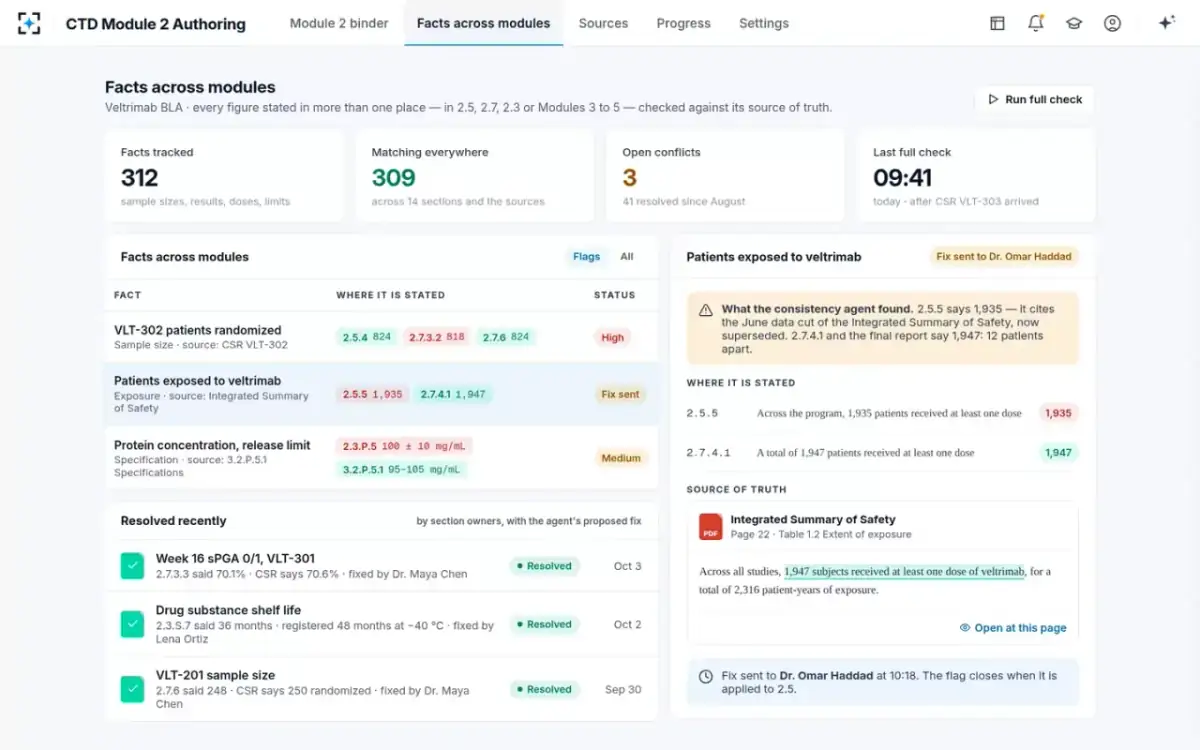
The general rule the example illustrates: a limit is quoted exactly as registered, in the units and to the precision the specification uses, with the Module 3 page it was read from attached to the sentence. Rewriting a two-sided range as a nominal value plus a tolerance is a transformation, and a transformation of a registered value is a new fact, which 2.3 may not contain.
Cross-referencing to volume and page number
M4Q asks the summary to integrate information across the quality module and from other modules, with cross-references to the volume and page in those modules where the data sit. The phrasing is from 2002 and the paper dossier, but the requirement survives the move to electronic submissions intact: the assessor reading a claim in 2.3 should be one click or one page reference away from the data behind it.
This is also where 2.3 stops being a writing task and becomes a bookkeeping one. A forty-page summary of a thousand-page module carries several hundred values, each needing a pointer that is still correct at filing — after the stability report has been reissued with a new page count, after the specification has gone from version 2.0 to 2.1. On the sample dossier the pointer is a property of the statement rather than a footnote: every sentence that states a fact carries the document, version and page it was read from, and a statement without one cannot leave drafting.
A citation opening the page it points at
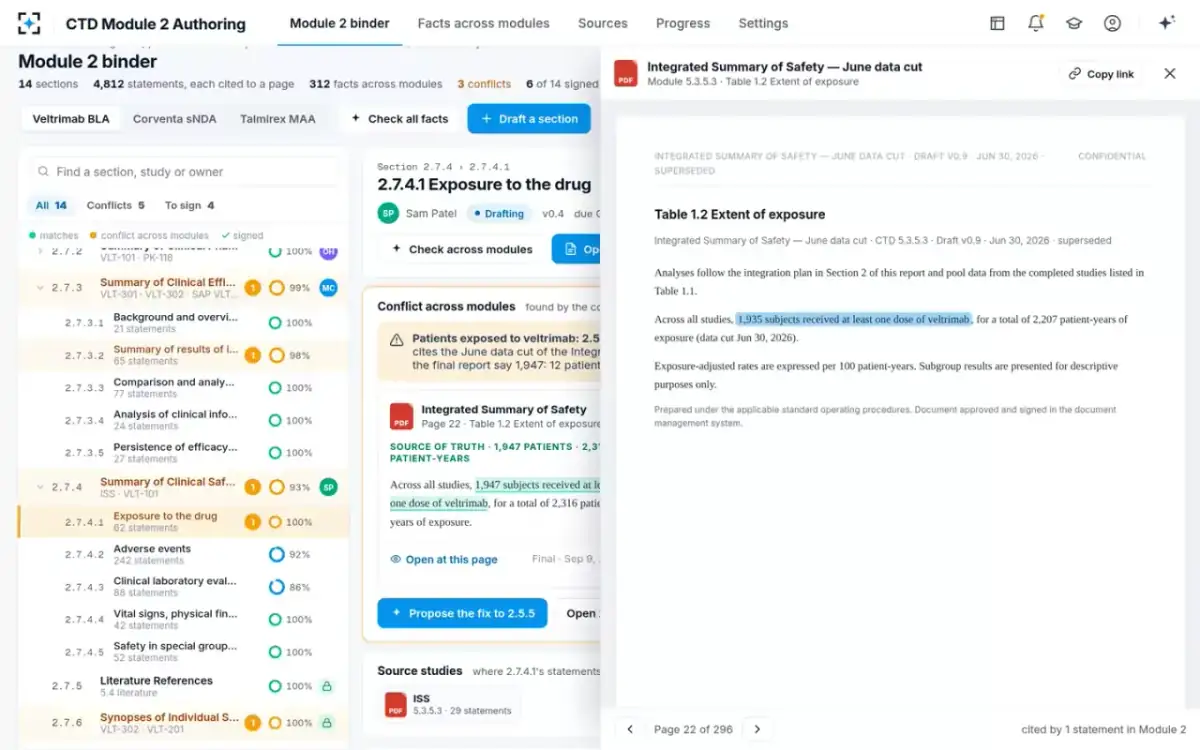
Health Canada's QOS-CE, and why its page guidance differs
The QOS-CE template exists because Canadian review practice wanted the same information in a predictable shape. It is described as consistent with ICH, optional, and useful mainly for review efficiency — and Health Canada's wider guidance adds something ICH does not say out loud: "sponsors are encouraged to devote sufficient time to prepare an accurate, consistent, and concise QOS based on the detailed information included in the Quality Module."
The 40 to 100 page range follows from that sentence rather than contradicting ICH's 40. Health Canada's instruction is the phrase before the range — limit the summary to the minimum number of pages required to summarise key information — with the range offered as a worked expectation. A team filing in both regions can write one document inside ICH's figure and satisfy both; a team that treats 100 pages as the target will have written something nobody asked for.
What an assessor does when the QOS is wrong
Nothing dramatic, and that is the problem. The assessor stops trusting the summary and goes to Module 3 for everything, which is the outcome the summary was created to avoid.
The filing of an inaccurate or incomplete QOS will result in greater expenditure of an assessor's time in retrieving, assessing and summarizing data.
Health Canada, Quality (Chemistry and Manufacturing) guidance for new drug submissions
In the United States the same failure has a name on a list. CDER's policy manual on refusing to file an application includes, among the general deficiencies that can make a section unreviewable, final reports or summaries that do not adequately say where the individual studies, data and records behind them can be found (CDER MAPP 6025.4, Rev. 1). A summary whose values cannot be traced is not a stylistic problem; it is a completeness problem, and the deficiency list Module 2 has to satisfy sets out what else is on it.
A 2.3 review pass that takes one afternoon
Most of what goes wrong in a Quality Overall Summary is findable by a reader who knows what to ask. The pass below is written as nine yes-or-no questions, in the order that catches the most for the least reading, and none of them requires quality expertise beyond access to Module 3.
Nine questions to ask of your own 2.3, in order
- Does every heading from 2.3.S.1 to 2.3.R appear?
Including the ones with nothing to say, each with a line explaining why it is empty.
- Does any paragraph contain a fact that is not in Module 3?
A justification, a recalculation or a comparison written for the summary is the one thing 2.3 may not carry.
- Is every specification quoted from the 3.2.S.4.1 or 3.2.P.5.1 version that is being registered?
Check the specification version number, not just the value — development and registered limits often differ by a few percent.
- Are the registered ranges written in the form the specification uses?
A two-sided range rewritten as nominal plus tolerance is a different claim.
- Does every carried-up value name the document, version and page it came from?
And does that pointer still resolve after the latest reissue of the source document?
- Do the batch analysis and stability tables match the ones in Module 3?
These are imported, not retyped; a retyped table is a second version of the data.
- Are the critical attributes identified as critical?
ICH asks the summary to emphasise critical key parameters, which means stating which ones they are.
- Are the manufacturing changes made during development described, with the studies that used the affected batches?
M4Q asks 2.3.S.2 to cross-refer to the nonclinical and clinical studies affected.
- Is the text inside its page budget without having lost its cross-references?
Move detail into tables, which are excluded from the count; never cut the pointers to make the length.
Citation rules as settings, in CTD Module 2 Authoring
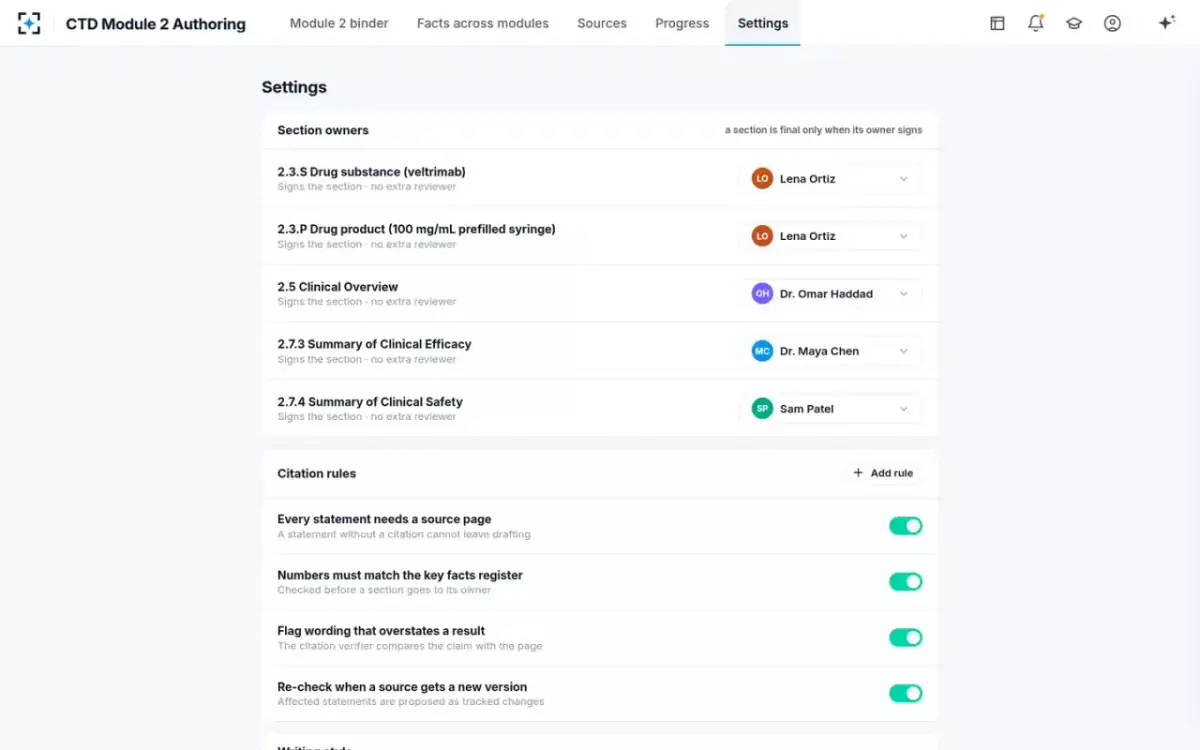
The pass is worth running twice: once when the first draft is complete and once after the last Module 3 document goes final, because the second pass catches the values that were right when written. Who runs it is a separate question — on most dossiers 2.3 belongs to a CMC regulatory lead rather than to the writer, as the five desks behind 2.3 to 2.7 sets out. To see the outline, the citations and the conflicts on a dossier of your own, start from CTD Module 2 Authoring.
Questions people ask
What is the difference between the QOS and Module 3?
Module 3 is the quality data: the full manufacturing descriptions, specifications, analytical validation, batch analyses and stability studies. Section 2.3 is a summary of it in the same heading order, meant for a first read, and may contain nothing that is not already in Module 3 or elsewhere in the dossier. The practical test is that you can draw an arrow from every sentence in 2.3 to a page in 3.2.
Can the Quality Overall Summary include new information?
No. ICH is explicit that it should not include information, data or justification not already included in Module 3 or in other parts of the dossier. That rules out a justification written for the summary, a recalculation, a rounded limit and a comparison across batches that appears nowhere else — and it is why reviewers treat a novel sentence in 2.3 as a sign that Module 3 is incomplete.
What is the QOS-CE template?
The Quality Overall Summary — Chemical Entities form that Health Canada publishes for new drug submissions and abbreviated new drug submissions. Health Canada describes it as consistent with ICH and optional, says its use may contribute to review efficiencies, and notes that its tables may need to be modified for a given product. It does not replace the ICH outline; it arranges the same content.
How do you cross reference Module 3 in the QOS?
By naming the section and the place in it that holds the data behind each claim — M4Q asks for cross-referencing to volume and page number in other modules, which in an electronic submission becomes a section reference and a working link. Attach the reference to the statement rather than collecting references at the end of a paragraph, so that a later change to one value does not strand the pointer belonging to another.
What goes in 2.3.P.5?
The justification of the drug product specification, a summary of the analytical procedures and their validation, the characterisation of impurities, the specification itself as registered in 3.2.P.5.1, and a tabulated summary of the batch analyses from 3.2.P.5.4. It is the heading where a wrong limit does the most damage, because a release specification quoted loosely in the summary reads as the limit the applicant is asking to register.
How long does a first draft of 2.3 take?
It varies with the product, and most of the elapsed time is usually not writing. The drafting can move quickly for someone who knows the product; waiting for the last stability or validation report to go final, then re-checking every carried-up value against the version that was issued, is what stretches the calendar.