SAE reconciliation is the field-by-field comparison of the two records every serious adverse event has: the one in the trial database, entered by the site on the case report form, and the one in the safety database, built from the expedited report. The two exist on purpose and are maintained by different teams under different rules, so they drift — on dates, on coded terms, on outcome, on causality. Reconciliation finds the drift before the clinical study report repeats it. It is hard because the comparison is mechanical and large, because the two databases do not share a key, and because the work rises with every event the study collects. A patient narrative is a third copy of the same event, which is where Botminds' CSR Patient Narratives comes in: it compares every fact in a draft narrative with the record the sentence cites, and cross-checks the onset, outcome and causality of serious events against the sponsor's medical review before the narrative can be signed.
The practical answer to drift is not a bigger quarterly spreadsheet. It is a continuous, field-level comparison in which every difference becomes a named query with an owner, and nothing is edited silently.
The measured figures on this page come from a published account of one centre's own reconciliation tool, cited where they appear; they describe that tool, not this one. Figures described as from the sample study are invented sample data in the solution.
What is SAE reconciliation, and why are there two records of one event?
Because the two records serve two different obligations. The trial database holds what the site recorded on the case report form, for the analysis and the study report. The safety database holds the expedited report, structured for the regulator and the periodic safety documents, usually keyed on a case number rather than on a participant. They are built by different people, often at different times, and the duplication is deliberate: each is independently complete.
The cost of that design is the one the pharmacovigilance literature names. "The independent and redundant methods for reporting SAEs require duplicate work on data processing, medical coding, and dictionary management, which could lead to the presence of inconsistencies that lower the exhaustiveness of regulatory reporting," write Contu and colleagues in Therapeutic Advances in Drug Safety (Reconciliaid, January 2025). Inconsistency is not an accident of sloppy work; it is the predictable consequence of entering the same event twice.
ICH E6(R3) treats reconciliation as one of the controls that keeps a transfer trustworthy: "Validated processes and/or other appropriate processes such as reconciliation should be in place to ensure that electronic data, including relevant metadata, transferred between computerised systems retains its integrity and preserves its confidentiality" (ICH E6(R3), adopted 6 January 2025). That framing matters for scope. Reconciliation is not only a safety-team ritual before a periodic report; it is a data-integrity control, and it belongs in the plan that describes every transfer in the study.
Which fields must match, exactly
Most of them. The published implementation is unusually specific about where it drew the line: "An exact match is required for all variables except Sex, Term highlighted by the reporter, Actions, and Results." Three of those four — sex, actions and results — are compared through a dictionary of equivalents rather than character by character, because the two systems record them in different vocabularies, and in that centre's case in two languages. The fourth, the term highlighted by the reporter, is left to a person, because it mixes English and French terms that cannot be compared automatically.
One serious event, two records: the fields that must match and the ones that need a dictionary
The trial database record: Study, site and participant number from the case report form.
The safety database record: A case number, plus the investigation number and patient initials. The two systems rarely share a key, which is why matching is the first hard problem.
The trial database record: The date the site entered for the start of the event.
The safety database record: The start date on the expedited report. Must match exactly; a partial date has to be handled by a stated rule, not by guesswork.
The trial database record: The resolution date, or empty where the event is ongoing.
The safety database record: The end date of the reaction. Must match exactly, with the same convention for ongoing events.
The trial database record: The investigator’s verbatim term, plus the coded preferred term.
The safety database record: The coded term, and the term highlighted by the reporter. The coded term must match; the highlighted term is checked by a person, not by the tool.
The trial database record: The seriousness flag and the criterion that was met.
The safety database record: The seriousness criteria at event level. Must match exactly, because this is what made the event reportable.
The trial database record: Withdrawn, dose reduced, dose not changed, unknown.
The safety database record: The same concept under a different code list, so it is compared through a dictionary rather than literally.
The trial database record: The outcome term and the investigator’s assessment.
The safety database record: The result of assessment, again on a different code list. Compared through the dictionary, and any real difference goes to a person.
Two of those rows cause most of the real work. The participant key, because the two systems identify the same person differently and a mismatch there silently pairs the wrong events. And the dates, because partial dates are common in safety reporting and the two systems fill the missing parts differently — a rule for that belongs in the reconciliation plan, written down, rather than in whatever the data manager did last quarter.
How long reconciliation takes by hand
Longer than the people who schedule it tend to assume, and it scales linearly. The same published account gives the figures for one centre's process before it was automated: "The whole process took up to 6 h for a single study with 187 reported SAEs and had to be performed every 3 months for the whole duration of the study." Per event, "the manual process takes an average of 2.5 min (range = 1.7–3 min)".
Measured in one published implementation
6h
for one study with 187 reported serious adverse events, repeated every three months
2.5min
per event by hand, range 1.7 to 3 minutes
24s
per event with the centre’s tool plus the manual verification, range 5 s to 1 min
97.2%
of reconciliations matched the same event correctly in both databases
Read the 97.2% carefully, because it is the honest number in that set. It is not an accuracy rate for the comparison; it is the share of reconciliations in which the tool paired the right event in one database with the right event in the other. The authors report that incorrect pairing came mainly from differences in the case identifier — the CIOMS number used to couple the two — between the two databases — which is the participant-key problem again, now measured.
Scale the manual figure and the planning conclusion follows on its own. At 2.5 minutes an event, a phase 3 oncology study with a few hundred serious events costs a working day per sweep; a cardiovascular outcome trial with two thousand costs more than two working weeks, four times a year, for years. That is the pressure that pushes teams to reconcile less often, which is exactly the wrong direction.
Where the differences come from: dates, coding, outcome, causality
Four sources account for most of them, and each has a different fix. Dates drift when the site corrects an onset in one system after the expedited report has gone, or when a partial date is completed differently in the two. Coding drifts when the two teams code to different dictionary versions, or when one codes the verbatim term and the other codes the diagnosis a reviewer later supplied.
Outcome drifts with time: the safety database often holds the outcome as it was at the time of the report, and the trial database holds it as of the last visit. Neither is wrong; they are snapshots of different moments, and a reconciliation plan that treats them as the same field will raise differences that are not errors. Causality drifts because the two systems may hold different assessors' views, which brings in ICH E2A's rule on who counts: "All cases judged by either the reporting health care professional or the sponsor as having a reasonable suspected causal relationship to the medicinal product qualify as ADRs" (ICH E2A). Either view can make the case an adverse drug reaction, so a difference between the two is a fact to report, not a conflict to resolve.
What inspectors have written about the query process
The European Medicines Agency's GCP Inspectors Working Group publishes what it finds, and the 2023 annual report puts a reconciliation failure at exactly the place this page is about — in the study report.
"Deficiencies in the data query process leading to incorrect information in the CSR."
EMA, Annual Report of the GCP Inspectors' Working Group 2023, data management findings
It is not an isolated category either. In the same report's table of findings by sub-category, data management carries more findings than any other part of trial management, and the report grades five of them critical.
2023 GCP inspection findings in trial management, by sub-category
The agency's guideline on computerised systems says what an inspector expects to be written down in advance: the sponsor "should describe which data will be transferred and in what format, the origin and destination of the data, the parties with access to the transferred data, the timing of the transfer and any actions that may be applied to the data, for example, data validation, reconciliation, verification, and review" (EMA, Guideline on computerised systems and electronic data in clinical trials). Reconciliation is named in that list. A study whose reconciliation exists as a recurring calendar entry rather than as a described process has the activity but not the evidence of it.
Who settles a difference, and how the answer is recorded
Not the person who found it. A difference between two records is a question for whoever owns the record that is wrong — usually the site, through a query, and sometimes the safety team, through a case amendment. The person running the comparison raises it and records the answer; they do not edit either database to make the two agree, because an edit without a source is the thing the audit trail is there to catch.
A difference in CSR Patient Narratives, from found to settled
Agent
ComparisonCompares each field pair on every serious event in the transfer, and each fact in a draft narrative against the record it cites.
Never: Never edits study data, and never writes to the sponsor’s medical review form.
Agent
Query draftedWrites the query naming the participant, the field, the two values and the record each came from, ready for a person to send.
Never: Never sends it: a query to a site goes out over someone’s name.
A person decides
Data manager or reviewerSends the query to the site, or settles the difference with a recorded reason where the two values are both correct.
Never: A difference is never closed without either an answer or a reason.
A person decides
The siteAnswers, and corrects its own record where the correction belongs to it. The correction arrives in the next transfer.
Never: Nobody corrects the site’s record on its behalf.
Agent
Narrative re-checkedRe-compares every fact in any narrative that used the changed record, and presents the change as a tracked edit for the reviewer.
Never: A signed narrative is never changed silently; it reopens as a tracked change.
A person decides
Signature allowedWith every difference settled, the study physician signs the narrative for section 14.3.3.
Never: A narrative with an open difference cannot be signed.
How do you reconcile without editing study data?
By making the comparison read-only and the correction someone else's act. This is the discipline that separates a reconciliation from a clean-up: the comparison may open any record, and may write to none. Every change to the data happens where the data live, by the person responsible for them, with a reason on the audit trail — which is what ICH E6(R3) asks of corrections generally.
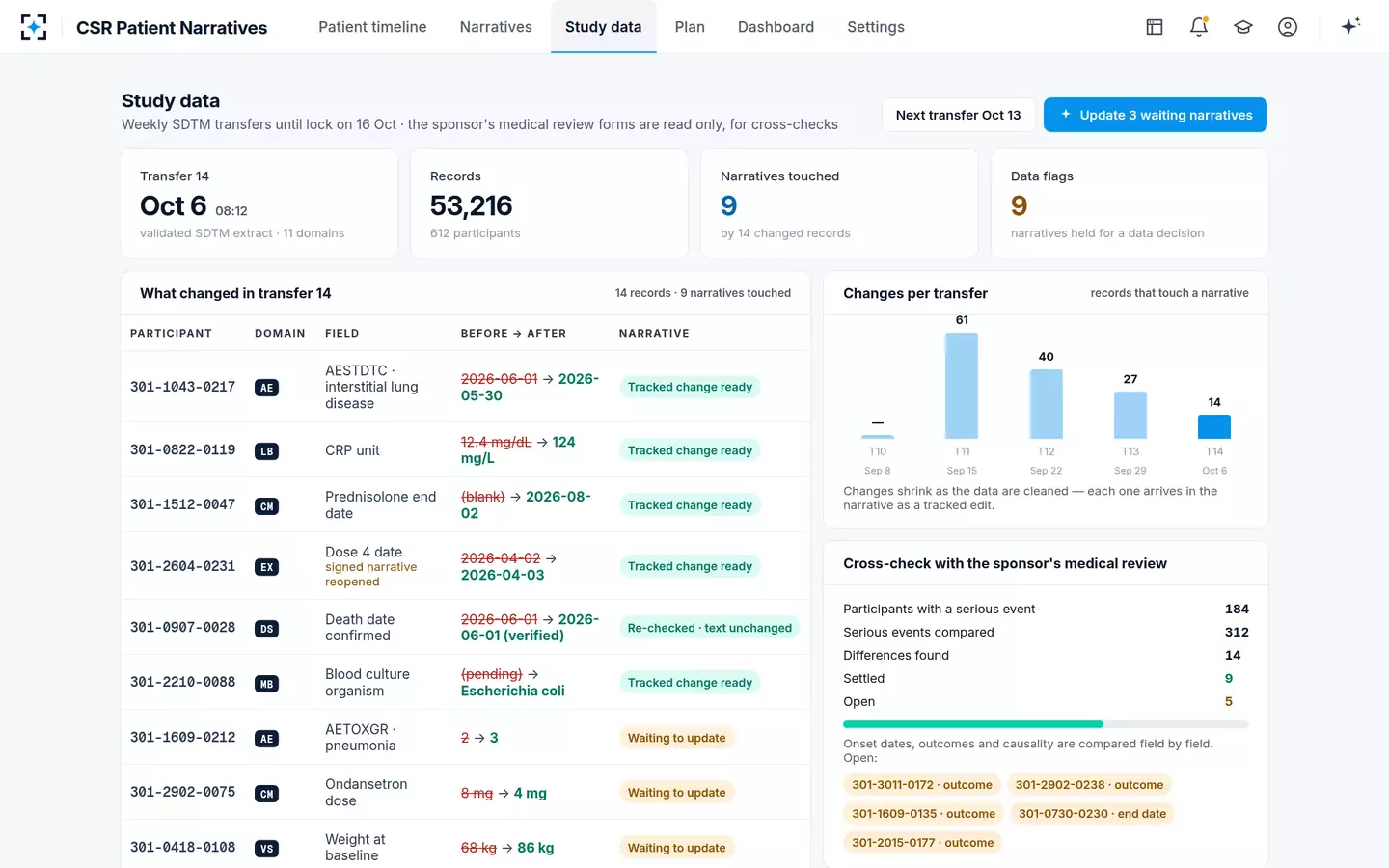
On the sample study the cross-check against the sponsor's medical review form is read-only for exactly this reason. The agents compare the onset, outcome and causality of every serious event with what the medical review says, draft the query where the two differ, and stop. When the site corrected an onset date from 1 June to 30 May after a query, the correction arrived in the next transfer, not from the checker — and the narrative that used the date reopened as a tracked change for the reviewer to accept.
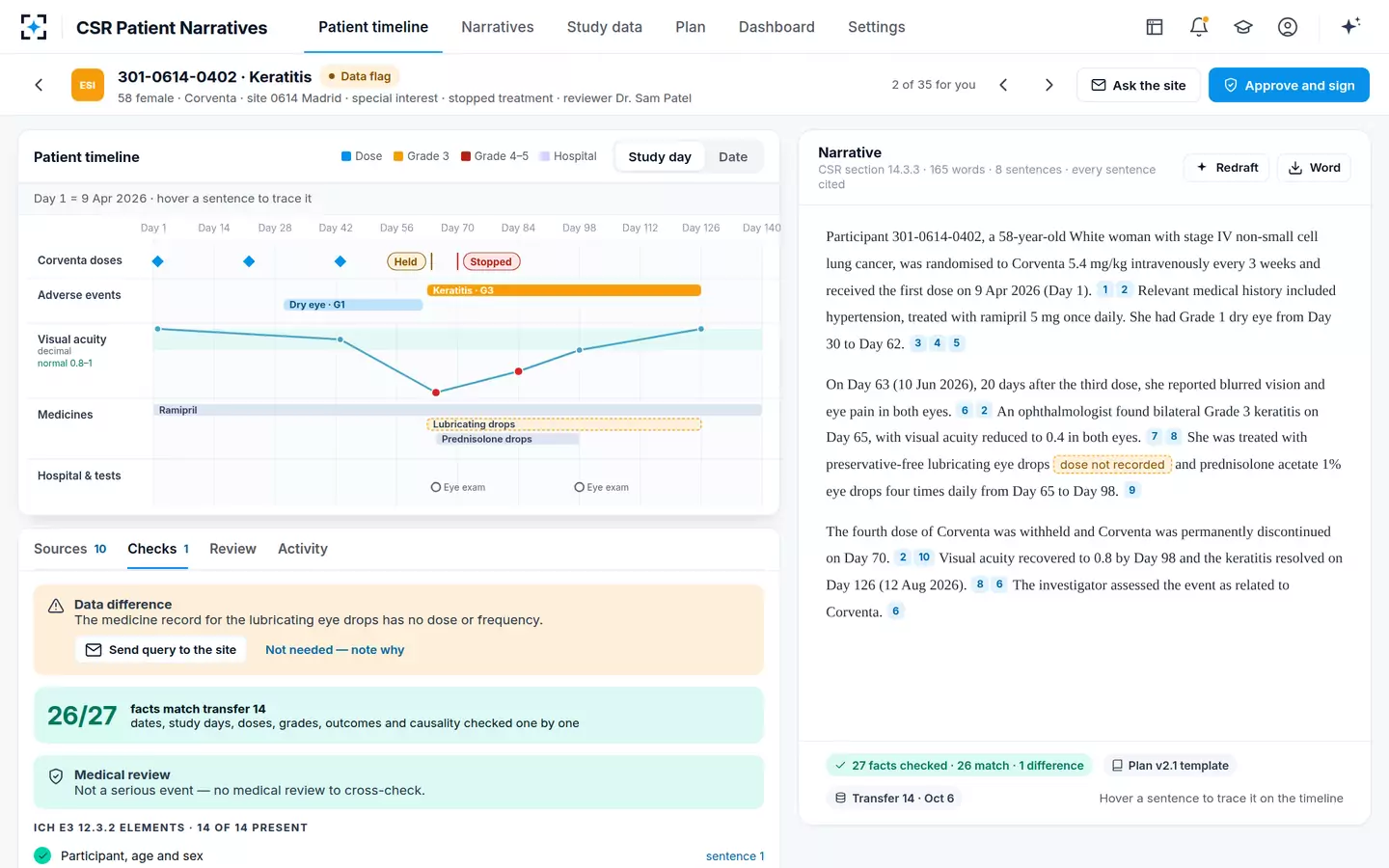
CSR Patient Narratives flagging a difference before anyone reviews the narrative
The narrative is the third copy of the same event
This is the part most reconciliation plans miss. Once a narrative is written, the study holds three accounts of the same event: the trial database record, the safety database record, and a paragraph of prose. Two of the three are structured and get reconciled. The third is the one the regulator reads first.
A narrative drifts from the data in a way the other two cannot, because a sentence can be right when it is written and wrong a fortnight later, when an onset date moves by two days. Nobody re-reads 247 narratives after each weekly transfer to find out. So either the narrative carries a link from each fact to the record behind it, and the comparison can be re-run, or it does not, and the agreement between the narrative and the data is a matter of when it was last read.
On the sample study the comparison runs on every transfer: every date, study day, dose, grade, value, outcome and causality statement in a draft is compared with the record the sentence cites, and the serious events are additionally cross-checked with the sponsor's medical review. One participant's narrative came through with 41 of 41 facts matching; another with 26 of 27, where a medicine record carried no dose. That second one is the useful result, because it is a difference someone now has to settle. The chain that makes a sentence re-checkable at all is the same chain an inspector asks about.
What the latest transfer changed, and which narratives it touched
A reconciliation plan an auditor can follow
Write it as a specification of the comparison, not as a description of a meeting. An auditor reading it should be able to say which fields were compared, on what cadence, against what rules, and what happened to each difference.
Eight things a reconciliation plan has to say
- The field pairs, named in both systems
Not "the key safety fields" but the variable in each database and the rule for comparing them.
- Which comparisons are exact and which use a dictionary
And where the dictionary lives, with its version, so a comparison can be reproduced.
- The matching key, and what happens when it fails
The published implementation’s own mismatches came mostly from the case identifier differing between the two databases.
- The partial-date rule
How an unknown day or month is completed before comparison, the same way every time.
- The cadence, and what triggers an out-of-cycle run
A data-cut, a safety signal, a protocol amendment or a database lock all justify one.
- Who owns each kind of difference
Site query, safety case amendment, or a recorded reason where both values are correct snapshots of different moments.
- That no comparison edits either database
Corrections are made where the data live, by the owner, with a reason on the audit trail.
- How narratives are re-checked after a correction
Which narratives used the changed record, what happens to a signed one, and who accepts the change.
Continuous comparison instead of a quarterly sweep
A quarterly cadence exists because the work is expensive, not because quarterly is the right answer. Its cost is latency: a difference that enters the data in the first week of a quarter sits unseen until the sweep, and if the sweep is the one before database lock, the query, the answer and the re-check all have to fit in the weeks that are left.
The same difference, the same lock date: found at the quarterly sweep, and found on the transfer that carried it
- The onset dates differ; nobody is looking61 days unseen
- Sweep, then the query to the site14 days
- Narratives using the date re-checked and re-signed9 days
- Margin before the lock date6 days
- Found on the transfer that carried the difference7 days
- Query to the site, and the answer14 days
- Narratives re-checked and re-signed7 days
- Margin before the lock date62 days
The published account makes the same argument from the other end. Having cut the per-event time, its authors conclude that the tool "reduces considerably the reconciliation time, allowing to increase the frequency of reconciliation processes and to focus resources on patient safety and medical assessment". Frequency is the gain, not headcount: the point of making a comparison cheap is to run it more often, so that differences surface while there is still time for a site to answer.
What that looks like on a study is unglamorous. Every transfer, compare the field pairs; every difference, a named query with an owner; every correction, a re-check of the narratives that used the record. It is the kind of work that is tedious at every scale and ruinous at none, until the week before lock. To see the comparison, the queries and the tracked changes on a study of your own, start from CSR Patient Narratives, or read how a narrative is put together in the first place.
Questions people ask
How often should SAE reconciliation be done?
As often as the comparison is affordable, and always before a data cut, a periodic safety report and database lock. Quarterly is common because the manual process is expensive — one published account describes up to six hours per sweep for a study with 187 serious events, repeated every three months — and the cost of that cadence is latency: a difference can sit unseen for most of a quarter. Making the comparison cheaper is what lets you run it more often.
What causes discrepancies between the clinical and safety databases?
Four things, mostly. Dates, where a site corrects an onset after the expedited report has gone, or where a partial date is completed differently. Coding, where the two teams use different dictionary versions or code the verbatim term and the diagnosis respectively. Outcome, where the safety database holds the state at the time of the report and the trial database the state at the last visit. And causality, where the two systems hold different assessors' views.
Who resolves an SAE discrepancy?
The owner of the record that needs to change: usually the site, through a query, and sometimes the safety team, through a case amendment. The person running the comparison raises the difference and records the outcome — an answer, or a reason why both values are correct — and does not edit either database. Where both values are right because they are snapshots of different moments, that reason belongs on the audit trail.
Does the narrative have to match the safety database?
It has to be consistent with the facts the sponsor has reported, and a difference between a narrative and the safety record is the kind of thing a reviewer notices quickly. The practical rule is that the narrative is written from the trial database and cross-checked against the sponsor's medical review of each serious event — onset, outcome and causality — so that any difference is found and settled before signature, not after submission.
What does a reconciliation plan contain?
The field pairs named in both systems, which comparisons are exact and which use a dictionary of equivalents, the matching key and what happens when it fails, the rule for partial dates, the cadence and its out-of-cycle triggers, who owns each kind of difference, a statement that no comparison edits either database, and how narratives are re-checked after a correction. The EMA's computerised-systems guideline expects the transfer and the actions applied to it — reconciliation among them — to be described in advance.
Can SAE reconciliation be automated?
The comparison can; the judgement cannot. A published implementation at one cancer centre cut the time per event from about 2.5 minutes to about 24 seconds including manual verification, and paired the right events correctly in 97.2% of reconciliations, with most failures coming from case identifiers that differ between the two databases. What no tool does is decide which value is right: that stays with the site or the safety team, through a query with an answer on the record.