Computer system validation in clinical trials means establishing, with documented evidence, that a system does what the trial needs it to do, reliably and consistently, and that it keeps doing it. For a tool that drafts regulated clinical text — patient narratives for a clinical study report, say — the question most quality leads are handed is which rulebook applies, and the answer is not the one the market talks about most. The device world's computer software assurance guidance is scoped to production and quality-management-system software for medical devices. The route here is the clinical-trial stack: fit for purpose under ICH E6(R3), 21 CFR part 11 for the records and signatures the tool creates, the European inspectors' expectations for audit trail and signature functionality, and, where the output supports a regulatory decision, the FDA's credibility framework for a stated context of use. The practical rule that falls out of all four is short: validate what the tool decides, not what it types. Botminds' CSR Patient Narratives is built to be tested that way, and nothing on this page claims it has been validated — that is the sponsor's activity, on the sponsor's intended use.
The rules below are quoted from their own texts and linked. Where the product appears, the study, the drug and the people in it are invented sample data: study CRV-301, 612 participants, 247 narratives. No figure here is a customer's measured result.
What European inspectors found in one year of clinical trial inspections
720
deficiencies recorded across the inspections conducted in 2023
36
of them critical — 5.0% of the total
67
inspections requested by the committee that year
11
findings per site inspected, on average
What does computer system validation mean for a clinical trial system?
It means three obligations held at once, and all three sit with the party responsible for the system rather than with whoever wrote the code. ICH E6(R3) is explicit on the first: the responsible party holds the validation status of the system for its whole life cycle, and the approach to validation follows from a risk assessment of three things — what the system is used for, how much the records it creates and keeps matter, and how far it could affect participants' well-being, rights and safety or the reliability of the results (ICH E6(R3) §4.3.4).
The second is the standard the evidence has to meet: the system has to be shown to meet its stated requirements for completeness, accuracy and reliability, and to perform consistently with what it is for. The third is scope, and it is the one most often cut: the guideline asks for the standard functionality and the trial-specific configuration and customisation — automated checks and calculations included — to be validated, and for the interfaces between systems to be defined and validated too. A drafting tool is almost entirely configuration — the triggers, the template, the house style, the data sources — so a validation that covers only the supplier's standard functionality has covered the part that matters least.
ICH E6(R3) also says what to do with what does not work: "Unresolved issues, if any, should be justified and, where relevant, the risks identified from such issues should be addressed by mitigation strategies prior to and/or during the continued use of the system." That is permission to go live with known limitations, provided they are written down and managed — which is a much more usable position than the all-or-nothing one teams often assume.
Fit for purpose: what ICH E6(R3) asks of a computerised system
The principle sits in the guideline's opening section, before any of the procedural detail, and it sets the altitude for everything else.
The responsible party is responsible for the validation status of the system throughout its life cycle.
ICH E6(R3), section 4.3.4
Principle 9.3 of the guideline puts the same idea at the top of the document: computerised systems used in trials should be fit for purpose — through risk-based validation where that is appropriate — with the factors critical to their quality built into their design or adaptation, so that the trial data keep their integrity.
Two phrases do the work. "Fit for purpose" means the purpose has to be written down first: a validation of a drafting tool that does not state which documents it will draft, for which triggers, from which data, and who will review and sign them, is a validation of nothing in particular. "If appropriate" is the risk-based qualifier, and it cuts both ways — it permits a light approach to a low-risk system and obliges a serious one where the records affect the reliability of trial results. Narratives in a clinical study report affect the reliability of what the study reports, so the appropriate approach here is not light.
The guideline adds a requirement about when the system may be used at all: trial-specific systems, including updates resulting from protocol amendments, "should only be implemented, released or activated for individual investigator sites after all necessary approvals for the clinical trial relevant to that investigator site have been received". For a sponsor-side drafting tool this is usually moot, but it matters the moment the tool reads anything a site enters.
Part 11, and which records are in scope
Part 11 applies to the electronic records and signatures the tool creates and keeps, and it asks for validation in one line: systems are to be validated for accuracy, reliability and consistent intended performance, and for the ability to tell when a record is invalid or has been altered (21 CFR 11.10(a)). The last clause is the interesting one for a drafting tool. Discerning an altered record is exactly the behaviour a narrative needs after signature, and it is testable: change a record behind a signed narrative and see what the system does.
The audit-trail requirement in the same section is equally concrete: secure, computer-generated, time-stamped audit trails that record on their own the date and time of every entry and action that creates, changes or deletes a record, without a change ever hiding what was there before. For a narrative that means every draft, every tracked change, every comment, every query and every signature carries a person and a time, and that an earlier version is never overwritten out of sight.
Which records are in scope is a judgement the sponsor documents, not a question the supplier answers. The drafts, the signed narratives, the fact-check results and the queries are records the trial relies on. A working note a writer keeps on their own machine is not a record the system holds. Drawing that line in writing, before the validation plan, saves an argument later — and it is the same line that decides what must survive in an inspection, which is the subject of tracing a sentence back to the record behind it.
What EMA’s inspectors expect a system to be able to do
The European guideline on computerised systems is written as a list of functions, which makes it the most directly testable of the four instruments. Its requirement for signatures is one a validation plan can be built on: in a closed system the signature functionality has to be shown, during system validation, to meet four expectations — authentication of the signatory, non-repudiation, an unbreakable link between the record and its signature, and a timestamp with date, time and time zone.
Shown during validation is a specific instruction. It is not satisfied by a supplier statement that the product supports electronic signatures; it is satisfied by a test, run by the sponsor, on the sponsor's configuration, whose result is documented. The easiest of those tests is the unbreakable link: sign a narrative, change a record behind it, and record what happens to the signature. What the four expectations are, and why a narrative is the hardest document to apply them to, is worked through in signing a narrative and stating what the signature means.
Is computer software assurance the right framework here?
Not for this. The FDA's computer software assurance guidance, reissued on 3 February 2026, states its own scope in its first substantive sentence: "This guidance provides recommendations regarding computer software assurance for computers or automated data processing systems used as part of production or the quality management system for medical devices" (FDA, 3 February 2026). A tool that drafts narratives for a drug's clinical study report is neither production software nor a medical device quality-management system, so the guidance does not reach it.
What is worth borrowing is its definition, because it describes the method the clinical guidelines also want: "Computer software assurance is a risk-based approach for establishing and maintaining confidence that software is fit for its intended use." That is the same sentence as ICH E6(R3)'s principle in different words, and a sponsor whose quality system already runs least-burdensome, risk-based assurance for device software can reuse the machinery — the risk framing, the test-effort grading, the record-keeping — provided the requirements it tests against come from the clinical rulebooks.
The device world’s assurance guidance against the clinical-trial expectations
Computer software assurance: Industry and FDA staff dealing with production and quality-management-system software for medical devices.
The clinical-trial stack: Sponsors, investigators and service providers running clinical trials of drugs and biologics.
Computer software assurance: Computers and automated data processing systems used as part of production or the device quality management system.
The clinical-trial stack: Computerised systems used in clinical trials, and the electronic records and signatures they create.
Computer software assurance: "A risk-based approach for establishing and maintaining confidence that software is fit for its intended use."
The clinical-trial stack: Fit for purpose, through risk-based validation where appropriate, with the approach set by a risk assessment of intended use, record importance and effect on participants and results.
Computer software assurance: Assurance activities and records proportionate to risk, with the least burdensome approach that establishes confidence.
The clinical-trial stack: Requirements and specifications, their testing, and the documentation of both — plus justified mitigations for anything unresolved.
Computer software assurance: Outside the scope. Useful as a method, not as an authority.
The clinical-trial stack: Inside it. This is the stack a sponsor validates against.
Where the FDA’s AI credibility framework starts and stops
The FDA's January 2025 draft guidance on artificial intelligence offers a framework that looks tailor-made for a tool like this, and its own scope sentence is the reason to be careful. The guidance describes a risk-based credibility assessment framework for establishing and evaluating the credibility of an AI model for a particular context of use, and defines its two key terms crisply: the context of use is the specific role and scope of the model in answering a question of interest, and credibility is trust in the model's performance for that context, established by collecting evidence (FDA draft guidance, January 2025).
But the guidance excludes AI used for operational efficiencies that do not affect patient safety, drug quality or the reliability of a study's results, and it names drafting or writing a regulatory submission as an example of such a use. So the framework does not apply to drafting as such. It does start to apply where a model's output feeds a regulatory decision — and a sponsor should reason from the scope sentence rather than assume either answer, because a narrative that misstates an onset date affects what the study reports.
The useful move is to borrow the vocabulary without claiming the framework. Write a context of use for the tool: the specific role it plays, the documents it drafts, the data it reads, the decisions it does not make, and the human review every output passes through. A context of use that ends "every output is reviewed fact by fact against the study data and signed by a named medical reviewer" is a much narrower claim than "the tool writes narratives", and it is the claim a validation can actually test.
Validating a tool that writes: the tests that mean something
A drafting tool's risk is not that it writes badly; a reviewer sees bad writing. The risk is that it states something the data do not say, or quietly stops stating something the data do say. Nine tests cover that, and each one can be run on a sponsor's own data with a known answer in hand.
Nine acceptance tests for a tool that drafts regulated clinical text
- Does it find every participant who meets a trigger?
Run the narrative plan’s rules against a transfer you have counted by hand. A false negative here is a missing narrative, which no later check will catch.
- Does every sentence carry the records behind it?
Open ten sentences at random and follow each to its record. A sentence with no source is a sentence nobody can check.
- Does it catch a date you have deliberately changed?
Seed a wrong onset date in a copy of the data and confirm the fact check reports it, names the record, and does not let the narrative be signed.
- Does it mark a missing value as missing?
Remove a dose from a concomitant medicine record. The text should say the dose was not recorded, not infer one.
- Does it re-draft only the affected sentences?
Change one record and compare the before and after text. Anything else changing is a finding, because a reviewer’s accepted sentence has silently become a new one.
- Does the signature stop being valid when the signed text changes?
Sign a narrative, then change a record behind it. This is the EMA unbreakable-link expectation and the Part 11 requirement to discern altered records, in one test.
- Is the audit trail complete and readable?
Follow one narrative from first draft to signature and confirm every draft, tracked change, comment, query and signature carries a person and a time, with nothing overwritten.
- Can everything be exported?
The narratives, the fact-check results, the queries and the audit trail. Evidence that can only be read inside the supplier’s product is evidence you cannot hand to an inspector.
- Does it refuse to decide causality?
Give it a case where the investigator and the sponsor assessments differ. It should state both and decide neither.
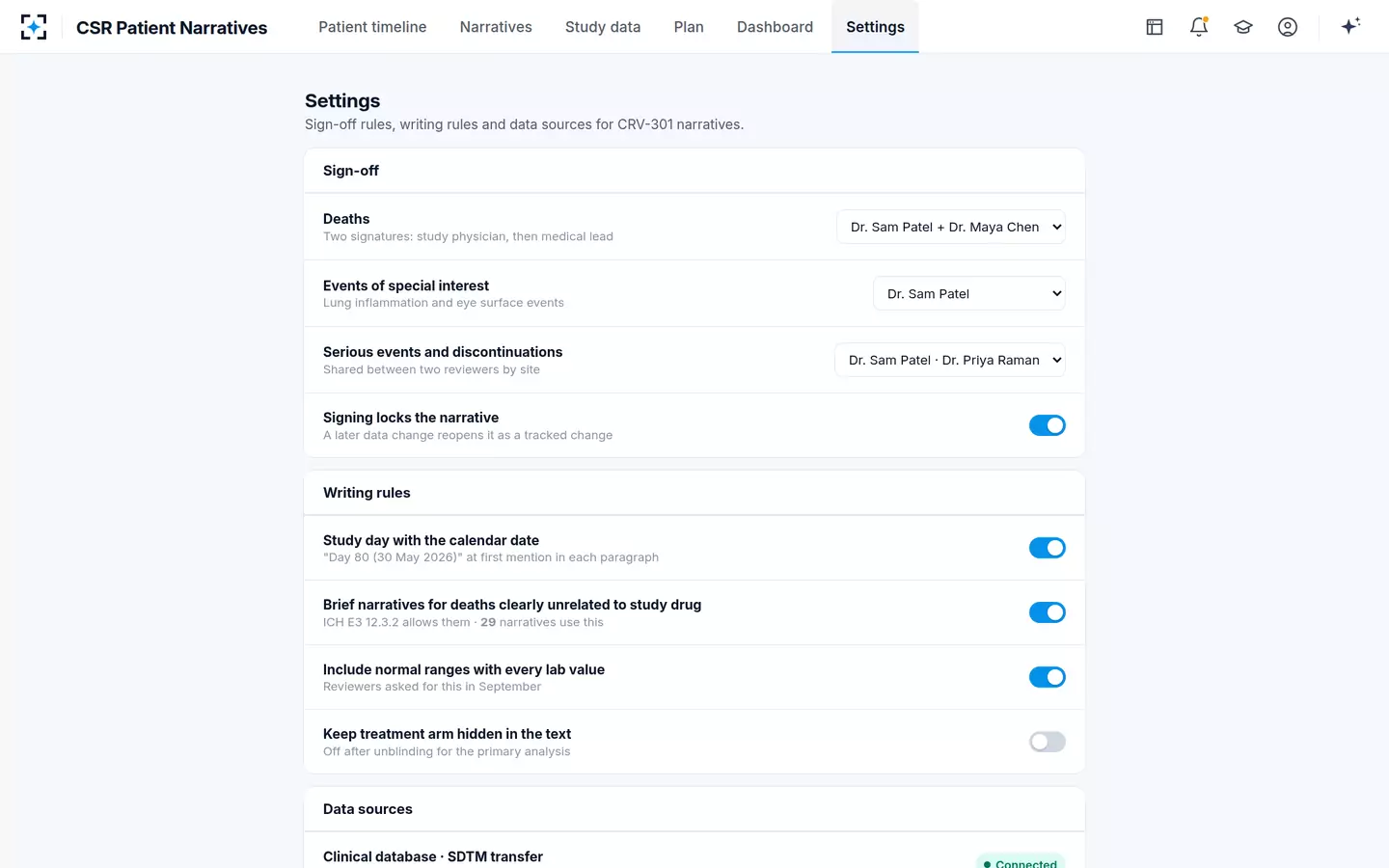
Each of those tests has an expected result that comes from a written limit rather than from a preference, which is what makes it a test. In this solution the limits are stated: no sentence without a source record; values copied, never inferred; missing values marked missing; a difference always reaches a person; read-only access to the sponsor's medical review forms, which the agents never write to; facts locked while wording changes; and no causality opinion of the tool's own. A sponsor should ask any supplier for the equivalent list and then build the acceptance tests directly from it — a limit nobody can test is not a limit.
A validation route for a drafting tool, from intended use to change control
A person decides
Intended use statedWhich documents, for which triggers, from which data, reviewed and signed by whom — written down before anything is tested.
A person decides
Risk assessmentThe importance of the records, and the effect an error would have on participants and on the reliability of the results, set the depth of everything that follows.
A person decides
Supplier evidence assessedDevelopment and testing records for the standard functionality, read as an input to the sponsor’s own assessment rather than as a conclusion.
Agent
Configuration built and exercisedThe triggers, the template, the house style and the data sources are configured, and the tool runs them against the sponsor’s own study data.
A person decides
Acceptance testing on your own dataThe nine tests above, with seeded errors and known answers, documented with their results and any mitigations for what is unresolved.
A person decides
Release decisionA named person accepts the system for the stated use, with the known limitations and their mitigations recorded.
Agent
Performance monitored in useFacts checked and matched, differences found, reviewer changes and queries per narrative — read as a performance series, not as a dashboard.
A person decides
Change control when anything movesA new model, a new template, a new data source or a protocol amendment reopens the risk assessment and the affected tests.
What to test on your own study data first
Configuration testing on the sponsor's own data is the meaningful acceptance test, for a reason specific to this kind of tool: it is built and deployed from the sponsor's own requirements and documents — the narrative plan, the template, the house style, a de-identified transfer — so almost everything that could be wrong is in the configuration rather than in the engine. A test on the supplier's demonstration data tests the supplier's configuration.
Pick one trigger with a known population, one participant with a complicated course, and one death. Count the triggered participants by hand and compare. Follow every sentence of the complicated narrative to its records. Then seed three errors — a wrong date, a missing dose, a causality that disagrees between the investigator and the sponsor — and confirm the tool reports all three rather than writing around them. That is half a day's work, and it settles more than a month of document review.
The configuration a sponsor validates, held as settings
Each requirement, the evidence that satisfies it, and who produces it
| Requirement | Where it comes from | The evidence | Who produces it |
|---|---|---|---|
| The system is fit for purpose for this trial | ICH E6(R3) principle 9.3 and §4.3.4 | A stated intended use, a risk assessment, and test results against the requirements derived from it | Sponsor |
| Standard functionality works as specified | ICH E6(R3) §4.3.4(e) | The supplier’s development and testing records, assessed by the sponsor | Supplier, assessed by sponsor |
| Configuration and customisation work as specified | ICH E6(R3) §4.3.4(e) | Acceptance tests of the triggers, template, writing rules and data sources on the sponsor’s own data | Sponsor |
| Records are accurate and altered records can be discerned | 21 CFR 11.10(a) | A seeded-error test and a post-signature change test, with results | Sponsor |
| The audit trail is secure, time-stamped and non-obscuring | 21 CFR 11.10(e) | One narrative followed end to end, exported | Sponsor, on supplier functionality |
| Signature functionality meets the four expectations | EMA guideline §4.8 | An authentication test, a link test, and a timestamp with time zone | Sponsor |
| Interfaces are defined and validated | ICH E6(R3) §4.3.4(e) | The transfer interface and the read-only connection to medical review forms, specified and tested | Sponsor and supplier |
| Known issues are justified and mitigated | ICH E6(R3) §4.3.4(i) | A list of unresolved issues with risks and mitigations, approved before release | Sponsor |
| Performance is monitored over the life cycle | ICH E6(R3) §4.3.4(d); EMA reflection paper on AI | A periodic review, and the in-use measures of facts checked and differences found | Sponsor |
Change control when the model changes
ICH E6(R3) handles changes in one sentence that is easy to read past: "Subsequent changes to the system should be validated based on risk and should consider both previously collected and new data in line with change control procedures." The clause about previously collected data is the one that bites for a drafting tool. If the model behind the drafting changes mid-study, the narratives already written were produced by a different system, and a sponsor has to decide — and record — whether that matters.
Three positions are defensible, and the choice should be made before the first change rather than during it. Freeze the model for the study, which costs improvements and buys a single system of record. Allow changes and re-check the already-written narratives against the data, which is cheap if the fact checking is mechanical and expensive if it is not. Or allow changes and accept a mixed population, with the version recorded against each narrative and the difference assessed. All three need the version of the engine recorded against every draft, which is a question to ask a supplier before signing anything.
The periodic side of the same obligation is in the guideline too: "Periodic review may be appropriate to ensure that computerised systems remain in a validated state throughout the life cycle of the system." For a tool whose behaviour can change without a release, periodic review is not optional in spirit, whatever the word "may" permits.
The evidence pack, section by section
What an inspector asks for is a story in a fixed order, and a sponsor that assembles it in that order has a much easier conversation. Intended use, so the rest has something to be measured against. The risk assessment that set the depth. The requirements, traced to the rules they come from. The supplier evidence, with the sponsor's assessment of it. The configuration, as it stands today and as it stood at each change. The acceptance tests, with their results, including the ones that failed and what was done. The release decision, with a name on it. The user access records. The known limitations and their mitigations. The change history. And the in-use performance measures.
Two sections of that pack are routinely thin, and both are easy to fix. The first is the test results that failed — a pack with no failures in it reads as a pack where nothing was really tested. The second is the performance measures after release: a validation that ends at go-live does not meet the periodic-review expectation, and in the sample study the measures that would serve are already produced as a by-product of the work, including facts checked and matched per narrative, differences found and settled, and what reviewers change.
What the system shows before a narrative is signed
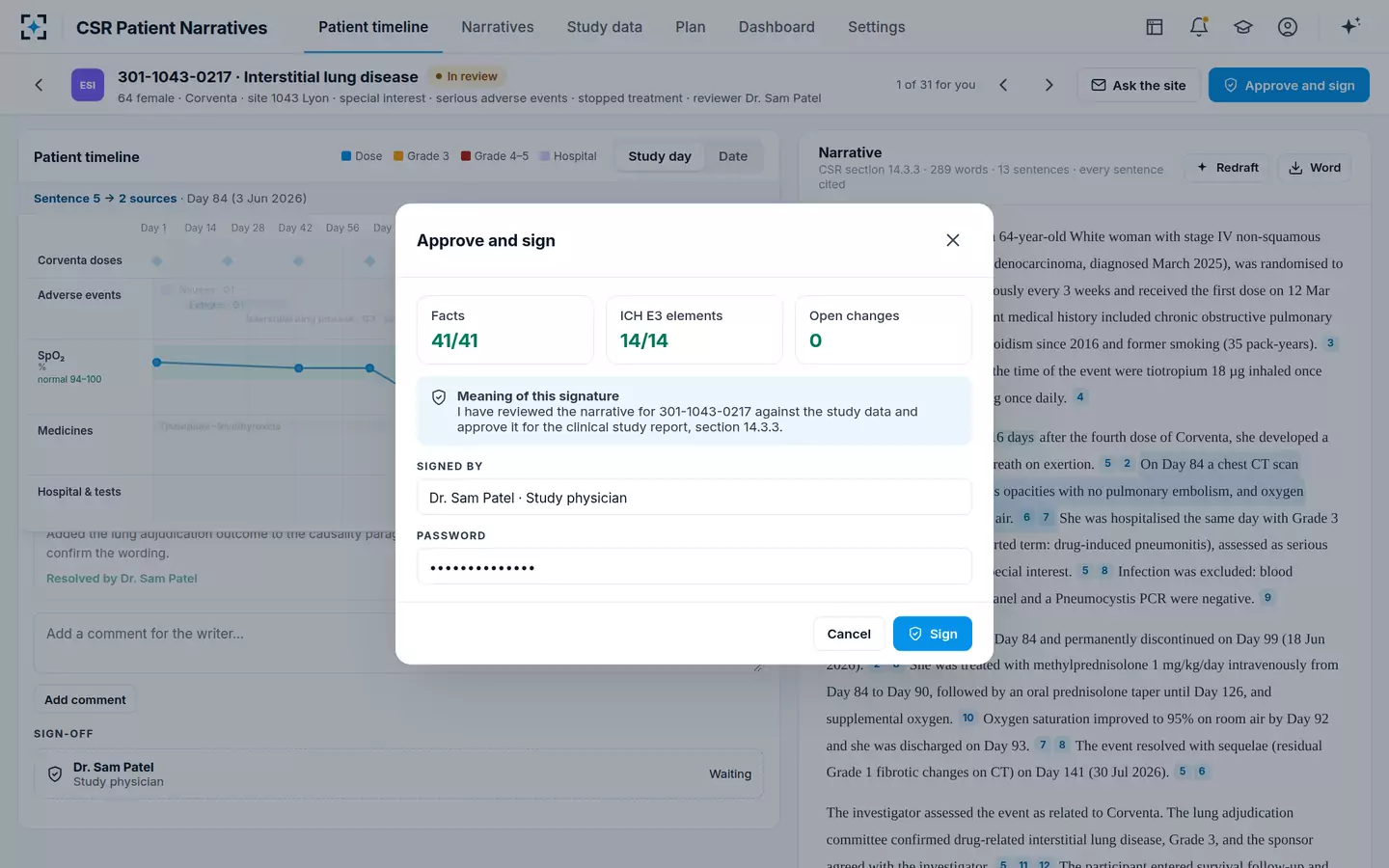
The last word belongs to the division of labour. A supplier can show how a system is built, what it refuses to do, and that every step is on the audit trail. Only the sponsor can say what it will be used for, decide how much assurance that use needs, and keep the evidence that it still works. Any supplier claim of being validated or compliant is a category error, and a sponsor who accepts one has taken on an obligation they cannot discharge. What the published evidence says about how much checking a drafting tool needs is set out in AI in pharmacovigilance and what it may draft for the report. To see the configuration, the checks and the signature on one study, start from CSR Patient Narratives.
Questions people ask
Does an AI writing tool need to be validated?
If it creates or supports the records a trial relies on, yes. ICH E6(R3) asks that computerised systems used in clinical trials be fit for purpose through risk-based validation where appropriate, and 21 CFR 11.10(a) requires systems to be validated for accuracy, reliability, consistent intended performance and the ability to discern invalid or altered records. The depth follows from a risk assessment of the intended use and of how much the records affect the reliability of the trial's results.
Is computer software assurance the same as computer system validation?
It is a method, applied to a different scope. The FDA's computer software assurance guidance, reissued in February 2026, is written for software used as part of production or the quality management system for medical devices, and defines assurance as "a risk-based approach for establishing and maintaining confidence that software is fit for its intended use". The method is reusable for a clinical trial system; the authority for what you must test is ICH E6(R3), part 11 and the EMA guideline.
Does Part 11 apply to a document drafting tool?
To the electronic records and signatures it creates and keeps, yes — the drafts, the signed narratives, the fact-check results, the queries and the audit trail. Part 11 asks for validation, secure computer-generated time-stamped audit trails that do not obscure previously recorded information, and signatures that carry the signer's printed name, the date and time, and the meaning associated with the signature.
What happens to validation when the model changes?
It reopens. ICH E6(R3) says subsequent changes "should be validated based on risk and should consider both previously collected and new data in line with change control procedures" — so a sponsor has to decide what a mid-study change means for the documents already produced. Record the engine version against every draft, and choose in advance between freezing for the study, re-checking what was written, or accepting a mixed population with the difference assessed.
What evidence does an inspector want to see for a clinical trial system?
Intended use, the risk assessment, requirements traced to the rules, the supplier evidence and the sponsor's assessment of it, the configuration and its change history, the acceptance tests with their results, a named release decision, user access records, known limitations with mitigations, and the measures that show it still works. In 2023 European inspectors recorded 720 deficiencies across 67 committee-requested inspections, 36 of them critical — an average of 11 findings per site.
Who is responsible for validating a vendor’s software?
The responsible party for the system — in practice the sponsor. ICH E6(R3) puts the validation status "throughout its life cycle" on the responsible party, and adds that they should ensure systems are validated as fit for purpose for use in the trial "including those developed by other parties", and that the validation documentation is maintained and retained. A supplier's records are an input to that; they are not a substitute for it.