SAE narratives for clinical study reports are required for three kinds of event, and ICH E3 names all three in one sentence: each death, each other serious adverse event, and each of the other significant adverse events judged to be of special interest because of clinical importance. Everything after that is the sponsor's decision — how briefly a clearly unrelated death may be described, whether the narratives sit in the report text or in section 14.3.3, and what else the study adds to the list. The hard part is not the rule; it is that the rule produces a number nobody can count until the triggers are written down precisely enough for two people to apply them the same way. Botminds' CSR Patient Narratives applies the narrative plan's triggers to every data transfer, lists every participant who meets one with the record that met it, and merges overlaps so a participant with three triggering events gets one narrative.
That count is not small, and on a large trial it is not even in the hundreds. It can be estimated before the study ends, from public records of comparable trials, and the second section below does exactly that.
Figures described as from the sample study are invented sample data in the solution — study CRV-301, 612 participants, people and sites all fictional. The counts taken from registry records are calculations from those public records, and are marked where they appear.
Which adverse events need an SAE narrative in a clinical study report?
Three triggers, in ICH E3's own words: "There should be brief narratives describing each death, each other serious adverse event, and those of the other significant adverse events that are judged to be of special interest because of clinical importance" (ICH E3 §12.3.2). Two of the three are mechanical. A death is a death; seriousness is decided by the protocol's criteria and recorded as a field on the adverse-event record, so a rule can find them.
The third trigger is a judgement, and that is where narrative plans differ. "Judged to be of special interest because of clinical importance" names no list and no judge. A plan that repeats the phrase has written down nothing; a plan that names the events — the protocol's safety endpoints, the adjudicated terms, a standardised query of related preferred terms — has written down something two writers can apply identically, and an inspector can audit.
The four tests a narrative plan has to answer, in order
1
Did the participant die, at any point in the study or its post-treatment follow-up?
Yes A narrative, full or brief
No Go to the next test
ICH E3 names deaths first. All of them belong in the Section 12.3.1.1 listing, whether or not they also appear as a serious event.
2
Was the event serious, by the protocol’s seriousness criteria?
Yes A full narrative
No Go to the next test
Includes serious laboratory abnormalities, abnormal vital signs and abnormal physical findings that were assessed as serious.
3
Is the event one the protocol names as of special interest, or one the sponsor judges clinically important?
Yes A full narrative
No Go to the next test
ICH E3’s third trigger is a judgement, so the narrative plan has to write down whose judgement and against what list.
4
Did the event lead to an intervention — withdrawal, a dose reduction or significant additional treatment — without being serious?
Yes Listing in Section 14.3.2; a narrative only if the sponsor’s plan asks for one
No Listing only, in the ordinary adverse-event displays
ICH E3 asks for the listing here. A narrative for every discontinuation is a sponsor’s choice, not a requirement of the guideline.
Deaths counted twice: what the E3 question and answer settles
A death that followed a serious adverse event can appear in two listings, and sponsors have asked ICH whether that double-counts it. The E3 implementation working group answered in 2012: "Although deaths may or may not be included in the listing for Section 12.3.1.2, all deaths should be captured in the listing for Section 12.3.1.1" (ICH E3 Questions & Answers (R1)). The deaths listing is the complete one; the other-serious-events listing may or may not repeat the fatal event, and either is acceptable as long as the deaths listing is whole.
For narratives the practical consequence is a merge rule. A participant who had a serious event on Day 31 and died of it on Day 33 has met two triggers and needs one narrative, not two, and that narrative has to carry both — the course of the event and the death. A plan that counts triggers rather than participants will over-count the work — heavily on an oncology study, where many participants with a serious event also die — and a tool that does the same will produce two narratives a reviewer then has to reconcile by hand.
Scope is the other thing the deaths listing settles. ICH E3 asks for all deaths "during the study, including the post treatment follow-up period", and deaths "that resulted from a process that began during the study". A participant who stopped treatment on Day 99 and died in follow-up on Day 240 is in scope.
Adverse events of special interest: who defines them, and where
In the protocol, by the sponsor, before the study starts. The FDA's December 2025 guidance on sponsor safety reporting puts it directly: "In addition to the study endpoints described above, some trials also evaluate the effect of the drug on several other pre-identified specific adverse events, often called safety endpoints or adverse events of special interest. These safety endpoints should be identified in the protocol and monitored and reported by the sponsor as specified in the protocol" (FDA, Sponsor Responsibilities — Safety Reporting Requirements).
Two words there do the work. Pre-identified: the list is fixed in advance, not assembled at the end from what happened to be interesting. In the protocol: a list that lives only in a safety management plan or a team's shared folder will not be where a reviewer looks for it. A narrative plan should therefore quote the protocol's list rather than restate it, and record its own version whenever the protocol is amended — because adding a term mid-study changes which participants need a narrative, retrospectively.
On the sample study, adding one trigger late is exactly what happens. A rule for liver events at Grade 3 or above matched nine participants against the latest transfer, none of whom had a narrative yet, and the match list named the record that met the rule for each — which is what the plan owner approves, rather than approving a rule in the abstract.
Laboratory abnormalities and events that led to an intervention
ICH E3 handles these separately from the narrative triggers, and reading the two instructions as one is a common and expensive mistake. The guideline says that "marked haematological and other laboratory abnormalities (other than those meeting the definition of serious) and any events that led to an intervention, including withdrawal of test drug/investigational product treatment, dose reduction, or significant additional concomitant therapy, other than those reported as serious adverse events, should be listed in section 14.3.2."
Listed — not narrated. A Grade 3 laboratory abnormality that was not serious and was not judged of special interest earns a row in the section 14.3.2 listing, not a narrative. A discontinuation for an adverse event that was not serious earns the same. Many sponsors do write narratives for discontinuations anyway, and there are good reasons to; the sample study does, and 44 of its 247 narratives are there for that trigger alone. But that is a plan decision with a cost attached, and it should be made deliberately rather than inherited from a template that read the two paragraphs as one rule.
The ICH E3 trigger wording and the 21 CFR 312.32 seriousness criteria: what each one counts
ICH E3 §12.3.2, for the clinical study report: Deciding which participants get a narrative in the report, after the study.
21 CFR 312.32(a), for IND safety reporting: Deciding which events the sponsor must report to the agency during the study, and how fast.
ICH E3 §12.3.2, for the clinical study report: A trigger in its own right: "each death".
21 CFR 312.32(a), for IND safety reporting: One of the listed outcomes that make an event serious.
ICH E3 §12.3.2, for the clinical study report: Borrows the ICH E2A definition: death, a life-threatening event, inpatient hospitalisation or its prolongation, persistent or significant disability or incapacity, or a congenital anomaly or birth defect.
21 CFR 312.32(a), for IND safety reporting: Death, a life-threatening event, inpatient hospitalisation or its prolongation, persistent or significant incapacity, or a congenital anomaly — plus important medical events that may require intervention to prevent one of those.
ICH E3 §12.3.2, for the clinical study report: The sponsor’s, applying the protocol.
21 CFR 312.32(a), for IND safety reporting: "In the view of either the investigator or sponsor" — one is enough.
ICH E3 §12.3.2, for the clinical study report: Not a trigger. Causality is reported inside the narrative, and a clearly unrelated event may be described very briefly.
21 CFR 312.32(a), for IND safety reporting: Decisive for expedited reporting: a suspected adverse reaction needs "a reasonable possibility" of causation.
ICH E3 §12.3.2, for the clinical study report: Adds a third trigger — significant events judged of special interest — that has no equivalent in the regulation.
21 CFR 312.32(a), for IND safety reporting: Adds expectedness, which plays no part in whether an event gets a narrative.
How many narratives does a study need? Counting from a public record
Nobody publishes narrative counts, but the registry publishes the inputs. A posted results record carries the number of participants with at least one serious adverse event in each arm and the number of deaths, and those two numbers, minus the participants who appear in both, are very close to the narrative count for the first two triggers.
One posted phase 3 oncology record, counted
335
participants with at least one serious adverse event in the two randomised arms, of 607 at risk
443
deaths recorded for the same two arms in the all-cause mortality table
259
distinct serious adverse event terms reported, before any merging
Two cautions before anyone uses that as a quote. It is arithmetic over a public record, not a published narrative count: the sponsor's own figure would differ, because some deaths are also the serious events already counted and because the brief-narrative allowance reduces the number of full narratives. And the windows do not match exactly. Still, as an order of magnitude for planning, it is far better than a guess, and it is available for any comparable trial before your own study locks.
Serious adverse events by arm in the same posted record
Scale that to a cardiovascular outcome trial and the planning problem changes character. The posted record of NCT01131676 reports 988 of 2,333 participants with a serious adverse event on placebo, 876 of 2,345 on the 10 mg arm and 913 of 2,342 on the 25 mg arm (ClinicalTrials.gov NCT01131676) — 2,777 participants in all, across 1,090 distinct serious event terms. No sponsor writes 2,777 full narratives. The brief-narrative allowance and the placement choice are not conveniences at that scale; they are what makes the report finishable.
The brief narrative, and when it is allowed
ICH E3 allows it for events clearly unrelated to the study drug, which it says may be left out or described very briefly. On an oncology study, deaths from the disease under study are the obvious candidates, and the allowance is substantial: the sample study uses the brief format for 29 of its narratives, all of them deaths assessed as clearly unrelated.
Two rules keep that allowance defensible. First, the test is causality, not convenience: "clearly unrelated" is a judgement recorded by the investigator and the sponsor, and the brief narrative should say so in a sentence. Second, the rule is written in the narrative plan and applied uniformly, so an inspector comparing two deaths of 60 and 400 words finds the reason in the plan rather than in a writer's workload that week. The sentence-by-sentence method for writing one covers what a brief narrative still has to carry.
In the text of the report, or in section 14.3.3?
ICH E3 leaves it to the sponsor and says why: "These narratives can be placed either in the text of the report or in section 14.3.3, depending on their number." Number is the criterion. A phase 1 study with four narratives can carry them in section 12.3.2 where a reader meets them in context. A phase 3 study with 247 of them cannot, and section 14.3.3 is the right home.
Placement is not purely cosmetic. Narratives in the body are read by everyone who reads the report, so they attract editorial attention and tend to grow; narratives in section 14.3.3 are read by reviewers who came looking for a particular participant, so they are better served by rigid, identical structure. Decide placement when you settle the template, because the two choices pull the house style in different directions.
What the regulator asks for besides the narrative
The same events surface in at least three other places, and a narrative that disagrees with any of them is a question waiting to be asked. Two of those places are US regulation rather than ICH guidance, and both are about deaths and discontinuations specifically.
Where else the same events have to appear, and in what form
| Where | What it must contain | What it means for the narrative |
|---|---|---|
| CSR section 14.3.2 — listings | All deaths, all other serious adverse events, and the marked laboratory abnormalities and events that led to an intervention. | Every narrative has a listing row behind it; the dates, terms and outcomes must be the same in both. |
| The marketing application — case report forms | Under 21 CFR 314.50, "copies of individual case report forms for each patient who died during a clinical study or who did not complete the study because of an adverse event, whether believed to be drug related or not, including patients receiving reference drugs or placebo." | The narrative for a death or an adverse-event discontinuation will be read beside the participant’s own case report form. |
| The annual report to the IND — 21 CFR 312.33 | "A list of subjects who died during participation in the investigation, with the cause of death for each subject." | The cause of death stated in a narrative should match the cause already reported to the agency, or the difference should be explainable. |
| CSR section 12.3.3 — analysis and discussion | An assessment of what the deaths and serious events mean for the safety of the drug. | The narrative supplies facts; the discussion supplies the interpretation. Keep the interpretation out of the narrative. |
Writing trigger rules two people read the same way
A narrative plan's trigger section is a specification, and it should be testable: run it against last week's data and it should return a list of participants anyone can check. The eight rules below are what the sample study's plan carries, and what a reviewer asks about when the list looks wrong.
Eight rules a narrative plan needs so two writers pick the same participants
- Name the seriousness source field, not the concept
The rule reads the protocol’s seriousness flag on the adverse-event record, so it cannot drift from the study’s own definition.
- Quote the protocol’s list of events of special interest
With the protocol version it came from, so an amendment is visible as a change of trigger.
- Say whether a discontinuation for an adverse event is a trigger
ICH E3 asks for the listing; the narrative is the sponsor’s choice, and it is a large share of the batch.
- Set the death window explicitly
All deaths during the study and its post-treatment follow-up, plus deaths from a process that began during the study.
- Merge by participant, not by event
One participant gets one narrative covering every triggering event, so a death following a serious event is not narrated twice.
- Say who may use the brief format, and on what test
Clearly unrelated to the study drug, as assessed and recorded — not "not interesting".
- Record the match, not just the rule
Each participant on the list carries the rule that caught them and the record that met it, so the list can be checked rather than trusted.
- Make a change to the triggers an approval, with its impact shown
A new trigger is approved against a count of who it newly matches, not in the abstract.
CSR Patient Narratives: every participant who needs one, by trigger and stage
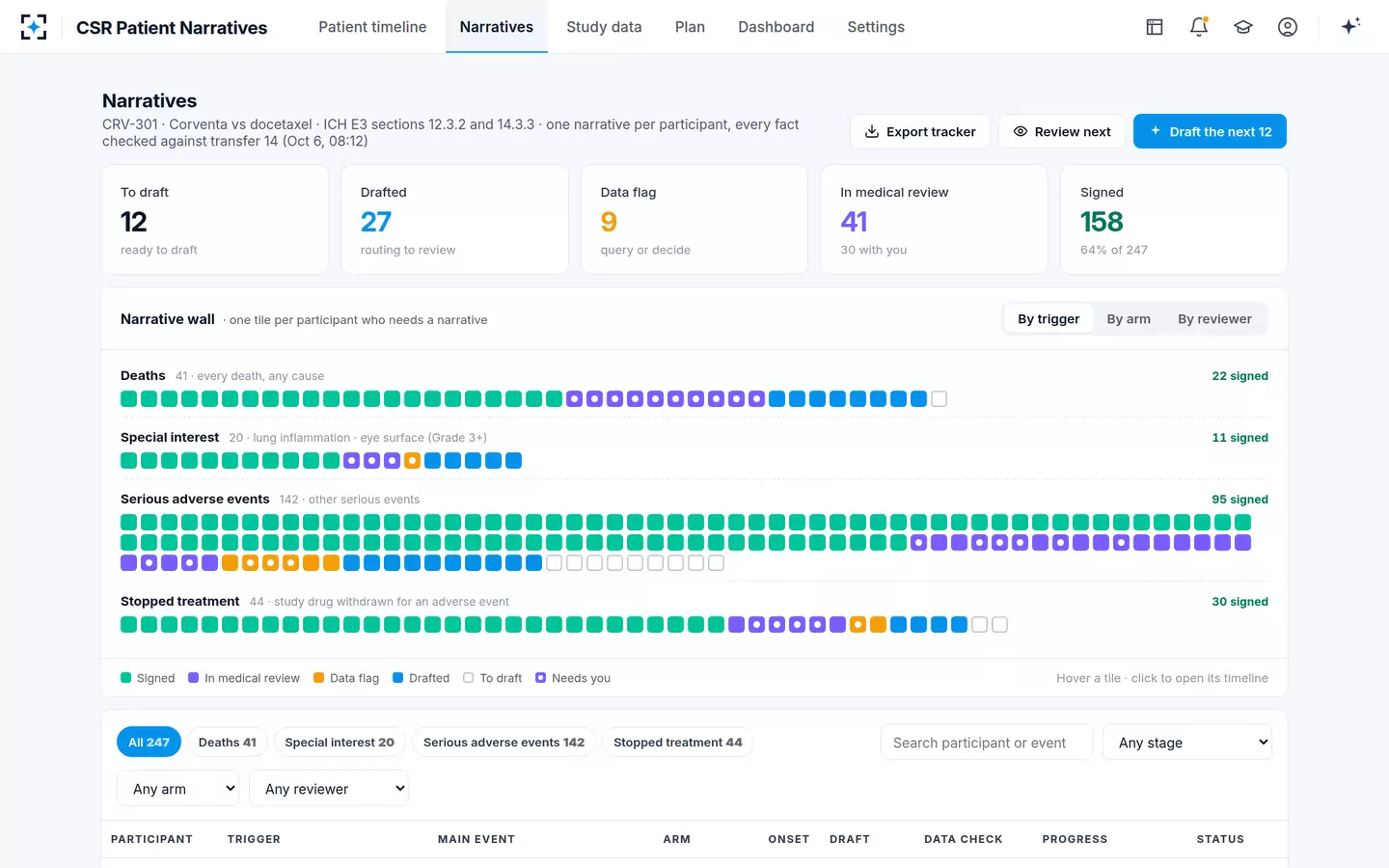
The number under each trigger is the number a plan owner should look at first, because it is the only direct measure of what a plan decision cost. Forty-four of the sample study's 247 narratives exist because the plan treats a discontinuation for an adverse event as a trigger — nearly a fifth of the batch, for a trigger ICH E3 does not require. That is a reasonable choice, made visible.
The narrative plan in CSR Patient Narratives: triggers, matches and template
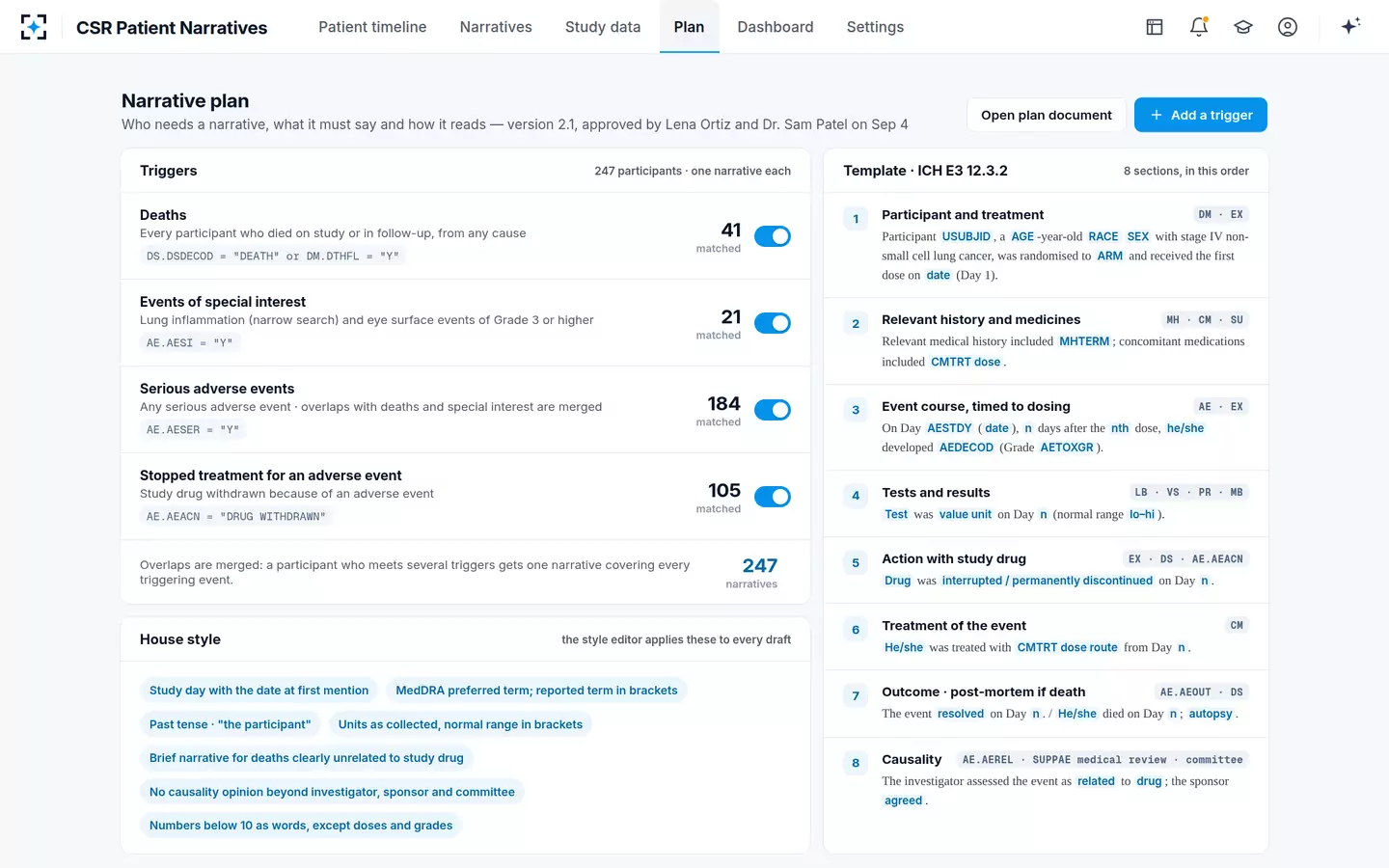
Who decides which events get a narrative
The sponsor, through the narrative plan, with the protocol deciding what counts as serious and as of special interest. The medical writer does not decide; nor does the tool. What a plan owner should insist on is that the decision be visible: a trigger list anyone can read, a match list anyone can check against the data, and an approval step when either changes.
That visibility is also what makes the count stable as the data move. Every weekly transfer before lock can add a serious event, upgrade a grade or record a death, and each of those can add a participant to the list after the batch is under way. What a database lock does to narratives already written follows that problem to its end. Before then, the practical answer is to re-apply the triggers on every transfer rather than once at the start, and to treat the new matches as work rather than as surprises. To see the triggers, the wall and the plan on a study of your own, start from CSR Patient Narratives.
Questions people ask
Do all serious adverse events need a narrative?
Yes, under ICH E3 §12.3.2, which asks for a narrative describing each death and each other serious adverse event. The guideline then softens it in one direction only: events clearly unrelated to the study drug "may be omitted or described very briefly". So the sponsor's room is in how much is written, and the judgement that allows it is a recorded causality assessment, not a workload decision.
Do you write a narrative for every death in a trial?
Every death in scope needs one, and the scope is wide: all deaths during the study and its post-treatment follow-up, and deaths resulting from a process that began during the study. Many of them will be brief, particularly on an oncology study where deaths from the disease under study are assessed as clearly unrelated to the drug. Brief is not the same as absent: the identifier, the exposure, the event, the date and the causality assessment still appear.
Are laboratory abnormalities given a narrative?
Only if they met the study's seriousness criteria or were judged of special interest. ICH E3 asks for marked haematological and other laboratory abnormalities that are not serious to be listed in section 14.3.2, alongside events that led to an intervention. A sponsor may narrate them anyway, but the guideline asks for the listing.
Do narratives go in the text of the CSR or in section 14.3.3?
Either, "depending on their number", in ICH E3's words. A handful can sit in section 12.3.2 where the reader meets them in context. A few hundred belong in section 14.3.3, where a reviewer goes to find one participant. Decide it when the template is settled, because it changes how the house style should read.
How many patient narratives does a clinical study report need?
As many as the triggers produce, which on a phase 3 study is usually in the hundreds. Counting a comparable posted registry record gives an order of magnitude before your own data lock: one phase 3 oncology record carries 335 participants with a serious adverse event and 443 deaths in its two randomised arms, and a large cardiovascular outcome trial record carries 2,777 participants with a serious adverse event. Those are calculations from public records rather than published narrative counts.
Who decides which events are of special interest?
The sponsor, in the protocol, before the study starts. FDA guidance asks for safety endpoints and adverse events of special interest to be pre-identified in the protocol and then monitored and reported as the protocol specifies. A narrative plan should quote that list rather than paraphrase it, and should record which protocol version it came from, because an amendment changes which participants need a narrative.