AI in pharmacovigilance covers four quite different jobs — reading incoming reports, coding events to a dictionary, detecting signals, and writing the narrative text a case or a report carries — and the last of those is where most buying conversations get confused. The reason is that the word "narrative" names two documents. An individual case safety report narrative is a required free-text field inside a regulated message, written within days of a report and transmitted to authorities. A clinical study report narrative is the chronology of one participant's whole course, assembled from the study database and signed into a named section of a submission. The published evidence says the failure mode is the same in both: when a fine-tuned model turned adverse-event report data into narrative text, human reviewers flagged wrong dates or times in most of the cases they read. So what a buyer is really buying, on either side, is the checking and the human oversight rather than the writing. Botminds' CSR Patient Narratives works on the second document only, and this page is explicit about what that means it does not do.
The regulatory positions and the measured results below are quoted from the agencies and the peer-reviewed paper that produced them. Where the product appears, the study, the drug and the people are invented sample data: study CRV-301, 247 narratives, a death narrative for participant 301-2210-0088 signed by a study physician and a medical lead.
What is AI used for in pharmacovigilance today?
Four uses, with very different maturity. Intake and triage: reading a report in any format and extracting the structured elements a case needs. Coding: selecting dictionary terms for the reported events and medicines. Signal work: classification, severity scoring and detection across accumulated cases. And text generation: writing the case narrative, or translating one written in another language.
The European Medicines Agency's reflection paper on artificial intelligence across the medicinal product lifecycle treats the safety side as the area with the most room to move, and attaches a condition to it in the same breath. Applications in pharmacovigilance "may allow a more flexible approach to AI/ML modelling and deployment, where incremental learning can continuously enhance models for classification and severity scoring of adverse event reports as well as signal detection." Then: "However, it remains the responsibility of the MAH to validate, monitor and document model performance and include AI/ML operations in the pharmacovigilance system, to mitigate risks related to all algorithms and models used" (EMA/CHMP/CVMP/83833/2023).
Read that as a buying instruction and it is quite specific. A model that keeps learning is permitted; a model whose performance nobody measures over time is not. The obligation to measure sits with the holder of the authorisation, which means a supplier's accuracy claim is an input to the sponsor's own monitoring, never a substitute for it.
An ICSR narrative and a CSR narrative are different documents
They share a name and almost nothing else. The case narrative is a field in a message: ICH E2B(R3)'s implementation guide says of it that "this data element captures a focused, factual and clear description of the case, including the words or short phrases used by the reporter", and the guide is blunt that "each ICSR must include a narrative" (ICH E2B(R3) implementation guide). Its clock is a reporting clock: under US rules a sponsor must report a qualifying potential serious risk "no case later than 15 calendar days" after determining it qualifies, and an unexpected fatal or life-threatening suspected adverse reaction within 7 calendar days (21 CFR 312.32).
The report narrative is a section of a submission. ICH E3 asks for brief narratives describing each death, each other serious adverse event and the other significant events judged to be of special interest, and says they may sit in the text of the report or in section 14.3.3 depending on their number (ICH E3 §12.3.2). Its clock is the report's clock, which is months rather than days, and its source is the study database rather than a reporter's words.
The case narrative and the report narrative, side by side
ICSR narrative: One report of one event reaching the sponsor or the authorisation holder.
CSR narrative: A participant meeting a trigger in the narrative plan — a death, another serious adverse event, an event of special interest, sometimes a discontinuation.
ICSR narrative: Days. 15 calendar days for a qualifying potential serious risk, 7 for an unexpected fatal or life-threatening suspected adverse reaction.
CSR narrative: Weeks to months, ending at the report date, with the data moving until database lock.
ICSR narrative: The reporter’s account, in their words or short phrases, plus whatever follow-up arrives.
CSR narrative: The study database — demographics, exposure, events, concomitant medicines, history, laboratory and vital signs, disposition — as validated transfers.
ICSR narrative: A structured message with a free-text element and defined data fields around it.
CSR narrative: The sponsor’s own template, usually a fixed set of sections built around what ICH E3 asks a narrative to describe.
ICSR narrative: The case is released by the safety function under the pharmacovigilance system’s procedures.
CSR narrative: A named medical reviewer, with the meaning of the signature stated; many sponsors take two signatures on a death.
ICSR narrative: Transmitted to authorities as a message, and held in the safety database.
CSR narrative: Compiled into one section of one clinical study report, and read there for the life of the submission.
ICSR narrative: A follow-up version of the case is created and retransmitted.
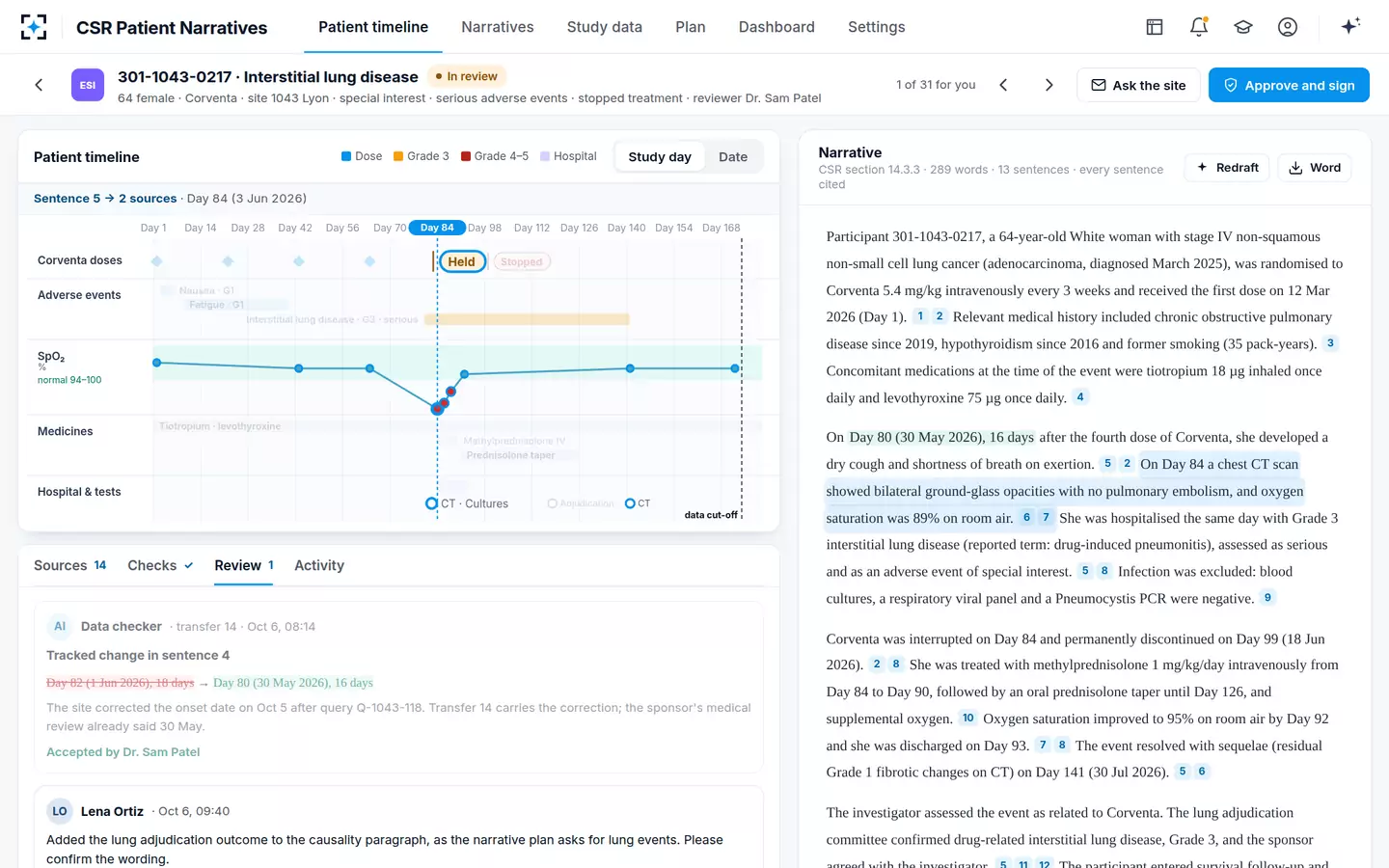
CSR narrative: The narrative is re-drafted on the sentences the change touches, and a signature already applied has to be reconsidered.
What the regulators have actually said
Less than the market implies, and more usefully. The EMA's reflection paper is not a rule but it sets a principle that answers most procurement questions on its own: whoever sponsors the trial or applies for or holds the authorisation is responsible for making sure that every algorithm, model, dataset and data-processing pipeline it uses is fit for purpose and in line with EU law, GxP standards and the Agency's guidelines.
The FDA's January 2025 draft guidance on artificial intelligence takes the opposite approach and is just as useful: it says what it is not about. The guidance is scoped to AI models that produce information to support a regulatory decision about safety, effectiveness or quality, and it excludes two things explicitly.
The two exclusions are AI used in drug discovery, and AI used for operational efficiencies — the guidance's examples are internal workflows, resource allocation, and drafting or writing a regulatory submission — that do not affect patient safety, drug quality, or the reliability of results from a nonclinical or clinical study (FDA draft guidance, January 2025).
That exclusion is cited a great deal and read carelessly. It does not say drafting is unregulated; it says the drafting that falls outside this guidance is drafting that does not affect patient safety, drug quality or the reliability of a study's results. A narrative that misstates the onset date of a serious adverse event affects the reliability of what the study reports, so the clause does not cover it. The honest conclusion for a drafting tool is narrower and harder: the credibility framework in that guidance may not be the right instrument, and the clinical trial rulebooks still are. Which rulebook applies to what is worked through in what validation a tool that writes regulated text needs.
Which rulebook governs which document, and which governs the tool
| The thing | The rulebook | What it requires of it |
|---|---|---|
| The case narrative | ICH E2B(R3) and the regional reporting rules | A focused, factual and clear description of the case in the reporter’s words or short phrases, present in every report, transmitted inside the reporting clock. |
| The report narrative | ICH E3 | A brief narrative for each death, each other serious adverse event and the significant events of special interest, in the text or in section 14.3.3. |
| The records and signatures either one creates | 21 CFR part 11, and the EMA guideline on computerised systems | Validation, audit trails, and signatures that carry a printed name, a date and time and a stated meaning, linked unbreakably to the signed text. |
| The system that drafts them | ICH E6(R3) for the trial; the sponsor’s own quality system | Fit for purpose, through risk-based validation where appropriate, with the responsibility sitting on the sponsor rather than the supplier. |
| The model inside it | EMA reflection paper on AI; FDA draft guidance where the output supports a regulatory decision | Performance validated, monitored and documented by the holder; a stated context of use where the credibility framework applies. |
Where a language model fails on safety text, measured
There is a published, peer-reviewed measurement of a language model writing safety text, and every buyer on either side of this market should read it. Hakim and colleagues fine-tuned a model for a text-to-text task that converted structured and unstructured data in adverse event reports into natural language, applied it to translating individual case safety reports documented in Japanese into English narrative text, and had drug safety experts review 210 cases, flagging each error category present.
Reviewer flags across 210 cases, by error category
Three things are worth taking from the table rather than from the headline. First, the top categories are factual rather than stylistic: events, outcomes, dates, drug names. Second, the error rates are high enough that the useful question is not "is the model good" but "what catches these before a human reads the case". Third, the task is a hard one — structured safety data with numeric codes turned into English prose from Japanese source text — and nothing about the arithmetic transfers to a different task without being measured again. A clinical study report narrative is written from a validated study database in one language, which is easier; it is also longer, and signed, which is harder.
The guardrails a published evaluation found necessary
The same paper's contribution is not the error table but what the authors built around the model, and the list reads like a specification a buyer can use.
These guardrails include mechanisms to detect anomalous documents to prevent the ingestion of inappropriate data, identify incorrect drug names or adverse event terms, and convey uncertainty in generated content.
Hakim et al., on what guardrails a safety-critical language model needs
Three mechanisms, three different problems. Anomaly detection at the input stops the model being asked to write about a document that is not what it claims to be. Entity checking at the output compares the drug and event names in the generated text against the names in the source, which is a comparison rather than a judgement and is therefore reliable. And conveying uncertainty puts the model's own doubt in front of the person who has to decide — which only helps if there is a person, and if they have time.
The authors are explicit about that last condition: "Understanding how LLMs are integrated with human end-users becomes essential, as human-mediated oversight systems will likely remain indispensable for certain tasks within safety-critical applications for the foreseeable future." That is the sentence to put in front of any supplier who describes their product as autonomous.
Can AI write a safety narrative?
It can produce the text, and on the published evidence it cannot be trusted to produce it correctly without checking. That is not a reason to reject the approach; it is a specification. The parts of a narrative that are copied — dates, study days, doses, grades, laboratory values, outcomes, the recorded causality assessments — can be taken from records and then compared back to those records, mechanically, every time. The part that is written is the connective prose, and prose errors are visible to a reviewer in a way that a wrong date is not.
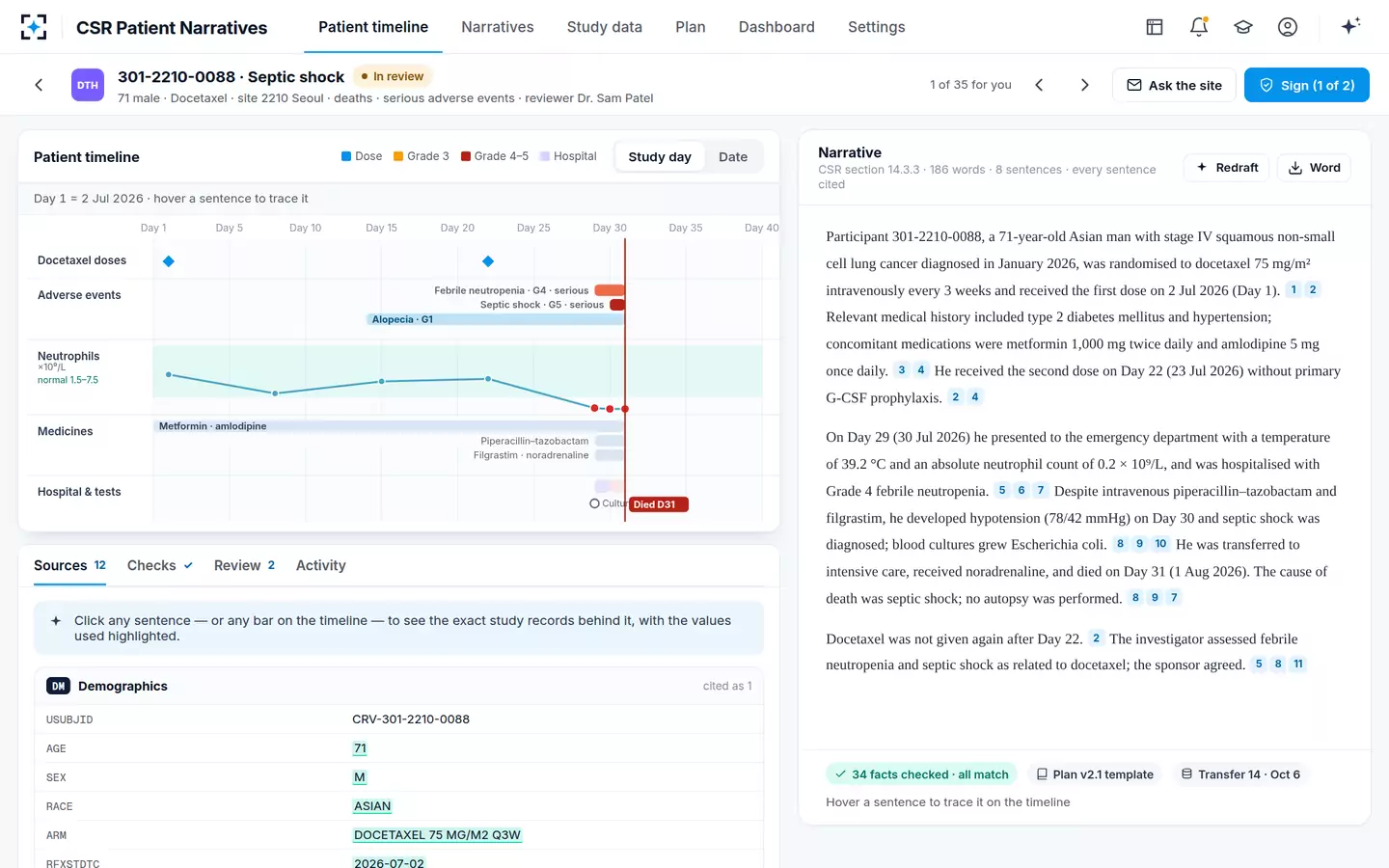
So the design that follows from the evidence has three properties. No sentence without a source record, so that every fact has something to be compared against. Values copied rather than inferred, and missing values marked missing rather than filled in. And a fact-by-fact comparison between the draft and the data, whose output is not a score but a list of differences that reach a named person. In the sample study that comparison runs on every narrative: 41 facts checked one by one on one participant, 34 on a death, and a medicine record with no dose caught on another before a reviewer ever opened it.
The four seats around safety text, and what each keeps
Today
Writes or reviews the case narrative inside the reporting clock, for cases arriving from every source and in every format.
With agents
Reviews a drafted case narrative against the extracted elements, with the drug and event names already compared against the source.
Still theirs: The decision to report, the assessment of expectedness, and the release of the case.
Today
Assembles each participant’s course from listings and profiles, drafts in the template, and re-reads drafts after every transfer to find what moved.
With agents
Owns the narrative plan, the template and the house style, and reviews wording rather than re-assembling data.
Still theirs: The template, the house voice across hundreds of documents, and what counts as a trigger.
Today
Checks every narrative line by line against the listings and the sponsor’s medical review forms, flipping between documents.
With agents
Points at a sentence, sees the data points and records behind it, accepts or rejects the transfer’s tracked changes, and signs.
Still theirs: The medical judgement, and the signature — with its meaning stated in words.
Today
Turns a reviewer’s note about a narrative into a query, and works out which record it meant.
With agents
Receives a drafted query that names the participant, the record and the difference.
Still theirs: The query process, and the data. No drafting tool should write to the study database.
Coding, and why human oversight is written into the rulebook
Coding is the one place where the requirement for a person is written down rather than inferred. The ICH-endorsed MedDRA Term Selection: Points to Consider says term selection should be reviewed by a qualified individual — "a person with medical background or training who has also received MedDRA training" — and then addresses automation directly: "Human oversight of term selection performed by IT tools (such as an autoencoder) is needed to assure that the end result fully reflects the reported information and makes medical sense" (MedDRA Points to Consider, Release 4.22).
That has a consequence for a report narrative that is easy to miss. A narrative states the preferred term and usually the reported term in brackets, and both come from the coded data. If the coding is reviewed by a qualified person in the clinical database, the narrative should quote it and not re-code it; a drafting tool that selects its own terms has quietly taken over a task the guide says needs a trained human reviewer. The right behaviour is narrow: use the terms the study data carry, and show which record they came from.
What a safety tool will not do for your clinical study report
A pharmacovigilance platform is built around cases: intake, coding, assessment, transmission, signal detection. It holds a case's own version history, and its clock is a reporting clock. None of that is the report narrative's problem. A report narrative needs one participant's whole course across every study domain, study days computed from first dose, the sponsor's template and house style across hundreds of documents, a link from each sentence to the study records behind it, a way to find which narratives a new transfer touched, and a signature with a meaning and a lock.
So the two tools are complements rather than substitutes, and the honest statement about this one is that it writes clinical study report narratives and does not submit individual case safety reports. It does not replace a safety database or a pharmacovigilance system; it reads the study data, and it reads the sponsor's medical review forms without ever writing to them. Where the two worlds meet is reconciliation — the comparison between what the safety database holds for a serious event and what the clinical database holds — and that comparison is a job of its own, set out in reconciling two records of one event.
A death narrative, checked and waiting for the first of two signatures
Where the oversight actually happens: a difference, in front of a person
Questions to ask either supplier
The same eleven questions work for a case-narrative tool and a report-narrative tool, because they are questions about checking and oversight rather than about writing.
Eleven questions, and why each one matters
- Which document does this write — the case narrative or the report narrative?
If the answer is both, ask to see the template, the trigger rules and the signature behaviour for each. They are different in every row of the comparison above.
- Where does every fact in a sentence come from, and can I open it?
A fact with no record behind it cannot be checked by anyone, including the model.
- What is compared back to the source, automatically, on every draft?
Dates, doses, grades, values, outcomes, drug names, event terms. The published guardrail list starts with entity checking for exactly these.
- What happens to a value that is missing?
It should be marked missing. A model that fills a gap plausibly is the single most dangerous behaviour in this category.
- Does it ever assert causality of its own?
It should not. Causality belongs to the investigator, the sponsor’s assessment and any adjudication committee.
- Does it code events itself, or use the coded data?
MedDRA’s own guide requires human oversight of term selection performed by IT tools. Using the reviewed codes in the database avoids the question.
- How does it convey uncertainty, and to whom?
Uncertainty that is logged but not shown to the reviewer is not a guardrail.
- What does it refuse to do?
Ask for the written limits. A supplier who cannot name them has not drawn any.
- How will model performance be monitored over time, and by whom?
The EMA reflection paper puts validating, monitoring and documenting performance on the holder, not the supplier. Ask what evidence you will receive, and how often.
- What evidence exists for this task, on data like mine?
The published evaluation of a different task found factual error flags in most cases. A claim without a measurement on your own data is a hypothesis.
- Who is accountable when it gets a case wrong?
There is only one answer in the regulations, and the next section is about it.
Who stays responsible
The sponsor, the applicant or the holder — in every instrument quoted on this page. The EMA reflection paper says it twice, once as the general principle about algorithms, models, datasets and pipelines being fit for purpose, and once specifically for pharmacovigilance, where it "remains the responsibility of the MAH to validate, monitor and document model performance and include AI/ML operations in the pharmacovigilance system". MedDRA's guide puts the oversight of coded terms on a qualified person. ICH E6(R3) puts the fitness for purpose of a computerised system on the responsible party.
No supplier can take that on, and a sponsor should be suspicious of one that offers to. What a supplier can do is make the obligation cheap to meet: show every fact's source, compare everything comparable, name its own limits, refuse to decide what it should not decide, and record every step so the sponsor's own monitoring has something to read. That is the whole of the claim worth making, and it is testable. How to test it, on your own study data and against the right rulebook, is the subject of validating a tool that drafts regulated clinical text. To see the checking and the two signatures on one death narrative, start from CSR Patient Narratives.
Questions people ask
Can AI write an individual case safety report narrative?
It can draft one, and the published evidence says the draft needs checking. In a peer-reviewed evaluation of a fine-tuned model translating 210 Japanese individual case safety reports into English narrative text, drug safety experts flagged wrong dates or times in 64% of cases, an incorrect or missing adverse event or wrong outcome in 71%, and judged 35% clinically accurate. The authors' conclusion was to build guardrails and keep human oversight, not to abandon the approach.
What does the EMA say about AI in pharmacovigilance?
Its reflection paper allows a more flexible approach to modelling and deployment on the safety side, including incremental learning for classification, severity scoring and signal detection — and then puts the obligation on the authorisation holder to "validate, monitor and document model performance" and to bring those operations inside the pharmacovigilance system. It is a reflection paper rather than a rule, but it is the clearest statement of where responsibility sits.
Does the FDA guidance on AI cover drafting documents?
Its January 2025 draft guidance leaves out AI used for operational efficiencies — internal workflows, resource allocation, drafting or writing a regulatory submission — but only where that use does not affect patient safety, drug quality or the reliability of a study's results. The qualifier is the point: drafting that could misstate what a study found is not covered by that exclusion, so the trial rulebooks apply instead.
Can AI code adverse events in MedDRA?
Tools do it, and the ICH-endorsed MedDRA Term Selection: Points to Consider requires a person over the top: "Human oversight of term selection performed by IT tools (such as an autoencoder) is needed to assure that the end result fully reflects the reported information and makes medical sense." For a narrative the cleaner answer is to use the terms already coded and reviewed in the study database, and to show which record they came from.
What guardrails does an AI safety tool need?
The published set is three: detect anomalous documents so inappropriate data is never ingested; identify incorrect drug names or adverse event terms in the generated text; and convey uncertainty in what was generated. For a report narrative, add a fourth that the study data make possible — compare every stated date, dose, grade, value and outcome against the record it was taken from, and send each difference to a person.
Who is responsible when an AI tool gets a case wrong?
The sponsor or the authorisation holder. The EMA's reflection paper states as a key principle that it is their responsibility to ensure all algorithms, models, datasets and data processing pipelines used are fit for purpose and in line with legal, ethical, technical, scientific and regulatory standards. A supplier's accuracy claim is evidence for that assessment; it is not the assessment.