Medical writing services are usually bought by the hour, by the document or by the study, and nobody publishes a price per patient narrative — which is awkward, because a narrative is the one deliverable a sponsor orders by the hundred. Every input to the number is public, though. The median wage of a technical writer and of a physician are published by the US Department of Labor; what benefits add on top of a wage is published by the Bureau of Labor Statistics; and how many narratives a trial triggers can be counted from posted trial records. Put them together and the total is dominated by two lines that almost no quote contains: the reviewer's hour and the re-work after each data change. Botminds' CSR Patient Narratives is a tool that attacks exactly those two lines, and this page is honest about where that helps and where it does not.
Every cost figure below is our own estimate, built from the public inputs named beside it, with the assumptions written out so they can be replaced. None is a price, a quotation or a customer's measured result. Where the sample study appears — study CRV-301, 612 participants and 247 narratives — the study, the drug and the people in it are invented sample data.
The public inputs the arithmetic rests on
$43.46/hr
median wage, technical writers, 2025 — $90,390 a year
Medical Writer and Narrative Writer are reported job titles in this occupation
$123.35/hr
median wage, general internal medicine physicians, 2025 — $256,560 a year
+46%
what benefits add to wages for civilian workers, before any overhead
$49.46 total compensation against $33.85 of wages per hour worked, June 2026
46,400
technical writers employed in the United States, 2025
What do medical writing services charge for?
Almost always for time, however the invoice is dressed. A per-document price is an hours estimate with a margin on it; a per-study price is the same estimate multiplied by a volume estimate; a rate card is the hours made explicit. That matters when comparing quotes, because the two suppliers with the most different prices are often the two with the most different volume assumptions, not the two with the most different productivity.
What is bought is also narrower than it looks. A narrative service typically covers assembling the participant's data into a profile, drafting in the sponsor's template, and an internal quality check. What it does not cover is the sponsor's own medical review, the queries that medical review raises, the re-draft after each data transfer, and the sign-off. Those stay inside the sponsor, and in the arithmetic below they are between a third and a half of the total.
The published literature on the process says the same thing in the language of risk. Reviewing narrative writing projects, Ledade and colleagues list the most commonly observed challenges, and the first three are the "large number of resources required for any given project", the difficulty of "maintaining consistency in the narratives due to multiple resources working on the same project", and the "requirement of quick turnaround time and timely delivery with high quality" (Perspectives in Clinical Research, 2017). Those are the three things a price per narrative hides.
Building the cost of one narrative from public numbers
The sum has four terms, three of them public and one of them the thing a supplier is selling. Write it out and the comparison between routes becomes arithmetic rather than negotiation.
Cost of one patient narrative, with every input named
Writer time
writer hours × loaded writer rate
Our assumption: 45 minutes assembling the participant’s profile from the listings, 90 minutes drafting in the template, 30 minutes checking the facts — 2.75 hours. Loaded rate $43.46 × 1.46 = $63.45.
Head of medical writing
Reviewer time
reviewer hours × loaded physician rate
Our assumption: 30 minutes of medical review, flipping between the narrative, the listings and the sponsor’s medical review forms. Loaded rate $123.35 × 1.46 = $180.09.
Study physician’s time, rarely in the quote
Re-work after a data change
changes per narrative × (writer minutes + reviewer minutes) × their rates
Our assumption: 20 writer minutes and 10 reviewer minutes per touched narrative. Rate of touches taken from the sample study — 9 narratives of 247 in one weekly transfer — and assumed to hold over ten weekly transfers before lock: about 0.37 touches per narrative.
Nobody, until it appears
Supplier price
quoted price per narrative, or hours × rate
Zero if the writing is in house. The one input nobody publishes, and the only one a supplier controls — which is why it is the wrong number to compare suppliers on.
Outsourcing manager
At those assumptions one narrative costs about $283 of writer and reviewer time: $174 of writer time, $90 of medical review and $19 of re-work. Multiply by the sample study's 247 narratives and the study's narrative work is about $70,000 of internal time, before any supplier is paid anything at all.
The sensitivity is worth knowing, because the writer-hours assumption is the one with no published value behind it. Hold the reviewer and the re-work still and move the writer from two hours to five, and the cost per narrative moves from about $236 to about $426. That is the whole range most arguments about productivity are fought over, and it is a range a sponsor can settle in a week by measuring its own first batch.
How long does one narrative actually take, step by step?
There is no published answer, and there is a reason for it. Describing how narrative projects are tracked, Ledade and colleagues note that a spreadsheet shared across stakeholders may not work "where it records confidential information such as time spent per narrative for budgetary purposes". Time per narrative is treated as commercially sensitive by the people who know it. A buyer should therefore treat any figure quoted at them, including every figure on this page, as an assumption to be tested.
What can be said is where the time goes, which is stable across accounts of the process. Four steps, in order: assemble the participant's whole course from the listings and profiles; write the chronology in the sponsor's template with study days, doses, grades, outcomes and causality in the house phrasing; check every stated fact against the data; and answer the medical reviewer. The first and third are mechanical and the second is not, which is why the first and third are where a tool changes the arithmetic and the second is where it changes it least.
Where the money goes in one narrative, at this page’s assumptions
One narrative, about $283
- Profile assembly, 45 min · $48 · 16.8%
- Drafting, 90 min · $95 · 33.6%
- Writer check, 30 min · $32 · 11.2%
- Medical review, 30 min · $90 · 31.8%
- Re-work · $19 · 6.7%
The volume: how many narratives a trial triggers
Volume is the other half of a quote, and unlike time it is public. ICH E3 asks for a narrative for each death, each other serious adverse event and events of special interest; posted results records publish those counts. Two posted phase 3 records show how far apart two studies can sit.
Narrative triggers counted from two posted phase 3 results records
| The record | Participants | What the record reports | What it implies for narratives |
|---|---|---|---|
| NCT02578680 (KEYNOTE-189), phase 3, non-squamous non-small cell lung cancer | 616 assigned, 607 treated | Death is recorded as the reason 510 participants did not complete the study (329 in the combination group, 181 in the control group). In the two randomised arms, 335 participants had at least one serious adverse event (233 and 102). | Deaths, not serious adverse events, drive the volume. In oncology a narrative for each death is most of the work, and most of those narratives are the ones read most closely. |
| NCT01131676 (EMPA-REG OUTCOME), phase 3, type 2 diabetes with cardiovascular risk | 7,064 enrolled, 7,020 treated | 2,777 participants had at least one serious adverse event across the three treatment arms, and 843 discontinued study drug because of an adverse event. | A cardiovascular outcome trial of this size can trigger thousands of narratives unless the narrative plan narrows the triggers, which is a decision to take before the first batch, not after. |
| The fictional sample study CRV-301 | 612 participants | 247 participants meet a trigger: 41 deaths, 20 events of special interest, 142 other serious adverse events and 44 participants who stopped treatment for an adverse event. | Two in five participants need a narrative, which is what turns a per-narrative figure into a budget line worth arguing about. |
Two lessons sit in that table. The first is that a quote per narrative is meaningless without a volume the sponsor has counted itself, from its own protocol's triggers against its own current data. The second is that the triggers are a lever: a narrative plan that treats every laboratory abnormality as an event of special interest will produce several times the volume of one that does not, and the decision belongs in the plan rather than in a change order halfway through.
The reviewer’s hour is the expensive one
A physician's median hour costs about 2.8 times a writer's, before benefits and overhead, and the gap is the single most important fact in this arithmetic. Thirty minutes of medical review costs almost as much as ninety minutes of drafting — $90 against $95. A service that halves the drafting time and leaves medical review untouched has taken about a sixth off the total; a change that halves medical review has taken about the same, from a line nobody quoted for.
What makes medical review slow is not reading the narrative, which is three hundred words. It is checking it. Ledade and colleagues describe what the reviewer actually does: a medical reviewer "possesses in-depth knowledge of the therapeutic area and usually verifies medical plausibility of the event/s, inclusion/exclusion of the content from a scientific perspective, safety data reported in the narrative, and flow and alignment of contents according to the applicable regulatory requirements". Three of those four are comparisons between the text and something else, and each comparison is a document to open.
That is the case for making the narrative carry its own evidence. If pointing at a sentence shows the data points and records it came from, the comparison stops being a search. In the solution the design target is 12 minutes of medical review per narrative with every sentence traced — a target, not a measured result — against the 30 minutes this page assumes by hand. The mechanics of that link are set out in tracing a sentence back to its records.
Re-work: the line nobody quotes for
A narrative is written before the data stop moving, so some narratives are written more than once. In the sample study one weekly transfer changed 14 records out of 53,216 and touched 9 of the 247 narratives already written — about one narrative in 27 per transfer. Run that over the transfers before database lock and a sponsor should budget something like a third of a re-draft per narrative, more for the events that attract queries.
The cost of each touch depends entirely on how it is found. If the writer re-reads drafts to discover which ones moved, the cost is not 20 minutes but the whole batch; if a changed record names its own sentences, it is 20 minutes on the narrative and 10 on the reviewer. The difference is why re-work belongs in a quote comparison at all: it is the line where two suppliers with the same hourly rate can differ by an order of magnitude. What a transfer touches, and how a signed narrative reopens, is worked through in what database lock does to a narrative.
This may not be applicable in instances, where it records confidential information such as time spent per narrative for budgetary purposes.
Ledade et al., on how narrative projects are tracked
In house, a CRO, or a tool: what changes in the arithmetic
The three routes do not differ in what the work is; they differ in which line moves. Outsourcing moves the writer line off the payroll and onto an invoice, and leaves the reviewer line and the re-work exactly where they were. A drafting and checking tool attacks the writer line and the re-work, and makes a claim about the reviewer line that has to be tested. Keeping the work in house moves nothing and buys control.
What one narrative costs on three routes, on this page’s assumptions
Read the middle bar carefully, because it is the one buyers get wrong. Outsourcing a study's narratives does not remove about $101 a narrative of the sponsor's own time — a little over a third of the by-hand total — and on the sample study's 247 narratives that remainder is around $25,000 whatever the supplier charges. A quote that looks cheap against the full $283 is being compared with the wrong number.
The third bar is a target rather than a result, and it should be read as a hypothesis the sponsor tests on its own data. The honest version of the claim is narrow: the profile assembly and the fact-checking are mechanical and can largely be done by software; the drafting can be done to a template and then edited; medical review can be shortened if, and only if, the reviewer can see the evidence for each sentence without opening anything. If the last of those is not true in practice, the third bar moves back towards the first.
How much does a patient narrative cost?
On the public wage data and this page's stated assumptions, between about $236 and $426 of a sponsor's own writer and reviewer time, with a central estimate of about $283 — before any supplier's price, and before overhead on top of wages and benefits. Narrow it for your study by changing three numbers: the writer hours, the reviewer minutes, and the touches per narrative. Everything else in the sum is published.
What that number is not is a market price. It is the cost of the time the work takes at median US wages, which is the floor a buyer should measure a quote against rather than the quote itself. A supplier in a lower-wage market, or one that has genuinely industrialised the mechanical steps, can price below it; a supplier whose quote excludes the sponsor's own review and re-work is not pricing the same job.
Seven questions to put to a quote so the numbers can be compared at all
- How many narratives is this price for, and counted how?
Ask for the trigger rules and the data cut-off used to count. Two quotes with different volumes are not two prices.
- What does the price include, step by step?
Profile assembly, drafting, internal quality check, re-draft after a data change, response to medical review comments. Get each one named or excluded.
- How is a re-draft after a data transfer charged?
Per narrative touched, per hour, or included? And how does the supplier find out which narratives a transfer touched?
- How much of our own reviewer time does this assume?
If the answer is a number, ask what it is based on. If there is no answer, the expensive half of the cost is unmanaged.
- Who holds the evidence for each sentence?
A narrative whose facts can only be rechecked by re-reading the listings costs reviewer hours for the life of the study.
- What happens to the price if the volume doubles?
Trigger rules and late-arriving events move volume. Ask for the breakpoints, not a reassurance.
- What will you measure in the first batch, and will you show us?
Hours per narrative, facts corrected at review, comments per narrative, days from data to signature. A supplier confident in its process will agree to be measured on it.
What to measure after the first batch
One batch of twenty narratives settles most of the arguments on this page, and it is worth running before the contract rather than after. Four measures are enough. Writer hours per narrative, taken from a timesheet and not an estimate. Medical review minutes per narrative, taken the same way. Facts corrected at review per narrative, which is the quality measure that matters because it predicts how much reviewer time the next batch will need. And days from the data arriving to the signature, which is the only measure that tells you whether the schedule works.
Add one more if the study is long: narratives touched per transfer, as a share of narratives already written. That is the re-work rate, and it is the number that decides whether narratives should start early or late.
The four measures, on one screen
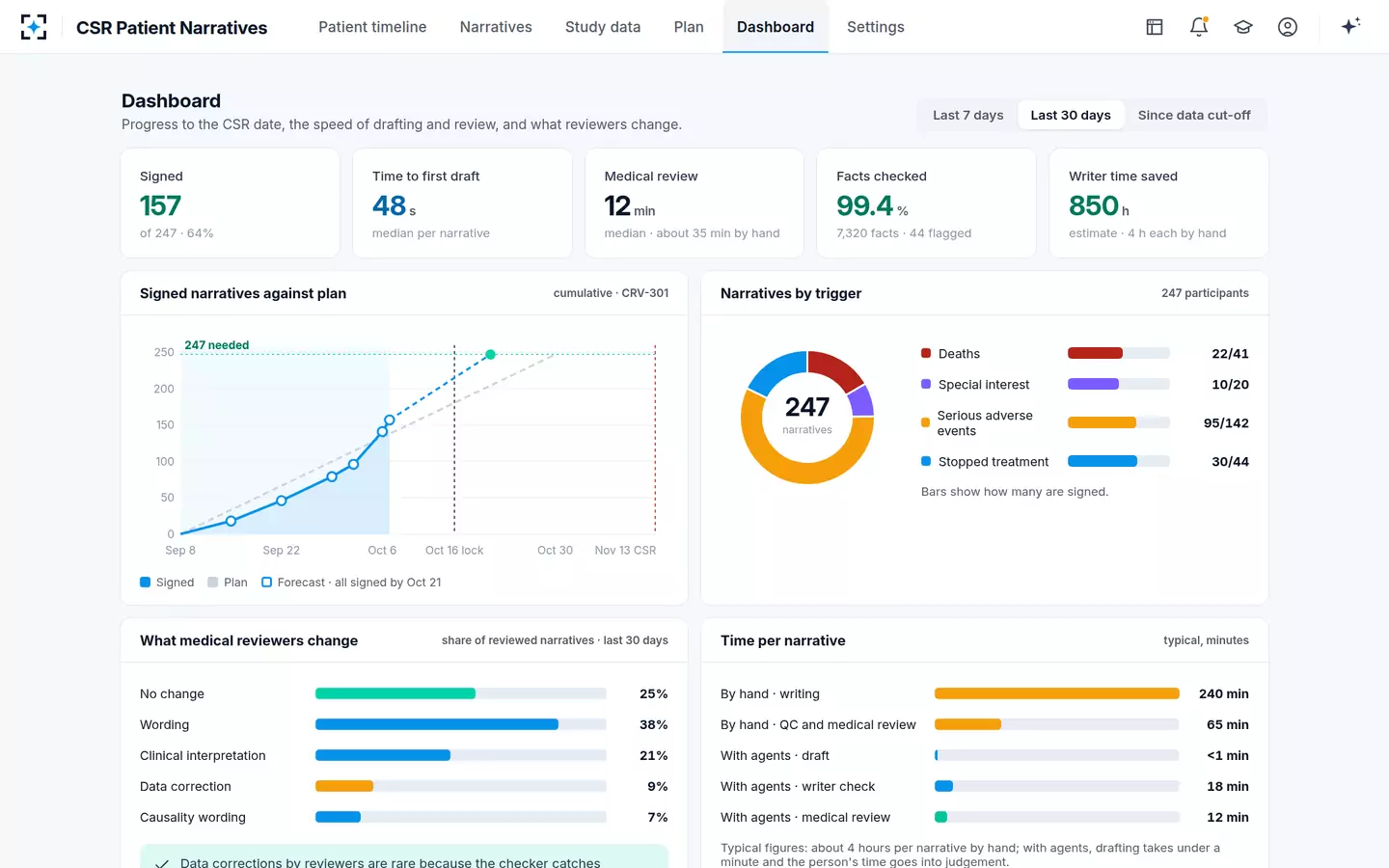
Volume as a work queue, by trigger and stage
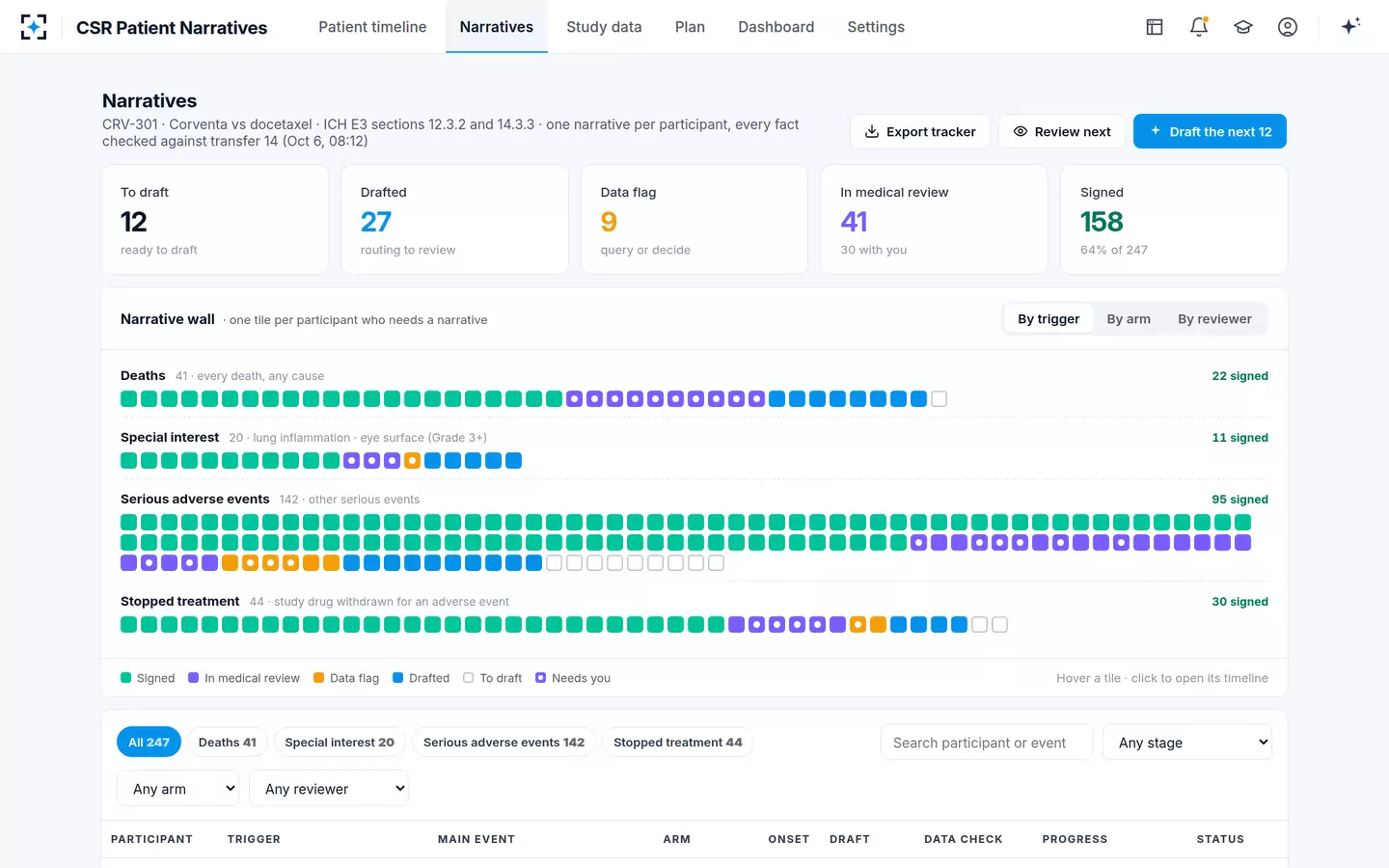
Where the saving is real, and where it is not
Real: assembling a participant's course from eight or ten data domains, and checking every date, dose, grade and outcome in a draft against the record it came from. Both are comparisons at scale, both are the kind of work people do slowly and imperfectly, and in the sample study the checking is what turns up the differences that would otherwise reach a reviewer — 41 facts checked one by one on one narrative, and a medicine record with no dose caught on another before anyone read it.
Real, but conditional: medical review time. It falls only if the reviewer can see the evidence for a sentence without leaving the sentence. That is a property of the tool, and it is testable in an afternoon on a sponsor's own data.
Not real: the judgement. Causality comes from the investigator's assessment, the sponsor's assessment and any adjudication committee, and no tool should add an opinion of its own. The signature stays with the study physician, a death narrative still takes two signatures in the sample study, and every difference between a draft and the data still reaches a person. Those are costs that should not fall, and a supplier promising that they will is selling the wrong thing — which is also the test to apply to any safety-side AI tool, worked through in AI in pharmacovigilance and what it may draft for the report. To see the four measures on a study of 247 narratives, start from CSR Patient Narratives.
Questions people ask
How much do medical writing services cost per hour?
Suppliers do not publish rate cards, but the wage floor is public: the US median wage for technical writers — an occupation whose reported job titles include Medical Writer and Narrative Writer — was $43.46 an hour in 2025, or $90,390 a year. Benefits add about 46% to wages for civilian workers before any overhead, so a loaded internal cost of roughly $63 an hour is a reasonable starting comparison for a quote.
How much physician review time does a narrative need?
There is no published figure. This page assumes 30 minutes by hand, because medical review is mostly comparison — plausibility, inclusion and exclusion of content, the safety data as reported, and alignment with the regulatory requirements — and each comparison means opening another document. At a loaded physician rate of about $180 an hour, that half hour is about a third of the whole cost of a narrative.
Should we outsource narratives to a CRO or keep them in house?
The arithmetic answer is that outsourcing moves one of the four cost lines. On this page's assumptions about $101 per narrative of sponsor time stays behind — medical review and the reviewer's share of re-work — whatever the supplier charges, so a quote should be compared with the writer line alone, not with the full cost. Control, consistency across hundreds of documents, and who holds the evidence for each sentence usually decide it rather than price.
What drives the cost of a clinical study report’s narratives?
Volume first, and volume is set by the trigger rules in the narrative plan rather than by the trial's size: in two posted phase 3 records, one implies hundreds of death narratives and the other thousands of serious adverse event narratives. After volume, the reviewer's hourly cost and the re-work rate — how often a data change touches an already-written narrative, and how it is found.
What does re-work cost when the data change?
Twenty writer minutes and ten reviewer minutes per touched narrative, on this page's assumptions — about $19 per narrative across a study at the sample study's touch rate of roughly one narrative in 27 per weekly transfer. The number only holds if the touched narratives can be identified from the transfer. If they are found by re-reading drafts, the cost is the whole batch each time.
Is there a published price per patient narrative?
No. The literature on narrative writing notes that time spent per narrative is held as confidential information for budgetary purposes, which is why no figure circulates. Wages, benefit loads and trial volumes are all published, so a buyer can build the floor themselves and treat any quoted price as a claim to be measured against their own first batch.